

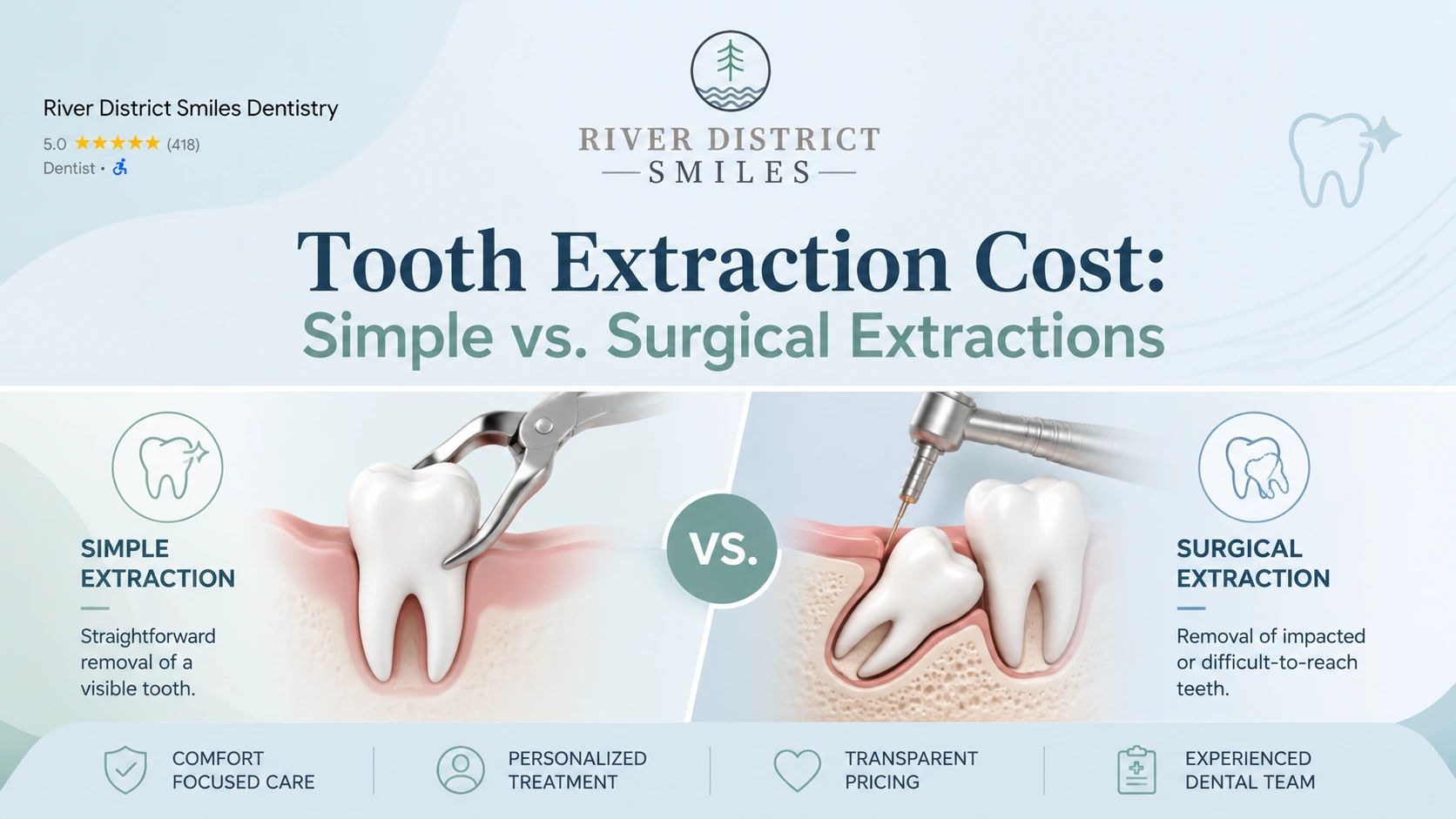


Most people asking about extraction cost already know the tooth is in trouble.
It may be badly decayed, broken near the gumline, infected, loose, or causing enough pain that keeping it no longer feels realistic. The difficult part is understanding why one person is quoted a few hundred dollars while another receives a much higher estimate for what sounds like the same procedure.
The main difference is usually whether you need a simple extraction or a surgical extraction.
A simple extraction commonly costs about $75 to $300 per tooth without insurance. A surgical extraction often costs approximately $250 to $700 per tooth, although impacted wisdom teeth and unusually difficult cases may cost more. Recent published estimates place the national average for a simple extraction near $177 and a single surgical extraction near $363, but actual fees vary widely.
Those figures usually describe the extraction itself. Your examination, X-rays, sedation, bone grafting, medications, or future tooth replacement may be separate.
Need a Tooth Removed?
Get a professional evaluation, clear treatment options, and straightforward extraction pricing. Call now.
Simple vs. Surgical Extraction at a Glance
| Simple extraction | Surgical extraction | |
| Typical situation | The tooth is visible and accessible above the gumline | The tooth is broken, impacted, covered by gum or bone, or difficult to access |
| How it is removed | The tooth is loosened and removed with dental instruments | The dentist may open the gum, remove a small amount of bone, or divide the tooth into sections |
| Common anesthesia | Local anesthetic | Local anesthetic, sometimes with sedation |
| General self-pay range | About $75–$300 | About $250–$700 or more |
| Recovery | Often shorter and more straightforward | May involve more swelling, soreness, or stitches |
| Typical provider | General dentist or oral surgeon | General dentist with surgical experience or an oral surgeon |
The type of extraction is not determined by how much the tooth hurts. It is determined by the tooth’s position, condition, root shape, and relationship to the surrounding gum and bone.
What Is a Simple Tooth Extraction?
A simple extraction is usually possible when the tooth has erupted through the gum and enough of it remains above the gumline for the dentist to hold securely.
After numbing the area, the dentist gently loosens the tooth from the ligament and bone that support it. The tooth is then removed with specialized instruments.
Simple extractions are often used for:
- Teeth with severe decay that are still intact above the gumline
- Loose teeth with advanced bone loss
- Teeth being removed for orthodontic treatment
- Baby teeth that have not fallen out normally
- Teeth that cannot be repaired but remain easy to reach
The American Dental Association notes that extractions may be recommended because of disease, trauma, or crowding. Local anesthetic is used to reduce discomfort during the procedure.
A simple extraction is generally less expensive because it usually takes less time and does not require an incision or removal of bone.
What Is a Surgical Tooth Extraction?
A surgical extraction is needed when the tooth cannot be removed predictably with a simple technique.
The dentist or oral surgeon may need to make a small opening in the gum, remove a limited amount of surrounding bone, or divide the tooth into smaller sections. Stitches may be placed afterward.
Surgical extraction is more common when:
- A tooth is broken at or below the gumline
- Only the roots remain
- A tooth has not fully erupted
- A wisdom tooth is impacted
- The roots are long, curved, or unusually shaped
- The tooth has fused closely with the surrounding bone
- A previous extraction attempt was unsuccessful
- The tooth is difficult to reach safely
Oral and maxillofacial surgeons describe surgical extraction as treatment involving the hard or soft tissues supporting the tooth, particularly in complicated or impacted cases.
A surgical extraction costs more because it usually requires more time, planning, equipment, and aftercare.
Typical Tooth Extraction Costs
These ranges are broad national planning estimates for patients paying without insurance. They are not River District Smiles’ published fees.
| Procedure | Approximate self-pay range |
| Simple extraction | $75–$300 per tooth |
| Difficult simple extraction | $200–$500 or more |
| Surgical extraction | $250–$700 per tooth |
| Impacted wisdom tooth extraction | $200–$1,100 per tooth |
| Multiple extractions | Varies by number and complexity |
| Bone graft or socket preservation | Additional fee |
| Sedation | Additional fee |
Published prices vary substantially. CareCredit reports an average simple-extraction cost of approximately $177, with a broad range beginning around $137. It reports an average of about $363 for a single surgical extraction, with costs in its study ranging from approximately $281 to $702. GoodRx lists a common uninsured range of $75 to $250 for simple extraction and notes that impacted or surgical removal generally costs more.
Wisdom-tooth pricing has an especially wide range because a fully erupted tooth can sometimes be removed simply, while a tooth buried under gum and bone may require a more involved surgical procedure. Published estimates for wisdom-tooth removal range from approximately $200 to $1,100 per tooth without insurance.
What May Be Added to the Extraction Fee?
When comparing estimates, make sure you are comparing the complete treatment rather than one procedure code.
Examination and X-rays
Before removing a tooth, the dentist needs to evaluate:
- How much healthy tooth remains
- The shape and number of roots
- The amount of surrounding bone
- The location of nearby teeth
- Whether infection is present
- Whether the tooth can still be saved
- Whether important nerves or the sinus are nearby
Some offices include imaging in the treatment estimate. Others bill the examination and X-rays separately.
Local anesthetic
Local anesthetic is normally used for both simple and surgical extractions. It numbs the treatment area while you remain awake.
Ask whether anesthesia is included in the extraction fee.
Sedation
Sedation is not necessary for every extraction.
It may be considered when:
- Several teeth are being removed
- The procedure is expected to take longer
- A tooth is deeply impacted
- The patient has significant dental anxiety
- Medical or behavioral needs make treatment difficult
Nitrous oxide, oral medication, and intravenous sedation are different services with different fees. Sedation can add considerably to the total, particularly when an oral surgeon and a surgical team are involved.
Bone grafting or socket preservation
After a tooth is removed, the bone that previously supported it begins to change. A bone graft may be recommended to help preserve the shape and volume of the area, especially if a dental implant may be placed later.
Bone grafting is not automatically necessary after every extraction. Its value depends on the tooth’s location, the condition of the bone, and your plans for replacing the tooth.
The American Association of Oral and Maxillofacial Surgeons explains that socket preservation may help maintain bone for future implant treatment and other restorative options.
Ask whether the graft is essential, recommended, or optional in your particular case.

Jaw Pain and Headaches: Could Your Bite Be Involved?
If your jaw feels tight and your headaches seem to begin around your temples, ears, or cheeks, it is reasonable…

Medication
Prescription medication may be recommended in selected situations, but antibiotics are not automatically needed after every extraction.
Medication costs are generally separate from the dental procedure. Tell the dentist about your allergies, medical conditions, and current medications before treatment.
Follow-up care
Routine follow-up may be included, particularly after a surgical extraction. Treatment for an unexpected complication may involve another fee depending on the office and the situation.
What Makes an Extraction More Expensive?
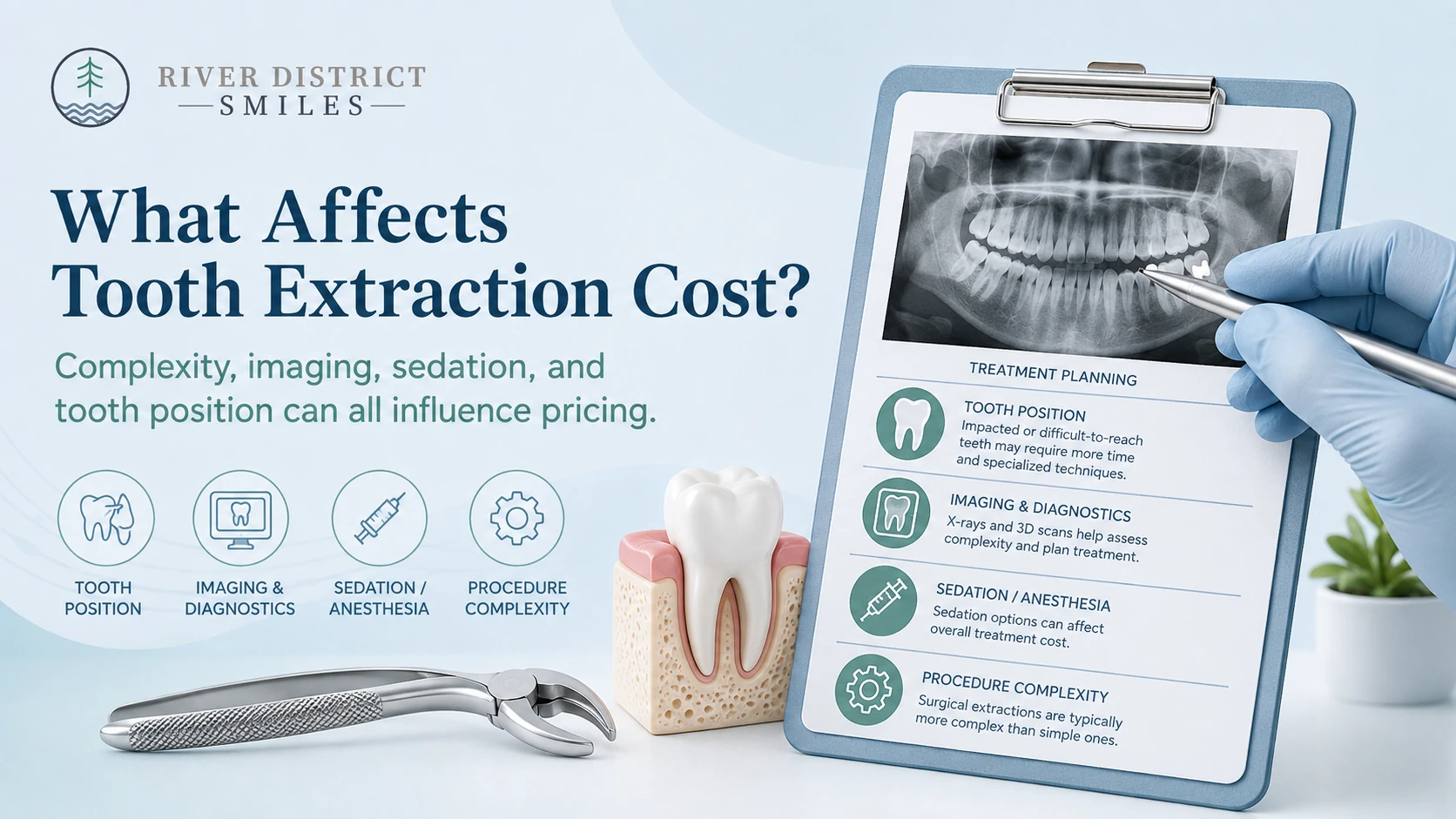
Several details can move an extraction from the lower end of the range to the higher end.
The tooth is broken below the gum
When there is little or nothing available to grip, the dentist may need to expose the remaining tooth structure surgically.
The tooth is impacted
An impacted tooth is partly or completely trapped beneath the gum or bone. The deeper it is positioned, the more involved its removal may be.
The roots are curved or spread apart
Straight, separate roots are often easier to remove than roots that curve, hook, or sit close to important structures.
The tooth has a crown or large filling
A heavily restored tooth may be more brittle and more likely to break during removal. This does not automatically make the extraction surgical, but it can increase the difficulty.
Infection or bone loss is present
Infection and changes to the surrounding bone can affect the surgical plan. In some situations, severe bone loss makes a tooth easier to loosen. In others, swelling, limited access, or damaged tissue adds complexity.
The tooth is close to a nerve or sinus
Lower wisdom teeth may sit near a nerve that supplies feeling to the lip, chin, or tongue. Upper back teeth may be close to the sinus.
Additional imaging or specialist care may be recommended when these structures need to be evaluated carefully.
A specialist performs the procedure
A general dentist can perform many routine and some surgical extractions. Complicated impacted teeth, difficult root anatomy, medical concerns, or higher-risk cases may be referred to an oral and maxillofacial surgeon.
Specialist fees may be higher, but the referral may provide a safer and more predictable approach for a difficult tooth.
Does Dental Insurance Cover Extractions?
Many dental plans cover a portion of medically necessary tooth extraction, but the amount depends on the plan.
Your cost may be affected by:
- Your deductible
- Whether the provider is in network
- The percentage your plan assigns to oral surgery
- Your annual benefit limit
- Waiting periods
- Whether sedation is covered
- Whether a bone graft is covered
- How much of your annual benefit you have already used
Dental PPOs commonly pay a percentage of treatment after the deductible, subject to a yearly maximum. Staying in the network may reduce the contracted fee and increase the plan’s contribution.
Ask the dental office for an estimate showing:
- The full office fee
- The expected insurance payment
- Your estimated portion
- Services that may not be covered
The estimate is not a guarantee. The insurance company makes its final decision after reviewing the claim.
Original Medicare generally does not cover routine tooth removal, including an impacted-tooth extraction, unless the dental treatment is directly connected to certain covered medical services. Some Medicare Advantage plans offer separate dental benefits.
Is Extraction Cheaper Than Saving the Tooth?
Extraction is often less expensive on the day of treatment.
That does not always mean it is the least expensive long-term option.
When a tooth can be restored predictably, treatment such as a root canal and crown may allow you to keep it. When a tooth is removed, replacing it with an implant, bridge, or partial denture can add substantially to the total cost.
The American Association of Endodontists advises patients to compare the complete cost of extraction and replacement with the cost of saving the natural tooth, not simply the extraction fee by itself.
Saving the tooth may make sense when:
- The crack does not extend deeply through the root
- Enough healthy structure remains for a crown
- The tooth has reasonable gum and bone support
- Root canal treatment has a predictable outlook
- The tooth is important for chewing or supporting other dental work
Extraction may make more sense when:
- The tooth has a vertical root fracture
- Decay extends too far beneath the gum
- Too little healthy structure remains
- Gum disease has destroyed most of the supporting bone
- The tooth has repeatedly failed treatment
- The tooth is impacted and damaging nearby structures
- Repair would have a poor long-term outlook
A good recommendation should answer two separate questions:
Can this tooth technically be treated?
Is treating it a sensible investment?
Those answers are not always the same.
What Will It Cost to Replace the Tooth?
The extraction fee does not normally include replacing the missing tooth.
Possible replacement options include:
- A dental implant and crown
- A fixed dental bridge
- A removable partial denture
- No immediate replacement
Not every extracted tooth must be replaced. Wisdom teeth, for example, generally are not replaced. The need to replace another tooth depends on its location, your bite, the condition of neighboring teeth, and your overall treatment goals.
Before an extraction, ask:
- Does this tooth need to be replaced?
- What are my replacement options?
- What will each option cost?
- Do I need a bone graft now?
- How long can I safely wait before replacing it?
- What may happen if I leave the space open?
This is especially important when the extraction appears inexpensive but the full replacement plan may involve several additional procedures.
How Long Does Recovery Take?
Recovery varies according to the procedure and the patient.
After a simple extraction, many people can return to normal non-strenuous activities relatively quickly. A surgical or impacted-tooth extraction may involve more swelling, soreness, and activity restrictions.
A blood clot forms in the socket as the first stage of healing. Protecting that clot is important because it covers the underlying bone and nerves.
Your dentist’s instructions may include:
- Bite on gauze as directed
- Use prescribed or recommended pain medication
- Avoid forceful rinsing at first
- Do not smoke or vape during healing
- Avoid drinking through a straw
- Eat softer foods temporarily
- Keep the rest of your mouth clean
- Avoid strenuous activity for the recommended period
Follow the instructions provided for your specific procedure rather than relying only on general online advice.
What Is Dry Socket?
Dry socket occurs when the protective blood clot is lost or does not remain over the extraction site. This leaves the underlying bone and nerves exposed and can cause significant pain.
It is more common after difficult lower-tooth extractions, especially wisdom teeth, but it can happen after other extractions.
Pain from dry socket often becomes more noticeable several days after the procedure rather than steadily improving. The ADA advises contacting the dentist if this occurs; treatment may include gently cleaning the socket and placing a medicated dressing.
Call the office if you develop:
- Pain that becomes significantly worse
- A persistent bad taste or odor
- Fever
- Increasing swelling
- Heavy or uncontrolled bleeding
- Difficulty swallowing or breathing
- Numbness that continues longer than expected
Difficulty breathing or swallowing requires immediate medical evaluation.
Can Waiting Turn a Simple Extraction Into a Surgical One?
Sometimes.
A tooth that is currently intact above the gumline may become harder to remove if more of it breaks away. Decay can also weaken the remaining tooth structure.
That does not mean every recommended extraction must happen immediately. Timing depends on whether there is pain, infection, swelling, trauma, or a risk of further damage.
Call sooner when you have:
- Significant or increasing pain
- Swelling around the tooth
- Drainage or a bad taste
- Fever with dental symptoms
- A tooth broken below the gumline
- Difficulty opening your mouth
- Facial swelling
- A loose adult tooth after an injury
A painless, noninfected tooth scheduled for orthodontic treatment may be less urgent than an abscessed tooth with increasing swelling.
Questions to Ask Before the Extraction
Before agreeing to treatment, ask:
- Is this expected to be simple or surgical?
- What makes the extraction difficult?
- Can the tooth still be saved?
- What is included in the quoted fee?
- Are the examination and X-rays separate?
- Will I need sedation?
- Is a bone graft recommended?
- Will I need stitches?
- Should the tooth be replaced?
- What will the full treatment plan cost?
- Will a general dentist or oral surgeon perform the procedure?
- What should I expect during recovery?
A clear estimate should help you understand both today’s procedure and any treatment that may follow.
The Bottom Line
A simple extraction commonly costs about $75 to $300 per tooth without insurance, while a surgical extraction often costs approximately $250 to $700 or more. Impacted wisdom teeth, sedation, specialist care, advanced imaging, and bone grafting can increase the total.
River District Smiles provides simple and surgical tooth extractions for patients in Rock Hill and surrounding communities, using imaging and treatment planning to determine the safest approach for each tooth.
The least expensive decision is not always simply removing the tooth. The right decision depends on whether the tooth can be saved predictably, what removal will involve, and whether replacing it will create additional cost later.
A good dental visit should leave you understanding all three not feeling pressured toward the fastest option.
Know Your Extraction Cost
Simple or surgical? Get clear answers about your tooth extraction cost before treatment. Call today.