


If your lower front teeth overlap, floss keeps getting stuck, or your toothbrush never seems to reach the space behind one crooked tooth, you are dealing with one of the most practical problems caused by dental crowding.
It is not just about appearance.
The short answer is that crowded teeth can make it harder to remove plaque because some tooth surfaces become difficult to reach with a toothbrush or floss. That does not mean everyone with crowded teeth will develop cavities or gum disease but it can make good home care more demanding.
For some people, better brushing and interdental cleaning are enough.
For others, especially when crowding is significant, straightening the teeth can make those areas easier to maintain over the long term.
The important question is not simply, “Are my teeth crooked?”
It is:
“Can I keep these teeth and gums consistently clean in the position they are in?”
What Does Teeth Crowding Actually Mean?
Crowding happens when there is not enough room for the teeth to sit in an ideal position within the dental arch.
As teeth compete for space, they may:
- Overlap each other
- Rotate
- Tilt inward or outward
- Erupt behind neighboring teeth
- Sit closer together than normal
- Become difficult to access from certain angles
Crowding can be mild enough that only one or two lower teeth overlap slightly.
In more significant cases, several teeth may be rotated or displaced.
The American Dental Association describes crowded or crooked teeth as one type of malocclusion, or improper tooth and bite alignment.
The appearance is often what people notice first.
From a dental standpoint, though, access for cleaning can be just as important.
Why Are Crowded Teeth Harder to Brush?
A toothbrush works best when its bristles can physically reach the tooth surface.
With relatively straight teeth, you can usually move the brush along the outside, inside, and chewing surfaces in a predictable pattern.
Crowding changes the geometry.
If one tooth sits partly behind another, the brush may glide over the front tooth while barely contacting the hidden surface.
If a tooth is rotated, one corner may become tucked into an area that is difficult to reach.
This is particularly common around the lower front teeth.
You may brush for two minutes and still miss the same small area every day.
That is not necessarily because you are brushing badly.
Sometimes the anatomy simply makes access more difficult.
Why Doesn’t Brushing Alone Clean Between Crowded Teeth?
Because toothbrush bristles are not designed to thoroughly clean every surface between two teeth.
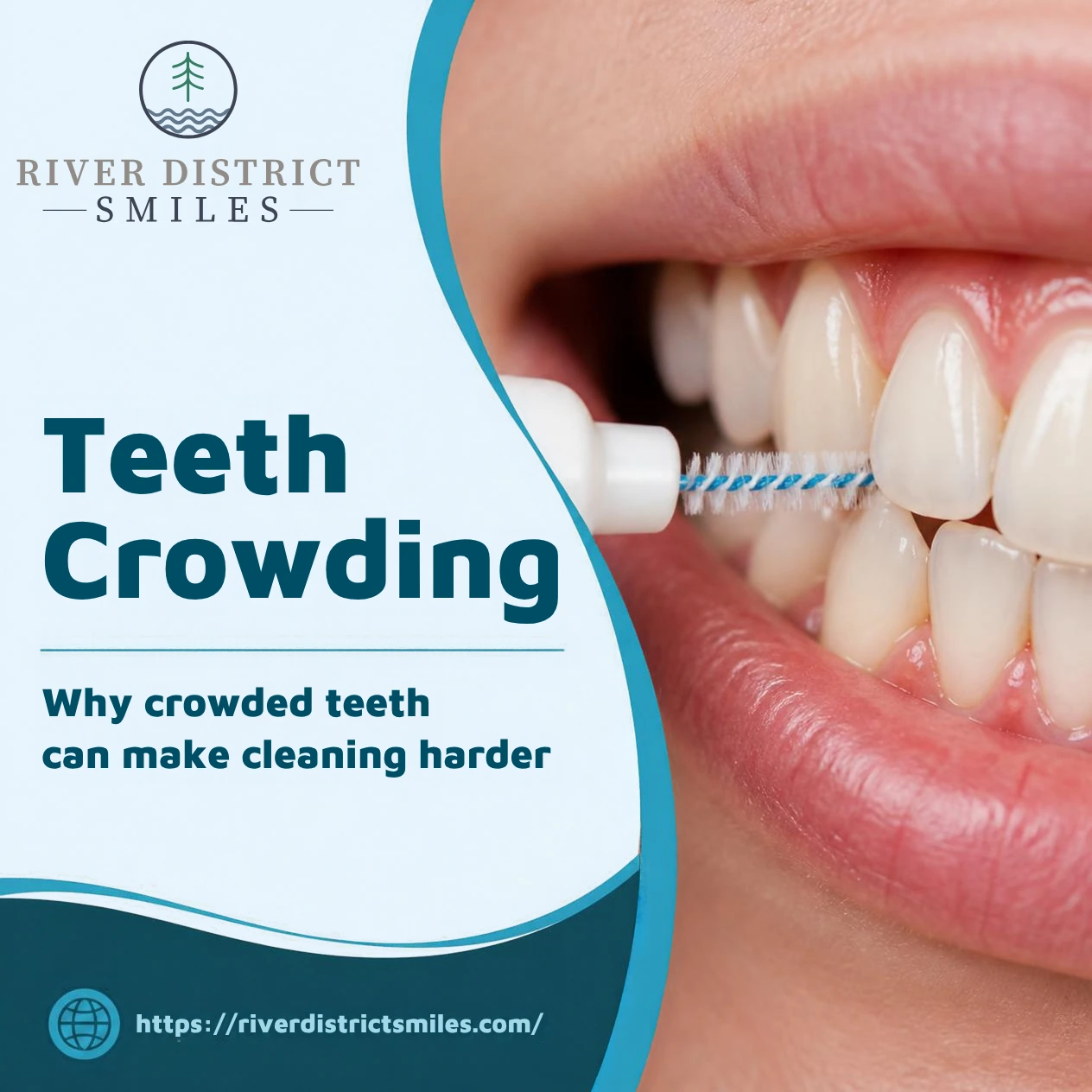
The ADA specifically notes that toothbrush bristles cannot effectively clean tight spaces between teeth. Cleaning between the teeth with floss or another interdental cleaner removes plaque and debris from surfaces a toothbrush cannot reliably reach.
Crowding can make that job harder.
Floss may:
- Catch on overlapping edges
- Shred
- Be difficult to guide through the contact
- Require awkward angles
- Feel impossible to position around a rotated tooth
That often leads to a predictable cycle.
Flossing is frustrating, so you do it less often.
Plaque accumulates in the difficult area.
Eventually tartar can develop, which makes the surface even harder to clean at home.
The ADA notes that once plaque hardens into tartar, it can no longer be removed with ordinary brushing and requires professional cleaning.
Does Crowding Cause Cavities?
Not automatically.
This distinction matters.
Having crooked or crowded teeth does not guarantee that you will develop decay.
Plenty of people have crowding and maintain healthy teeth for decades.
But crowded areas can make plaque removal more challenging, and plaque that repeatedly remains around teeth can contribute to tooth decay.
The ADA recommends twice-daily brushing with fluoride toothpaste and daily cleaning between the teeth as basic measures for reducing cavity and gum-disease risk.
So the relationship is better explained this way:
Crowding can make effective cleaning harder. Harder cleaning can make plaque more likely to remain. Persistent plaque can increase the risk of dental problems.
That is different from saying crooked teeth themselves create cavities.
What About Gum Disease?
The same basic issue applies.
Plaque tends to collect near the gumline and between teeth.
If overlapping teeth make those areas difficult to reach, the gums may become irritated.
You might notice:
- Bleeding while brushing
- Bleeding when flossing
- Redness
- Puffiness around certain teeth
- Tender gums
- Persistent bad breath
Early gum inflammation is called gingivitis.
The ADA explains that plaque left around the gumline can eventually contribute to swollen or bleeding gum tissue. Daily interdental cleaning can help reduce plaque in those areas.
Again, crowding does not mean gum disease is inevitable.
But if the same overlapping area bleeds every time you clean it, that is worth discussing at your dental visit.
“My Gums Only Bleed When I Floss. Should I Stop?”
Usually, stopping is not the solution.
Bleeding can occur when inflamed gum tissue is disturbed during cleaning.
That said, technique matters.
You do not need to aggressively snap floss into the gums.
Guide it between the teeth, curve it against the side of one tooth, gently move it below the gumline, and then repeat against the neighboring tooth.
If traditional floss is difficult because of crowding, that does not mean you have failed at oral hygiene.
Another cleaning tool may suit the space better.
The ADA recognizes several options for interdental cleaning, including traditional floss, interdental brushes, and water flossers. The best choice can vary according to the patient’s anatomy and needs.
The goal is not loyalty to one product.
The goal is getting plaque off the tooth.
Is a Water Flosser Better for Crowded Teeth?
For some people, it is easier.
That does not necessarily mean it is universally “better” than traditional floss.
Water flossers can be useful when manipulating string floss is difficult or when a patient is more likely to use the water flosser consistently.
Traditional floss can work very well in tight contacts when used correctly.
Small interdental brushes may work particularly well in more open spaces, but they should not be forced into contacts that are too tight. The ADA recommends choosing interdental tools according to the individual patient’s needs.
If your teeth are crowded, a realistic routine might even involve more than one tool.
For example:
- Floss for very tight front contacts
- A small interdental brush in more open areas
- A water flosser where access is awkward
There is no dental prize for making your cleaning routine unnecessarily difficult.
Would an Electric Toothbrush Help?
It can.
Both manual and powered toothbrushes can clean teeth effectively.
The ADA recommends brushing for two minutes twice daily with fluoride toothpaste using a soft-bristled toothbrush.
Some patients with crowding find a small powered brush head easier to maneuver around rotated or overlapping teeth.
But an electric toothbrush does not eliminate the need to clean between teeth.
The brush still cannot reliably reach every interproximal surface.
Think of it as a potentially useful tool not a replacement for interdental cleaning.
How Can You Tell If You Are Missing an Area?
Your gums often give clues.
If one small area repeatedly:
- Bleeds
- Builds tartar quickly
- Feels rough
- Traps food
- Develops recurrent cavities
- Looks inflamed
then cleaning access may be part of the issue.
A dental hygienist can also show you where plaque is consistently collecting.
That can be more useful than simply being told to “brush better.”
Sometimes adjusting the angle of the toothbrush solves the problem.
Sometimes a different interdental tool helps.
Sometimes the tooth position itself is what makes the area persistently difficult.
Does Crowding Get Worse With Age?
Teeth can change position over time.
Adults sometimes notice the lower front teeth becoming increasingly crowded even if they looked relatively straight when they were younger.
Previous orthodontic treatment can also relapse when retainers are not worn as recommended.
That does not mean everybody’s teeth inevitably become severely crooked with age.
But if you have noticed that flossing is becoming progressively harder or one tooth appears to be moving behind another, it is reasonable to mention the change at your next exam.
The dentist can determine whether this is primarily an appearance concern, a bite issue, a periodontal issue, or simply something worth monitoring.
Does Crowding Mean I Need Braces?
No.
Not every crowded tooth needs orthodontic treatment.
If the crowding is mild, your bite is stable, your gums and teeth are healthy, and you can maintain the area adequately, treatment may be optional.
Some patients choose to straighten their teeth mainly because they prefer the appearance.
Others have a combination of concerns:
- Cleaning is difficult
- Plaque accumulates repeatedly
- Teeth overlap significantly
- The bite is abnormal
- Teeth are wearing unevenly
- Food constantly gets trapped
- They dislike the appearance
The ADA notes that orthodontic treatment may be recommended for crowded teeth and other bite problems, with oral-health considerations extending beyond appearance.
The important point is that orthodontics should solve a problem worth solving.
You do not need to straighten teeth simply because they are not perfectly lined up.
Can Clear Aligners Fix Crowding?
Often, yes but not every case.
Clear aligners gradually move teeth using a planned sequence of removable trays.
River District Smiles offers SureSmile clear aligners and describes them as an option commonly used for mild to moderate alignment concerns. More complex crowding or bite problems may be better suited to traditional orthodontic treatment or require additional planning.
That is why you cannot reliably decide from a selfie whether aligners will work.
The dentist needs to evaluate:
- How much crowding exists
- Where space can be created
- Tooth and root positions
- Gum and bone health
- The bite
- Whether teeth need rotation or more complex movement
- Whether there are untreated cavities or gum problems
Clear aligners can be convenient because they are removable for brushing and flossing.
But they also depend heavily on patient compliance.
River District Smiles advises patients using SureSmile to wear the aligners roughly 20 to 22 hours per day.
If the trays spend most of the day in their case, the treatment cannot work as planned.
Are Braces Better for Severe Crowding?
They can be.
Traditional braces give the treating clinician direct control over tooth movement and can be useful for more complex alignment and bite problems.
River District Smiles notes that braces may be more appropriate in cases involving severe crowding or complex bite correction.
The tradeoff is that braces themselves make cleaning more complicated.
Brackets and wires create additional places where plaque and food can collect.
So if the reason you are considering orthodontics is partly to make long-term cleaning easier, remember that the treatment phase temporarily requires even more careful cleaning.
That is manageable.
It just needs to be part of the decision.
Can Teeth Be Too Crowded for Aligners?
Yes.
Some crowding cannot be predictably corrected by simply placing clear trays over the teeth and waiting.
Space may need to be created.
Depending on the case, orthodontic planning could involve strategies such as:
- Expanding available space
- Moving teeth backward or outward when appropriate
- Carefully reducing tiny amounts of enamel between selected teeth
- Removing a tooth in more severe cases
- Using attachments or other orthodontic mechanics
Not every patient needs any of those things.
But they illustrate why an orthodontic exam matters.
The question is not only how crowded the teeth look.
It is where the needed space is going to come from.
Will Straightening My Teeth Prevent Cavities?
It may make cleaning easier.
That is not the same as making cavities impossible.
Straight teeth still need to be brushed.
Floss still matters.
Diet still matters.
Fluoride still matters.
Regular preventive care still matters.
Orthodontics changes tooth position.
It does not replace oral hygiene.
That is an important expectation to have before spending time and money on treatment.
If you straighten crowded teeth but stop cleaning between them, you can still develop dental problems.
How Much Does It Cost to Fix Crowded Teeth?
Cost depends on what the crowding actually requires.
A mild alignment case treated with clear aligners is very different from a complex bite problem requiring comprehensive orthodontic treatment.
Factors that can change the price include:
- Severity of crowding
- Length of treatment
- Number of aligners
- Need for refinements
- Attachments or other treatment mechanics
- Whether bite correction is needed
- Retainers after treatment
- Insurance orthodontic benefits
River District Smiles describes SureSmile treatment as generally costing several thousand dollars, with the final price determined by case complexity and the treatment plan.
Before starting, ask what the quoted price includes.
For example:
Does it include scans?
Refinement trays?
Retainers?
Follow-up visits?
What happens if additional treatment is needed?
You should understand the full plan rather than comparing only the first number you are given.
When Is Orthodontic Treatment Probably Not the First Step?
If your gums are actively inflamed or you have untreated cavities, those problems may need attention before focusing on tooth movement.
The ADA emphasizes that dental evaluation before and during orthodontic treatment is important because conditions such as periodontal disease can affect treatment and oral health.
Similarly, if the only issue is very mild crowding that you can clean effectively and that does not bother you, orthodontic treatment may simply not be a priority.
That is a perfectly reasonable decision.
Treatment should match the problem.
What Can You Do Today If Your Teeth Are Crowded?
You do not have to straighten them tomorrow to improve your oral health.
Start with access.
Brush twice daily with fluoride toothpaste. Spend extra time deliberately angling the brush toward overlapping and rotated surfaces rather than simply sweeping across the front.
Clean between your teeth every day. Traditional floss, interdental brushes, water flossers, or a combination may be appropriate depending on the space.
Ask your hygienist to show you the areas you are missing. Specific advice is much more useful than “floss more.”
Pay attention to repeat problem spots. If one crowded area constantly bleeds, traps food, builds tartar, or develops decay, tell your dentist.
Discuss alignment if cleaning remains difficult. Sometimes changing the tooth position becomes a reasonable long-term solution.
When Should You Have Crowding Evaluated?
Crowding itself is usually not an emergency.
Bring it up at a routine visit if:
- You cannot floss between certain teeth
- Food is constantly trapped
- Your gums repeatedly bleed in the same crowded areas
- Tartar quickly returns around overlapping teeth
- You have had repeated cavities between crowded teeth
- Your teeth appear to be shifting
- Your bite feels different
- You are interested in straightening them for appearance or function
An examination can help separate three different questions:
Is this healthy?
Can you keep it clean?
Would changing the alignment provide enough benefit to justify treatment?
Those answers are not always the same.
The Bottom Line
Crowded teeth are not automatically unhealthy teeth.
But they can make oral hygiene less forgiving.
When one tooth overlaps another, the brush may not reach every surface easily. Tight or rotated contacts can make flossing more difficult. If plaque repeatedly remains in those areas, the risk of cavities and gum inflammation can increase.
Sometimes the answer is simply finding a better way to clean.
Sometimes it is changing your toothbrush technique or using a different interdental tool.
And sometimes significant crowding makes orthodontic treatment worth considering—not only because straighter teeth look different, but because the new position may be easier to maintain.
River District Smiles offers preventive care as well as SureSmile clear-aligner treatment for appropriate alignment concerns, with treatment recommendations based on the patient’s teeth, bite, gum health, and goals.
If you are fighting with the same overlapping teeth every night when you floss, you do not have to guess whether the problem is your technique or the tooth position.
A good dental visit should help you figure out what is making the area difficult to clean and whether the simplest solution is a better cleaning method or actually changing the alignment.