


Crooked teeth are often treated as an appearance concern. You may notice one tooth that turns inward, crowding along the bottom teeth, or a smile that does not look as even as you would like.
But appearance is only part of the picture.
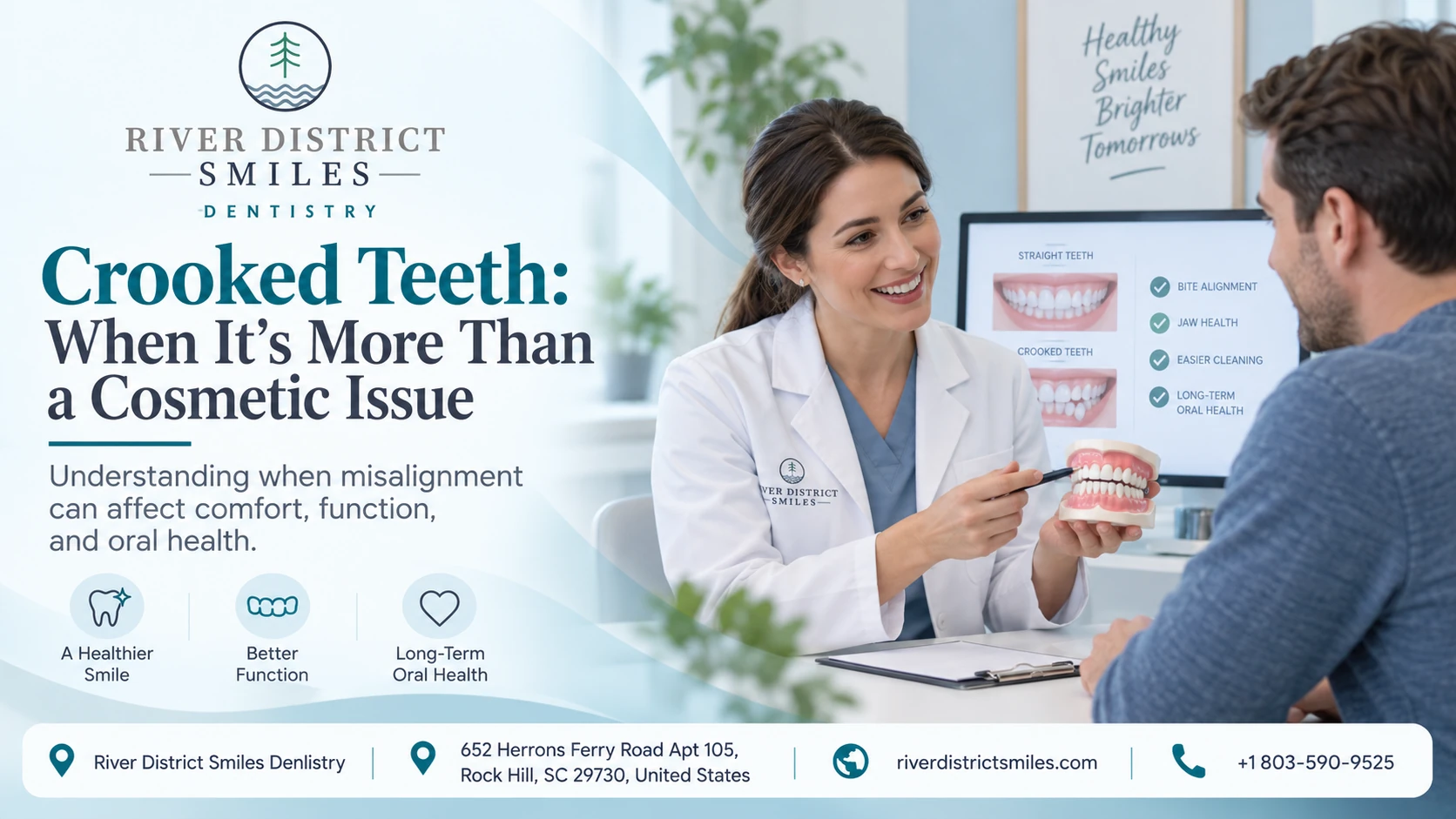
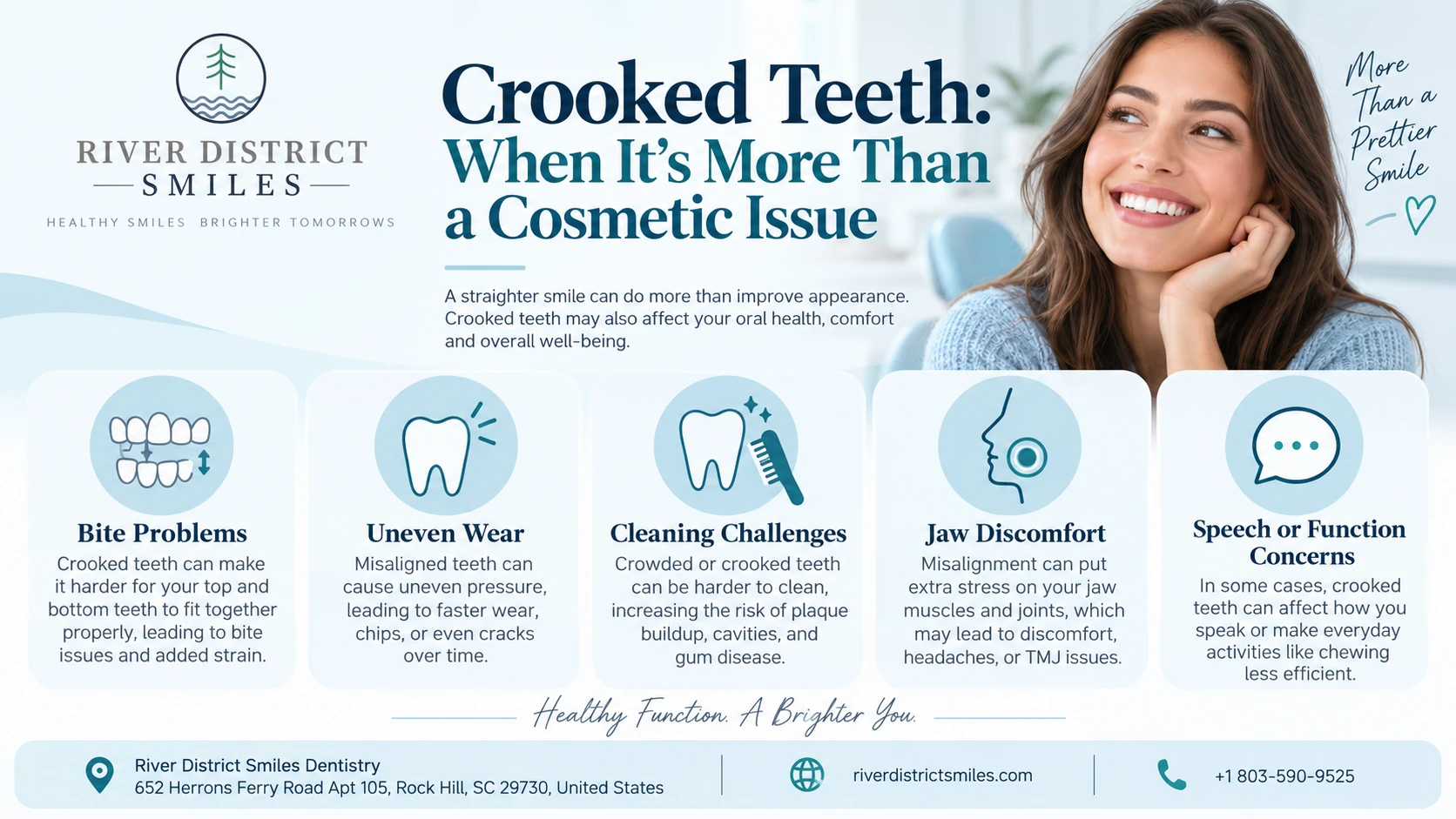
Crooked teeth become more than a cosmetic issue when they make your teeth difficult to clean, affect the way your bite fits together, contribute to uneven tooth wear, or make chewing uncomfortable.
That does not mean every slightly crooked tooth needs treatment. Many people have minor misalignment and healthy, comfortable teeth. The important question is not whether your smile is perfectly straight. It is whether the position of your teeth is creating a problem now or increasing the likelihood of one later.
When are crooked teeth mainly cosmetic?
Crooked teeth may be mostly cosmetic when:
- You can brush and clean between your teeth effectively
- Your gums are healthy and do not bleed regularly
- Your bite feels comfortable
- You can chew normally
- Your teeth are not wearing down unevenly
- The alignment has remained relatively stable
- The appearance does not bother you
In these cases, straightening your teeth is usually a personal decision rather than an urgent dental need.
Some patients decide to pursue treatment because they would feel more confident with a straighter smile. Others are comfortable leaving mild misalignment alone. Both choices can be reasonable when the teeth, gums, and bite are healthy.
Signs crooked teeth may be affecting your oral health
The position of your teeth deserves a closer look when you notice one or more of the following problems.
Your teeth are difficult to clean
Crowded or overlapping teeth can create narrow spaces that are difficult to reach with a toothbrush or floss. Plaque can remain in these areas even when you are brushing consistently.
Over time, difficult-to-clean areas may contribute to cavities, inflamed gums, and tartar buildup. The American Dental Association recommends daily cleaning between the teeth, but the most effective tool may differ when spaces are unusually tight or irregular.
You may have a cleaning-related problem if:
- Floss repeatedly shreds or gets stuck
- Food becomes trapped in the same places
- Certain areas bleed whenever you floss
- Your hygienist regularly finds buildup around overlapping teeth
- Cavities keep developing between the same teeth
Straightening is not the only possible solution. Your dentist may recommend a different flossing tool, an interdental brush, a water flosser, or more frequent professional cleanings. However, significant crowding may continue to make home care difficult until the teeth are repositioned.
Your gums bleed around crowded teeth
Bleeding gums are usually a sign of inflammation rather than a normal consequence of brushing. Gingivitis can cause gums to become red, swollen, and prone to bleeding, especially where plaque is difficult to remove.
Crowding does not automatically cause gum disease. Plenty of patients with crooked teeth maintain healthy gums. The concern is that overlapping teeth can create areas where plaque is easier to miss.
An examination can help determine whether the problem is primarily:
- Plaque and tartar buildup
- An ineffective home-care technique
- Crowding that makes cleaning unusually difficult
- A more advanced gum condition
- A combination of these factors
It is usually best to stabilize active gum disease before beginning orthodontic treatment.
Your bite does not come together comfortably
Dentists use the word bite to describe how your upper and lower teeth meet when you close your mouth.
A misaligned bite, also called malocclusion, can occur along with crooked or crowded teeth. Common examples include an overbite, underbite, crossbite, open bite, or teeth that contact too early on one side.
Possible signs of a bite problem include:
- Only a few teeth touch when you bite
- Your jaw shifts to one side as you close
- Chewing feels easier on one side
- You frequently bite your cheek or tongue
- Certain teeth feel as though they hit first
- Your front teeth do not meet
- Your lower teeth sit outside the upper teeth in some areas
A bite can look reasonably straight from the front and still function poorly. That is why treatment planning should consider how the teeth meet, not just how they appear in a photograph.
Some teeth are wearing down faster than others
Teeth are designed to share chewing pressure. When they do not meet evenly, a small number of teeth may carry more force than they should.
Over time, you may notice:
- Flattened biting edges
- Small chips
- Rough or shortened teeth
- Cracks in heavily loaded teeth
- Sensitivity where enamel has worn thin
- Dental bonding or fillings that repeatedly break
Straightening may help distribute pressure more evenly, but it is not always the complete answer. Grinding, clenching, missing teeth, weakened enamel, and damaged dental work can also contribute to wear.
Your dentist may recommend a combination of orthodontic treatment, restorative dentistry, and a protective night guard depending on the cause.
Chewing or speaking feels difficult
More significant tooth or jaw misalignment can interfere with chewing. Some bite problems may also affect speech, although this is less common and should be evaluated carefully rather than assumed. The American Association of Orthodontists lists chewing, speech, jaw discomfort, and abnormal bite relationships among concerns that may warrant evaluation.
Difficulty chewing does not always come from crooked teeth. Cavities, cracked teeth, missing teeth, jaw-joint conditions, and muscle problems can produce similar symptoms.
The goal of an examination is to identify what is actually causing the difficulty before recommending treatment.
Your teeth are shifting
Teeth can move gradually throughout life. Minor changes are common, especially if you previously had orthodontic treatment and stopped wearing your retainer.
More noticeable or rapid movement deserves attention. Teeth may shift because of:
- Loss of a tooth
- Inadequate retainer use
- Changes in the supporting gums or bone
- Grinding or clenching
- Continued jaw growth
- Pressure from the surrounding lips, cheeks, or tongue
A newly developing gap, a tooth that appears to be rotating, or a change in the way your bite feels should be checked. In some cases, shifting can be connected to loss of support from periodontal disease rather than a simple orthodontic relapse.
Do crooked teeth cause jaw pain or headaches?
Sometimes bite problems contribute to muscle fatigue or discomfort, but jaw pain and headaches are complicated symptoms. They may involve clenching, grinding, stress, sleep problems, the jaw joints, muscles, or causes unrelated to dentistry.
It would be too simple to say that straightening your teeth will automatically cure headaches or jaw pain.
An evaluation should look at:
- Where the discomfort occurs
- When it happens
- Whether you grind or clench
- How widely and smoothly your jaw opens
- Whether the jaw clicks or locks
- How your teeth contact
- Whether another medical evaluation is appropriate
Orthodontic treatment may be part of the solution for some patients, but it should not be presented as a guaranteed treatment for every jaw symptom.
What causes crooked teeth?
Crooked teeth commonly develop because the teeth and jaws do not have enough room to align evenly. Genetics often influences tooth size, jaw shape, spacing, and bite relationships. Childhood habits, early tooth loss, retained baby teeth, injuries, and changes after a missing tooth can also affect alignment.
Crooked teeth are not evidence that someone failed to care for their smile. Many alignment problems develop for reasons that brushing and flossing could not have prevented.
What are the treatment options?
The right option depends on whether the goal is to improve appearance, function, oral hygiene, or all three.
Clear aligners
Clear aligners use a planned series of removable trays to move teeth gradually. River District Smiles offers SureSmile clear aligner treatment for appropriately selected cases.
Clear aligners may be a good fit for patients who:
- Want a less noticeable treatment
- Can wear the trays consistently
- Prefer to remove them for meals and brushing
- Have an alignment problem that can be predictably treated with aligners
They may be a poor fit when someone is unlikely to wear them as directed or when the tooth and jaw movements needed are better controlled with another form of orthodontic treatment.
Traditional braces
Braces remain useful because they give the clinician continuous control over tooth movement. They may be recommended for more complicated crowding, significant bite correction, impacted teeth, or cases where removable-tray compliance could be a problem.
Braces are more visible and require careful cleaning around brackets and wires. However, they can be the more predictable choice for certain movements.
Cosmetic bonding or veneers
Bonding and veneers can sometimes make slightly rotated, uneven, or irregularly shaped teeth look straighter.
The important limitation is that these treatments change the appearance or shape of the teeth. They do not reposition the roots or correct an unhealthy bite.
Cosmetic treatment may make sense when:
- The alignment issue is minor
- The bite is already healthy
- Tooth shape is part of the concern
- The patient understands that the teeth will not actually be moved
It may not make sense when crowding is causing hygiene problems, when the bite needs correction, or when healthy tooth structure would have to be removed unnecessarily.
No immediate treatment
Monitoring is a legitimate option.
If the misalignment is mild, stable, easy to clean, and not affecting function, your dentist may simply document it and watch for changes. Treatment should have a clear benefit. Straightening every imperfect tooth is not automatically necessary.
How much does it cost to straighten crooked teeth?
The cost varies because “crooked teeth” can describe anything from one mildly rotated tooth to a complicated bite involving both jaws.
Price is usually affected by:
- The severity of the crowding or bite problem
- Whether one or both arches need treatment
- Clear aligners versus braces
- The expected treatment length
- Whether teeth need to be removed
- Whether gum or restorative treatment is needed first
- Retainers and follow-up care
- Insurance orthodontic benefits
Before comparing prices, ask what the estimate includes. A lower fee may not include diagnostic records, refinement trays, retainers, replacement aligners, or follow-up visits.
The more useful question is not simply, “Which option is cheapest?” It is, “Which treatment can predictably correct my specific problem without doing more dentistry than I need?”
What happens if you leave crooked teeth untreated?
For mild, healthy misalignment, possibly nothing significant. Not every case gets worse, and not every patient needs orthodontic treatment.
Waiting matters more when you already have:
- Repeated cavities in crowded areas
- Persistent gum inflammation
- Progressive tooth wear
- Chipping or cracking
- Increasing difficulty cleaning
- A bite that is becoming uncomfortable
- Teeth that are actively shifting
- Trouble chewing
Delaying care does not necessarily make treatment impossible. It may, however, allow damage to accumulate if the alignment is already interfering with hygiene or function.
When should you schedule an evaluation?
Crooked teeth are rarely a dental emergency. You do not usually need an urgent appointment simply because a tooth is rotated or crowded.
It is worth arranging a routine evaluation when:
- Your teeth are difficult to floss
- Your gums repeatedly bleed in crowded areas
- Your bite feels uneven
- You see increasing wear or chipping
- Your teeth appear to be moving
- Chewing has become uncomfortable
- You are considering aligners, braces, veneers, or bonding
- You want to know whether the concern is cosmetic or functional
A proper evaluation may include photographs, digital scans, X-rays, a gum-health assessment, and an examination of how the upper and lower teeth meet.
Questions to ask before choosing treatment
Before agreeing to straighten or cosmetically alter your teeth, ask:
- Is this primarily a cosmetic concern or a health concern?
- Does my bite need correction, or only the visible alignment?
- Are my gums healthy enough to begin treatment?
- Which option gives the most predictable result in my case?
- What are the disadvantages of clear aligners for me?
- Would braces provide better control?
- Would bonding or veneers hide the issue without correcting it?
- What is included in the quoted fee?
- How long will I need to wear retainers?
- What is likely to happen if I decide not to treat it?
A useful consultation should answer these questions clearly and without pressuring you toward one option.
The bottom line
Crooked teeth do not need treatment simply because they are not perfectly straight.
They become more than a cosmetic concern when they interfere with cleaning, contribute to gum inflammation, affect the bite, create uneven wear, or make chewing uncomfortable. Even then, the best solution is not automatically braces or clear aligners. The right recommendation depends on what the alignment is actually doing to your teeth and gums.
At River District Smiles in Rock Hill, the first step is an examination of your tooth alignment, bite, gum health, and treatment goals. The practice provides general, cosmetic, implant, and clear-aligner care with an emphasis on personalized treatment planning.
The next step is not assuming every crooked tooth needs to be fixed. It is finding out whether yours is simply part of your smile or whether it is beginning to affect your oral health.