


When a tooth needs a crown, many patients are surprised to learn that the restoration may be completed in one appointment.
A CEREC same-day crown is digitally scanned, designed, and made inside the dental office. A traditional crown is usually created by an outside dental laboratory, which means wearing a temporary crown and returning for a second appointment.
For many straightforward cases, a CEREC crown offers the most convenient option because it can restore the tooth in a single visit without a temporary crown. A traditional laboratory-made crown may be better when the case requires a specialized material, highly detailed cosmetic layering, or a more complex restoration.
The quality of a crown depends on more than where it is made. Tooth preparation, material selection, bite design, fit, cementation, and daily care all matter.
What is a dental crown?
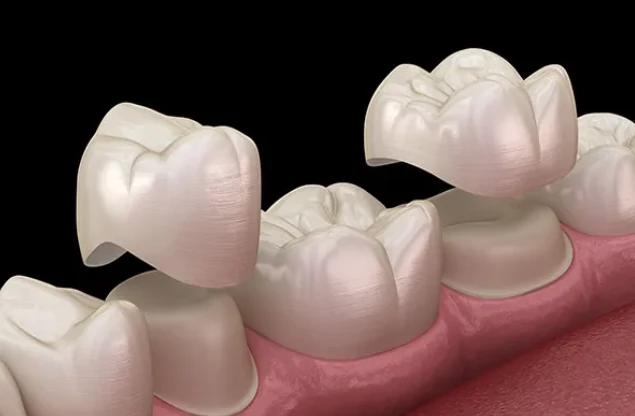
A dental crown is a restoration that covers the visible portion of a damaged or weakened tooth.
A dentist may recommend one to:
- Protect a tooth with a large filling
- Restore a broken or badly worn tooth
- Strengthen a tooth after root canal treatment
- Cover a severely discolored or misshapen tooth
- Support a dental bridge
- Restore a dental implant
Crowns are intended to restore the tooth’s shape, strength, appearance, and ability to function.
What is a CEREC same-day crown?
CEREC is a digital system that allows a dentist to scan, design, mill, and place certain ceramic restorations in the office.
Instead of sending a physical impression to a laboratory, the dentist uses a digital scanner to create a three-dimensional model of the prepared tooth and surrounding bite. The crown is then designed with dental software and milled from a block of restorative material. Depending on the material, it may also be polished, glazed, crystallized, or fired before placement.
River District Smiles uses CEREC technology to provide same-day crowns and other restorative procedures when the case is appropriate.
What is a traditional crown?
A traditional crown is made through a dental laboratory.
At the first appointment, the dentist prepares the tooth and takes either a digital scan or a conventional impression. A temporary crown is placed while the laboratory makes the final restoration.
The patient then returns for a second appointment. The temporary is removed, the final crown is checked for fit, appearance, and bite, and the crown is cemented or bonded into place.
This workflow usually gives the laboratory several days or weeks to create and characterize the restoration.
CEREC vs. traditional crowns at a glance
| Consideration | CEREC same-day crown | Traditional crown |
| Number of visits | Usually one | Usually two |
| Impression | Digital scan | Digital or traditional impression |
| Temporary crown | Usually not needed | Usually required |
| Where it is made | In the dental office | Dental laboratory |
| Treatment time | Several hours in one visit | Two shorter visits separated by laboratory time |
| Materials | Selected chairside ceramics and zirconia | Wider laboratory material selection |
| Cosmetic customization | Designed and characterized in office | Can include detailed laboratory layering and staining |
| Best fit | Many routine single-tooth restorations | Complex, highly cosmetic, or specialized cases |
| Main advantage | Convenience | Laboratory flexibility |
| Main disadvantage | Longer single appointment | Temporary crown and second visit |
How does the CEREC process work?
A typical same-day crown appointment includes several steps.
1. The tooth is examined and prepared
The dentist removes decay, old restorative material, and weakened tooth structure. The tooth is shaped so the crown can fit securely over it.
Local anesthetic is normally used to keep the area comfortable.
2. A digital scan is taken
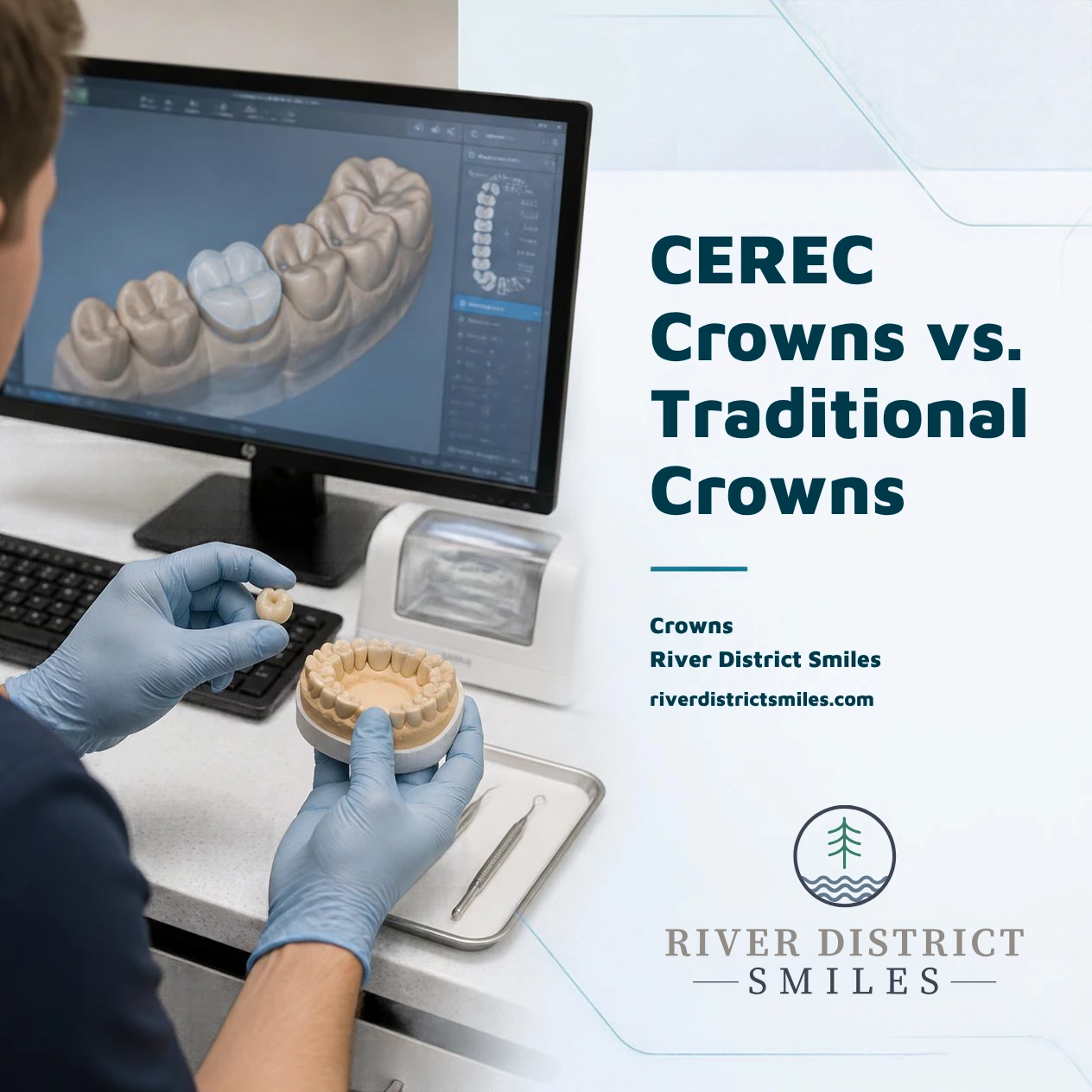
A handheld scanner records the prepared tooth, neighboring teeth, and opposing bite. This replaces the traditional tray filled with impression material in many cases.
The scan creates a digital model that can be viewed and adjusted on a computer.
3. The crown is designed
The dentist uses software to develop the crown’s shape, contacts, and biting surface.
CEREC systems can use the surrounding teeth and bite information to help generate a patient-specific restoration proposal, although the dentist remains responsible for reviewing and refining the design.
4. The restoration is milled
The crown is carved from a solid block of ceramic or zirconia in an in-office milling unit.
The exact manufacturing steps depend on the material. Some crowns can be polished and placed relatively quickly. Others require additional firing, glazing, or crystallization before they are ready.
5. The crown is tried in and placed
The dentist checks:
- The fit along the tooth
- Contact with neighboring teeth
- The bite
- Shape and appearance
- Shade
- Patient comfort
Adjustments can be made before the restoration is bonded or cemented.
How does the traditional crown process work?
The first traditional-crown visit is similar at the beginning. The tooth is numbed, any damage is treated, and the tooth is prepared.
After the impression or scan is taken, the dentist places a temporary crown. The laboratory then creates the final restoration based on the prescription, images, shade information, and records provided by the office.
At the second appointment, the dentist removes the temporary, evaluates the final crown, makes any necessary adjustments, and permanently places it.
A traditional crown therefore involves more calendar time, even though each individual appointment may be shorter.
Are same-day crowns as strong as traditional crowns?
They can be.
“Same-day” describes the workflow, not one specific crown material. CEREC restorations may be made from several ceramics or zirconia products, each with different strength, appearance, bonding requirements, and ideal uses.
Traditional laboratory crowns can also be made from different materials, including:
- Zirconia
- Lithium disilicate
- Layered ceramic
- Porcelain fused to metal
- Full metal
- Other specialized materials
Research on dental crowns generally shows that modern all-ceramic restorations can perform well when the material is matched to the tooth, bite, and clinical situation. Longevity is influenced by restoration design, available tooth structure, grinding habits, cementation, hygiene, and the location of the tooth, not simply whether the crown was made in an office or laboratory.
A well-planned same-day crown is not automatically weaker than a laboratory crown. A poorly selected material, however, can be a problem in either workflow.
Which crown looks more natural?
Both can look very natural.
A same-day crown can be shaped, polished, stained, and glazed to blend with nearby teeth. For many back teeth and routine single crowns, the cosmetic result can be very convincing.
A laboratory crown may have an advantage when the case requires:
- Complex shade matching
- Multiple colors or translucent layers
- Matching one highly visible front tooth
- Replicating unusual enamel characteristics
- Significant changes in tooth shape
- Several crowns that must match each other precisely
A dental laboratory technician may spend additional time layering porcelain and reproducing small details such as translucency, surface texture, and internal color.
That does not mean every front tooth requires a laboratory crown. It means that the more demanding the cosmetic match, the more important the material and customization process become.
Which option fits better?
Either option can fit accurately.
CEREC uses digital scanning and computer-guided design. A laboratory crown may be created from either a digital scan or a conventional impression.
The final fit depends on:
- How clearly the tooth was prepared
- Whether the gums and moisture were controlled during scanning or impression-taking
- The accuracy of the design
- The milling or laboratory process
- The dentist’s evaluation before placement
- The cementation or bonding technique
A digital workflow can reduce some problems associated with distorted impression material, but technology does not eliminate the need for careful clinical work.
What are the advantages of CEREC same-day crowns?
One appointment
The clearest advantage is convenience. The tooth can often be prepared and restored permanently during the same visit.
This may be especially helpful for patients who:
- Have difficulty taking time away from work
- Travel a significant distance for care
- Feel anxious about repeated appointments
- Need to restore a tooth quickly
- Have trouble becoming numb
- Prefer to avoid wearing a temporary crown
No temporary crown
Temporary crowns serve an important purpose, but they are not as strong or precise as the final restoration.
They can occasionally:
- Come loose
- Break
- Feel sensitive
- Trap food
- Affect the bite
- Require an additional visit for recementation
A same-day workflow usually avoids that stage.
Digital impressions
Many patients find a digital scanner more comfortable than traditional impression trays, especially if they have a sensitive gag reflex.
Immediate adjustments
Because the crown is designed and made in the office, the dentist can modify the design and manufacture another restoration during the same visit if a significant issue is identified before placement.
Less time between preparation and final restoration
The tooth is permanently covered on the same day rather than relying on a temporary while the laboratory crown is being produced.
What are the disadvantages of CEREC crowns?
A longer single appointment
Same-day does not mean a quick appointment.
The visit may take several hours because it includes preparation, scanning, design, milling, finishing, try-in, and placement. There may be periods of waiting while the restoration is being manufactured.
Some patients prefer two shorter visits rather than one longer appointment.
Not every material is available chairside
Dental laboratories generally offer a broader selection of metals, ceramics, custom layering techniques, and complex restorative designs.
Some cosmetic cases benefit from a laboratory technician
Matching one central front tooth can be more demanding than restoring a back molar. A laboratory technician may be able to add layers and subtle color variations that are difficult to reproduce from a single milled block.
Not every case can be completed the same day
Same-day treatment may not be appropriate when:
- Gum tissue prevents a clear scan
- The tooth needs additional healing
- A complex foundation or buildup is required
- The case involves a large bridge
- Specialized laboratory materials are needed
- The dentist wants to evaluate the bite or gum response before final placement
- The restoration is part of a more extensive treatment plan
“Same-day crown” should describe what is clinically possible, not a promise that applies to every tooth.
What are the advantages of traditional crowns?
Wider material selection
A laboratory can work with a broad range of ceramics, zirconia, metal alloys, and layered combinations.
This can be useful when the tooth requires unusual strength, limited thickness, a metal substructure, or a particular cosmetic effect.
Detailed customization
Traditional crowns can be closely customized with layered porcelain, hand-applied stains, and surface texture.
This may matter for:
- Highly visible front teeth
- Difficult shade matches
- Patients with unusual tooth translucency
- Multiple restorations in the smile line
- Complex implant restorations
Laboratory collaboration
The dentist can send photographs, scans, shade information, and design instructions to a dental technician who focuses specifically on making restorations.
In some cases, the patient may even visit the laboratory for a custom shade evaluation.
Useful for complex treatment
Laboratory fabrication may be more appropriate for long-span bridges, complex implant cases, removable prosthetic work, or restorations involving several teeth.
What are the disadvantages of traditional crowns?
Two appointments
The patient usually needs to return after the laboratory finishes the crown.
A temporary crown
Temporary restorations require some caution. Patients may need to avoid sticky or hard foods and contact the office if the crown becomes loose.
Traditional impressions may be uncomfortable
Some offices still use impression material for certain cases, although many laboratory-made crowns now begin with digital scans.
The tooth must be numbed again in some cases
Not every patient needs significant anesthesia at the delivery visit, but numbing may be required if the tooth is sensitive or adjustments are needed.
Delays are possible
Laboratory processing, shipping, remakes, or scheduling can extend the time before the final crown is placed.
Does a same-day crown remove more tooth structure?
Not necessarily.
The amount of tooth preparation is determined mainly by:
- The crown material
- The tooth’s existing damage
- The thickness needed for strength
- The location of the tooth
- The bite
- The way the crown will be retained or bonded
Both same-day and laboratory crowns can be conservative or aggressive depending on the design.
In some cases, digital dentistry allows a more limited restoration such as an inlay, onlay, or partial crown rather than covering the entire tooth. Whether that is appropriate depends on how much healthy structure remains.
Is a same-day crown appropriate after a root canal?
Often, yes.
Back teeth that have received root canal treatment frequently need cuspal coverage because they may have lost significant structure from decay, cracks, previous fillings, and access into the nerve chamber.
A same-day crown can sometimes complete the root canal and final restoration efficiently, but the timing depends on:
- Whether the infection is under control
- How much tooth remains
- Whether the tooth has symptoms
- Whether a post or buildup is needed
- Whether the dentist wants to monitor healing
- The complexity of the root canal treatment
The fastest plan is not always the safest plan. Some teeth should be permanently restored immediately, while others benefit from a period of observation.
How long do CEREC and traditional crowns last?
Both types can last many years.
A crown’s lifespan is affected by:
- The condition of the underlying tooth
- Crown material
- Tooth location
- Bite force
- Grinding or clenching
- Daily brushing and flossing
- Gum health
- Diet
- Smoking
- Regular dental examinations
- Whether decay develops at the crown margin
The ADA advises patients to keep crowned teeth clean because decay can still develop where the restoration meets the natural tooth.
Neither crown is permanent in the sense that it is guaranteed never to chip, loosen, wear, or require replacement.
Can a crown still get a cavity?
The crown itself cannot decay, but the natural tooth beneath and around it can.
Cavities commonly begin near the edge where the crown meets the tooth. This may happen when plaque accumulates, gums recede, cement breaks down, or the patient frequently consumes sugary or acidic foods and drinks.
To protect the tooth:
- Brush twice daily with fluoride toothpaste
- Clean between the crowned tooth and its neighbors
- Maintain regular dental visits
- Address dry mouth
- Avoid chewing ice or other very hard objects
- Wear a night guard if one is recommended
A crown protects weakened tooth structure. It does not make the tooth immune to future disease.
Which option is better for people who grind their teeth?
The answer depends more on material and design than on whether the crown is made the same day.
Patients who grind may require:
- A stronger crown material
- Adequate restorative thickness
- Careful bite adjustment
- Protection from a night guard
- Evaluation of whether several teeth are overloaded
A very cosmetic but more fragile material may not be appropriate for a heavily loaded back tooth.
Tell your dentist about clenching, grinding, broken restorations, morning jaw soreness, or repeated tooth wear before selecting the crown.
How much do same-day and traditional crowns cost?
Costs vary by office, tooth, material, insurance plan, and the amount of preparation needed.
The total may be affected by:
- Examination and X-rays
- Removal of decay or an old crown
- A core buildup
- Root canal treatment
- Crown material
- Digital scanning
- Laboratory fees
- Temporary restoration
- Sedation
- Whether the treatment is part of a bridge or implant
A CEREC crown is not automatically more expensive or less expensive than a traditional crown. Although it avoids an outside laboratory fee and a second visit, the office invests in scanning, design, milling, and finishing equipment.
Traditional crowns may carry higher laboratory costs when advanced materials or custom cosmetic work are required.
When comparing estimates, ask whether the quoted fee includes the buildup, temporary crown, final crown, follow-up adjustments, and any required imaging.
Does insurance cover CEREC crowns?
Dental insurance usually considers the type of restoration and the tooth being treated rather than whether the crown was made on-site or in a laboratory.
Coverage depends on:
- Whether the crown is considered necessary
- Which tooth is being restored
- Your plan’s waiting period
- Deductible
- Annual maximum
- Replacement-frequency rules
- Alternate-benefit provisions
- Whether the dentist is in network
Some plans may pay only toward a less expensive material. That does not necessarily mean the proposed material is inappropriate; it means the plan has a benefit limitation.
Ask for a pretreatment estimate, but remember that it is not a guarantee of payment.
When is a CEREC crown usually the better choice?
A same-day crown may be a particularly good fit when:
- You need a routine single-tooth crown
- The tooth can be prepared and restored predictably in one visit
- An appropriate chairside material is available
- You want to avoid a temporary crown
- Returning for a second appointment is difficult
- The cosmetic match is manageable in the office
- You prefer digital impressions
- The dentist has significant experience with the system
River District Smiles uses CEREC technology as part of its same-day restorative workflow, and Dr. Matthew Hubis is described by the practice as a CEREC mentor who teaches other dentists to use the technology.
When is a traditional crown usually the better choice?
A laboratory-made crown may make more sense when:
- One highly visible front tooth requires a demanding shade match
- Hand-layered porcelain is desired
- A specialized material is needed
- The crown is part of a complex bridge
- Several restorations must be coordinated
- The gum tissue needs time to heal
- The tooth’s stability needs to be observed
- The case involves complex implant or full-mouth treatment
- A chairside crown cannot be made with adequate strength or appearance
Choosing a traditional crown is not a step backward. In the right case, the laboratory process provides useful flexibility.
When might neither crown be the right first treatment?
A crown is not always the most conservative solution.
Another option may be better when:
- A small filling can repair the damage
- An inlay or onlay can preserve more tooth structure
- The tooth is cracked below the gum and cannot be restored
- Periodontal disease has left inadequate support
- Decay extends too far beneath the bone
- The tooth needs root canal treatment first
- The main concern is cosmetic and can be addressed with bonding or a veneer
- The tooth has a poor long-term prognosis
Before preparing a tooth for a crown, the dentist should explain why a smaller restoration is unlikely to last or protect the tooth adequately.
Questions to ask before choosing a crown
Ask your dentist:
- Why does this tooth need a crown?
- Could a filling, onlay, or other conservative restoration work?
- Which crown material do you recommend?
- Why is that material appropriate for this tooth?
- Can the restoration be completed with CEREC?
- Would a laboratory crown provide a better cosmetic result?
- How much healthy tooth structure remains?
- Does the tooth need a root canal or buildup first?
- What happens if I delay treatment?
- Is the crown fee different for either workflow?
- What does the estimate include?
- Will I need a night guard?
- How should I care for the crown?
The technology should support the treatment plan, not determine it.
What happens if you wait to get a recommended crown?
Waiting does not cause every weakened tooth to break, but the risk may increase when the tooth has:
- A large filling
- A significant crack
- Missing cusps
- Root canal treatment
- Repeated fractures
- Extensive decay
- Pain when biting
If more tooth structure breaks away, a restorable tooth can become more difficult or impossible to save. A smaller problem may then require root canal treatment, surgical crown lengthening, or extraction.
On the other hand, a crown should not be rushed simply because same-day technology is available. The diagnosis and long-term outlook still need to make sense.
The bottom line
CEREC same-day crowns are usually better for convenience. They can often restore a tooth in one appointment, avoid a temporary crown, and provide an accurate, durable ceramic result. Traditional crowns are often better when the case requires specialized materials, detailed laboratory artistry, or more complex planning.
Neither workflow is automatically superior.
A well-designed CEREC crown is better than a poorly planned laboratory crown, and a carefully made laboratory crown is better than a same-day restoration chosen mainly for speed.
River District Smiles offers same-day CEREC crowns as part of its restorative dental care in Rock Hill. The practice also provides traditional crown and bridge treatment, allowing the restoration method to be chosen according to the tooth, bite, cosmetic goals, and material requirements rather than convenience alone.
The most useful question is not, “Which crown is newer?” It is, “Which material and process will give this tooth the most predictable result?”