


Let’s Start With the Question You Actually Have
If your tongue keeps finding its way to one sore, puffy spot on your gums and everywhere else in your mouth feels normal, you’re not imagining it — a swelling that’s limited to a single tooth almost always has a specific, local cause, rather than being a sign of something wrong with your whole mouth. That’s actually good news: localized problems are usually easier to identify and treat than something spread across your gums generally.
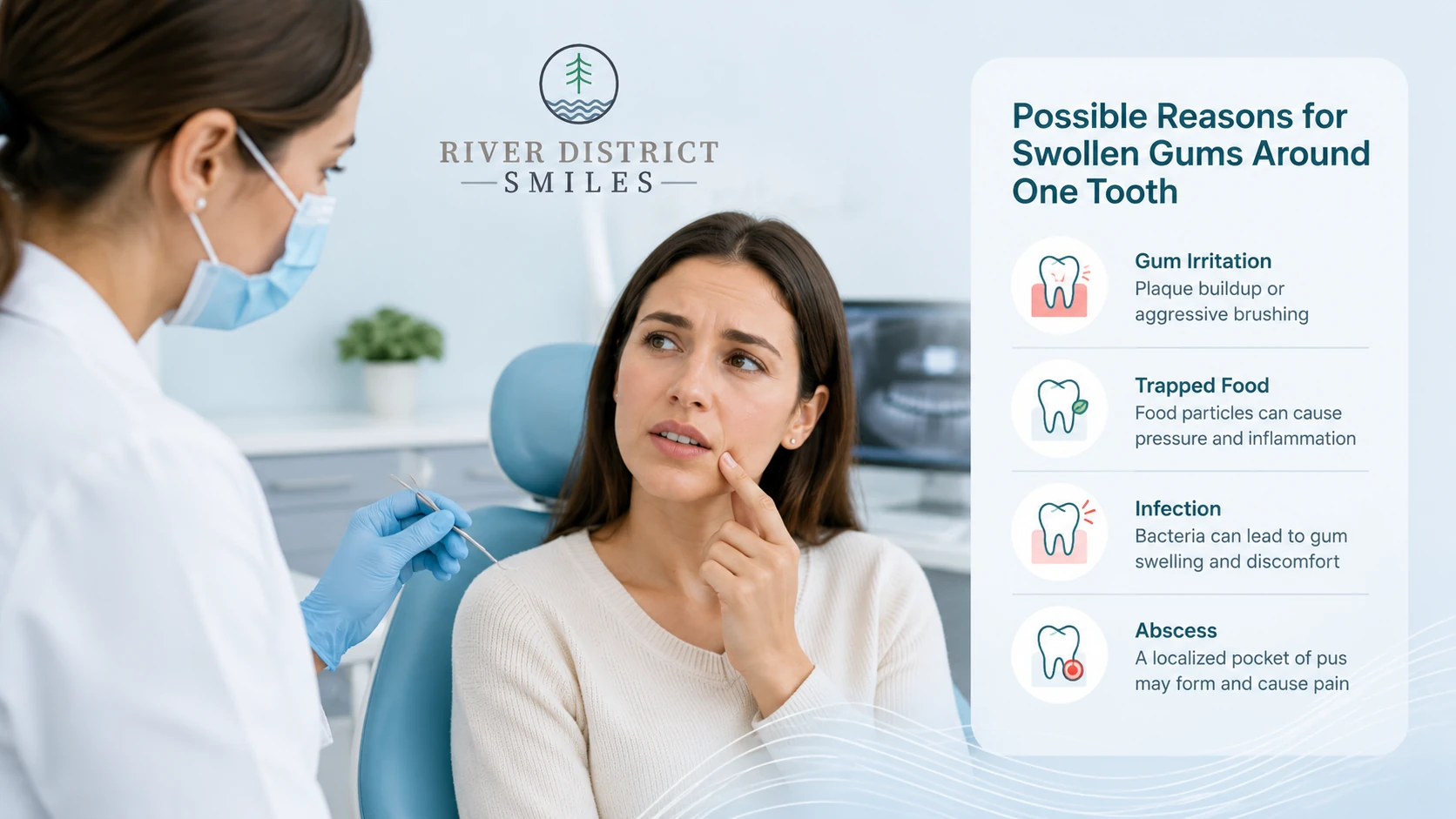
Most of the time, this comes down to one of a handful of causes: something trapped between your tooth and gum, an infection brewing at or below the gumline, early gum disease that’s started in one spot before spreading, a cracked tooth, or a filling, crown, or denture that doesn’t quite fit right anymore. We’ll walk through each one, what it tends to feel like, and importantly, the specific signs that mean this needs same-day attention rather than a wait-and-see approach.
One Swollen Gum? Don’t Ignore It
Localized swelling may signal a dental problem. Call now to have it checked before it gets worse.
The Most Common Cause: Something Trapped Under the Gumline
By far the most common reason for one spot of swollen, tender gum is trapped food debris or plaque that’s worked its way between the tooth and gum, especially in a tight contact between two teeth or around the back molars where flossing is easy to skip. Your gum tissue reacts to that irritation by swelling up around it, sometimes within just a day of the debris getting stuck.
This kind is usually easiest to spot because it often responds fast: gently flossing the area (not jamming the floss in, just working it in a small back-and-forth motion) and rinsing with warm salt water can bring noticeable relief within a day or two.
If the swelling doesn’t start improving after a couple of days of good cleaning, or it keeps coming back in the exact same spot, that’s usually your sign that there’s more going on than debris — often the start of a small pocket where plaque keeps collecting no matter how well you brush.
A Localized Gum Infection or Abscess
When bacteria get trapped in one area long enough, they can form a pocket of infection — a periodontal abscess — right at the gumline near one tooth. Unlike simple irritation from trapped food, an abscess tends to look and feel more like a distinct, tender bump rather than general puffiness, and it often comes with a bad taste, a foul odor, or mild throbbing that’s more constant than a chewing-related ache.
Common contributors include gum disease that’s already active in that area, a cracked or chipped tooth that lets bacteria in, trauma to the tooth, or dental work (a filling, crown, or bridge) that’s no longer sealing the tooth the way it should.
An abscess won’t resolve with flossing and salt water the way trapped debris will — it needs a dentist to drain it and treat the underlying cause, sometimes with a course of antibiotics.
Left alone, the infection can spread beyond that one tooth, which is why it’s worth getting looked at rather than hoping it clears on its own.
Early Gum Disease Starting in One Spot
Gum disease (gingivitis, and its more advanced form, periodontitis) doesn’t always show up evenly across your whole mouth. It’s common for it to start in one or two spots first — often where plaque and tartar have quietly built up along the gumline, frequently around teeth that are harder to clean thoroughly, like your back molars or an area with slightly crowded teeth.
In this stage, you might notice the gum around one tooth is puffy, a little tender, and bleeds more easily than the rest of your gums when you brush or floss — even though the swelling itself might be mild.
This is exactly the kind of thing a routine dental exam is built to catch early, before it progresses into deeper gum and bone loss around that tooth. Our periodontal services page covers what treatment looks like if gum disease has already taken hold in one area.
A Cracked Tooth or Failing Dental Work
Sometimes the gum itself isn’t really the problem — it’s reacting to something happening at the tooth. A hairline crack, a filling that’s pulled away from the tooth, or a crown that no longer fits snugly can all let bacteria sneak in right at the gumline, and the gum swells up in response, right around that one tooth and nowhere else.
This kind is a little trickier to self-diagnose, because the swelling can look identical to trapped debris or early gum disease from the outside. A few clues that point toward the tooth itself: pain specifically when you bite down or chew on that side, sensitivity to hot or cold that lingers longer than a few seconds, or a tooth that looks slightly different (a crown that seems loose, a visible crack, or a filling with a rough edge you can feel with your tongue). If any of that sounds familiar, it’s worth having the tooth itself checked, not just the gum.
When This Needs Same-Day or Emergency Care
Most causes of localized gum swelling are uncomfortable but not urgent — they’re worth a dental visit soon, not a trip to the ER. But there are specific signs that mean the infection may be spreading beyond what a routine appointment can safely wait out. Call your dentist right away, or seek emergency/ER care if you can’t be seen same-day, if you notice:
- Fever or chills along with the gum swelling
- Swelling that’s spreading toward your cheek, jaw, or neck rather than staying in one small spot
- Difficulty swallowing, opening your mouth fully, or breathing
- Swollen lymph nodes under your jaw or in your neck
- Severe pain that over-the-counter pain relievers aren’t touching
- A rapidly worsening, hard, or hot-to-the-touch swelling
These are the signs that an infection may be moving beyond the tooth into deeper tissue, which can become a serious medical issue if it’s not treated promptly. Our emergency dentistry team is set up to see patients quickly for exactly this kind of situation — please don’t try to wait out a fever or spreading swelling until a routine opening becomes available.

What to Really Expect From a Professional Teeth Cleaning
Why a Professional Cleaning Still Matters, Even If You're Great About Brushing and Flossing Brushing and flossing keep soft plaque…

What You Can Reasonably Try at Home in the Meantime
While you’re waiting for your appointment, a few things can ease discomfort without masking a problem that needs professional treatment:
- Rinse gently with warm salt water a few times a day
- Floss carefully around the area to clear any trapped debris (stop if it’s sharply painful rather than just tender)
- Use a soft-bristled brush and avoid scrubbing the spot aggressively
- Over-the-counter pain relievers as directed, for comfort
- Avoid very hot, cold, or hard foods on that side until it’s been checked
None of these fix an underlying infection, cracked tooth, or advancing gum disease — they’re just ways to stay comfortable until you’re seen. If the swelling is getting worse rather than better despite these steps, that’s a reason to move your appointment up rather than wait it out.
Frequently Asked Questions
Q: Should I be worried if only one tooth’s gum is swollen and the rest of my mouth feels fine?
Not usually a reason to panic, but it’s not something to ignore either. A swelling limited to one spot almost always has a specific, local cause — trapped debris, a small infection, early gum disease, or a problem with that particular tooth — and most of these are very treatable once identified. The main thing is not letting it sit for weeks without a dentist actually looking at it.
Q: How long should I wait before seeing a dentist if my gum is swollen around one tooth?
If it’s mild and improves within a day or two of gentle flossing and salt water rinses, it was likely just trapped debris and you can mention it at your next regular visit. If it persists more than 2-3 days, keeps recurring in the same spot, or is accompanied by pain, a bad taste, or a visible bump, don’t wait — call and get it looked at.
Q: Can a swollen gum around one tooth go away on its own?
Sometimes, if it’s simple irritation from something trapped that eventually works its way out. But an abscess, a cracked tooth, or active gum disease won’t resolve on their own — they tend to come back, often worse, until the underlying cause is treated.
Q: Is swollen gum around one tooth always a sign of gum disease?
No. Gum disease is one possible cause, but trapped food debris, a localized infection, a cracked tooth, or a poorly fitting filling or crown can all cause the exact same symptom. That’s part of why it’s worth having a dentist take a look rather than assuming — the right fix depends entirely on which of these is actually going on.
Q: What’s the difference between a “regular” swollen gum and one that needs emergency care?
Fever, spreading swelling toward your face or neck, difficulty swallowing or opening your mouth, or pain that over-the-counter medication doesn’t touch are the signals that this has moved from “needs a dental appointment” to “needs care today.”
Sources:
https://my.clevelandclinic.org/health/diseases/24573-periodontal-abscess
https://www.mayoclinic.org/diseases-conditions/tooth-abscess/symptoms-causes/syc-20350901
Swelling Around One Tooth? Get Answers
Find out what’s causing the irritation and protect your smile. Schedule a dental evaluation today.