

If you have been diagnosed with sleep apnea and somebody recommends CPAP, you may immediately wonder whether there is a smaller option.
No mask.
No hose.
No machine beside the bed.
That is usually when oral appliance therapy enters the conversation.
A custom sleep apnea appliance can be an effective treatment for certain adults with obstructive sleep apnea. But it is important not to frame the choice as:
“CPAP or the easier option.”
The treatments work differently, and CPAP is generally more effective at controlling the breathing interruptions and oxygen changes associated with obstructive sleep apnea.
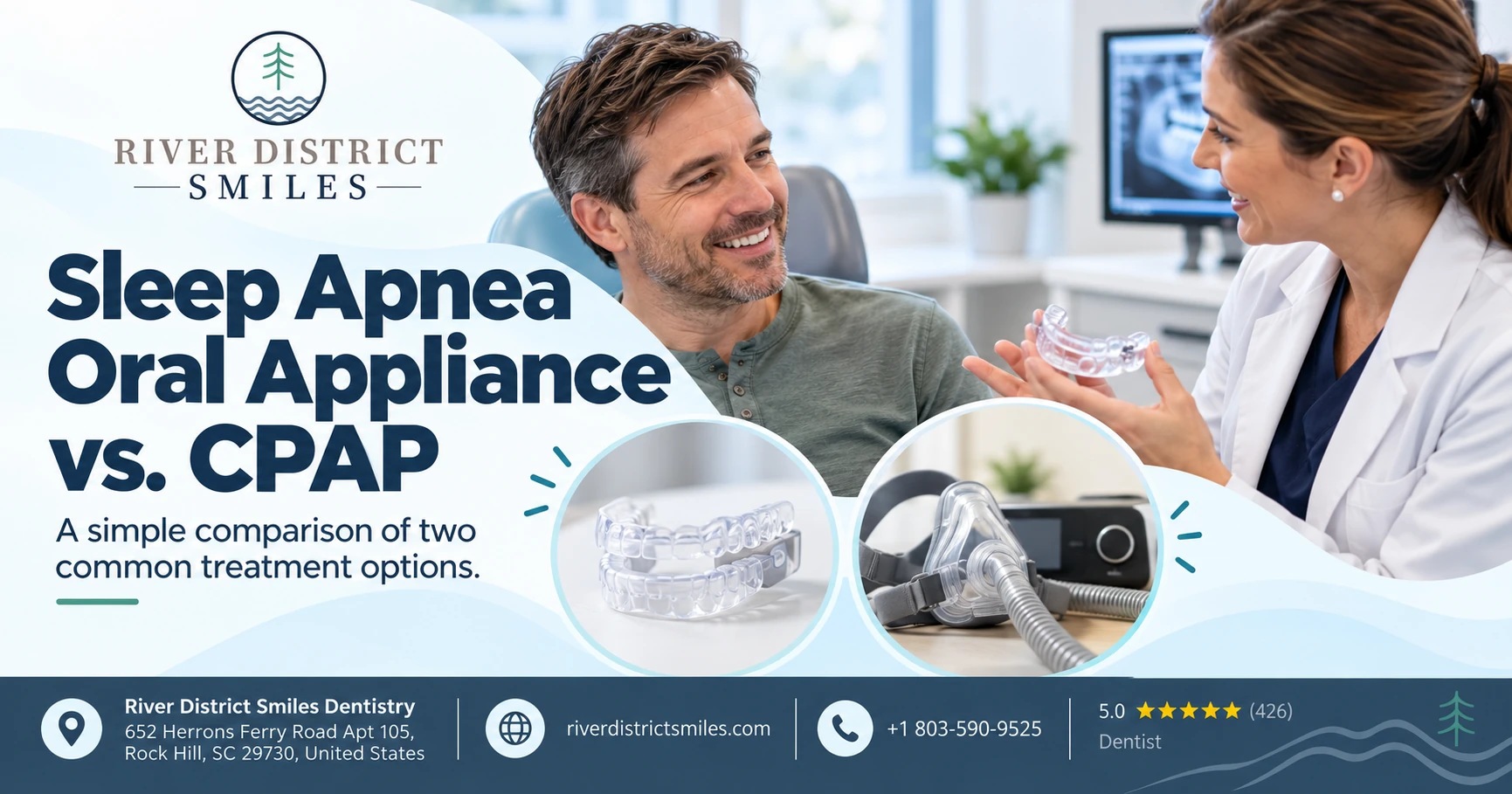
The short answer is that CPAP remains the most effective and commonly used treatment for obstructive sleep apnea, particularly when the condition is more significant. A custom oral appliance can be a good alternative for selected adults who cannot tolerate CPAP or prefer another approach, provided the treatment is prescribed and monitored appropriately.
At River District Smiles, custom sleep apnea appliances are designed to move the lower jaw forward enough to help keep the airway more open during sleep. The practice uses digital impressions and follow-up adjustments to customize the fit.
But the process should start with one thing before choosing either treatment:
A proper sleep apnea diagnosis.
What Is Obstructive Sleep Apnea?
Obstructive sleep apnea, or OSA, occurs when the upper airway repeatedly becomes narrowed or blocked during sleep.
You may still be trying to breathe, but airflow decreases or stops temporarily.
That can lead to repeated drops in oxygen, disrupted sleep, and brief awakenings that you may not remember in the morning.
Possible warning signs include:
- Loud habitual snoring
- Pauses in breathing witnessed by another person
- Waking up choking or gasping
- Daytime sleepiness
- Morning headaches
- Trouble concentrating
- Poor-quality or unrefreshing sleep
Snoring by itself does not prove someone has sleep apnea.
That distinction matters because oral appliances are also marketed for snoring.
Professional sleep guidelines emphasize that obstructive sleep apnea should be diagnosed by an appropriate sleep physician rather than assuming a patient has uncomplicated snoring.
River District Smiles states that when symptoms suggest sleep apnea, the practice can help coordinate an at-home sleep study when appropriate and review the information with the patient as part of the treatment process.
How Does CPAP Work?
CPAP stands for continuous positive airway pressure.
A machine provides pressurized air through a mask worn over the nose, or the nose and mouth.
That air pressure works like a pneumatic splint.
Instead of physically pulling the jaw forward, CPAP uses positive pressure to prevent the airway from collapsing while you sleep.
The National Heart, Lung, and Blood Institute describes PAP therapy as the most common treatment for sleep apnea. CPAP provides continuous pressure, while related devices such as APAP automatically adjust pressure and BPAP can use different pressures during inhalation and exhalation.
The important advantage is effectiveness.
When worn correctly at an appropriate pressure, CPAP can be extremely effective at preventing airway obstruction.
How Does an Oral Sleep Appliance Work?
A sleep apnea oral appliance is not an ordinary night guard.
The most common type is a mandibular advancement device.
It fits over the upper and lower teeth and holds the lower jaw somewhat forward.
Moving the jaw forward can also move the tongue and associated tissues forward, creating additional space behind them and making airway collapse less likely.
NHLBI describes mandibular repositioning appliances as devices that hold the jaw in a position that helps prevent blockage of the upper airway.
At River District Smiles, appliances are made from digital impressions and adjusted according to the patient’s bite and airway needs.
This is very different from buying a generic “anti-snoring mouthpiece” online.
Current AASM/AADSM guidance favors a custom, titratable appliance provided by a qualified dentist when oral appliance therapy is prescribed for obstructive sleep apnea.
“Titratable” simply means the appliance can be gradually adjusted to change how far forward the jaw is positioned.
Which One Works Better: CPAP or an Oral Appliance?
If we are talking strictly about controlling sleep apnea events, CPAP generally wins.
The joint American Academy of Sleep Medicine and American Academy of Dental Sleep Medicine guideline found that CPAP is superior to oral appliances in:
- Reducing the apnea-hypopnea index
- Reducing arousals from sleep
- Improving oxygen saturation
The apnea-hypopnea index, or AHI, is one measure used to describe how frequently breathing interruptions occur during sleep.
That difference is important, especially when sleep apnea is moderate or severe or when oxygen levels fall significantly.
An oral appliance can still meaningfully improve breathing in appropriately selected patients.
It is simply not accurate to tell every patient that a mouthpiece is medically equivalent to CPAP.
Then Why Would Anyone Choose an Oral Appliance?
Because the most effective treatment on paper is only useful if the patient actually uses it.
Some people adapt very well to CPAP.
Others struggle with:
- Mask discomfort
- Air leaks
- Claustrophobia
- Dry mouth
- Nasal congestion
- Skin irritation
- Noise or equipment concerns
- Difficulty traveling with the machine
- Removing the mask during sleep
NHLBI lists dry mouth, nasal symptoms, nosebleeds, and mask irritation among possible PAP side effects and notes that different masks, humidification, or machine settings can sometimes make CPAP easier to tolerate.
That last part matters.
If your CPAP is uncomfortable, the first answer does not always have to be abandoning CPAP.
Sometimes the answer is a better mask, different pressure setting, humidification, or another PAP configuration.
But when those efforts do not solve the problem or when a patient strongly prefers an alternative oral appliance therapy becomes a reasonable treatment discussion.
AASM/AADSM guidance recommends considering an oral appliance for adults with OSA who cannot tolerate CPAP or who prefer alternate therapy.
Is an Oral Appliance Only for Mild Sleep Apnea?
You will often hear oral appliances described as a treatment for mild to moderate sleep apnea.
That is a useful generalization, but reality is slightly more nuanced.
NHLBI notes that oral devices may be used for people with mild sleep apnea and for patients who do not want to use or cannot tolerate CPAP.
Professional guidelines also allow oral appliance therapy to be considered in adults with OSA who prefer it or cannot tolerate CPAP without limiting the recommendation to one severity category.
The practical issue is effectiveness.
The more severe the obstruction or oxygen disturbance, the more important it becomes to confirm that the chosen treatment is actually controlling the disease.
For someone with severe OSA, I would not recommend simply buying a mouthpiece and assuming the problem has been handled.
Treatment needs medical oversight and objective follow-up.
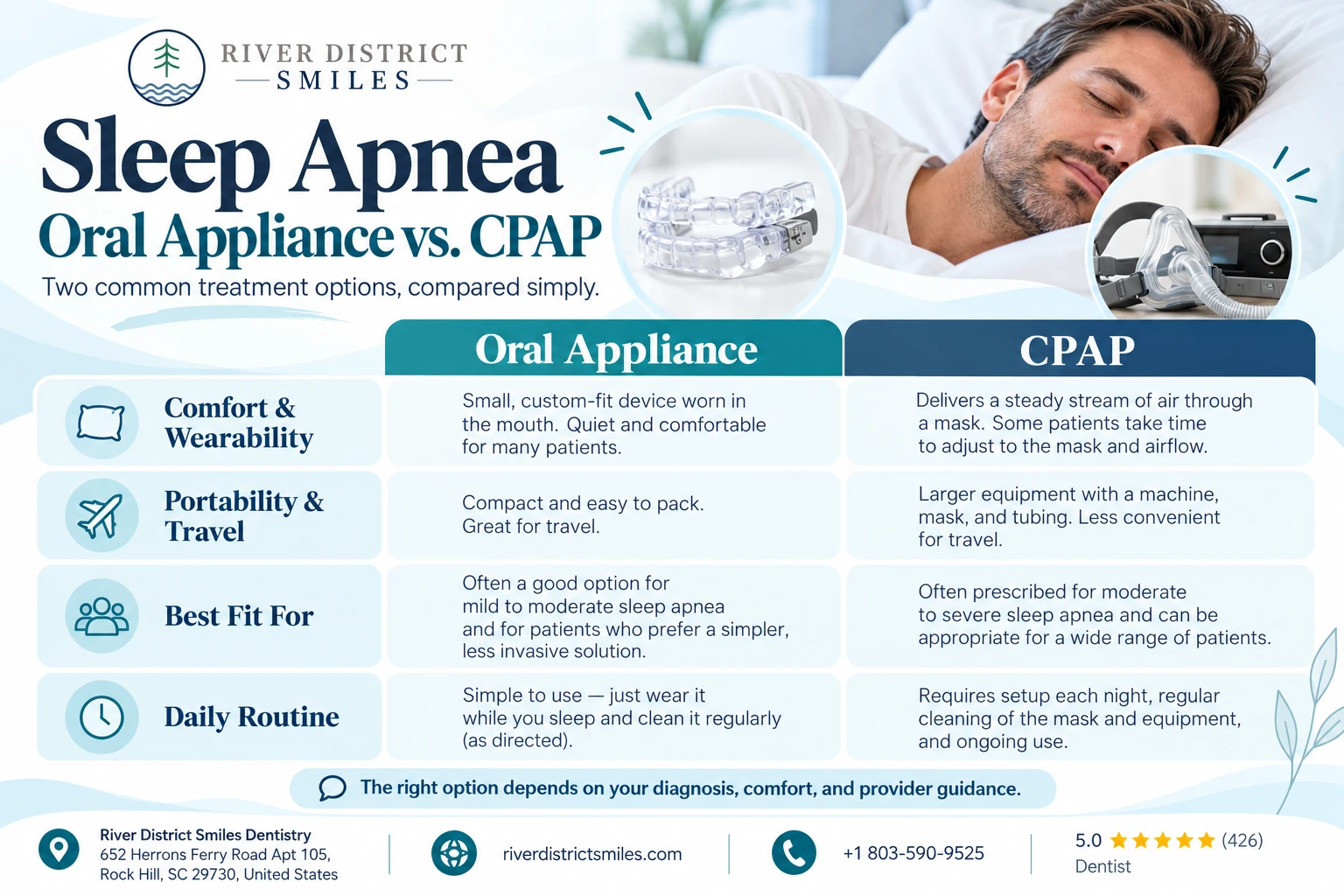
CPAP vs. Oral Appliance at a Glance
| CPAP | Custom oral appliance | |
| How it works | Uses pressurized air to hold airway open | Moves lower jaw forward to improve airway space |
| Overall effectiveness | Generally highest | Effective in selected patients but usually reduces AHI less than CPAP |
| Equipment | Machine, hose, mask | Small dental appliance |
| Electricity | Usually required | No |
| Travel | More equipment to pack | Small and portable |
| Noise | Modern machines are relatively quiet but still use equipment | Silent |
| Mask required | Yes | No |
| Dental side effects | None from tooth movement itself | Possible bite, tooth, jaw, or salivary changes |
| Common comfort issues | Mask leaks, dryness, congestion, irritation | Jaw soreness, tooth discomfort, bite changes |
| Adjustment | Pressure/mask adjustments | Dentist gradually advances appliance |
| Monitoring | Sleep clinician/PAP data | Dentist plus sleep clinician and follow-up sleep testing |
| Best fit | Many OSA patients, especially when stronger control is needed | Selected adults who prefer it or cannot tolerate CPAP |
The best treatment is not determined solely by which side of that table looks more convenient.
Your sleep study and medical situation matter.
Is the Oral Appliance Basically a Night Guard?
No.
This is a particularly important distinction because both fit over the teeth.
A traditional night guard is primarily designed to protect teeth from grinding or clenching.
A mandibular advancement appliance is designed to reposition the jaw to influence the airway.
River District Smiles specifically distinguishes the two: a night guard protects the teeth, while its sleep apnea appliance moves the jaw forward to help improve breathing.
Using an ordinary grinding guard does not treat obstructive sleep apnea.
And using an online boil-and-bite snoring device is not the same as undergoing custom oral appliance therapy.
Is an Oral Appliance More Comfortable Than CPAP?
For some people, yes.
But comfort is personal.
The appliance is small, quiet, requires no electricity, and can be easier to travel with. Those are real advantages.
River District Smiles highlights those same practical benefits for patients who struggle with larger CPAP equipment.
However, oral appliances have their own adjustment period.
Potential issues can include:
- Sore teeth
- Jaw-muscle soreness
- TMJ discomfort
- Excess saliva
- Dry mouth
- Temporary morning bite changes
- Difficulty chewing first thing in the morning
Longer-term changes in tooth position or bite can also occur.
Updated AADSM standards emphasize ongoing dental monitoring because oral appliance treatment can produce jaw soreness, tooth discomfort, changes in bite, loosening of teeth, or problems with existing dental restorations in some patients.
That is why this treatment should not end when someone hands you the appliance.
Follow-up matters.
Can an Oral Appliance Permanently Change Your Bite?
It can create gradual dental changes in some patients.
Moving the lower jaw forward every night creates repeated forces on the teeth and jaw.
Over time, some patients develop changes in:
- Tooth position
- The way upper and lower teeth meet
- Overbite or overjet
- Tooth contacts
These changes are often gradual, but they are well recognized enough that professional guidelines recommend ongoing dental oversight during treatment.
This does not mean oral appliances are unsafe.
It means the benefits need to be balanced against side effects and monitored over time.
For someone with significant existing dental work, loose teeth, active gum disease, or certain jaw-joint problems, those factors need to be considered before fabrication.
What If You Have TMJ Problems?
Tell the dentist before beginning oral appliance therapy.
Moving the jaw forward can temporarily affect jaw muscles and joints.
Some people tolerate this easily.
Others may experience soreness.
Existing TMD does not automatically rule out oral appliance treatment, but it changes the evaluation and follow-up.
Current oral appliance guidelines specifically recognize possible jaw-joint discomfort and muscle soreness among treatment side effects.
The dentist should evaluate your jaw movement, bite, teeth, gums, and existing dental work before deciding whether you are a reasonable candidate.
Do You Need Enough Teeth for an Oral Appliance?
Generally, the device needs adequate dental support to stay stable.
Someone with many missing teeth, very loose teeth, severe gum disease, extensive removable dentures, or certain other dental conditions may require a modified approach or may not be a good candidate for a conventional mandibular advancement appliance.
This is one reason oral appliance therapy belongs within a dental-medical collaboration.
A sleep physician understands the breathing disorder.
The dentist evaluates whether the mouth can safely support the device.
The 2025 AADSM standards emphasize this collaborative approach to examination, treatment management, education, and long-term follow-up.
Do You Still Need a Sleep Doctor If a Dentist Makes the Appliance?
Yes.
A dentist can screen for signs that suggest sleep-disordered breathing.
A dentist can evaluate your teeth and jaws.
A qualified dentist can fabricate and manage an oral appliance after the treatment has been appropriately prescribed.
But sleep apnea is a medical condition.
Professional guidelines specifically call for collaboration between sleep physicians and dentists.
That matters because successful treatment is not simply:
“My husband says I stopped snoring.”
Snoring may improve while some breathing abnormalities remain.
Objective follow-up can determine whether the apnea itself is adequately controlled.
Do You Need Another Sleep Test After Getting the Appliance?
Follow-up testing is an important part of confirming treatment effectiveness.
The oral appliance can be adjusted gradually until symptoms improve and the jaw reaches an appropriate therapeutic position.
But feeling better is not the only measure.
AASM/AADSM guidance recommends follow-up sleep testing to confirm the effectiveness of oral appliance therapy.
That is particularly important when the original OSA was more significant.
The goal is not simply to reduce snoring.
The goal is to treat the underlying sleep-related breathing disorder.
What If CPAP Works but You Hate Wearing It?
Before giving up on it, tell your sleep provider exactly what you dislike.
If the problem is a mask leak, different mask designs may help.
If your nose is dry or congested, humidification may help.
If the pressure feels uncomfortable, the clinician may consider pressure adjustments, APAP, or another type of PAP therapy when appropriate.
NHLBI specifically recommends working with the healthcare team on mask fit, humidification, and PAP settings rather than simply stopping treatment.
If those changes still do not make CPAP workable, then discussing an oral appliance is reasonable.
What you should not do is stop treating diagnosed sleep apnea without an alternative plan.
What If the Oral Appliance Is Easier to Wear but Does Not Control the Apnea Enough?
Then convenience cannot be the only consideration.
This is one of the honest tradeoffs patients need to understand.
A treatment you happily wear every night has an advantage over a CPAP machine that remains in the closet.
But if the oral appliance does not adequately control breathing events, it may not be sufficient treatment.
That is exactly why follow-up sleep testing exists.
Treatment decisions sometimes involve:
- Further appliance adjustment
- Returning to PAP therapy
- Trying another PAP configuration
- Considering other medical or surgical options
- Addressing contributing factors such as body weight, alcohol use, sleep position, or nasal obstruction
Sleep apnea treatment is not always an either-or decision made once for the rest of your life.
Can Weight Loss Replace CPAP or an Oral Appliance?
Weight management can improve sleep apnea in some people when excess body weight contributes to airway obstruction.
NHLBI includes achieving or maintaining a healthy weight, physical activity, limiting alcohol, and healthy sleep habits among lifestyle strategies used alongside sleep apnea treatment.
But someone with diagnosed OSA should not stop prescribed therapy simply because they are trying to lose weight.
The condition should be reassessed objectively if health or weight changes significantly.
Some thin patients also have sleep apnea because anatomy, jaw structure, tongue position, age, and other factors can influence the airway.
OSA is not exclusively a weight-related condition.
What About Positional Sleep Apnea?
Some patients experience more airway obstruction when sleeping on their back.
NHLBI notes that side sleeping can help some people keep the airway more open and that oral devices may be particularly relevant in certain positional cases.
That does not mean everyone can simply buy a special pillow and eliminate the problem.
Again, treatment depends on what the sleep study shows.
Which Is Better for Travel?
The oral appliance has a clear convenience advantage.
It fits into a small case.
There is no hose, mask, electrical outlet, or machine.
That can matter for people who travel frequently for work or spend nights camping, flying, or staying in multiple locations.
River District Smiles specifically identifies portability as one of the practical advantages of oral appliance therapy.
CPAP can absolutely be traveled with, including portable travel units.
It simply requires more equipment.
Convenience can legitimately matter when choosing a treatment because adherence matters.
It just should not outweigh whether the treatment adequately controls your OSA.
Which Treatment Is Quieter?
An oral appliance makes no machine noise.
Modern CPAP equipment is generally much quieter than older units, but there can still be airflow noise, mask leaks, or tubing sounds.
For couples whose sleep is being disrupted by severe snoring, either successful therapy can make the bedroom substantially quieter because treating OSA often reduces snoring.
But quieter does not necessarily mean medically better.
The purpose is restoring breathing.
Does Insurance Cover an Oral Sleep Appliance?
Often, this is handled differently from ordinary dental treatment.
Because obstructive sleep apnea is a medical diagnosis and an oral appliance is being used to treat that medical condition, coverage may fall under medical insurance rather than routine dental benefits.
River District Smiles states that many patients receive at least partial coverage through medical insurance and that the team can help verify benefits before treatment.
Coverage still varies by plan.
Before treatment, ask:
- Does my medical plan cover oral appliance therapy for OSA?
- Is a sleep study required?
- Does treatment require a physician’s prescription?
- Are there documentation requirements showing CPAP intolerance?
- Does the dentist need to be in a network?
- Is there a deductible or coinsurance?
- Are follow-up visits and sleep testing included?
Do not assume that because your dental plan covers a night guard, it also covers a sleep apnea appliance.
They are different devices for different conditions.
Does Insurance Cover CPAP?
CPAP is commonly covered under medical insurance when prescribed for diagnosed sleep apnea, but requirements vary.
NHLBI notes that insurers may monitor CPAP usage data to verify that the machine is actually being used and working appropriately.
That is another practical difference.
Modern PAP machines can often provide objective usage information.
Oral appliance adherence historically has been more difficult to measure objectively, although monitoring technology continues to evolve.
Which One Costs Less?
There is no universal answer because insurance coverage can change the patient’s actual cost substantially.
CPAP expenses may include:
- The machine
- Mask
- Tubing
- Filters
- Humidification equipment
- Replacement supplies
Oral appliance expenses may include:
- Consultation and dental evaluation
- Digital impressions or scans
- Custom appliance fabrication
- Adjustment visits
- Replacement over time
- Follow-up sleep testing
River District Smiles does not currently publish a fixed cash price for its sleep apnea appliance on the service page, so it would be misleading to quote one on the practice’s behalf. The office does state that medical-insurance benefits can be checked before treatment.
When comparing costs, ask for the total expected treatment cost, not simply the price of the physical device.
Who Is More Likely to Prefer CPAP?
CPAP often makes sense when:
- Sleep apnea is more severe
- Oxygen levels drop significantly
- Maximum control of breathing events is a priority
- The patient tolerates the mask well
- PAP therapy is already working successfully
- The sleep physician considers it the safest and most effective approach
If CPAP is working well and you comfortably use it every night, there may be no good reason to replace it simply because oral appliances look more convenient.
Who Might Prefer an Oral Appliance?
A custom appliance becomes especially worth discussing when:
- You have diagnosed OSA
- CPAP has been difficult to tolerate
- You strongly prefer a non-PAP alternative
- Your sleep physician considers oral appliance therapy appropriate
- Your teeth and gums can adequately support an appliance
- You are willing to attend adjustment and follow-up visits
- You understand that follow-up sleep testing is important
The decision should still be individualized.
Two patients can have the same AHI and very different dental anatomy, symptoms, oxygen levels, medical histories, and treatment preferences.
Can You Use Both?
In some situations, combination approaches can be considered under professional guidance.
For example, an oral appliance may occasionally be used alongside PAP therapy to alter jaw position and potentially make PAP treatment easier.
But this is not something to improvise at home.
If you are struggling with your current treatment, involve the clinicians managing your sleep apnea before combining devices or changing treatment.
Five Questions to Ask Before Choosing
If you are trying to decide between CPAP and an oral appliance, I would want clear answers to these questions:
- How severe is my obstructive sleep apnea?
- How low does my oxygen level fall during sleep?
- Why is this treatment being recommended for me specifically?
- How will we confirm that the treatment is actually working?
- What side effects and long-term maintenance should I expect?
If you are considering an oral appliance, add:
“Will this be a custom, adjustable device, and who will monitor my bite and dental health over time?”
Professional guidelines specifically favor custom, titratable appliances with ongoing dentist oversight.
The Bottom Line
CPAP and oral appliance therapy are both legitimate treatments for obstructive sleep apnea.
But they are not identical.
CPAP generally does a better job of reducing breathing events and improving oxygen levels.
A custom oral appliance is smaller, quieter, easier to travel with, and can be an effective alternative for appropriately selected patients particularly those who cannot tolerate CPAP or prefer another therapy.
The biggest mistake is choosing based only on which treatment looks more convenient.
Untreated or undertreated sleep apnea is a medical problem.
The right treatment is the one that you can use consistently and that objective follow-up shows is adequately controlling your condition.
At River District Smiles, custom mandibular advancement appliances are available for appropriate patients, using digital impressions and follow-up adjustments to achieve a comfortable, individualized fit. The practice can also help coordinate sleep testing when it is needed to guide care.
If CPAP is already working well, there may be no reason to abandon it.
If CPAP is sitting unused because you cannot tolerate it, that is worth discussing rather than leaving your sleep apnea untreated.
A good sleep-apnea treatment plan should not force you to choose between effectiveness and practicality without understanding the tradeoffs. It should show you how well each option is likely to work for your particular condition and how we will confirm that it actually does.