

Most people looking into a sleep apnea dental appliance are not simply shopping for a mouthguard.
They may already have a sleep apnea diagnosis and dislike using CPAP. They may travel frequently, struggle with a mask, or want to know whether a smaller and quieter treatment could work. Others are starting with loud snoring, morning headaches, or daytime exhaustion and are wondering whether a dental appliance could be the answer.
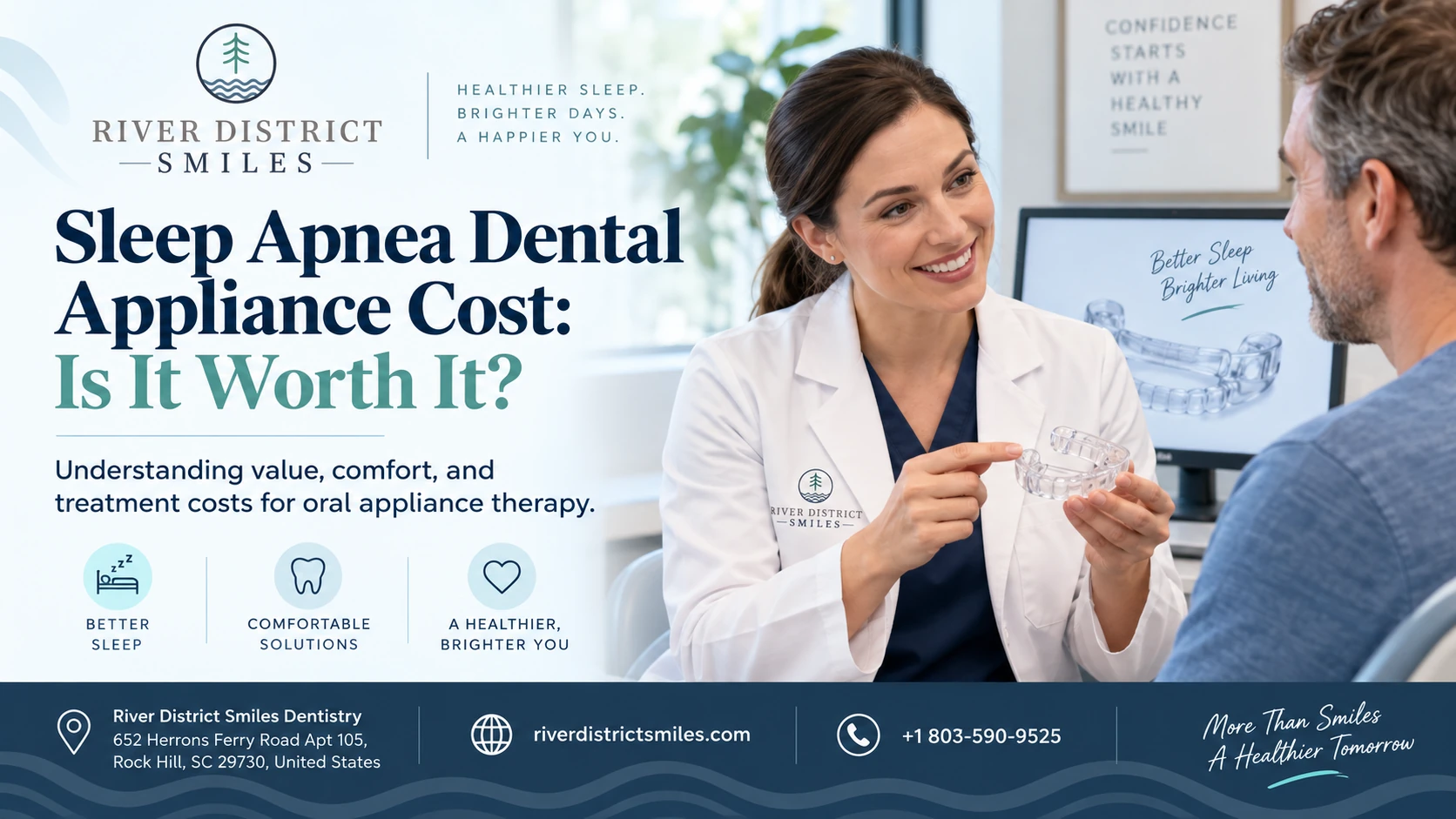
For patients paying without insurance, a custom sleep apnea oral appliance commonly costs approximately $1,500 to $3,000. Some treatment plans cost more depending on the device, examination, records, follow-up adjustments, and whether additional sleep testing is included. This is a general planning range, not River District Smiles’ current fee.
For the right patient, it can be worth the cost especially when the appliance is comfortable enough to wear consistently and follow-up testing confirms that it is controlling the sleep apnea.
It may not be worth it when:
- You have not received a proper sleep apnea diagnosis
- You are buying a generic anti-snoring mouthguard online
- The appliance is not appropriate for your type or severity of sleep apnea
- Your teeth or jaw cannot support it comfortably
- No one plans to adjust it or verify whether it is working
- You expect it to cure sleep apnea permanently
The value is not determined only by the price of the device. It depends on whether the appliance actually improves your breathing while you sleep.
Sleep Apnea Appliance Cost at a Glance
| Cost or decision factor | What patients should know |
| Custom oral appliance | Commonly about $1,500–$3,000 without insurance |
| Sleep study | May be a separate medical expense |
| Dental examination and records | May be included or billed separately |
| Follow-up adjustments | Sometimes included for a defined period |
| Follow-up sleep testing | May be billed separately |
| Medical insurance | May cover part of treatment when requirements are met |
| Dental insurance | Often does not cover treatment for diagnosed sleep apnea |
| Replacement appliance | Usually a future separate expense |
| Over-the-counter mouthguard | Less expensive, but not equivalent to custom treatment |
When reviewing an estimate, ask whether it covers the entire course of treatment or only the appliance itself.
What Is a Sleep Apnea Dental Appliance?
A sleep apnea dental appliance is a device worn over the teeth while you sleep.
The most common type is a mandibular advancement device. It holds the lower jaw slightly forward, which helps reduce the chance that the jaw and tongue will move backward and obstruct the upper airway. Other designs may help hold the tongue forward.
A custom appliance is made to fit your teeth and bite. Many designs are adjustable, meaning the jaw position can be changed gradually until the dentist finds a balance between airway improvement and comfort.
It should not be confused with:
- A sports mouthguard
- A night guard for tooth grinding
- A retainer
- A generic boil-and-bite anti-snoring device
- An appliance intended to permanently change an adult jaw
Each of these devices has a different purpose.
What Are You Paying For?
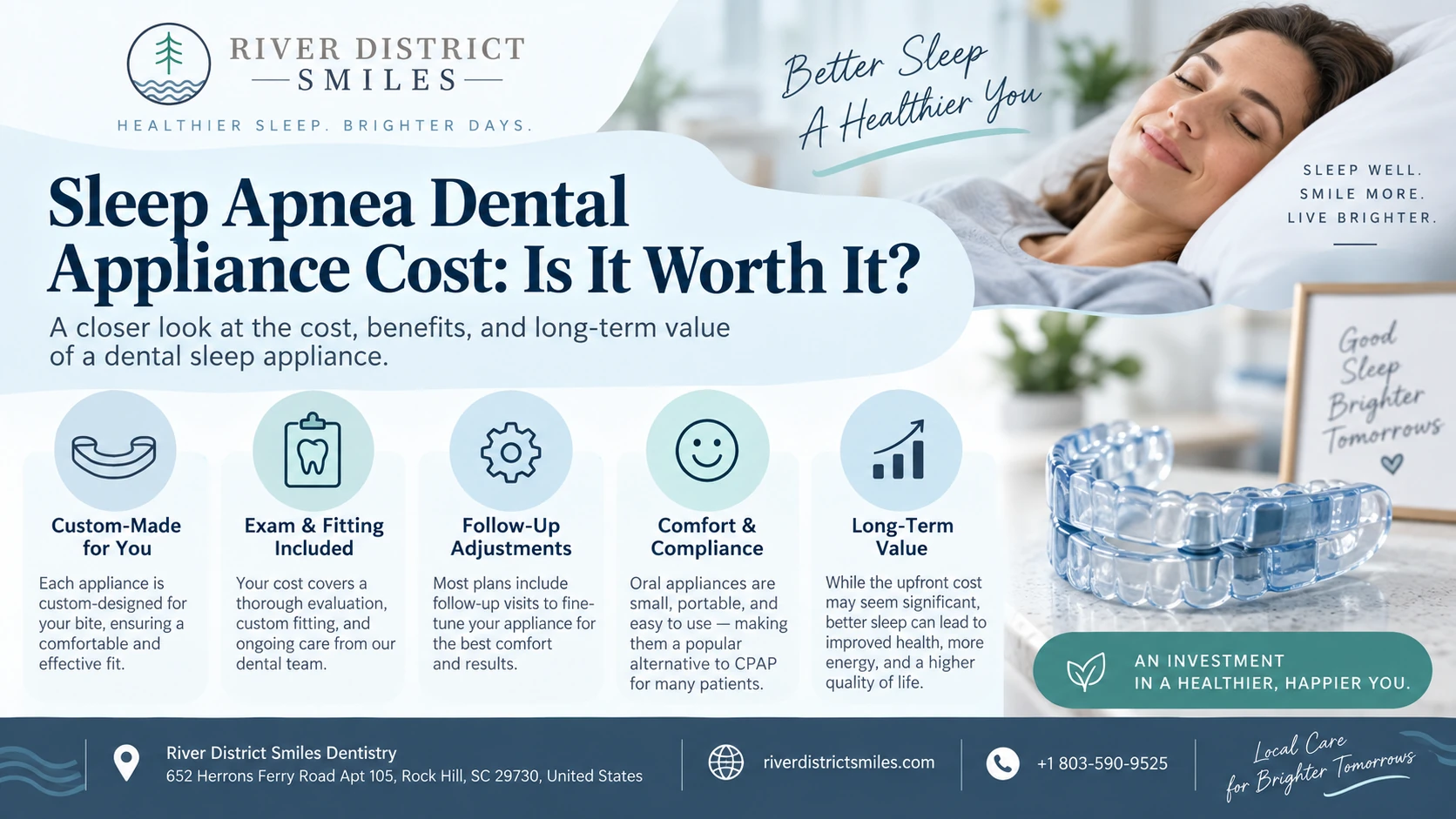
The price of oral appliance therapy usually involves more than the plastic or acrylic device.
1. A proper sleep apnea diagnosis
A dentist can screen for possible sleep apnea, discuss symptoms, and evaluate whether your mouth may be suitable for an appliance.
The actual diagnosis and severity assessment generally require medical evaluation and a sleep study. A sleep study can help distinguish obstructive sleep apnea from other sleep disorders and show how frequently breathing events occur.
This distinction matters because an oral appliance is designed primarily to help with obstructive sleep apnea. It is not intended to treat central sleep apnea, in which breathing interruptions occur because the brain does not consistently send the appropriate signals to breathe.
If you have not been diagnosed, the first step should not be purchasing a mouthguard. It should be determining what is happening while you sleep.
2. A dental and jaw examination
Before making an appliance, the dentist needs to evaluate whether your mouth can support it.
The examination may include:
- The number and stability of your teeth
- Existing crowns, bridges, or implants
- Gum and bone health
- Tooth decay
- Jaw-joint comfort and movement
- Muscle tenderness
- Your bite
- Previous dental treatment
- Your ability to move the lower jaw forward
- Signs of grinding or clenching
A patient with loose teeth, active gum disease, significant untreated decay, or certain jaw-joint problems may need dental care before oral appliance treatment or may need a different sleep apnea option.
3. Digital scans or impressions
A custom device must fit closely over the teeth.
The dentist may use digital scans or traditional impressions, along with bite records showing the relationship between the upper and lower jaws. These records are sent to a dental laboratory or appliance manufacturer.
The cost of these records may be included in the total fee or shown separately.
4. The custom appliance
Custom oral appliances cost more than generic mouthguards because they are fabricated for one patient and designed for controlled jaw positioning.
Professional guidelines recommend a custom, titratable appliance over a non-custom device when oral appliance therapy is prescribed for an adult with obstructive sleep apnea. Custom adjustable appliances generally provide better control and allow the dentist to make gradual changes rather than placing the jaw in one fixed position.
The appliance fee may also reflect:
- The specific design selected
- Laboratory fabrication
- FDA clearance for the intended use
- Appliance materials
- Adjustability
- Warranty terms
- Repair or remake policies
Ask which appliance is being recommended and why it fits your situation.
5. Delivery and fitting
When the appliance returns from the laboratory, the dentist checks:
- How securely it fits
- Whether it creates painful pressure
- Whether you can insert and remove it
- Whether your jaw can tolerate the starting position
- Whether your bite returns to normal after removal
- How to clean and store the device
You should also receive instructions on how long to wear it, how adjustments will be made, and what symptoms should prompt a call.
6. Gradual adjustments
A sleep apnea appliance is not always delivered in its final position.
The lower jaw is often advanced gradually. Moving it too little may not improve the airway enough. Moving it too far or too quickly may cause tooth soreness, jaw pain, muscle fatigue, or difficulty chewing.
The goal is to find a position that improves breathing while remaining comfortable enough for nightly use.
Medicare’s billing rules for the custom oral-appliance code include fitting and adjustment in the appliance service, but commercial insurance contracts and private-pay packages may handle follow-up differently.
Ask how many adjustment visits are included and how long the included follow-up period lasts.
7. Follow-up sleep testing
Feeling less tired or hearing less snoring is encouraging, but it does not prove that sleep apnea is adequately controlled.
Professional guidelines recommend follow-up sleep testing to confirm treatment effectiveness. Periodic visits with both the dentist and sleep physician are also recommended.
Follow-up testing may involve:
- An at-home sleep apnea test
- An in-laboratory sleep study
- Testing with the appliance in place
- Additional adjustment based on the results
Ask whether follow-up testing is included in the dental estimate or billed through a separate medical provider.
Why Can One Appliance Cost More Than Another?
Several factors can change the price.
The appliance design
There are multiple custom appliance designs. They differ in thickness, adjustment mechanisms, materials, durability, and how much room they allow for jaw movement.
The most expensive appliance is not automatically the best. The right design depends on your teeth, bite, jaw movement, grinding habits, comfort needs, and the dentist’s clinical judgment.
The complexity of your bite
A straightforward case may require fewer records and adjustments.
Someone with significant dental work, a limited range of jaw movement, an uneven bite, or previous jaw-joint problems may require more planning and follow-up.
The number of follow-up visits
Some fees include a defined period of adjustments and monitoring. Other offices charge for individual visits after the appliance is delivered.
A lower appliance price can become less attractive if most follow-up care is billed separately.
Testing and medical coordination
The dental office may need to coordinate with:
- A primary care provider
- A sleep physician
- A sleep-testing company
- A medical insurance carrier
- A durable medical equipment administrator
Treatment involving prior authorization, medical records, and insurance documentation can be more administratively complex than making a traditional dental night guard.
Repairs, remakes, and warranties
Ask what happens if:
- The appliance breaks
- A component wears out
- Your bite changes
- You receive a new crown
- You lose the device
- Your teeth shift
- The appliance no longer fits
A warranty may cover certain manufacturing problems, but it usually does not cover every reason an appliance might need to be replaced.
Does Medical Insurance Cover a Sleep Apnea Appliance?
Medical insurance not dental insurance is usually the more relevant coverage for an appliance prescribed to treat obstructive sleep apnea.
Coverage commonly depends on:
- A documented diagnosis
- A qualifying sleep study
- An order or prescription from an appropriate medical provider
- The severity of the sleep apnea
- Whether the appliance and provider meet the insurer’s requirements
- Whether prior authorization is obtained
- Whether the dentist is enrolled or in network
- Your medical deductible and coinsurance
Do not assume that coverage is guaranteed simply because the appliance is medically necessary.
Before treatment, ask the office to clarify:
- Which insurance policy will be billed?
- Is the dentist in network with that medical plan?
- Is prior authorization required?
- Has the appliance benefit been verified?
- Does your deductible apply?
- What is your estimated coinsurance?
- Are sleep testing and dental follow-up separate claims?
- What will you owe if the insurer denies the claim?
An insurance estimate is not a guarantee of payment. The carrier makes the final decision after reviewing the claim and supporting records.
Does Medicare Cover Oral Appliance Therapy?
Medicare may cover a custom mandibular advancement appliance under its durable medical equipment benefit when specific conditions are satisfied.
Current Medicare criteria include an in-person clinical evaluation before testing, a qualifying Medicare-covered sleep study, an order after the sleep-test report has been reviewed, and provision and billing by a licensed dentist. Additional requirements apply based on the apnea-hypopnea index and, in severe cases, whether PAP therapy cannot be tolerated or is contraindicated.
Medicare generally does not consider a prefabricated oral appliance medically necessary for treating obstructive sleep apnea under this policy.
Coverage can still depend on:
- Whether the dentist is an approved supplier
- Documentation
- Your deductible
- Medicare-approved payment limits
- Assignment status
- Secondary coverage
Patients with Medicare should ask whether the dental office can submit the appliance under the applicable durable medical equipment rules.
Oral Appliance vs. CPAP: Which Is the Better Value?
CPAP and oral appliance therapy keep the airway open in different ways.
CPAP provides pressurized air through a mask. An oral appliance helps hold the jaw or tongue in a position that reduces airway obstruction.
| Oral appliance | CPAP |
| Small and portable | Requires a machine, mask, and tubing |
| Does not normally require electricity | Requires electricity or battery power |
| Quiet | Produces some machine and airflow noise |
| May be easier for some patients to wear | Often provides stronger control of breathing events |
| Can cause tooth, bite, or jaw changes | Can cause mask discomfort, dryness, congestion, or air leakage |
| Requires dental follow-up | Requires sleep-medicine and equipment follow-up |
| No regular masks or filters | Supplies need periodic replacement |
| May not control every case adequately | Can treat a broad range of OSA severity |
PAP remains the most common sleep apnea treatment. Oral appliances may be prescribed when a patient does not want to use CPAP, cannot tolerate it, or prefers an alternative after discussing the options with a healthcare provider.
CPAP may appear less expensive at first, but comparison is not always simple. Depending on insurance, CPAP costs can include:
- The machine
- Rental or purchase terms
- Masks
- Tubing
- Filters
- Humidifier components
- Replacement supplies
- Follow-up visits
An oral appliance usually has a higher up-front cost but fewer routine supplies.
The best value is not necessarily the device with the lowest initial price. It is the treatment that adequately controls your sleep apnea and that you can use consistently.
Who Is Most Likely to Find an Oral Appliance Worth It?
An appliance may offer good value when:
- You have medically diagnosed obstructive sleep apnea
- Your sleep physician considers oral appliance therapy appropriate
- You cannot tolerate CPAP
- You prefer an alternative to CPAP
- You travel frequently
- You want a quiet treatment without hoses or a mask
- Your teeth and gums can support the device
- You are willing to attend adjustment and follow-up visits
- You will complete follow-up sleep testing
- You understand that ongoing monitoring is necessary
Clinical guidelines recommend considering oral appliance therapy for adults with obstructive sleep apnea who cannot tolerate CPAP or prefer an alternative treatment.
When Might It Not Be the Best Fit?
An appliance may not be the best first choice when:
You have central sleep apnea
Mandibular advancement appliances are intended for obstructive airway problems, not central apnea.
You have severe untreated dental problems
Loose teeth, significant gum disease, untreated decay, or unstable restorations may need attention before an appliance can be worn safely.
You have certain jaw-joint conditions
An appliance holds the jaw forward for several hours. Patients with active jaw-joint pain, limited movement, or certain joint disorders may need additional evaluation.
Your sleep apnea is severe
Some patients with severe obstructive sleep apnea can be treated with an oral appliance, particularly when PAP cannot be tolerated. However, the decision should involve a sleep physician, and follow-up testing is especially important.
Under current Medicare criteria, patients with an AHI or RDI above 30 generally need documentation that PAP cannot be tolerated or is contraindicated before the appliance qualifies for coverage.
You expect it to cure the underlying tendency
An oral appliance controls airway obstruction while it is being worn. It does not permanently eliminate every anatomical, weight-related, muscular, or medical contributor to sleep apnea.
You are unwilling to complete follow-up care
An appliance that fits comfortably but does not control the breathing events is not a successful treatment.
Why Not Buy a Cheap Mouthguard Online?
A generic anti-snoring device may cost far less than a professionally managed custom appliance.
That does not make it equivalent.
A non-custom product may:
- Fit poorly
- Place uneven pressure on the teeth
- Move the jaw too far or not far enough
- Worsen jaw discomfort
- Cause tooth movement
- Fail to control sleep apnea
- Reduce snoring while breathing interruptions continue
- Delay proper diagnosis and treatment
Professional guidelines favor custom, adjustable appliances for diagnosed obstructive sleep apnea.
The FDA identifies potential risks from intraoral sleep devices including tooth or gum soreness, jaw-joint problems, difficulty breathing through the mouth, and tooth movement.
There is also an important distinction between a device cleared for simple snoring and one intended for diagnosed obstructive sleep apnea. Read the intended use carefully rather than assuming every anti-snoring mouthpiece treats the same condition.
What Side Effects Can Occur?
Most patients need an adjustment period.
Early side effects may include:
- Increased saliva
- Dry mouth
- Tooth tenderness
- Gum irritation
- Jaw-muscle soreness
- Morning bite changes
- Difficulty chewing immediately after removal
Longer-term changes can include:
- Tooth movement
- Changes in the bite
- Changes in jaw position
- Wear or damage to dental restorations
- Jaw-joint symptoms
Qualified dental oversight is recommended so these changes can be identified and managed.
Some morning bite changes are temporary. A dentist may recommend exercises or a morning repositioning device to help the teeth settle back into their usual contact.
Persistent pain or bite changes should not simply be ignored.
How Long Does a Sleep Apnea Appliance Last?
Appliance life varies based on:
- The device material
- Grinding or clenching
- Cleaning habits
- How often it is worn
- Changes to the teeth
- Repairs
- Weight or treatment changes
- Manufacturer warranty terms
A patient who grinds heavily may wear through parts of an appliance sooner. Major dental treatment such as crowns, bridges, implants, or tooth loss may also change the fit.
Ask:
- How long this specific appliance usually lasts
- Which parts can be replaced
- What the warranty covers
- What a repair costs
- What a replacement costs
- Whether insurance limits replacement frequency
The annual cost may be reasonable when a well-maintained appliance lasts several years, but that should not be assumed without understanding the particular device and warranty.
Is It Worth It for Snoring Without Sleep Apnea?
Possibly, but snoring should not be treated casually until obstructive sleep apnea has been ruled out.
Snoring may occur without sleep apnea, but it can also be a sign of repeated airway obstruction. A reduction in sound does not necessarily mean that breathing and oxygen levels are normal.
Guidelines recommend that primary snoring be diagnosed by a sleep physician rather than assumed by a dentist or patient, because snoring frequently occurs alongside obstructive sleep apnea.
Once sleep apnea has been ruled out, an oral appliance may be an option for primary snoring. The value then depends on comfort, effectiveness, side effects, and how much the snoring is affecting sleep or relationships.
What Happens If Sleep Apnea Is Not Treated?
Untreated sleep apnea can affect more than snoring.
Repeated breathing interruptions can fragment sleep and contribute to daytime fatigue, difficulty concentrating, and reduced alertness. Research supported by the National Heart, Lung, and Blood Institute also associates sleep apnea with increased risks involving high blood pressure, heart disease, diabetes, and stroke.
That does not mean every person who snores has sleep apnea or will develop these conditions.
It does mean that cost comparisons should include the value of obtaining an accurate diagnosis and using a treatment that can be verified not simply buying the least expensive mouthpiece.
Questions to Ask Before Paying for an Appliance
Before beginning treatment, ask:
- Do I have a confirmed diagnosis of obstructive sleep apnea?
- How severe is it?
- Why is an oral appliance appropriate for me?
- Should I try CPAP first?
- Which appliance are you recommending?
- Is it custom and adjustable?
- Is the device cleared for treating obstructive sleep apnea?
- What does the quoted price include?
- Are scans, delivery, and adjustments included?
- How many follow-up visits are included?
- Is follow-up sleep testing included?
- Will medical insurance be billed?
- What is my estimated out-of-pocket cost?
- What happens if the device does not work?
- What side effects should I watch for?
- How will you monitor changes in my bite?
- How long is the appliance expected to last?
- What does repair or replacement cost?
A good consultation should explain the full treatment process not simply show you a device.
The Bottom Line
A custom sleep apnea dental appliance commonly costs approximately $1,500 to $3,000 without insurance, although the complete price may be higher when sleep testing, additional examinations, or extended follow-up are billed separately.
For many patients, the appliance is worth considering when:
- Obstructive sleep apnea has been properly diagnosed
- CPAP is difficult to tolerate or an alternative is preferred
- The teeth and jaw can support the device
- A custom adjustable appliance is used
- Follow-up adjustments are provided
- Sleep testing confirms that treatment is working
It is less likely to be a good investment when someone buys a generic snoring mouthguard without a diagnosis or receives a custom device without proper monitoring.
River District Smiles provides oral appliance therapy for patients in Rock Hill who are dealing with snoring, interrupted sleep, morning headaches, and other possible sleep apnea symptoms. The practice’s role includes evaluating the mouth and jaw, providing a personalized appliance when appropriate, and helping patients understand how dental treatment fits into their broader sleep care.
The next step is not deciding whether a mouthguard sounds more convenient than CPAP. It is finding out which type of sleep apnea you have, how severe it is, and whether a custom appliance can control it predictably.
A treatment is worth paying for when it is comfortable enough to use and testing shows that it is actually protecting your breathing.