


Most people who grind their teeth at night do not know they are doing it.
You may never hear the sound. You may sleep alone, or your partner may be a heavy sleeper. In many cases, the first clue is not the grinding itself. It is waking with a tight jaw, noticing that your teeth feel sensitive, or learning during a dental examination that your enamel is wearing down.
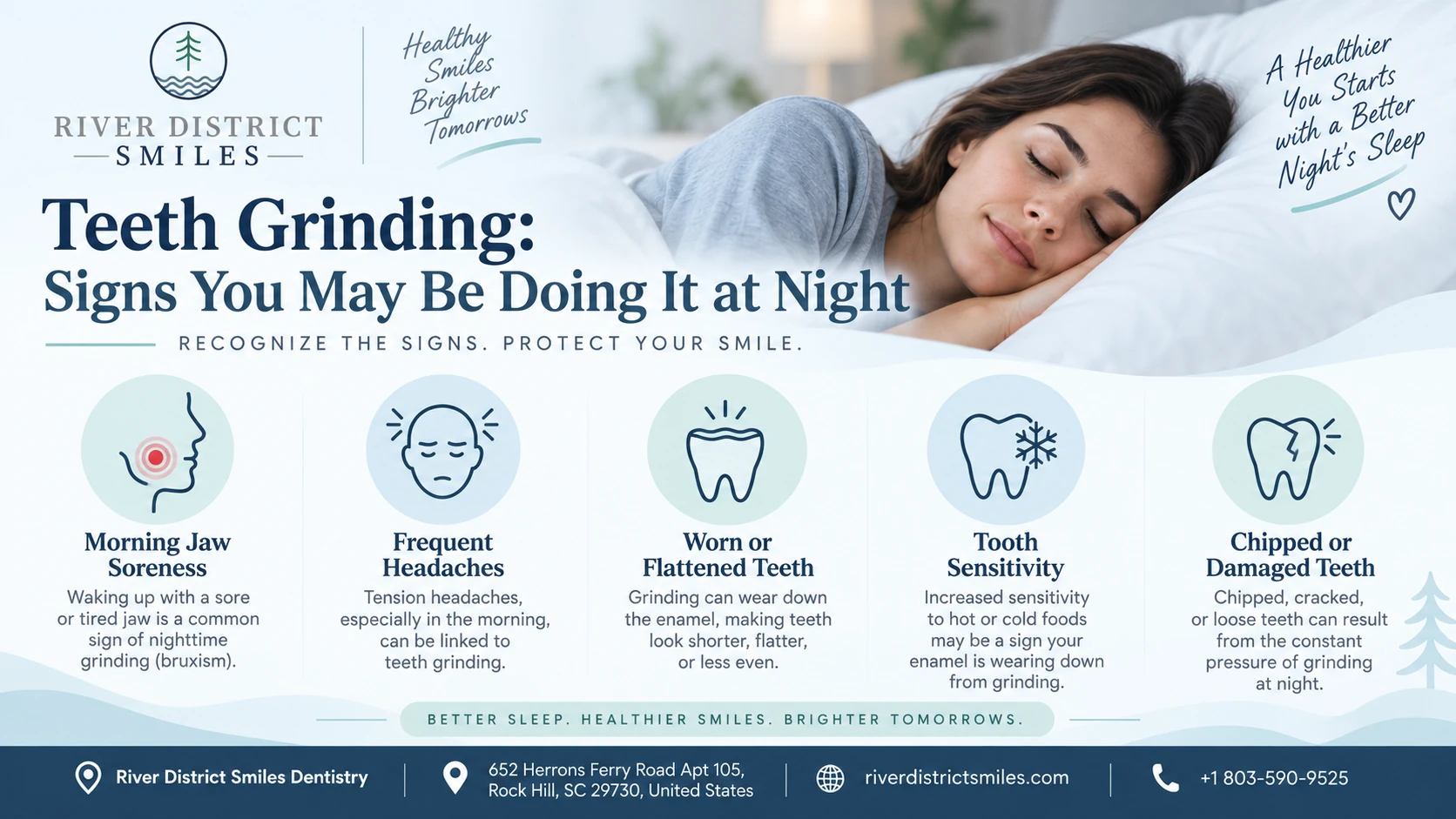
The most common signs of nighttime teeth grinding include morning jaw soreness, dull headaches, worn or flattened teeth, unexplained chips, tooth sensitivity, and repeated damage to fillings or crowns.
One of these signs alone does not prove that you grind. Tooth wear, jaw pain, and headaches can have several causes. But when several signs occur together particularly when they are strongest in the morning, sleep bruxism becomes more likely.
Bruxism is the medical term for grinding, clenching, or forcefully holding the teeth together. It can happen while you are awake or asleep. Mild or occasional grinding may not require treatment, but frequent or forceful bruxism can damage teeth and contribute to jaw pain, muscle fatigue, and headaches.
Signs of Nighttime Teeth Grinding at a Glance
| What you notice | Why grinding may be involved |
| Jaw feels tight or tired when you wake | Chewing muscles may have remained active overnight |
| Dull morning headaches | Temple muscles involved in chewing may be overworked |
| A partner hears grinding sounds | This is one of the clearest clues, although not everyone makes noise |
| Teeth look shorter or flatter | Repeated tooth-to-tooth contact can wear enamel |
| Small chips or cracks keep appearing | Grinding places repeated pressure on weakened areas |
| Teeth have become more sensitive | Enamel wear or small fractures may expose sensitive tooth structure |
| Fillings, crowns, or bonding keep breaking | Dental work may be carrying excessive force |
| Jaw or ear area feels sore | Chewing muscles and tissues near the jaw joint may be irritated |
| Symptoms are worse during stressful periods | Stress can increase awake clenching and may contribute to bruxism |
| Loud snoring, gasping, or daytime sleepiness also occur | A sleep-breathing problem should be considered |
These signs can help guide the conversation, but they are not a diagnosis. Jaw pain, tooth sensitivity, headaches, and broken restorations may also result from cavities, cracked teeth, gum disease, joint disorders, infections, or other medical conditions.
1. Your Jaw Feels Tight in the Morning
Morning jaw tightness is one of the most common clues that your chewing muscles were working while you slept.
You may notice:
- Tired or heavy jaw muscles
- Tenderness along the cheeks
- Soreness near the temples
- Difficulty opening comfortably at first
- A feeling that you were “chewing all night”
- Temporary stiffness that improves as the morning continues
The masseter muscles along the sides of the jaw and the temporalis muscles at the temples are responsible for closing the teeth together. Repeated clenching can fatigue these muscles in much the same way that holding any other muscle contracted for a long period can make it sore.
NIDCR lists jaw-muscle soreness, tightness, and tiredness among the recognized symptoms of bruxism.
Morning soreness does not automatically mean you are grinding. Jaw pain may also come from a tooth problem, sinus pressure, arthritis, trauma, gum disease, or a temporomandibular disorder. A dental examination is useful when the symptoms continue or keep returning.
2. You Wake With a Dull Headache
Nighttime grinding may contribute to headaches around the temples, forehead, or sides of the head.
These headaches are often described as:
- Dull rather than sharp
- Tight or pressure-like
- Strongest shortly after waking
- Accompanied by tender temples
- Associated with jaw fatigue or facial soreness
The temporalis muscles are located on both sides of the head and help close the jaw. When those muscles remain active for extended periods, they may become tender and contribute to head pain.
Headache and facial pain are both listed among the possible symptoms of bruxism.
However, not every morning headache is dental. Sleep apnea, migraine, medication effects, dehydration, sinus conditions, poor sleep, and other medical problems can cause similar symptoms.
Dental treatment should not be presented as a guaranteed cure for headaches unless the examination supports a dental or muscle-related cause.
3. Someone Hears You Grinding
A partner or family member may hear scraping, tapping, or crunching sounds while you sleep.
This is useful information because you may have no memory of the episodes. NIDCR notes that a sleeping partner may be the person who first reports nighttime grinding.
Still, the absence of noise does not rule it out.
Some people grind their teeth back and forth loudly. Others clench without producing much sound. Quiet clenching can still place significant pressure on the teeth, restorations, muscles, and jaw joints.
When possible, ask your partner whether they notice:
- Grinding sounds
- Repeated jaw movements
- Snoring
- Gasping or choking
- Pauses in breathing
- Restless sleep
The breathing information is important because grinding can sometimes occur alongside a sleep-related breathing disorder.
4. Your Teeth Look Flat, Short, or Worn
Repeated grinding can gradually remove enamel from the biting edges and chewing surfaces.
A dentist may notice:
- Flattened chewing surfaces
- Matching wear patterns on opposing teeth
- Shortened front teeth
- Thin or uneven enamel edges
- Small cracks in the enamel
- Yellowing as the underlying dentin becomes more visible
- Sharp edges that have become smooth over time
NIDCR identifies flattened teeth and worn enamel as common signs of bruxism. Severe wear may expose the inner layers of the tooth.
Patients sometimes assume worn teeth are simply part of getting older. Some gradual wear is expected over a lifetime, but rapid, uneven, or advanced wear deserves evaluation.
Grinding is not the only possible cause. Teeth may also wear because of:
- Acid reflux
- Frequent acidic drinks
- Certain eating disorders
- Aggressive brushing near the gumline
- A rough opposing restoration
- Long-term chewing habits
- A combination of acid erosion and grinding
This distinction matters. A night guard may protect against mechanical pressure, but it will not treat stomach acid or frequent dietary acid exposure.
5. Your Teeth Keep Chipping or Cracking
Grinding does not guarantee that a tooth will fracture, but repeated pressure can expose weak areas.
Risk may be higher in teeth that already have:
- Large fillings
- Existing cracks
- Thin enamel
- Root canal treatment
- Significant wear
- Decay
- Previous trauma
- Large bonded restorations
You may notice tiny enamel chips at first. In other cases, part of a filling, crown, or natural tooth may suddenly break during normal chewing.
River District Smiles notes that treating grinding habits and wearing an appropriate night guard may reduce the risk of future chips in susceptible teeth.
A broken tooth should still be examined individually. The dentist needs to determine whether grinding contributed, whether decay is present, and how deeply the fracture extends.
Call sooner when the tooth is painful, sensitive, bleeding, loose, or interfering with your bite.
6. Your Teeth Have Become Sensitive
Grinding can contribute to sensitivity in several ways.
It may:
- Wear away protective enamel
- Create small cracks
- Damage an existing filling
- Expose deeper tooth structure
- Increase pressure on the tissues supporting a tooth
- Contribute to gumline wear in combination with other factors
Sensitivity may occur with cold drinks, air, sweets, or brushing.
NIDCR includes tooth pain and sensitivity among the signs of bruxism.
Brief sensitivity does not necessarily indicate serious nerve damage. However, one tooth that reacts much more strongly than the others may have a cavity, crack, leaking restoration, or another local problem.
Contact a dentist promptly when sensitivity:
- Lingers after the trigger is gone
- Is getting worse
- Occurs when biting
- Becomes spontaneous or throbbing
- Wakes you from sleep
- Is accompanied by swelling
Sensitive-tooth toothpaste may reduce the symptom, but it will not repair a crack or damaged restoration.
7. Your Dental Work Keeps Breaking
Fillings, crowns, veneers, bonding, bridges, dentures, and implant restorations are designed to tolerate normal function.
Heavy grinding forces may contribute to:
- Chipped bonding
- Cracked porcelain
- Worn denture teeth
- Loose or broken crowns
- Fractured fillings
- Repeated loss of temporary restorations
- Damage to implant-supported teeth
Dental work can fail for many reasons, including decay, material age, fit, design, or changes in the supporting tooth. Repeated breakage in several areas, however, can be a clue that the bite forces need to be evaluated.
A night guard may help protect repaired teeth after the underlying problems have been treated. It does not make a poorly fitting or decayed restoration healthy again.
8. Your Jaw or Ear Area Feels Sore
The jaw joint sits just in front of the ear. Chewing muscles also extend into the temples, cheeks, and areas around the ears.
This is why grinding-related discomfort may feel like:
- An earache without an ear infection
- Pressure in front of the ear
- Tenderness along the jaw angle
- Facial fatigue
- Neck discomfort
- Pain during chewing
The ADA lists jaw tenderness, dull headaches, ear-area symptoms, and neck pain among signs that may occur with grinding.
Jaw pain can also come from a temporomandibular disorder, arthritis, infection, trauma, or a painful tooth. The diagnosis should not be based on location alone.
Painless clicking is common and does not automatically require treatment. Painful clicking, locking, or limited opening deserves evaluation.
9. You Clench During the Day Too
Nighttime grinding and daytime clenching are not the same behavior, but they can occur in the same person.
You may be clenching during the day if you notice your teeth touching while you:
- Work at a computer
- Drive
- Exercise
- Concentrate
- Respond to stress
- Lift something heavy
- Use a phone
- Sleep lightly or rest
Your teeth generally do not need to remain in contact when you are not chewing or swallowing.
A useful resting position is:
- Lips relaxed
- Teeth slightly apart
- Tongue resting gently near the roof of the mouth
- Jaw muscles relaxed
NIDCR recommends reminders, such as phone alerts or notes, to help people notice awake clenching and keep their teeth apart.
Reducing daytime clenching may lessen the total workload on already tired muscles, even if nighttime episodes continue.
10. You Snore, Gasp, or Wake Unrefreshed
Grinding does not mean you have sleep apnea.
However, bruxism and sleep-related breathing problems can occur together. NIDCR notes that sleep bruxism may sometimes be connected with airway activity during sleep and that a sleep study may be recommended when sleep apnea or another sleep disorder is suspected.
Consider discussing sleep evaluation when grinding occurs with:
- Loud, frequent snoring
- Pauses in breathing reported by a partner
- Gasping or choking during sleep
- Morning headaches
- Dry mouth on waking
- Daytime sleepiness
- Trouble concentrating
- Unrefreshing sleep
- High blood pressure
- Frequent nighttime waking
Sleep apnea involves repeated interruptions in breathing during sleep and requires medical diagnosis. Snoring is common among people with sleep apnea, but not everyone who snores has the condition.
A standard night guard protects the teeth. It does not diagnose or treat sleep apnea.
A sleep apnea oral appliance is a different device that positions the jaw to help maintain the airway. River District Smiles specifically distinguishes sleep apnea appliances from night guards because they serve different purposes and are not interchangeable.
Why Do People Grind Their Teeth?
There is rarely one simple cause.
Factors associated with bruxism include:
- Stress or emotional distress
- Anxiety or depression
- Genetics
- Caffeine
- Alcohol
- Smoking
- Certain medications
- Sleep-related conditions
NIDCR notes that some medications used for depression, seizures, or attention deficit hyperactivity disorder may increase the likelihood of bruxism.
Do not stop a prescribed medication because you suspect grinding. Discuss the symptoms with the clinician who prescribed it and with your dentist. The benefits of the medication may outweigh the dental concern, or a supervised adjustment may be possible.
Is stress always the cause?
No.
Stress can contribute, particularly to daytime clenching, but blaming every case on stress oversimplifies the problem.
Some patients grind during calm periods. Others have a family history, medication-related risk, sleep-disordered breathing, or a combination of factors.
Stress management may help, but it should not replace evaluation of damaged teeth, persistent pain, or possible sleep problems.
How Does a Dentist Know You Grind?
A dentist usually begins with your symptoms, dental history, and a physical examination.
The evaluation may include:
- Asking when the symptoms are strongest
- Asking whether anyone hears you grind
- Checking tooth wear patterns
- Looking for chips and cracks
- Examining fillings and crowns
- Evaluating tooth sensitivity
- Checking jaw-muscle tenderness
- Examining jaw movement
- Assessing painful or heavy bite contacts
- Looking for gum recession or damaged tooth structure
- Reviewing medications and health history
- Asking about sleep quality, snoring, caffeine, alcohol, and smoking
NIDCR describes the diagnosis as a combination of medical history and examination of the teeth, restorations, jaw, and facial muscles.
The dentist may take X-rays when a cracked tooth, infection, decay, or another dental condition needs to be ruled out. X-rays do not directly show every grinding episode, but they help identify other causes of pain and assess damaged teeth.
Do You Need a Sleep Study?
Not everyone who shows tooth wear needs a sleep study.
A sleep study may be appropriate when:
- The diagnosis remains uncertain
- Significant sleep symptoms are present
- A partner reports breathing pauses or gasping
- Sleep apnea is suspected
- Grinding is severe despite appropriate dental care
- Another sleep-related movement disorder is being considered
- Objective confirmation would change the treatment plan
During polysomnography, sensors record functions such as brain activity, muscle activity, heart rate, and breathing. Audio or video may also be used to evaluate nighttime behaviors.
A dentist may screen for sleep-related concerns, but obstructive sleep apnea requires appropriate medical or sleep-medicine evaluation.
What Can a Night Guard Do?
A night guard is worn over the teeth while you sleep.
Its main purpose is to:
- Keep the upper and lower teeth from directly contacting
- Reduce wear on natural enamel
- Protect fillings, crowns, veneers, and other restorations
- Distribute pressure across the appliance
- Reduce damage if grinding continues
NIDCR describes mouth guards as appliances that separate the teeth to prevent damage and that may reduce some muscle activity.
A guard is protective equipment. It is not always a cure for the behavior.
You may continue activating the jaw muscles while wearing it. The difference is that the guard takes much of the direct wear instead of the teeth.
What a Night Guard Cannot Do
A night guard does not automatically:
- Stop every grinding episode
- Treat an infected tooth
- Repair a crack
- Eliminate every headache
- Cure a jaw-joint disorder
- Treat sleep apnea
- Remove the need to manage daytime clenching
- Correct every bite problem
- Replace evaluation of medication or sleep factors
This is why simply ordering a guard without examining the teeth and discussing the symptoms may miss the real problem.
Custom Night Guard vs. Store-Bought Guard
Over-the-counter guards are less expensive and may be reasonable as a short-term option for some patients.
However, they may:
- Feel bulky
- Fit unevenly
- Fall out
- Create pressure on individual teeth
- Encourage chewing
- Wear through quickly
- Make it difficult to monitor bite changes
- Be unsuitable for extensive dental work
A custom guard is made from scans or impressions of your teeth. The dentist can evaluate its fit, thickness, bite contacts, comfort, and effect on existing restorations.
The ADA notes that a custom night guard generally provides a closer and more comfortable fit than a store-bought product. It also distinguishes a night guard from a sports mouthguard, which has additional cushioning and is not designed for routine sleep.
A custom guard may be a better fit when:
- Grinding has already damaged teeth
- You have several crowns, veneers, implants, or large fillings
- Jaw symptoms are present
- Store-bought guards are uncomfortable
- Your bite needs to be monitored
- You need long-term protection
When to stop wearing a guard and call the dentist
Contact the office when the guard:
- Makes your pain worse
- Causes one tooth to become sore
- Changes how your teeth fit together after removal
- No longer seats fully
- Cracks or wears through
- Causes gum irritation
- Develops an odor that cleaning does not remove
A guard should be checked periodically because the teeth, dental work, and appliance can change over time.
Will a Night Guard Help Jaw Pain?
It may help some patients, particularly when tooth protection and force distribution are important.
It may not eliminate pain when the primary issue is:
- A cracked or infected tooth
- Arthritis in the joint
- A displaced joint disc
- Neck-related pain
- Migraine
- A sleep-breathing disorder
- Persistent daytime clenching
- Another medical condition
A guard should be viewed as one part of a plan rather than proof that every symptom is caused by grinding.
When jaw pain is the main concern, conservative care may also include temporary diet changes, avoiding gum chewing, heat, physical therapy, posture work, or other treatment based on the diagnosis.
Can You Stop Grinding Naturally?
There is no guaranteed home method that permanently stops sleep bruxism.
There are still several useful steps.
Notice daytime clenching
Set reminders to check whether your teeth are touching. Relax the jaw when you catch yourself clenching.
Protect your sleep schedule
Consistent sleep and adequate rest may help overall sleep quality. NIDCR also recommends maintaining a regular sleep schedule as part of managing bruxism.
Review evening caffeine and alcohol
Caffeine and alcohol are among the factors associated with bruxism. Reducing them particularly later in the day may help some patients.
Avoid tobacco
Smoking is also associated with bruxism and affects oral health in several other ways.
Use relaxation strategies
Meditation, counseling, exercise, breathing exercises, and other stress-management approaches may be useful when tension contributes to awake clenching or poor sleep.
Do not repeatedly “test” your bite
Patients with jaw or tooth discomfort sometimes bite down over and over to determine whether the symptom is still present.
Repeated testing can keep the muscles and tooth-supporting tissues irritated.
What Happens If Grinding Is Not Treated?
Mild or occasional grinding may never cause meaningful damage.
Frequent or forceful grinding can contribute to:
- Progressive enamel wear
- Tooth sensitivity
- Chipping
- Cracking
- Loose teeth
- Jaw-muscle fatigue
- Facial pain
- Headaches
- Damage to fillings, crowns, and other restorations
NIDCR specifically identifies damaged teeth, pain, muscle tiredness, and headaches as possible consequences of severe bruxism.
The financial effect can also grow over time. A guard and monitoring may be less costly than repeatedly repairing fractured bonding, fillings, crowns, or severely worn teeth.
That does not mean everyone with minor wear needs an appliance. Treatment makes the most sense when there is evidence of active damage, symptoms, or meaningful risk.
Does Grinding Mean Your Bite Is Wrong?
Not necessarily.
Teeth do not need to be perfectly straight or contact with perfect symmetry to function comfortably. Bruxism is influenced by several biological, behavioral, genetic, medication-related, and sleep-related factors.
A specific bite problem may still matter when:
- A new crown or filling contacts too heavily
- One tooth hurts under pressure
- A broken tooth has changed how you chew
- Tooth loss has concentrated force in another area
- A restoration interferes with normal jaw movement
That is different from broadly reshaping healthy teeth because someone grinds.
Permanent bite changes should not be the automatic first treatment for nighttime bruxism. The dentist should be able to identify the specific contact being treated and explain why a reversible option would not be enough.
What About Botox?
Botulinum toxin can temporarily reduce activity in selected chewing muscles and may be considered for certain patients with strong muscle-related symptoms.
It does not protect teeth physically in the same way a guard does, and it is not appropriate for every cause of jaw pain. Effects are temporary, repeat treatment may be necessary, and treatment of bruxism or TMD symptoms may be off-label depending on the specific use.
Before considering it, ask:
- Is the problem primarily muscular?
- Have dental disease and sleep problems been evaluated?
- Will I still need a night guard?
- What result is realistic?
- How long should the effect last?
- What are the possible effects on chewing and facial movement?
- What happens if it does not help?
The diagnosis should come before the injection.
What About Grinding in Children?
Children commonly grind their teeth, and many eventually outgrow the behavior.
The ADA notes that childhood grinding does not always cause serious damage because the teeth and jaws are changing rapidly. Possible contributors may include oral irritation, allergies that affect breathing, or the way the teeth meet.
Discuss it with the child’s dentist when:
- Teeth are visibly wearing down
- The child reports pain
- The jaw is sore
- Teeth are chipping
- Grinding is very loud or frequent
- The child snores or struggles to breathe during sleep
- Sleep is restless
- Daytime behavior or concentration has changed
A night guard is not automatically recommended for every child because teeth are erupting and the bite is developing.
When Should You Call a Dentist?
Arrange an examination when:
- You regularly wake with jaw tightness
- Morning headaches keep returning
- A partner hears grinding
- Teeth look worn or shorter
- Teeth have become sensitive
- Small chips keep appearing
- Dental work repeatedly breaks
- One tooth hurts during biting
- Your jaw movement is limited
- Your bite suddenly feels different
- Symptoms are affecting sleep or eating
- You are considering buying a night guard
Contact the office more promptly when:
- A tooth has cracked significantly
- Pain is severe or worsening
- A tooth becomes loose
- Swelling develops
- You have drainage or a bad taste
- Fever occurs with dental pain
- The jaw locks and cannot open or close normally
Rapid facial or neck swelling that affects breathing or swallowing requires immediate medical attention.
Questions to Ask at Your Appointment
Ask:
- Do you see active grinding damage or only old wear?
- Could acid erosion or another condition be causing the wear?
- Is one tooth cracked or infected?
- Are my fillings, crowns, or implants at risk?
- Do my jaw muscles feel overworked?
- Could daytime clenching be part of the problem?
- Do my symptoms suggest a sleep disorder?
- Should I discuss a sleep study with a physician?
- Would a night guard protect my teeth?
- What type of guard are you recommending?
- Will the guard stop grinding or mainly prevent damage?
- How should the fit be monitored?
- What should I do if it makes the pain worse?
- Do any damaged teeth need repair first?
- What long-term maintenance should I expect?
A good bruxism evaluation should separate active grinding from old wear, tooth disease, acid erosion, jaw-joint problems, and sleep-related concerns.
The Bottom Line
You may be grinding your teeth at night if you regularly notice:
- Morning jaw tightness
- Dull headaches
- Tender temples or cheeks
- Tooth sensitivity
- Flat or worn teeth
- Unexplained chips
- Repeated damage to dental work
- Grinding sounds reported by a partner
Mild grinding does not always need treatment. Frequent or severe bruxism can damage teeth and restorations and contribute to jaw pain, muscle tiredness, and headaches.
A custom night guard may protect the teeth, but it does not necessarily stop the behavior or treat an underlying sleep-breathing problem. Loud snoring, gasping, breathing pauses, or significant daytime sleepiness deserve a broader sleep evaluation.
River District Smiles provides comprehensive dental examinations and protective treatment for patients in Rock Hill with worn, chipped, or damaged teeth. The practice also evaluates jaw symptoms and sleep-related concerns so that a night guard is used for the right reason rather than as a one-size-fits-all solution.
The next step is not trying to catch yourself grinding while you sleep.
It is looking for the evidence left behind on the teeth, dental work, jaw muscles, and quality of your sleep and deciding whether protection or further evaluation is appropriate.