
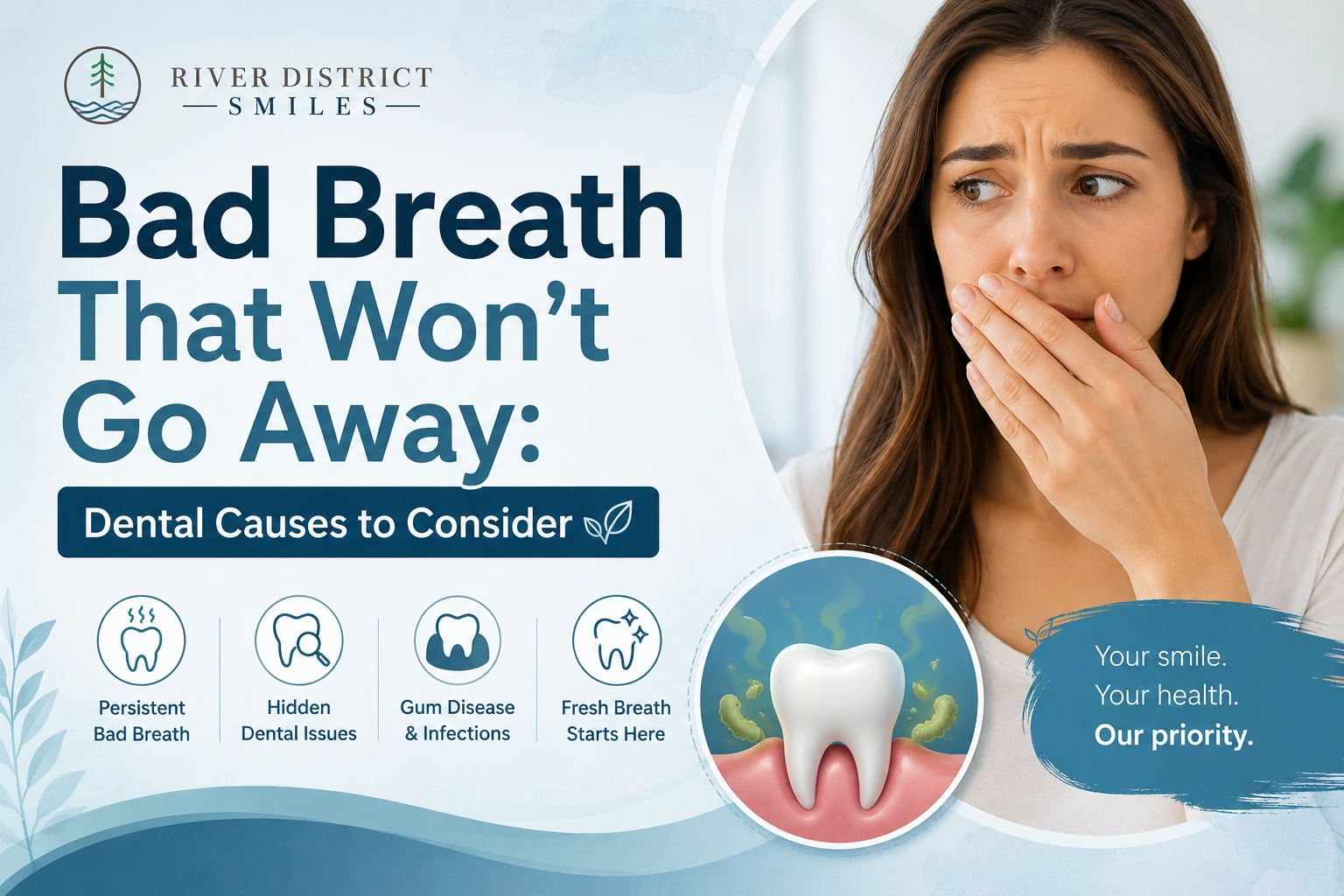


Bad breath after coffee, garlic, or waking up in the morning is usually temporary.
Bad breath that continues to return even after brushing, using mints, or rinsing with mouthwash is different. It may indicate that odor-producing bacteria are collecting somewhere daily cleaning cannot reach. Persistent bad breath may also be associated with gum disease, dry mouth, tooth decay, infection, or another condition that deserves professional attention.
The practical answer is:
When bad breath lasts for more than a few weeks despite consistent brushing, cleaning between your teeth, and cleaning your tongue, schedule a dental examination.
Persistent odor does not automatically mean a serious dental problem is present. It simply means it is time to identify the source instead of continuing to cover the smell temporarily.
The NHS recommends seeing a dentist when bad breath does not improve after several weeks of self-care, particularly when it occurs along with bleeding gums, tooth pain, loose teeth, or problems with dentures.
Bad Breath Could Be a Dental Warning
Ongoing odor may be more than what you ate. Get your oral health checked and address the problem at its source.
What Persistent Bad Breath May Be Telling You
| What You Notice | Possible Dental Cause |
| Thick coating on the tongue | Bacteria and debris collecting on the tongue |
| Bleeding, swollen, or receding gums | Gingivitis or periodontitis |
| Food odor after flossing one area | Food trapping, decay, or a restoration problem |
| Bad taste near one tooth | Decay, infection, or drainage |
| Dry or sticky mouth | Reduced saliva flow |
| Odor around dentures or retainers | Buildup on the appliance or tissue underneath |
| Pain, swelling, or a bump on the gum | Possible dental infection |
| Bad breath that improves briefly after mouthwash | The odor is being covered rather than the cause being removed |
| Persistent odor despite a healthy mouth | A medical, sinus, throat, or digestive cause may need evaluation |
More than one factor can contribute at the same time. Someone may have a coated tongue, mild gum inflammation, and medication-related dry mouth, for example.
Where Does Bad Breath Usually Come From?
Persistent bad breath is often called halitosis.
In many cases, odor develops when bacteria break down food particles, proteins, dead cells, and other material inside the mouth. This process produces odor-causing compounds, including volatile sulfur compounds.
Dental plaque, tongue coating, food trapped between the teeth, and bacteria associated with oral disease may all contribute.
That is why a mint can make your breath smell better for a few minutes while the odor eventually returns. The mint changes the smell temporarily, but it does not remove tartar, bacteria, decay, infection, or a dry-mouth condition that may be responsible for the problem.
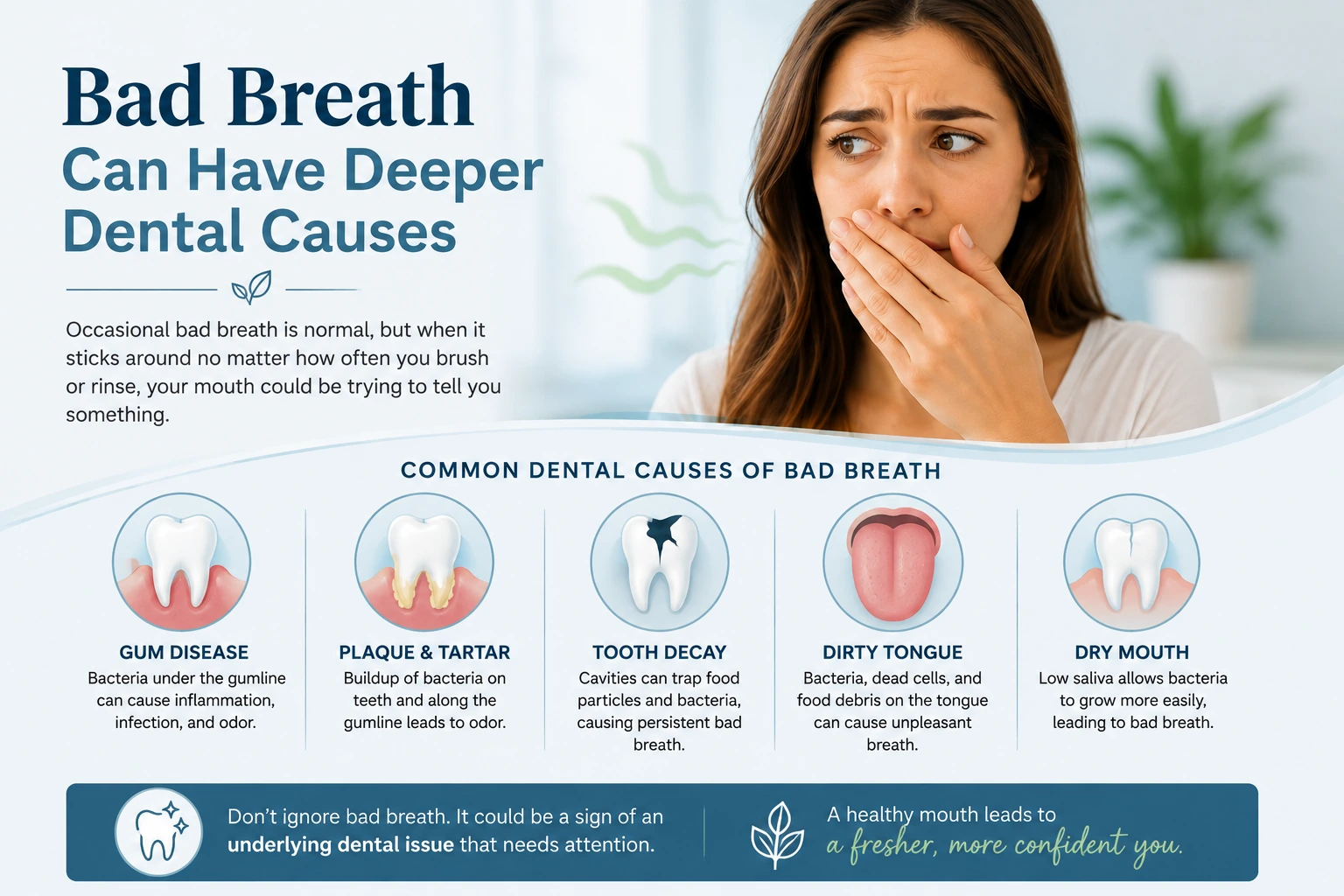
1. Bacteria on the Tongue
The surface of your tongue is not completely smooth.
It contains small grooves and projections where bacteria, mucus, food particles, and dead cells can accumulate. The back portion of the tongue can be particularly difficult to clean and may develop a visible white, yellow, or brown coating.
Tongue coating is one of the common contributors to bad breath that originates in the mouth. Bacteria living within this coating can produce sulfur-containing compounds associated with unpleasant breath.
Clues That the Tongue May Be Involved
- A visible coating is present
- Breath is strongest in the morning
- Your mouth feels dry when you wake up
- Brushing your teeth does not fully improve your breath
- Your breath improves after cleaning your tongue
- You breathe through your mouth while sleeping
Gently clean your tongue once each day using a tongue cleaner, scraper, or soft toothbrush. Avoid scraping so aggressively that the tissue becomes sore or begins to bleed.
The NHS includes daily tongue cleaning, brushing twice each day, and daily cleaning between the teeth among its recommendations for managing persistent bad breath.
A tongue scraper can help reduce buildup, but it cannot correct gum disease, cavities, an abscess, or another underlying oral-health problem.
2. Plaque and Food Between the Teeth
A toothbrush cannot effectively reach every narrow space between your teeth.
When plaque and food remain between teeth, bacteria begin breaking down the trapped material. This can produce an unpleasant smell or taste, particularly when food repeatedly collects in the same location.
You might notice:
- Floss smells unpleasant after passing between certain teeth
- One area bleeds when you floss
- Food regularly becomes stuck between two teeth
- Floss shreds or gets caught
- A crown, bridge, filling, or implant traps food
- There is a persistent unpleasant taste near the back teeth
Daily cleaning between the teeth with floss, interdental brushes, or another appropriate cleaning tool helps remove plaque and food that brushing leaves behind.
The American Dental Association recommends brushing twice daily with fluoride toothpaste and cleaning between the teeth every day.
If one area continues to produce an odor despite careful cleaning, the problem may not simply be your technique. There could be an open contact between teeth, a rough filling edge, decay, or gum inflammation that has created a deeper space requiring professional evaluation.
3. Gingivitis
Gingivitis is the earliest form of gum disease.
Plaque accumulating along the gumline causes the tissue to become inflamed. The gums may appear red, swollen, or tender and may bleed when you brush or floss.
Bad breath can occur even when there is no tooth pain.
Common Signs Include:
- Bleeding while brushing or flossing
- Red or swollen gums
- Tenderness around the gumline
- A persistent bad taste
- Bad breath that quickly returns
- Visible plaque or tartar
Gingivitis can often be reversed when plaque and tartar are removed and home oral hygiene improves.
Professional cleaning may be necessary because hardened tartar cannot be removed effectively with regular brushing or flossing.
Bleeding gums are not a reason to stop cleaning the area. Instead, bleeding is a reason to have the gums evaluated and make sure you are using a gentle but effective cleaning technique.
4. Periodontitis
Periodontitis is a more advanced form of gum disease that affects the tissues and bone supporting the teeth.
As the gums pull away from the teeth, deeper pockets may develop. Plaque, tartar, bacteria, and food can collect inside these spaces, where a toothbrush and ordinary floss may no longer clean effectively.
Persistent bad breath or a constant unpleasant taste can sometimes be an early warning sign.
Other possible signs include:
- Receding gums
- Teeth that appear longer
- Loose or shifting teeth
- New spaces developing between teeth
- Tenderness or discomfort while chewing
- Pus or drainage around the gums
- Changes in how your teeth fit together
- Changes in how a partial denture fits
Gum disease is not always painful. Some patients first recognize that something is wrong because of bleeding gums or bad breath rather than discomfort.
A standard dental cleaning may not be enough if bacterial deposits and tartar have accumulated beneath the gumline. Treatment may involve scaling and root planing, often called a deep cleaning, followed by periodontal maintenance. Advanced cases may require evaluation by a periodontist.
River District Smiles evaluates gum health by looking at inflammation, bleeding, pocket depths, recession, bone changes, and tooth stability. These findings can help determine whether persistent odor is associated with early gingivitis or deeper periodontal disease.
5. Tooth Decay
A cavity may contribute to persistent bad breath when bacteria and food become trapped inside damaged tooth structure.
Very small cavities do not always produce a noticeable odor. Larger cavities, broken teeth, or decay around an older crown or filling may create spaces that trap debris and are difficult to clean at home.
Mayo Clinic lists tooth decay as one possible oral cause of persistent bad breath.
Possible signs of tooth decay include:
- Sensitivity to sweets
- Sensitivity to hot or cold temperatures
- Food collecting repeatedly in one location
- A visible hole or dark area
- Floss catching or tearing
- A broken filling
- A rough tooth or restoration edge
- Persistent unpleasant taste
- Pain while chewing
Mouthwash cannot repair a cavity.
A dentist needs to evaluate the extent of the decay and determine whether the tooth can be restored. Depending on how much healthy tooth structure remains, appropriate care may include a filling, crown, extraction, or another recommended course of treatment.
6. A Loose, Broken, or Leaking Restoration
Dental fillings and crowns do not last forever.
Over time, a restoration may chip, loosen, break, develop an open margin, or become surrounded by new decay. When this occurs, plaque and food can collect in areas that are difficult to reach with a toothbrush or floss.
Warning signs may include:
- Food collecting around a crown
- Floss shredding around a filling
- Sensitivity near previous dental work
- A bad taste from one particular area
- A crown that feels loose
- Pain while biting
- A visible gap, crack, or broken edge
A restoration can appear normal when viewed from above while a problem is developing underneath it or between the teeth.
A dental examination and appropriate X-rays may be necessary to evaluate the area fully.
River District Smiles uses clinical examinations and digital imaging when appropriate to assess decay, infection, gum health, and concerns involving existing dental work.
X-rays are not automatically necessary at every appointment. Their timing depends on your dental history, current symptoms, previous findings, and the condition being evaluated.
7. A Dental Infection or Abscess
A dental infection can sometimes produce a persistent foul smell or unpleasant taste, particularly when fluid is draining through the gum.
An infection may develop when deep decay, a crack, or trauma allows bacteria to reach the inner portion of a tooth. Infection can also occur around a tooth affected by severe periodontal disease.
Possible signs include:
- Persistent or throbbing tooth pain
- Pain while biting
- Swelling near a tooth
- A pimple-like bump on the gum
- Drainage
- A persistent bad taste
- Facial swelling
- Fever
- A tooth becoming darker
- Tender lymph nodes
An abscess can occasionally drain on its own and temporarily feel better. That does not mean the underlying infection has disappeared.
The source still needs to be professionally evaluated. Depending on the condition of the tooth, gums, and surrounding tissues, treatment may involve periodontal care, extraction, medication when appropriate, or referral for additional care.
Contact a dentist promptly if persistent bad breath occurs along with pain, swelling, drainage, or fever.
Rapidly increasing facial or neck swelling, difficulty breathing, or difficulty swallowing requires emergency medical attention.
8. Dry Mouth
Saliva continually helps wash food particles and bacteria away from your teeth and oral tissues.
When saliva production decreases, debris can remain in the mouth longer. Odor-producing bacteria may accumulate more easily, and the risk of cavities and oral infections can increase.
Persistent dry mouth is also known as xerostomia.
Signs of Dry Mouth Include:
- A sticky or dry feeling in your mouth
- Thick or stringy saliva
- Frequent thirst
- Cracked lips
- A dry or burning tongue
- Difficulty swallowing dry foods
- Changes in taste
- Mouth sores
- Persistent bad breath
- Cavities developing more frequently
Dry mouth may be associated with medications, certain medical conditions, dehydration, salivary-gland problems, cancer treatment, and mouth breathing.
The ADA notes that antihistamines, decongestants, certain pain medications, diuretics, and many other medicines may reduce saliva production.
Do not stop taking a prescribed medication without first speaking with the healthcare professional who prescribed it.
Helpful measures may include:
- Drinking water regularly
- Using sugar-free gum or mints when appropriate
- Limiting tobacco use and excessive alcohol
- Using products designed for dry mouth
- Sleeping with a humidifier
- Receiving professional fluoride treatment
- Treating existing cavities or oral infections
- Reviewing medications with your physician or pharmacist
These measures may help support comfort and oral health, but persistent dry mouth still deserves evaluation so its underlying cause can be identified.
9. Mouth Breathing and Snoring
People who breathe through their mouths while sleeping often wake up with a dry tongue and stronger morning breath.
The odor may improve once you drink water, eat, brush your teeth, and normal saliva flow returns.
When bad breath remains throughout the day, however, another cause may also be contributing.
Chronic mouth breathing may be associated with:
- Nasal congestion
- Allergies
- Enlarged tonsils
- Sleep-disordered breathing
- Habitual mouth breathing
- Difficulty breathing comfortably through the nose
A dentist can evaluate the effects of mouth breathing on oral health and look for signs that may suggest sleep-disordered breathing.
Nasal obstruction and other airway concerns may require evaluation by an appropriate medical professional.
10. Dentures, Retainers, Aligners, and Night Guards
Removable dental appliances can collect bacteria, food, plaque, and odor when they are not cleaned thoroughly.
This includes:
- Full dentures
- Partial dentures
- Clear orthodontic aligners
- Retainers
- Night guards
- Sports mouthguards
- Removable sleep-apnea appliances
Dentures should generally be cleaned every day and removed at night unless your dentist has provided different instructions.
Your mouth also needs attention. The gums, cheeks, palate, and tongue should be cleaned regularly rather than focusing only on the appliance.
Clear appliances should be cleaned according to the instructions provided by the dentist and manufacturer.
Brushing your teeth and then immediately placing an unclean appliance back into your mouth allows bacteria and odor-producing buildup to remain.
Contact the dental office when an appliance:
- Develops a persistent odor
- Stops fitting correctly
- Causes sores
- Regularly traps food
- Develops visible cracks or buildup
- Cannot be cleaned adequately
Odor associated with dentures may also originate from inflammation, infection, or debris beneath the appliance rather than from the denture itself.
11. Food Trapped Around Bridges, Implants, or Wisdom Teeth
Some parts of the mouth require specialized cleaning.
Food and plaque may collect:
- Beneath a dental bridge
- Around an implant restoration
- Under an implant-supported denture
- Behind the last molars
- Beneath gum tissue surrounding a partly erupted wisdom tooth
- In spaces created by missing teeth
- Around crowded or rotated teeth
Regular floss may not clean all of these locations effectively.
Depending on the restoration and available space, your dentist or hygienist may recommend floss threaders, interdental brushes, water flossers, or other specialized cleaning tools.
Persistent odor from one specific location should be evaluated.
The issue may simply be difficulty cleaning the area, but it could also involve gum inflammation, tooth decay, loose dental work, an open contact between teeth, or infection.
12. Smoking, Vaping, and Tobacco Use
Tobacco can affect breath directly while also contributing indirectly to conditions that make bad breath more likely.
Smoking and other tobacco use can dry the mouth and increase the risk of gum disease.
Tobacco odor may remain in the mouth, lungs, clothing, and soft tissues. Mouthwash may temporarily cover the smell, but it cannot correct tobacco-related dry mouth or periodontal damage.
The American Dental Association recommends avoiding tobacco in all forms as part of protecting oral and overall health.
Patients should not feel judged for nicotine or tobacco use.
A productive dental conversation focuses on what the dentist is observing, how the habit may be affecting the mouth, and what support is available if and when the patient is ready to reduce or stop using tobacco.
Why Mouthwash May Not Fix Persistent Bad Breath
Mouthwash can be useful, but how much it helps depends on what is causing the odor.
Some mouth rinses primarily cover odors temporarily. Others can help reduce certain bacteria or neutralize compounds that contribute to bad breath.
Neither type can remove hardened tartar, repair a cavity, resolve an abscess, correct a loose crown, or restore normal saliva production.
The ADA describes over-the-counter mouthwash as a temporary approach when an underlying source of bad breath remains.
Prescription antimicrobial rinses may be appropriate for certain periodontal or surgical conditions, but they should be used exactly as directed.
Chlorhexidine, for example, can cause staining of the teeth or tongue and may temporarily change how foods taste.
Using increasingly strong mouthwash without identifying the source of persistent bad breath can delay appropriate treatment while an underlying condition continues to progress.
What You Can Try at Home First
If you do not have significant pain, swelling, loose teeth, or another urgent symptom, begin by following a consistent oral-hygiene routine.
Brush Twice a Day
Use fluoride toothpaste and brush gently for approximately two minutes.
Pay attention to the gumline rather than brushing only the visible and chewing surfaces of the teeth.
Clean Between the Teeth Daily
Use dental floss, interdental brushes, or another cleaning tool appropriate for the spaces between your teeth.
Pay particular attention to areas that bleed, consistently trap food, or cause a noticeable odor on the floss.
Clean the Tongue
Gently clean your tongue from the back toward the front once a day.
Do not scrub hard enough to make the tissue painful or cause bleeding.
Drink Water
Regular hydration may help when temporary dry mouth contributes to bad breath.
Sugar-free chewing gum may also stimulate saliva production for some patients.
Clean Removable Appliances
Clean every surface of dentures, retainers, aligners, night guards, and other removable appliances according to the instructions provided for them.
Remove dentures at night unless your dentist has instructed you otherwise.
Avoid Relying on Mints All Day
Sugary mints can repeatedly expose your teeth to sugar.
Sugar-free products may be a better temporary option, but mints cannot replace diagnosis or professional treatment when an oral-health problem is causing persistent odor.
Track When the Odor Is Strongest
Pay attention to whether your bad breath becomes worse:
- In the morning
- After wearing a removable appliance
- When your mouth feels dry
- After flossing a specific area
- When your gums bleed
- Along with sinus symptoms
- After consuming certain foods
- After alcohol use
- After smoking or using tobacco
This information can help your dentist identify patterns and narrow down possible causes.
How Can You Tell Whether Your Own Breath Smells?
It can be surprisingly difficult to judge your own breath accurately.
People become accustomed to familiar smells over time, making it difficult to recognize persistent odor themselves.
Possible ways to check include:
- Asking a trusted family member or partner
- Smelling floss after cleaning between your back teeth
- Checking your tongue for a visible coating
- Paying attention to a persistent unpleasant taste
- Asking your dentist or dental hygienist directly
There is no reason to feel embarrassed about discussing bad breath during a dental appointment.
Persistent bad breath is a common oral-health concern, and determining where it comes from is a normal part of dental care.
What a Dentist Checks
An evaluation for persistent bad breath may include:
- Reviewing your brushing habits
- Reviewing how you clean between your teeth
- Examining the tongue
- Looking for plaque and tartar
- Measuring periodontal pockets
- Looking for gum bleeding
- Evaluating gum recession
- Checking for cavities
- Examining fillings, crowns, bridges, and implants
- Checking for signs of dental infection or drainage
- Evaluating dentures and other dental appliances
- Reviewing symptoms of dry mouth
- Discussing medications and medical conditions
- Taking X-rays when clinically appropriate
River District Smiles describes its evaluation process as including a medical-history review and an examination of the teeth, gums, and oral tissues for signs of gum disease, tooth decay, and other possible concerns.
The purpose of the appointment is not simply to confirm that your breath smells unpleasant.
The goal is to determine what is producing the odor so an appropriate solution can be recommended.
How Dental Causes Are Treated
Treatment for persistent bad breath depends on its underlying cause.
Plaque and Tongue Coating
Professional dental cleaning, improved home oral care, and gentle daily tongue cleaning may be enough when no deeper dental disease is present.
Gingivitis
Professional cleaning combined with improved brushing and interdental cleaning can often reverse early gum inflammation.
Periodontitis
Treatment may involve scaling and root planing, ongoing periodontal maintenance, localized periodontal therapy, or specialist care when gum disease is advanced.
Tooth Decay
The appropriate treatment depends on how much of the tooth is affected and how much healthy structure remains.
Options may include a filling, crown, extraction, or another treatment recommended after the tooth has been examined.
Dental Infection
The source of a dental infection needs professional treatment.
Antibiotics may be appropriate in certain circumstances, particularly when there are signs that an infection is spreading. Medication alone, however, generally does not permanently correct the source of an infected tooth.
Your dentist can evaluate the affected area, explain the available options, and recommend the appropriate next step or referral when needed.
Dry Mouth
Managing dry mouth may involve:
- Regular hydration
- Products designed to support saliva
- Fluoride treatment
- Medication review
- Treatment of oral disease
- Medical evaluation when appropriate
Appliance Buildup
A denture, retainer, night guard, or other appliance may require professional cleaning, adjustment, repair, replacement, or a different home-care routine.
When Bad Breath May Not Be Dental
The mouth is often the first place to investigate persistent bad breath, but it is not the only possible source.
When a dentist does not find a meaningful oral cause, persistent odor may sometimes be associated with:
- Tonsil stones
- Chronic sinus conditions
- Throat conditions
- Postnasal drainage
- Acid reflux
- Diabetes
- Liver or kidney conditions
- Certain respiratory problems
- Medication-related changes
The ADA recommends consulting an appropriate healthcare provider when dental causes have been ruled out but persistent bad breath continues.
Tonsil stones, sinus infections, throat inflammation, and reflux are examples of non-dental conditions that may contribute to ongoing odor.
This does not mean persistent bad breath usually originates in the stomach.
Beginning with a dental examination is reasonable because the teeth, gums, tongue, saliva, and dental appliances contain many of the most common and treatable causes.
When Should You Call a Dentist?
Schedule an examination if:
- Bad breath continues after several weeks of consistent home care
- The odor returns soon after brushing
- Your gums bleed or appear swollen
- You have a persistent unpleasant taste
- Food repeatedly becomes trapped in one location
- Floss has a strong odor after cleaning one specific area
- Your mouth remains persistently dry
- A denture, retainer, or night guard smells or does not fit properly
- You have a broken tooth, crown, or filling
- A tooth hurts when you bite
- A tooth feels loose
- You notice drainage or a bump on the gum
The NHS specifically recommends dental evaluation when persistent bad breath occurs with painful, bleeding, or swollen gums, toothache, loose adult teeth, or problems with dentures.
Seek more urgent care when a foul taste or bad breath occurs along with:
- Increasing tooth or facial pain
- Swelling of the gums or face
- Fever
- Pus or drainage
- Difficulty opening your mouth
- Rapidly increasing swelling
Difficulty breathing or swallowing along with swelling of the face, jaw, tongue, or neck requires immediate medical attention.
Questions to Ask at Your Appointment
Consider asking your dentist:
- Does the odor appear to be coming from my mouth?
- Is there a significant coating on my tongue?
- Do I have gingivitis or periodontitis?
- What are my gum-pocket measurements?
- Is food becoming trapped around a crown, filling, bridge, or implant?
- Do you see signs of decay or infection?
- Could dry mouth be contributing to the problem?
- Could one of my medications be reducing saliva flow?
- Am I cleaning between my teeth effectively?
- Do I need a regular dental cleaning or periodontal treatment?
- Could my denture, retainer, or night guard be contributing?
- Which home-care products would be most useful for me?
- Should I see a physician or ear, nose, and throat specialist?
- What improvement should I expect after treatment?
- When should the condition be reevaluated?
A productive appointment should leave you understanding the likely source of the problem, not simply carrying home another bottle of mouthwash.
The Bottom Line
Bad breath that does not go away is often related to bacteria or debris somewhere inside the mouth.
Common dental causes include:
- Tongue coating
- Plaque and food trapped between teeth
- Gingivitis
- Periodontitis
- Cavities
- Broken or leaking dental work
- Dental infections
- Dry mouth
- Buildup on dentures or other removable appliances
- Food trapped around restorations or wisdom teeth
Persistent bad breath can sometimes be an early sign of gum disease, particularly when it occurs alongside bleeding gums, recession, loose teeth, or a constant unpleasant taste.
River District Smiles provides dental examinations, professional cleanings, gum evaluations, digital imaging, restorative care, and guidance for patients experiencing dry mouth in Rock Hill.
The practice can evaluate your teeth, gums, tongue, existing dental work, appliances, and health history to help determine where persistent odor is coming from rather than simply masking the symptom.
The next step is not buying a stronger mint or avoiding conversations because you are embarrassed about your breath.
It is finding the source.
Once you understand what is causing persistent bad breath, addressing the problem is usually much more practical than continuing to cover it up.
Bad Breath That Brushing Won’t Fix?
Persistent bad breath may point to an underlying dental issue. Call now for a professional dental evaluation.