
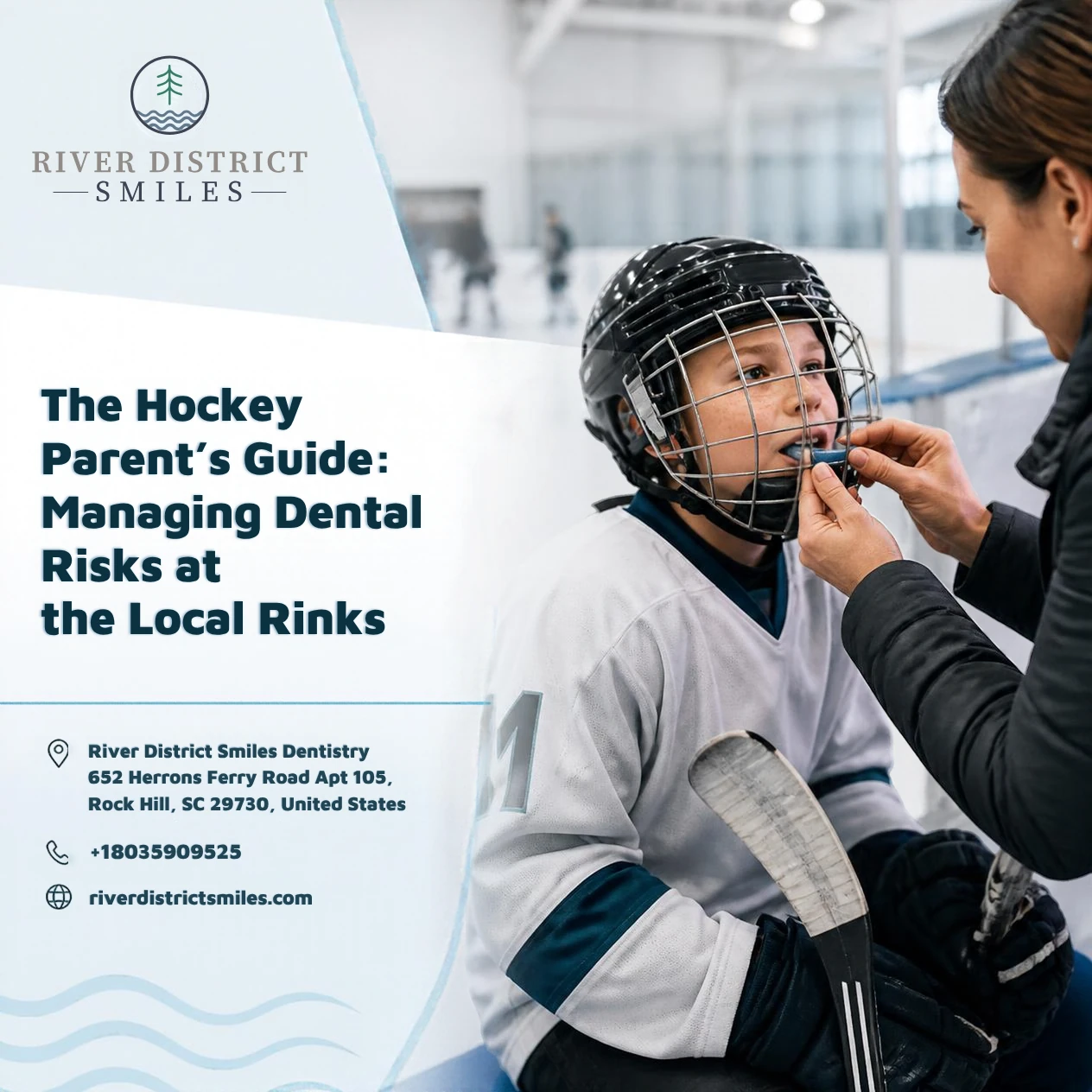


If your child plays hockey, you already know the equipment routine.
Helmet. Cage. Shoulder pads. Elbow pads. Gloves. Neck guard. Skates.
And somewhere in that bag sometimes properly fitted and sometimes looking like it has been chewed by the family dog is the mouthguard.
It is easy to assume that the cage handles the dental risk.
It does not.
The short answer is that hockey players can still chip, fracture, loosen, or knock out teeth even while wearing a helmet and full facial protection. A properly fitted mouthguard adds another layer of protection, but parents also need to know what to do when an injury gets through the equipment anyway.
For families around Rock Hill, hockey often means trips into the greater Charlotte area. Pineville Ice House currently offers youth, travel, adult, and developmental hockey programs, while Extreme Ice Center in Indian Trail offers hockey from Learn to Play through adult leagues.
So this is less about what might happen someday and more about being prepared when you are sitting rinkside and your player comes off the ice holding their mouth.
Why Are Teeth Still at Risk When Players Wear a Cage?
A hockey cage does an important job.
It can help prevent direct contact between the face and a puck, stick, boards, another player’s equipment, or the ice.
But not every dental injury requires something to pass through the cage.
A hard collision can force the lower jaw upward into the upper teeth. A player can fall chin-first. Teeth can strike each other. The lips and cheeks can be pushed against the teeth. A mouthpiece can fall out or be chewed so badly that it no longer fits properly.
The American Dental Association recommends mouthguards for hockey and other sports with meaningful risk of dental or facial injury. Research reviewed by the ADA has consistently found lower rates of oral injuries among athletes who use mouthguards compared with athletes who do not.
That does not mean a mouthguard makes a player injury-proof.
It means it is another piece of protective equipment doing a different job from the helmet and cage.
Does USA Hockey Require a Mouthguard?
For many youth players, yes.
Under USA Hockey’s current 2025–29 playing rules, players and goalkeepers from the 12U classifications through Youth 18U, including high school, and Girls 19U are required to wear a colored internal mouthpiece covering the remaining teeth of one jaw, usually the upper. USA Hockey also strongly recommends properly fitted mouthpieces more broadly.
Parents should still confirm the requirements for their child’s specific league, tournament, and age division.
But there is a more useful dental question than simply asking whether the referee requires one:
Does the mouthguard actually fit?
A mouthguard can technically be in the player’s mouth and still do a poor job.
What Should a Hockey Mouthguard Fit Like?
A useful mouthguard should stay seated over the teeth without the player needing to constantly clench down to hold it in place.
The ADA describes an appropriate guard as one that fits accurately, stays comfortably and securely in place, uses resilient material, and provides adequate coverage of the dental arch being protected.
That matters in hockey because a player needs to breathe hard, communicate with teammates, and react quickly.
If your child constantly takes the guard out because it interferes with breathing or talking, the theoretical protection does not matter very much.
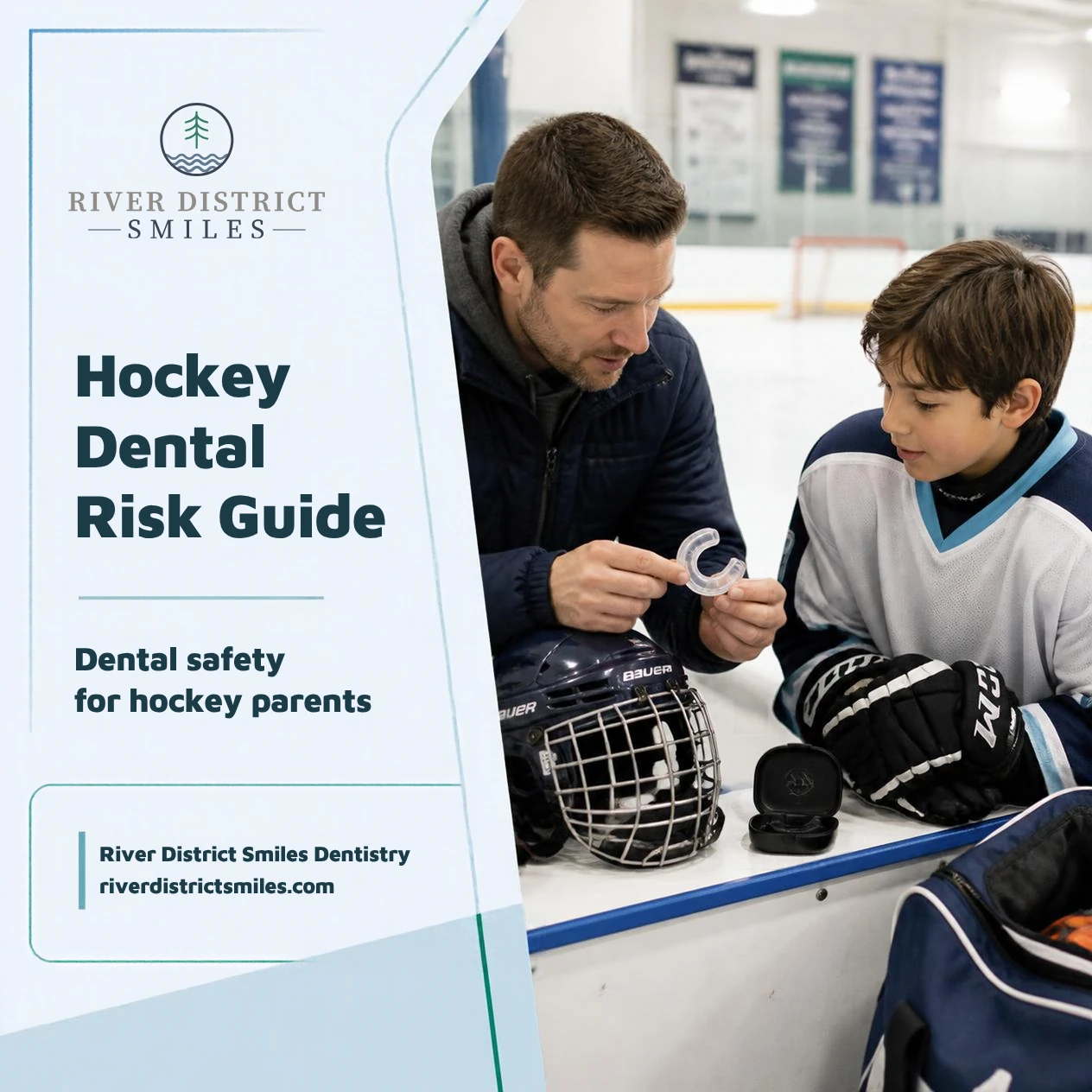
There are three broad categories: stock mouthguards, boil-and-bite guards, and custom-fabricated guards.
Stock guards are inexpensive but generally offer the least adaptation to an individual mouth. A properly fitted boil-and-bite guard can be reasonable for many young athletes. A dentist-made custom guard offers individualized fit but costs more.
There is no rule that every hockey player needs the most expensive option.
The goal is a guard that fits securely enough that the athlete actually wears it.
When Does a Custom Mouthguard Make More Sense?
A store-bought guard can work well for plenty of children.
A custom guard becomes worth discussing when fit is becoming the problem.
For example, some players repeatedly chew through boil-and-bite guards, cannot keep them seated, complain that they are too bulky, or have dental work that makes an ordinary guard difficult to adapt.
Orthodontic treatment can complicate things further because the teeth are actively moving.
The decision is usually not:
“Which mouthguard provides a guarantee that nothing will happen?”
No mouthguard can provide that guarantee.
It is:
“Which option provides reasonable protection and a fit this player will actually tolerate?”
How Often Should Hockey Players Replace Their Mouthguards?
Young athletes can outgrow mouthguards faster than parents expect.
Teeth erupt. Bites change. Orthodontic treatment moves teeth. Children grow.
And hockey players are particularly talented at chewing through anything placed in their mouths.
A guard that fitted well last season may not fit correctly this season.
It should be replaced if it is badly distorted, split, torn, excessively chewed, or no longer stays securely over the teeth.
It is also reasonable to bring the guard to a routine dental appointment.
That gives the dentist a chance to look at how it fits the child’s current mouth rather than simply deciding based on how old the guard is.
What Dental Injuries Actually Happen in Hockey?
Not every hockey injury results in a dramatic tooth flying across the ice.
Some are much less obvious.
A player may come off with a small chip. Another may say one front tooth feels “weird” when biting. A tooth may be slightly pushed backward or forward. The gum around a tooth may bleed even though the crown looks normal.
The absence of severe pain does not always mean the tooth escaped injury.
Trauma can affect the enamel, deeper tooth structure, root, nerve, periodontal ligament, or supporting bone.
That is why significant impacts deserve more attention than simply asking, “Does it hurt?”
A Chipped Tooth: Emergency or Not?
A tiny chip limited to enamel usually is not the same emergency as a knocked-out tooth.
But larger fractures deserve prompt evaluation.
If the tooth becomes sensitive to air or cold, a substantial section is missing, there is bleeding from the tooth itself, or the player has pain when biting, deeper structures may be involved.
River District Smiles evaluates chipped and broken teeth as part of its emergency dental care. Depending on the extent of the damage, treatment may range from bonding to a crown or another restorative approach. Same-day emergency appointments are available when scheduling allows.
If you can find the broken piece of tooth, save it and bring it with you.
What If the Tooth Looks Fine but Feels Loose?
Call the dentist.
A loosened permanent tooth may need to be evaluated for displacement, damage around the root, or injury to the supporting tissues.
Trying to “test” it repeatedly with a finger or tongue does not help.
The dentist may need an examination and imaging to understand whether the tooth has shifted and whether stabilization or monitoring is appropriate.
The important point for parents is that visible damage and actual damage are not always the same thing.
What Should You Do If a Permanent Tooth Gets Knocked Out?
This is the situation where knowing what to do before arriving at the rink really matters.
If a permanent tooth is completely knocked out, treatment is time-sensitive. River District Smiles advises parents and patients to handle the tooth by the crown rather than the root, avoid scrubbing it, gently rinse it only if necessary, and keep it from drying out. If it cannot be repositioned safely, keeping it moist in milk while contacting a dentist immediately is an option. A knocked-out baby tooth should not be put back into the socket.
A practical hockey-parent emergency kit does not need to be complicated:
- Your dentist’s phone number saved in your phone
- A small clean container
- Access to milk or an appropriate tooth-preservation medium if available
- Your child’s dental insurance information
- A basic understanding that a permanent tooth should be handled by the crown, not the root
- The knowledge that serious head, jaw, breathing, or uncontrolled-bleeding emergencies belong in medical emergency care
The goal is not for parents to become rinkside dentists.
It is to avoid losing valuable time.
Dentist or Emergency Room?
This is one of the most important distinctions after a hockey collision.
If the main problem is a chipped, loosened, displaced, or knocked-out tooth, a dentist is usually the more appropriate place to start.
If the player has serious head trauma, loss of consciousness, difficulty breathing or swallowing, uncontrolled bleeding, severe rapidly spreading facial swelling, or a suspected jaw or facial fracture, emergency medical care comes first. River District Smiles makes the same distinction in its emergency-care guidance.
With hockey injuries, the two can occasionally overlap.
A child who has been hit hard enough to damage a tooth may also need concussion or facial-trauma evaluation.
Do not let concern about the tooth distract from the rest of the athlete.
Should the Player Go Back Into the Game?
That depends on the injury.
A dentist cannot responsibly give one universal “yes” or “no” for every chipped tooth.
A very small enamel chip with no other signs of injury is different from a displaced front tooth after a major collision.
The player’s medical status also matters.
If there is any concern about concussion, head injury, facial fracture, or another medical problem, that needs to be handled according to the appropriate medical and league return-to-play process.
USA Hockey maintains safety and return-to-play requirements around suspected concussion, separate from dental treatment.
From the dental side, the question is whether returning to contact could worsen an unstable tooth or fresh repair.
Sometimes missing the rest of one game is a much smaller problem than turning a manageable dental injury into a more complicated one.
What If the Player Has Braces?
Braces change the mouthguard conversation.
The guard has to protect the teeth and soft tissues without preventing the teeth from moving as orthodontic treatment progresses.
It may also need to accommodate brackets and wires.
This is a situation where asking the dentist or orthodontist before buying a random guard online makes sense.
A poorly adapted mouthguard that fits tightly over orthodontic appliances can quickly become uncomfortable as the teeth move.
Hockey parents should also remember that the inside of the lips can be injured when they are forced against brackets during impact, even when the teeth themselves remain intact.
What If My Child Has a Crown or Bonded Front Tooth?
Tell the dentist that your child plays hockey.
Previous dental work does not necessarily mean the athlete needs to stop playing.
It does mean the mouthguard and restoration should be considered together.
A tooth that has already fractured once may have less natural structure remaining. A bonded edge can fracture again. A crown can occasionally be damaged or dislodged.
River District Smiles also treats lost or damaged restorations through its emergency dental services and can evaluate whether a restoration can be repaired, replaced, or requires a different treatment approach.
For a hockey player, the conversation should include how that tooth will be protected when the athlete returns to the ice.
Are Dental Injuries the Only Oral-Health Issue for Hockey Players?
No.
Hockey creates some less obvious dental habits too.
Players may clench during competition. Long practices and tournaments can mean repeated sports-drink exposure. Travel weekends can disrupt brushing and flossing routines. Children may spend hours sipping flavored drinks between games.
None of that means hockey causes cavities.
But frequent sugar and acid exposure can matter, particularly if a player spends an entire tournament weekend slowly drinking sports drinks rather than using them during the periods when they are actually needed.
Water remains the simplest drink for teeth between games.
If an athlete does use a sports drink, rinsing or drinking some plain water afterward can help reduce how long sugar and acid remain around the teeth.
What About Neck Guards?
They are not dental appliances, but hockey parents should know the current requirement.
USA Hockey requires HECC-certified neck laceration protection for players and goalkeepers in all age classifications except Adults, with specific transitional provisions in the current rule cycle. USA Hockey continues to recommend neck protection for adult players as well.
This is separate from the mouthguard requirement.
A neck guard does not replace a mouthguard.
A cage does not replace a mouthguard.
A mouthguard does not replace a helmet.
Each piece manages a different part of the risk.
Local Hockey Means Having a Plan Before You Leave Rock Hill
For Rock Hill families, hockey may involve more driving than many other youth sports.
Pineville Ice House describes itself as a year-round hockey facility with youth programs, house and travel opportunities, Stick & Puck, and adult hockey.
Extreme Ice Center in Indian Trail likewise operates hockey programming ranging from developmental programs to adult play and youth travel hockey.
That means an injury may happen when you are not five minutes from your usual dentist.
Knowing whom you intend to call before the game starts is more useful than trying to search “emergency dentist” from the parking lot while your child is bleeding.
River District Smiles provides emergency dental evaluations in Rock Hill for broken teeth, knocked-out teeth, lost restorations, sports injuries, swelling, and other urgent dental problems, with same-day appointments offered when scheduling permits.
Should Hockey Players Have More Frequent Dental Visits?
Not automatically.
Playing hockey does not mean a child needs a cleaning every three months.
Routine preventive visits should be based on the child’s cavity risk, gum health, dental history, orthodontic treatment, existing restorations, and other individual factors.
What hockey does change is the information worth sharing with the dentist.
Tell them your child plays.
Bring the mouthguard.
Mention previous hits to the teeth, even if they seemed minor at the time.
If one tooth has changed color, become sensitive, feels different when biting, or has been repeatedly traumatized, say so.
Some consequences of dental trauma appear later rather than on the night of the injury.
The Bottom Line for Hockey Parents
You cannot remove every dental risk from hockey.
That is not a realistic goal.
What you can do is reduce avoidable risk.
Make sure the mouthguard fits. Replace it when it no longer does. Do not assume the cage makes the teeth invulnerable. Know the difference between a small chip and a time-sensitive knocked-out tooth. And have a dental plan before an injury happens.
Most importantly, do not judge the seriousness of a hockey dental injury entirely by how dramatic it looks.
A small chip may be simple.
A normal-looking tooth may have been displaced.
A knocked-out permanent tooth needs immediate attention.
And a player with significant head or facial trauma needs medical care, regardless of what happened to the teeth.
At River District Smiles, the goal after a sports injury is not simply to patch the tooth and send the player back onto the ice.
It is to understand what was actually injured, preserve natural tooth structure when possible, explain the treatment options clearly, and help reduce the chance that the next hit creates a bigger problem.
For hockey parents, preparation does not mean expecting an injury. It means knowing what to do if one happens.