


Most people comparing All-on-X with individual dental implants are dealing with more than one missing tooth. They may have several failing teeth, wear an uncomfortable denture, or have been told that much of an upper or lower arch cannot be saved.
The difficult part is understanding whether it makes more sense to rebuild the entire arch as one connected restoration or replace teeth separately.
The direct answer is this: individual dental implants are usually preferred when only one or several teeth need replacement and the remaining teeth are healthy. All-on-X is generally designed for patients who have already lost or are likely to lose most or all of the teeth in one arch.
One is not automatically better than the other. They solve different problems.
Choose the Right Implant Solution
Get personalized guidance on the dental implant option that fits your smile. Call now to book your consultation.
What Is the Difference?
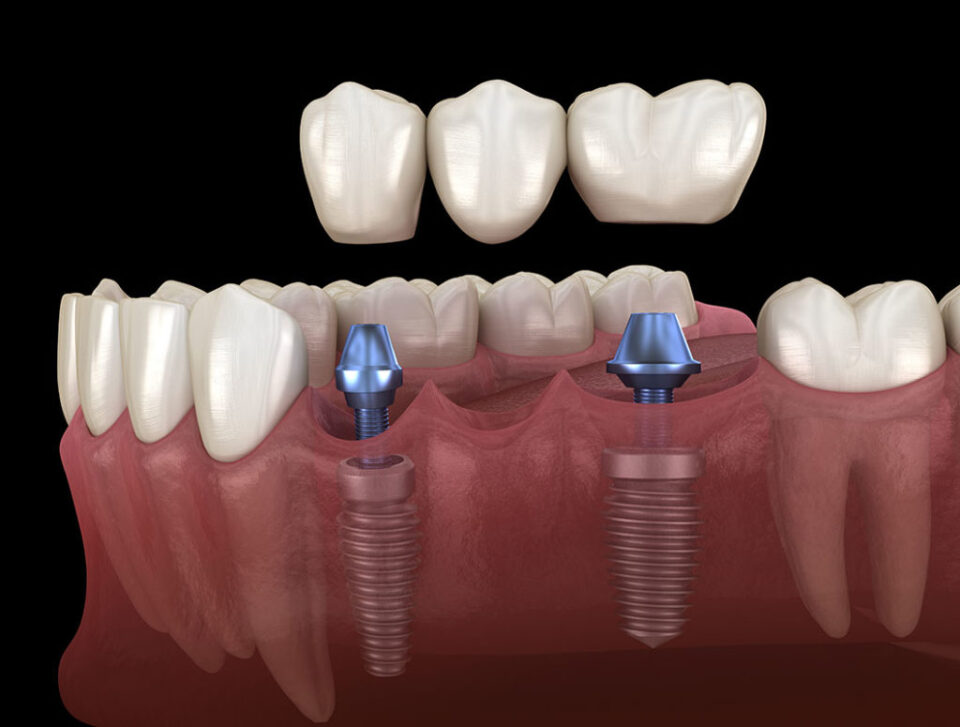
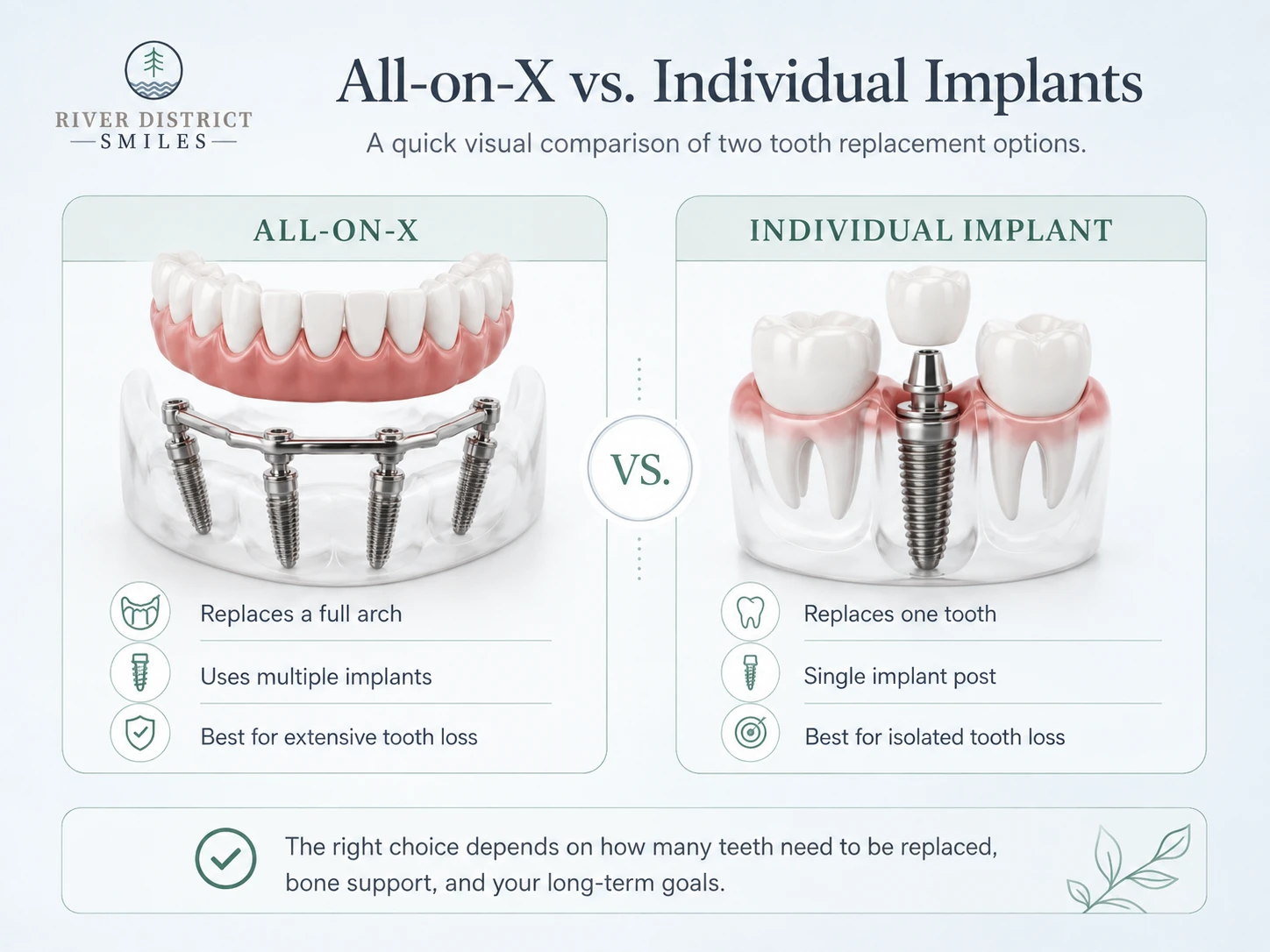
An individual dental implant typically replaces one missing tooth. A titanium implant is placed in the jawbone, an abutment connects to it, and a separate crown is attached on top.
When several teeth are missing, individual implant crowns may be used, or a smaller number of implants may support an implant bridge. It is not always necessary or advisable to place one implant for every missing tooth. Implant restorations can include individual crowns, bridges, and full-arch hybrid restorations.
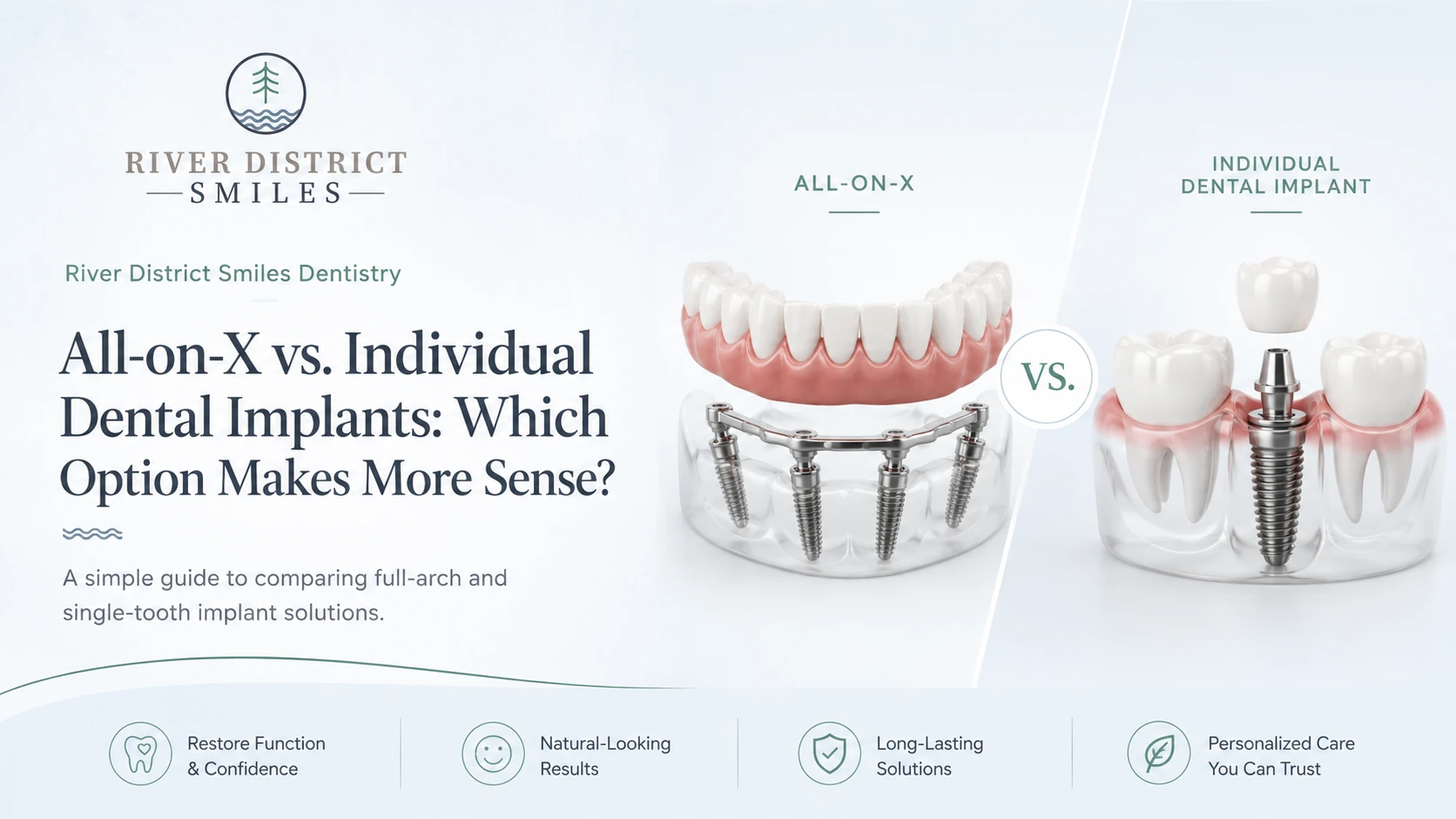
All-on-X uses a smaller number of implants to support a full, connected arch of replacement teeth. The “X” refers to the number of implants used, which is determined by the patient’s bone, anatomy, bite, and treatment plan. River District Smiles describes its All-on-X treatment as using approximately four to six implants to support a fixed upper or lower arch.
In plain terms:
| Option | What It Usually Replaces | How the Teeth Are Connected |
| Individual implant | One missing tooth | Separate implant crown |
| Several implants or implant bridge | A few missing teeth | Separate crowns or a short connected bridge |
| All-on-X | Most or all teeth in one arch | One full connected restoration |
Who Is Usually a Better Fit for Individual Implants?
Individual implants tend to make more sense when the patient has isolated tooth loss and the neighboring teeth are worth keeping.
They may be the better option when:
- One tooth is missing
- A few teeth are missing in different areas
- Most remaining teeth and gums are healthy
- The patient wants each replacement to look and function more like a separate tooth
- There is enough bone to support implants in the required locations
- Removing healthy or predictably treatable teeth would be unnecessarily aggressive
For example, a patient missing one front tooth and one back tooth would usually not need a full-arch restoration. Each space could be evaluated separately.
Individual implants also allow the dentist to preserve the patient’s natural teeth. That matters because a full-arch implant restoration should not be recommended simply because implants are available. Healthy natural teeth are generally worth keeping when they have a good long-term outlook.
Who Is Usually a Better Fit for All-on-X?
All-on-X is intended for a much larger problem.
It may be appropriate when:
- Nearly every tooth in an arch is missing
- The remaining teeth are severely decayed, loose, broken, or otherwise unlikely to last
- A traditional denture is unstable or difficult to tolerate
- The patient wants a fixed restoration rather than one removed at night
- Rebuilding every tooth separately would be impractical
- Bone availability favors a strategically placed full-arch design
- The patient understands the maintenance and repair needs of a connected prosthesis
Full-arch implant treatment uses multiple implants as the foundation for an entire upper or lower set of replacement teeth.
A common All-on-X patient is not someone with two or three problem teeth. It is someone whose entire arch has reached the point where repeated restorative care, crowns, periodontal treatment, extractions, and repairs are no longer producing a stable or predictable result.
The Most Important Question: Can Your Natural Teeth Be Saved?
Before comparing implant systems, the dentist should determine which teeth are healthy, which are questionable, and which have a poor prognosis.
That evaluation may include:
- A clinical examination
- Gum and bone measurements
- Digital X-rays
- A 3D cone-beam CT scan
- Bite evaluation
- Review of cavities, fractures, infections, and previous dental work
- Discussion of smoking, diabetes, medications, and other health factors
River District Smiles uses 3D cone-beam imaging as part of its available dental technology, which can help assess bone volume, anatomy, and implant position during treatment planning.
Be cautious if a full-mouth extraction is recommended before anyone clearly explains why the existing teeth cannot be predictably maintained.
All-on-X can be an excellent solution for the right patient. It is not a reversible experiment. Once natural teeth are removed, they cannot be put back.
All-on-X vs. Individual Implants: Practical Comparison
| Consideration | All-on-X | Individual Implants |
| Best suited for | Most or all teeth failing in an arch | One or several missing teeth |
| Number of implants | Often four to six per arch | Based on the number and location of missing teeth |
| Replacement design | One connected full arch | Separate crowns or shorter bridges |
| Natural teeth | Usually removed if they remain in the treated arch | Healthy teeth are preserved |
| Cleaning | Requires cleaning under a connected restoration | More similar to cleaning individual teeth |
| Repairs | A problem may affect part or all of the connected arch | A crown can often be addressed individually |
| Initial treatment scope | Major full-arch procedure | Usually more localized |
| Appearance | Designed as an entire coordinated smile | Designed to blend with remaining teeth |
| Cost pattern | Large cost per arch | Cost grows with each implant, crown, or bridge |
| Best advantage | Replaces an entire failing arch efficiently | Preserves healthy teeth and replaces only what is missing |
Which Option Feels More Like Natural Teeth?
Individual implant crowns usually behave more like separate natural teeth because each restoration emerges independently from the gumline. Floss can often pass between them, and damage to one crown does not necessarily involve the others.
All-on-X teeth are connected as one prosthesis. They can feel very stable because they are fixed to implants rather than resting on the gums, but they do not function exactly like a row of independent natural teeth.
Patients sometimes hear “fixed teeth” and assume the result will be identical to having their original teeth. It is more accurate to think of All-on-X as a strong, fixed replacement for an entire arch, rather than a recreation of every natural tooth individually.
The American Academy of Implant Dentistry explains that full-arch treatment replaces all upper or lower teeth at one time, while individual implants can replace one tooth or several teeth in selected areas.

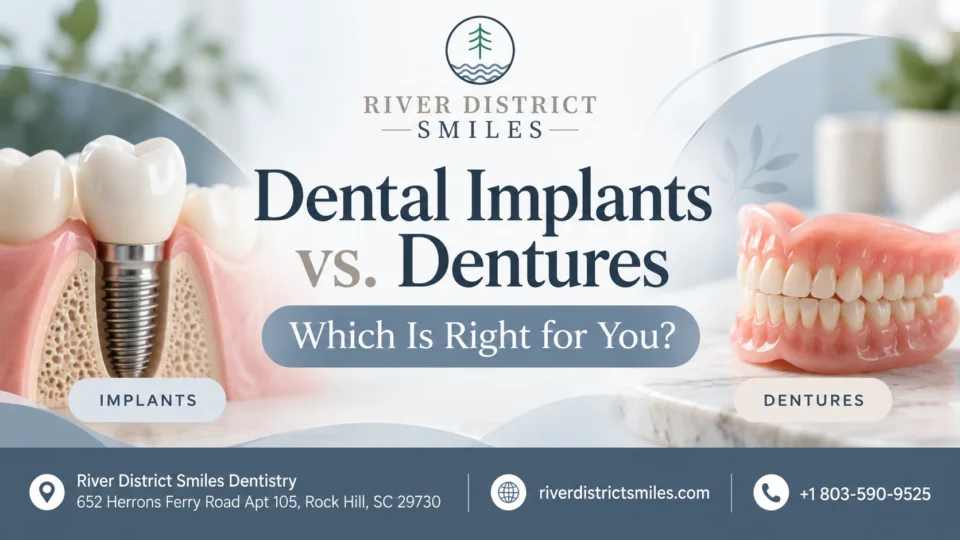
Dental Implants vs. Dentures: Which Is Right for You?
How Each Option Actually Works A dental implant is a small titanium post placed directly into the jawbone, where it…
Which Option Is Easier to Clean?
Neither option is maintenance-free.
Cleaning Individual Implants
Individual implants are usually cleaned with:
- A toothbrush
- Floss or implant-specific floss
- Interdental brushes
- A water flosser when appropriate
- Regular professional maintenance
Because the crowns are separate, access may feel more familiar.
Cleaning All-on-X
With All-on-X, the patient must clean around the implants and underneath the connected arch. Depending on the design, this may require:
- A water flosser
- Floss threaders or specialty floss
- Small interdental brushes
- Angled or single-tuft brushes
- Periodic professional removal of the prosthesis when clinically necessary
A fixed arch does not come out for daily cleaning, but that does not mean food and plaque cannot collect beneath it. Long-term success depends on keeping the implant sites healthy and attending maintenance appointments.
Which Option Lasts Longer?
Both can last many years, but “How long does it last?” needs to be divided into two parts:
- How long the implants remain healthy in the bone
- How long the crowns, bridges, screws, and full-arch teeth remain serviceable
The implant itself may remain stable for a long time, while the visible restoration may eventually require repair or replacement. Teeth can chip, screws can loosen, and restorative materials can wear.
With an individual implant, a damaged crown may be repaired or replaced by itself.
With All-on-X, the teeth are connected. A repair may therefore involve removing or servicing a larger prosthesis. That does not make All-on-X unreliable. It simply means patients should understand the maintenance considerations associated with a full-arch design.
Implants also depend on healthy gums and bone. Smoking, uncontrolled diabetes, poor plaque control, grinding, and skipped maintenance can increase the risk of complications.
Does All-on-X Really Provide Teeth in One Day?
In selected cases, failing teeth may be removed, implants placed, and a fixed temporary arch attached during the same appointment.
The key word is temporary.
“Teeth in a day” usually refers to receiving a provisional restoration while the implants heal. The final restoration is generally made after healing and tissue changes have occurred.
Not every patient qualifies for immediate fixed teeth. The implants must have adequate initial stability, and the bone, bite, and overall health must support the plan.
During healing, patients are commonly instructed to follow a softer diet. A temporary arch should not be treated as though the implants have already completed the bone-integration process.
How Do the Costs Compare?
All-on-X is usually priced by the arch. Individual implants are generally priced according to the number of implants, abutments, crowns, bridges, and supporting procedures required.
River District Smiles reports a typical All-on-X range of approximately $15,000 to $36,000 per arch, with treatment for both arches often ranging from about $30,000 to $70,000 or more. The actual price may change based on implant number, extractions, bone grafting, temporary teeth, final materials, sedation, and what the treatment estimate includes.
That does not mean All-on-X is inexpensive. It means the cost is concentrated into rebuilding an entire arch.
Individual implants may be more affordable when replacing one or two teeth. As more teeth require replacement, however, the combined cost of multiple surgeries, implants, abutments, crowns, and bridges can become substantial.
A useful way to think about it is:
- One or a few missing teeth: Individual treatment is generally more conservative and financially sensible.
- An entire failing arch: All-on-X may be more efficient than attempting to replace every tooth with a separate implant and crown.
- A mixture of healthy and unhealthy teeth: A combination plan may be more appropriate than either extreme.
What May or May Not Be Included in an Implant Quote?
Two treatment estimates can look very different while covering different services.
Ask whether the quoted cost includes:
- The examination and 3D imaging
- Tooth extractions
- Bone grafting
- Implant placement
- Sedation
- Temporary teeth
- Abutments and prosthetic components
- The final crowns or full-arch restoration
- The material used for the final teeth
- Follow-up visits
- Adjustments during healing
- The first year of maintenance
- A night guard
- Repairs or replacement components
- Treatment if an implant does not integrate
The lowest number is not necessarily the lowest total cost. A clear estimate should separate likely treatment from procedures that may become necessary after surgery begins.
Does Insurance Cover Either Option?
Dental insurance may contribute to certain parts of treatment, but plans vary widely. Some policies cover extractions or a portion of an implant restoration while excluding implant placement itself. Many plans also have annual maximums that are small compared with the cost of full-arch treatment.
Medical insurance occasionally contributes when tooth loss or reconstruction is connected to trauma, tumors, congenital conditions, or another covered medical issue. Routine implant treatment is commonly handled through dental benefits instead.
Before treatment, request:
- A written treatment plan
- Procedure codes
- A pretreatment insurance estimate
- A list of what the office expects insurance to pay
- The estimated patient responsibility
- Financing terms, including interest and total repayment
Insurance approval is not the same as a clinical recommendation. Likewise, lack of coverage does not mean a treatment is unnecessary. The dental decision and the financial decision should be discussed separately.
When All-on-X May Not Be the Best Fit
All-on-X may not be appropriate when:
- Most natural teeth are healthy and maintainable
- The patient cannot clean under the prosthesis consistently
- Gum disease is uncontrolled
- Smoking or health conditions create an unacceptable surgical risk
- There is not enough bone for the proposed design without additional treatment
- The patient expects the restoration to be maintenance-free
- The patient cannot follow a soft-diet period during healing
- A removable implant-supported denture would better match the patient’s needs or budget
Some patients also need lip or facial support that is easier to provide with a removable prosthesis. Fixed teeth are not automatically the most attractive or functional solution for every face and jaw relationship.
When Individual Implants May Not Be the Best Fit
Separate implants may be a poor choice when:
- Nearly all teeth in the arch have a poor prognosis
- There is extensive bone loss in several implant sites
- Replacing each tooth separately would require excessive surgery
- The proposed teeth would be difficult to position or clean
- A connected bridge would distribute forces more predictably
- The total treatment would be significantly more complex without providing a meaningful benefit
- The patient is trying to save teeth that are repeatedly infected, mobile, or structurally unsalvageable
Attempting to preserve every tooth at any cost is not always the most conservative approach. Sometimes repeated restorative procedures, crowns, periodontal treatment, and repairs only postpone a decision that eventually needs to address the entire arch.
The goal is not to keep every tooth forever. It is to create the most predictable healthy result while preserving teeth that genuinely have a reasonable future.
Are There Options Between All-on-X and Individual Implants?
Yes. This comparison is not limited to two choices.
Depending on the situation, alternatives may include:
- A conventional removable denture
- An implant-retained removable denture
- An implant-supported bridge replacing several teeth
- A combination of natural teeth and implant restorations
- Saving selected teeth and replacing only those that cannot be predictably maintained
- Phased treatment over time
For example, someone missing four back teeth may need an implant bridge rather than four individual implants. Someone with a loose lower denture may benefit from a removable overdenture supported by fewer implants rather than a fixed All-on-X arch.
A good plan should show you all reasonable categories, not only the most extensive treatment.
Questions to Ask Before Choosing
Before agreeing to either approach, ask:
- Which of my natural teeth can predictably be saved?
- Why are any remaining teeth being recommended for extraction?
- Would an implant bridge work instead of separate implants?
- How many implants are planned, and why?
- Will I receive temporary teeth on the day of surgery?
- What material will be used for the temporary and final teeth?
- How will I clean the restoration?
- What maintenance appointments will I need?
- What happens if one implant does not integrate?
- How are chips, worn teeth, or loose screws handled?
- What is included in the fee?
- Is a removable implant-supported option reasonable?
- What happens if I delay treatment?
- Can I see the proposed tooth position before surgery?
You should be able to explain your treatment plan in plain language before signing consent forms or financing documents.
What Happens If You Wait?
Waiting is not automatically dangerous, but the consequences depend on what is happening now.
A short delay may be reasonable when the condition is stable and there is no active pain or infection. Waiting becomes more concerning when teeth are loose, infected, breaking, or no longer usable for chewing.
Possible effects of delaying necessary treatment include:
- Additional tooth fractures
- Repeated infections
- Progression of gum and bone loss
- Changes in the bite
- Reduced ability to chew
- More complicated extractions
- Changes in the amount or shape of available bone
- A need for more extensive grafting or reconstruction
An abscess, facial swelling, fever, uncontrolled bleeding, or difficulty swallowing or breathing should not wait for a routine implant consultation.
The Bottom Line
All-on-X and individual implants should not be viewed as competing versions of the same treatment.
Individual implants are usually the more conservative choice when one or several teeth are missing and the rest of the mouth is healthy. All-on-X is generally the more practical choice when an entire upper or lower arch is missing or no longer predictably maintainable.
The hardest situations fall in the middle, when some teeth are healthy, some are questionable, and others clearly cannot be saved. That is where careful diagnosis matters most.
At River District Smiles, full-arch planning can include an examination, 3D imaging, evaluation of the remaining teeth and bone, and a discussion of fixed and removable options. The practice describes its approach as personalized, patient-focused, and centered on clear communication rather than a one-size-fits-all recommendation.
A good implant consultation should not leave you feeling that every tooth must be saved or that every tooth must be removed. It should leave you understanding which teeth have a future, which do not, and why the recommended replacement plan makes sense.
Find Your Best Dental Implant Option
Not sure which implant approach makes more sense? Get professional answers and a personalized plan. Call today.