


How Losing a Tooth Actually Affects You
It’s easy to treat this as a purely cosmetic topic, but the physical effects come first and they’re well documented. A missing tooth changes how you chew. You may start favoring one side, which can affect nutrition if certain foods become hard to manage. It can affect speech, since some sounds rely on your tongue and lips contacting your teeth in specific ways; missing front teeth in particular tend to affect enunciation more noticeably than a missing back tooth would. And the jawbone that used to support the tooth root begins to resorb once it’s no longer stimulated by chewing forces — the longer a tooth stays missing, the more of that bone is lost, which can eventually change the shape of the lower face and, for larger cases, contribute to sagging around the mouth.
None of that is speculative — it’s the same mechanical reason dentists recommend replacing a missing tooth reasonably promptly rather than waiting, which our post on what happens if you wait too long to replace missing teeth covers in more depth. The confidence and self-image conversation is really downstream of these physical changes — people notice differently when they can’t chew comfortably, when their speech shifts, or when the lower half of their face looks different than it used to.
Missing Teeth Holding You Back?
Eat, speak, and smile with greater confidence. Call now to explore your dental implant options!
What Changes After Treatment
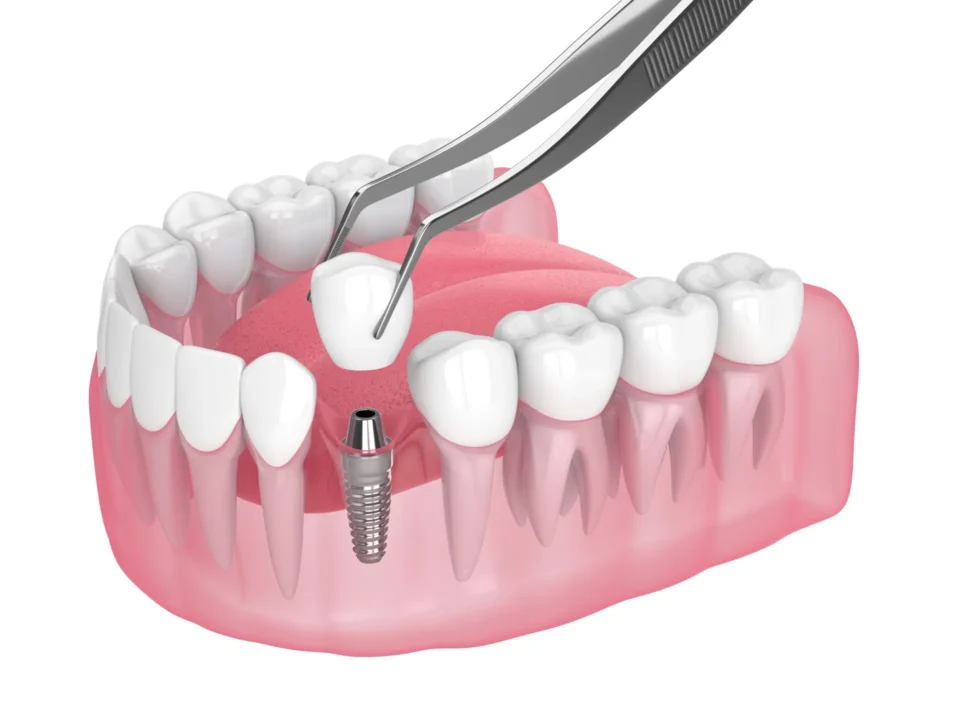
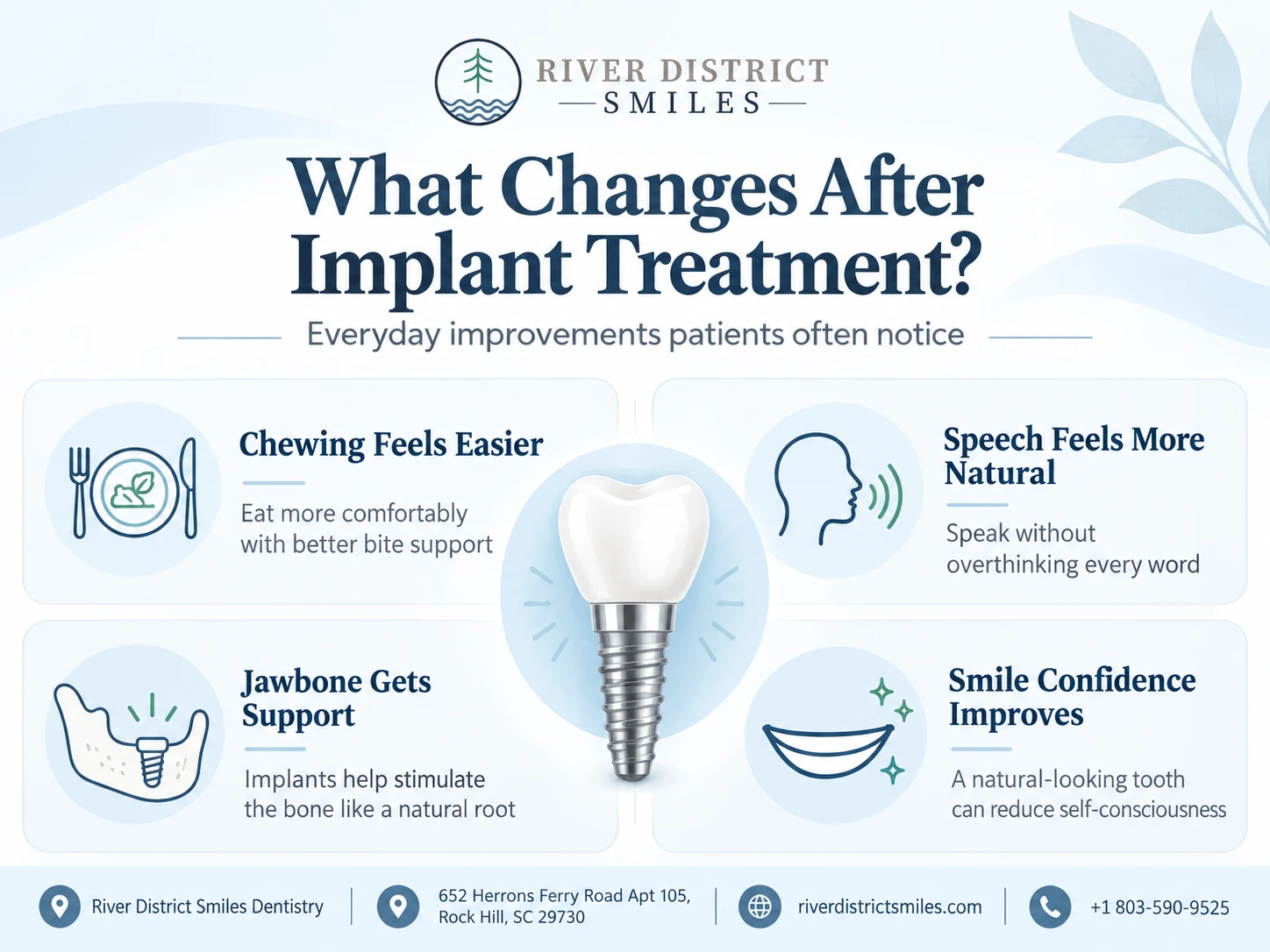
Because implants are anchored in the jawbone rather than resting on the gum, they restore chewing function closer to a natural tooth than a removable option does, and they help slow the bone loss described above by continuing to transmit some of that chewing stimulation.
Patients generally describe returning to eating and speaking without thinking about it — which is really the point: the goal of good tooth replacement is that you stop noticing your teeth in everyday situations, not that you notice them less unpleasantly.
We want to be straightforward here: we don’t have a formal patient survey or published statistics specific to our practice to cite for this section, and we’re not going to invent quotes or numbers to make the point sound more dramatic than it is.
What we can say, grounded in general clinical literature rather than anecdote, is that self-consciousness about a visibly incomplete smile — things like covering your mouth when laughing, or avoiding smiling in photos — is a commonly described pattern before treatment, and it’s a reasonable expectation (not a guarantee) that a well-fitted, natural-looking restoration reduces that specific behavior once healing is complete.
When This Angle is Genuinely Relevant — and When It Isn’t
This matters more in some situations than others, and it’s worth being honest about that instead of treating every missing tooth as an identity crisis. A single missing molar, out of view when you smile, is mostly a functional and long-term bone-health issue — the psychological stakes are lower, even though replacing it still matters for your bite and jaw health.
A missing front tooth, multiple missing teeth, or a full arch is a different situation: the visible and speech effects are more immediate, and it’s genuinely reasonable for confidence to be part of that conversation with your dentist, not an afterthought.
If you’re deciding between implants and a removable option like dentures for a larger case, our separate comparison of dental implants vs. dentures covers the practical differences — cost, durability, daily maintenance — in more detail than belongs on this page.

Who’s the Go-To Expert for Dental Implants in Edgemoor, SC?
When it comes to restoring missing teeth, residents in Edgemoor, SC want results that look natural and last for years.…
What Actually Determines a Natural-Looking Result
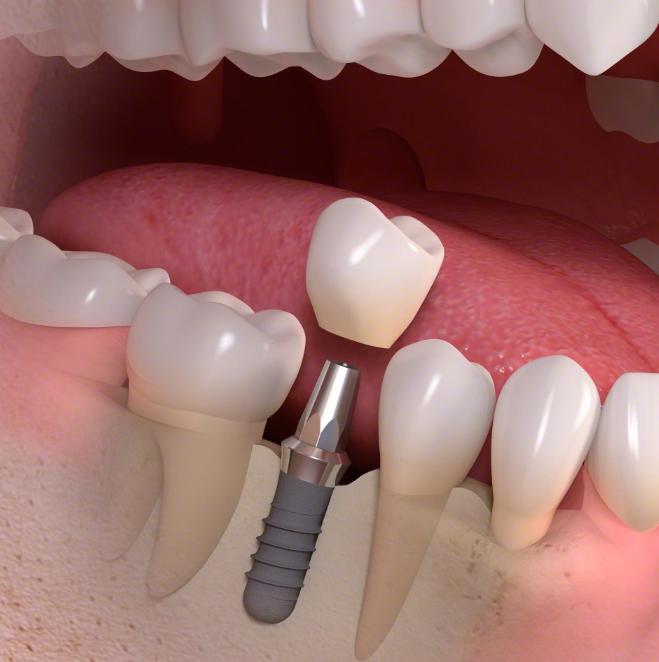
If appearance and how a restoration “reads” to other people is part of your decision, the details that matter most are tooth shape and proportion, shade-matching to your remaining teeth, and how the restoration meets the gum line — not simply the category of treatment (implant vs. bridge vs. denture).
A well-planned implant restoration can look essentially indistinguishable from a natural tooth; a poorly planned one, in any category, can look obviously artificial. This is a conversation about your dentist’s planning and lab work as much as it is about the treatment type itself.
You can browse the full range of our dental implant services or see a broader rundown of benefits of dental implants if you want more detail on the clinical side before your consultation.
Frequently Asked Questions
Q: Is it reasonable to get an implant mainly for how it looks, not because it hurts or affects eating?
Yes. Appearance and confidence are legitimate reasons to replace a tooth, especially a visible one — you don’t need to be in pain to justify treatment. That said, it’s worth discussing your specific situation with your dentist so you understand the full picture, including any bone or bite considerations.
Q: Does a missing back tooth really need to be replaced if no one can see it?
Often yes, but for different reasons than a front tooth — an unreplaced back tooth can let neighboring teeth shift, affect your bite, and lead to jawbone loss in that area over time. It’s less about visible appearance and more about long-term function and oral health.
Q: How soon after losing a tooth should I consider an implant?
There’s no single universal timeline, but waiting longer generally means more bone loss in that area, which can make implant placement more complex (sometimes requiring bone grafting). It’s worth having the conversation with your dentist sooner rather than later, even if you’re not ready to commit to treatment yet.
Q: Will people be able to tell I have a dental implant?
With good planning and lab work, a well-placed implant restoration is designed to blend in with your natural teeth. The result depends much more on the quality of that planning than on the fact that it’s an implant.
Q: I’ve had a missing tooth for years — is it too late for an implant?
Not necessarily. Significant bone loss can make implants more complicated, but bone grafting and other techniques often make implants possible even in longstanding cases. The only way to know is a proper evaluation.
Sources:
- https://www.prosthodontics.org/assets/1/7/ACP_Talking_points_for_Missing_Teeth_1-12-15.pdf
- https://my.clevelandclinic.org/health/diseases/tooth-loss
Get Your Confident Smile Back!
Discover how dental implants can improve your smile and everyday comfort. Book your consultation today!