


Losing a tooth can feel urgent when the space is visible. When the missing tooth is farther back, it is easier to wonder whether replacing it is really necessary.
You may be chewing reasonably well. Nothing hurts. The people around you may not even notice the gap.
So, can you simply leave it alone?
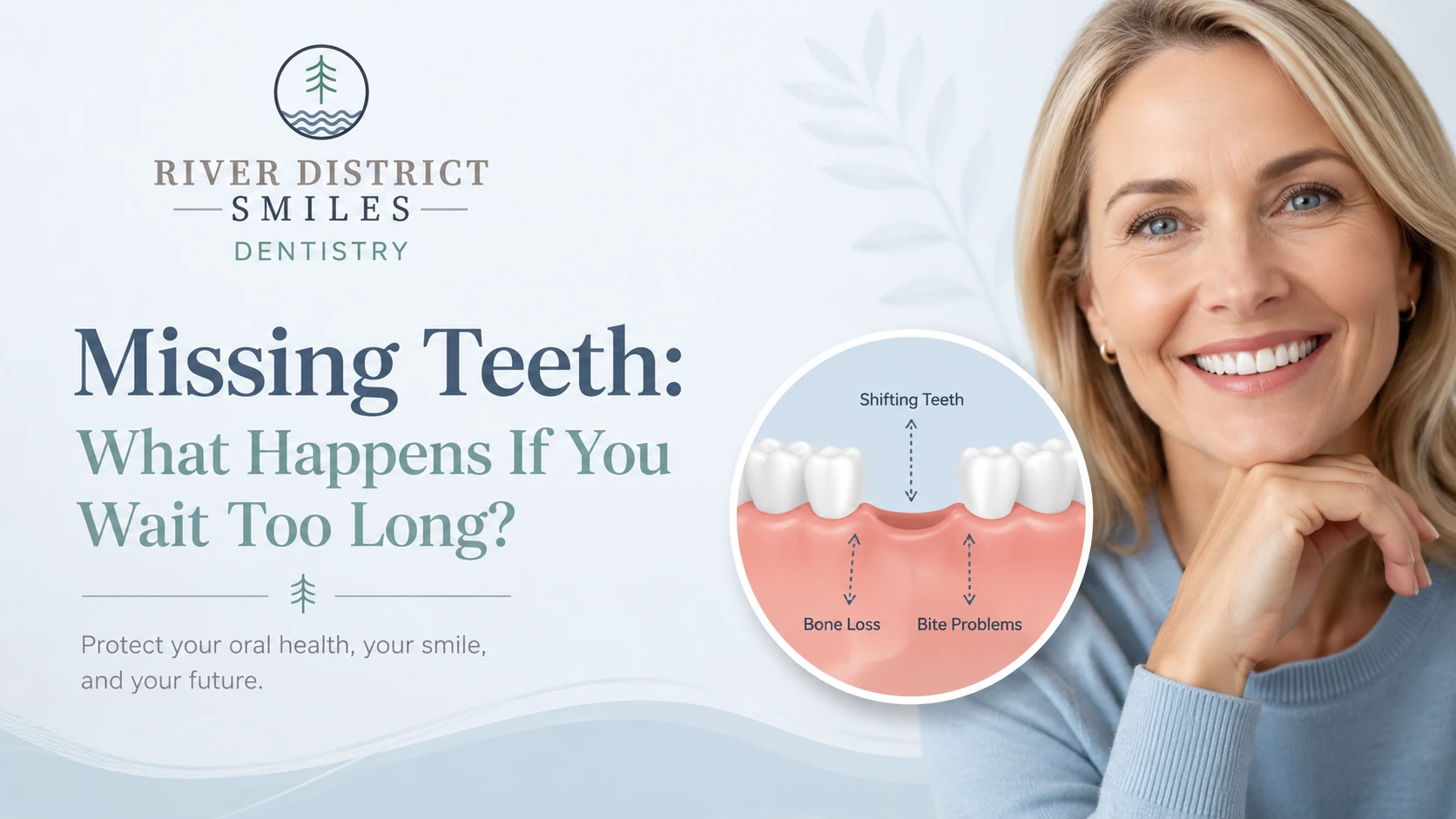
Sometimes a missing tooth can be monitored safely. However, waiting may allow the bone in the area to shrink, nearby teeth to move, the opposing tooth to change position, and your replacement options to become more complicated.
Those changes do not happen the same way or at the same speed for every patient. The location of the tooth, your bite, the health of the remaining teeth, the cause of the tooth loss, and your future treatment goals all matter.
The important step is not replacing every missing tooth automatically. It is understanding what is likely to happen in your particular mouth before the space begins to change.
What Can Happen After a Tooth Is Lost?
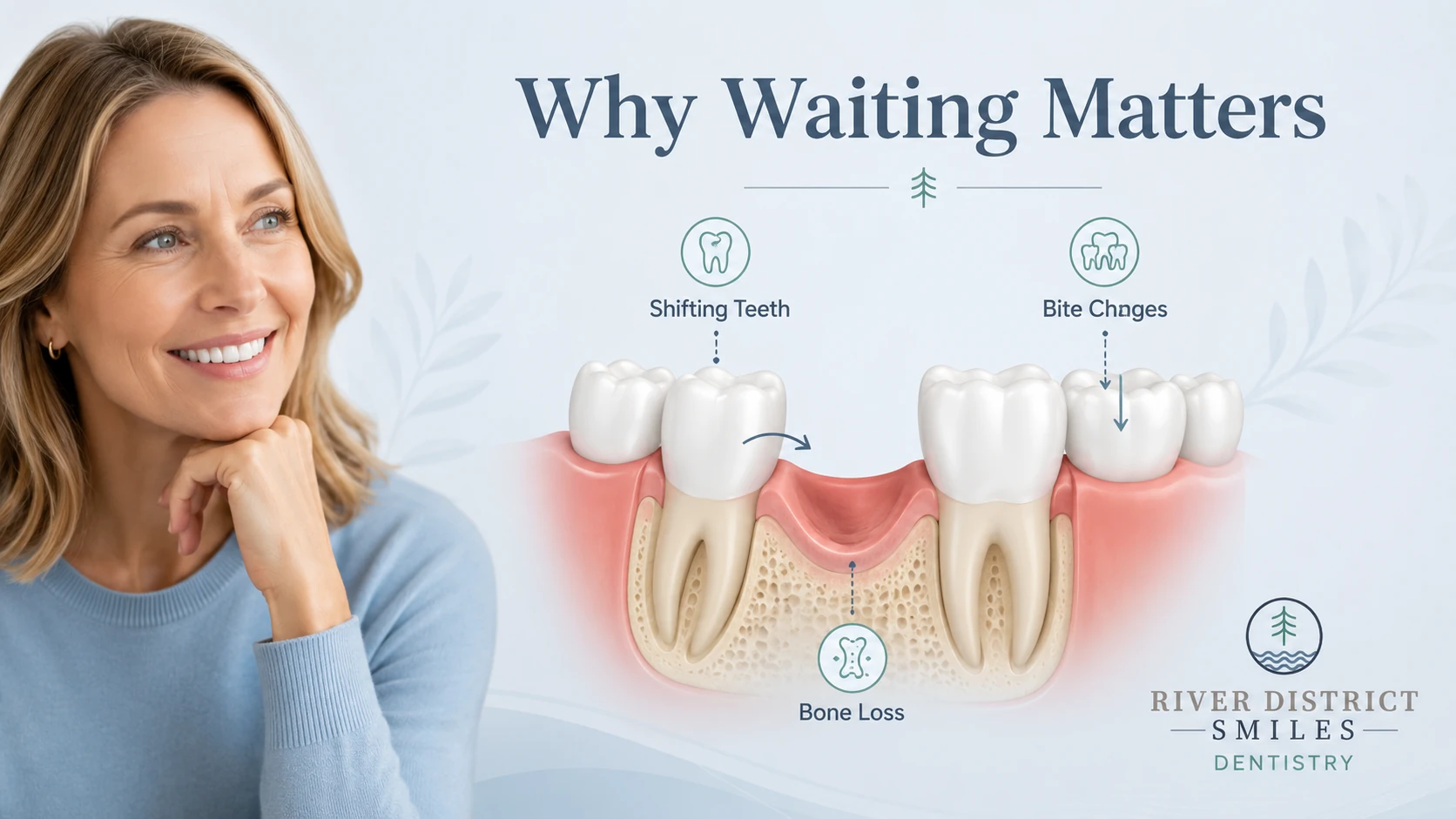
| Possible change | Why it matters |
| Bone in the area shrinks | Future implant placement may require additional treatment |
| Nearby teeth tilt or drift | The space may become harder to restore |
| The opposing tooth moves into the opening | Your bite and available replacement space may change |
| Chewing shifts to other teeth | Remaining teeth and restorations may carry more of the workload |
| Food becomes trapped | The area may become harder to keep clean |
| Speech or appearance changes | More noticeable with front teeth or several missing teeth |
| A denture becomes less stable over time | Changes in the gums and jaw can affect its fit |
| Replacement becomes more complicated | Additional imaging, grafting, or corrective treatment may be needed |
These are possibilities, not guarantees. The American College of Prosthodontists notes that tooth drifting, tipping, rotation, and over-eruption can occur after a back tooth is lost, but also cautions that these changes are not always as frequent or extensive as patients have historically been told.
1. The Jawbone in the Area Can Shrink
A tooth does more than help you chew.
The root also transfers forces into the surrounding jawbone. After the tooth is removed or lost, that area no longer receives the same stimulation. The bone that once supported the tooth can gradually lose height and width through a process called resorption.
This usually does not mean that the entire jaw suddenly becomes weak. With one missing tooth, the change is generally concentrated around that site.
The practical concern is that future treatment may become less straightforward.
A dental implant needs enough healthy bone to support it. If the ridge has become too narrow or short, a bone graft or ridge-modification procedure may be recommended before or during implant placement. The American Academy of Periodontology notes that inadequate bone can complicate implant placement and that ridge modification may be used to rebuild the site.
Does bone loss happen immediately?
Healing and remodeling begin after the tooth is lost, but there is no single deadline after which implant treatment becomes impossible.
Some patients maintain enough bone for an implant years later. Others lose a meaningful amount relatively quickly because of:
- The reason the tooth was lost
- Infection around the tooth
- Existing gum and bone disease
- The thickness of the original bone
- The tooth’s location
- Smoking or nicotine use
- Medical health
- Trauma during tooth loss or extraction
- Whether socket-preservation treatment was completed
The longer you wait, the greater the chance that the site will need additional evaluation or treatment. That does not mean you have “missed your chance” if the tooth has been gone for years.
2. Nearby Teeth May Tilt or Drift
Teeth help stabilize one another.
When a space opens, the teeth beside it may gradually lean, rotate, or move toward the opening. The amount of movement varies considerably and depends on the tooth’s location, the patient’s bite, age, and other factors.
This movement can matter because it may:
- Reduce the width available for a replacement tooth
- Create uneven contact between teeth
- Make the space more difficult to clean
- Change where food collects
- Complicate the shape of a bridge or implant crown
- Affect how the upper and lower teeth meet
Not every open space will close dramatically. Some remain relatively stable for years.
That is why monitoring can be a reasonable option in selected cases but “monitoring” should mean periodically checking the space, bite, bone, and neighboring teeth rather than assuming that nothing is changing.
3. The Opposing Tooth May Move Into the Space
When an upper tooth loses the lower tooth that normally contacts it or the other way around it may gradually move farther out of its socket toward the empty space. Dentists call this over-eruption or supra-eruption.
This does not happen predictably in every patient. When it does occur, it can reduce the room needed for a future replacement and change how the tooth contacts the rest of the bite. The American College of Prosthodontists includes supra-eruption among the potential changes associated with an unreplaced back tooth.
If the opposing tooth has moved significantly, replacing the missing tooth may require more planning than it would have earlier.
The dentist may need to determine whether:
- Enough vertical space remains
- The opposing tooth can be adjusted safely
- A crown is needed on the opposing tooth
- Tooth movement should be corrected first
- The replacement can be designed around the change
- Leaving the space alone is still reasonable
This is one reason a gap that causes no pain can still be worth evaluating.
4. Your Chewing Pattern May Change
A missing molar may not be visible, but it can still affect how you chew.
The ADA notes that even an unseen missing back tooth can change chewing function. A larger space can also affect speech and eating.
Many patients adapt by chewing more heavily on the opposite side.
That adaptation may feel normal after a while, but it can place more of the workload on:
- The remaining natural teeth
- Existing fillings and crowns
- A bridge
- A partial denture
- The jaw muscles
This does not mean that one missing tooth will automatically damage every remaining tooth.
The concern is more practical: if the rest of the mouth already contains large fillings, worn teeth, gum disease, or several missing teeth, concentrating the chewing forces into fewer areas may become less comfortable or less predictable.
5. Food May Become Harder to Clear
An open space can trap food.
This is especially common when nearby teeth have tilted, the gum contour has changed, or the contact between teeth is no longer stable.
You may notice:
- Food packing into the gap
- Tender gums after meals
- Floss carrying a strong odor from the area
- Bleeding during cleaning
- Difficulty reaching the back of the space
- Decay beginning on the exposed side of a neighboring tooth
The missing tooth itself cannot develop a cavity, but the teeth bordering the space still can.
Cleaning tools may need to be adjusted as the area changes. Depending on the space, the dentist or hygienist may recommend regular floss, an interdental brush, a water flosser, or another approach.
Persistent food trapping deserves an examination. The problem may come from tooth movement, gum disease, decay, or the shape of existing dental work rather than from the gap alone.
6. Your Speech or Appearance May Change
Front teeth play an important role in appearance and in forming certain speech sounds.
A missing front tooth may change how air moves during speech, particularly with sounds that involve the lips, tongue, and front teeth. Several missing teeth can have a larger effect on both speaking and chewing. The ADA notes that larger spaces can affect how a person speaks and eats.
The cosmetic effect is also personal.
Some patients want the space replaced immediately. Others are comfortable with it. There is no reason to shame someone for either decision.
From a treatment perspective, waiting can change the gum and bone contour around a visible tooth. That may affect how easily a future bridge or implant crown can be made to emerge naturally from the gum.
A single missing tooth does not normally cause the entire face to collapse. More noticeable facial changes are generally associated with substantial tooth and bone loss rather than one small space.
7. A Removable Denture May Become Less Stable
When several or all teeth are missing, the gum and bone underneath a removable denture continue to change.
A denture that fit well when it was made may later:
- Rock during chewing
- Create pressure spots
- Trap food
- Feel loose while speaking
- Require adhesive more often
- Need adjustment, relining, or replacement
Dentures can replace several or all missing teeth and remain a reasonable option for many patients, particularly when surgery is not desired or affordable. The ADA describes dentures as removable appliances that can restore missing teeth and support appearance and function.
The limitation is that a traditional denture rests on the gum and does not replace each missing tooth root. Implant-supported options can provide additional stability for selected patients.
8. Future Treatment May Cost More
Waiting does not automatically make treatment more expensive.
It can, however, add steps.
For example, a missing tooth that initially had adequate bone and a stable space might later require:
- Additional three-dimensional imaging
- Bone grafting
- Ridge modification
- Treatment of gum disease
- Repair of decay on neighboring teeth
- Adjustment of an opposing tooth
- Correction of lost restorative space
- A more complex temporary tooth
- A different replacement option than originally planned
The AAOMS explains that bone preservation can help maintain the ridge after tooth loss and improve the predictability of future implant treatment.
This does not mean every patient needs a graft or implant immediately.
It means that when you know you may want an implant in the future, discussing bone preservation at the time of extraction can be useful.
Should Every Missing Tooth Be Replaced?
No.
Not every missing tooth must automatically be replaced.
Replacement may be unnecessary or lower priority when:
- The missing tooth is a wisdom tooth
- The space is stable
- Chewing remains comfortable
- The opposing tooth is absent
- Replacement would provide limited functional benefit
- The patient’s health makes treatment unnecessarily risky
- Other dental disease needs to be controlled first
- The patient understands and accepts the likely tradeoffs
- The area can be cleaned and monitored effectively
The decision to leave a missing back tooth unrestored should be individualized. The American College of Prosthodontists recommends considering the tooth’s location, bite, long-term stability, maintenance, cost, and the likely effects of each option rather than assuming that every posterior space needs the same treatment.
Replacement is more likely to make sense when:
- The gap affects chewing
- A front tooth is missing
- Several teeth are missing
- Nearby teeth are beginning to move
- The opposing tooth is over-erupting
- Food repeatedly traps in the area
- The space affects speech
- A replacement is needed to support other dental work
- The patient wants to restore appearance
- Preserving the bone for long-term treatment is a priority
A good evaluation should explain what is likely to happen if you replace the tooth and what is likely to happen if you do not.
How Long Can You Wait?
There is no universal deadline.
Waiting a few weeks while an extraction site heals is very different from leaving a space unexamined for several years.
Your appropriate timeline depends on:
- Which tooth is missing
- Whether it was recently extracted
- Whether infection was present
- Whether bone grafting was completed
- Your gum and bone health
- The condition of neighboring teeth
- Your bite
- Whether an implant is planned
- Whether the space is changing
- Your medical health and budget
When an implant is planned
Some implants can be placed at the time of extraction. Others are placed after the site has healed. In some cases, bone grafting is recommended first.
The timing depends on infection, bone quantity, gum condition, implant stability, and the final restorative plan. An implant requires adequate bone mass and density for support.
Do not assume that faster is always better. Immediate placement is not appropriate for every extraction site.
When you are not sure what you want
You do not necessarily need to commit to an implant, bridge, or denture at the first visit.
You can ask the dentist to:
- Evaluate the site
- Document the current space and bite
- Explain whether bone preservation is useful
- Discuss temporary options
- Estimate the costs of each permanent option
- Identify what may become harder if you wait
- Recommend a monitoring schedule
The goal is to preserve reasonable choices while you make the financial and personal decision.
Tooth-Replacement Options
1. Dental Implant
A dental implant is a post placed into the jawbone to support a crown, bridge, or denture.
For one missing tooth, an implant generally replaces the root and visible tooth without relying on the neighboring teeth for support. Implants are designed to function as stable anchors for replacement teeth.
May be a good fit when:
- You want a fixed replacement
- The neighboring teeth are healthy
- Adequate bone is available
- You are comfortable with surgery
- You can maintain the area
- Long-term stability is a priority
Tradeoffs
- Surgery is required
- Treatment generally takes longer
- The initial cost is higher
- Bone grafting may be needed
- Implants can still develop gum and bone problems
- Long-term professional and home maintenance is necessary
River District Smiles’ June 2026 comparison guide lists a general planning range of approximately $3,000 to $5,000 per tooth for an implant restoration. That is educational guidance rather than a quote for a specific patient.
2. Dental Bridge
A traditional bridge replaces a missing tooth by connecting the artificial tooth to crowns or restorations on the neighboring teeth.
Bridges can restore chewing and appearance without implant surgery. The ADA describes a fixed bridge as a restoration anchored to surrounding teeth that fills the open space.
May be a good fit when:
- You want a fixed replacement without implant surgery
- The neighboring teeth already need crowns
- Implant treatment is not medically or anatomically appropriate
- A faster restorative timeline is important
- Bone grafting is not desired
Tradeoffs
- The supporting teeth must carry the bridge
- Healthy tooth structure may need to be removed
- Cleaning underneath requires additional care
- Decay or damage to a supporting tooth can affect the entire bridge
- The bridge does not replace the missing root or directly preserve bone in the open site
River District Smiles’ current comparison guide lists a broad planning range of approximately $1,500 to $3,000 for a single-tooth bridge, although actual fees depend on the materials, supporting teeth, and treatment required.
3. Removable Partial Denture
A partial denture can replace one or several missing teeth and is removed for cleaning.
May be a good fit when:
- Several teeth are missing
- A lower-cost initial option is needed
- Surgery is not desired
- A temporary replacement is needed
- The remaining teeth can support the design
Tradeoffs
- It is removable
- It may move slightly during chewing
- Clasps may be visible
- It takes time to adapt
- It requires regular cleaning and maintenance
- Changes in the teeth and gums can affect the fit
Partial dentures usually have a lower initial cost than multiple implants, but comfort and stability vary according to the design and remaining teeth.
4. Full Denture
A full denture replaces all teeth in one arch.
It can restore appearance, support the lips, and improve the ability to eat compared with having no teeth. However, traditional dentures rest on the gum and may require adjustments as the mouth changes.
May be a good fit when:
- Most or all teeth are missing
- Remaining teeth cannot be saved predictably
- A nonsurgical or lower-cost option is preferred
- The patient understands the adaptation and maintenance involved
Tradeoffs
- Chewing force is lower than with stable natural teeth or implant-supported restorations
- Movement and pressure spots can occur
- Fit can change over time
- Certain foods may remain difficult
- Relines, repairs, or replacement may be needed
5. Implant-Supported Denture or Full-Arch Restoration
Implants can also be used to stabilize a removable denture or support a fixed full-arch restoration.
This can improve stability for people who are missing most or all their teeth. The number of implants, whether the restoration is removable, bone availability, and the condition of the mouth all affect treatment.
Tradeoffs
- Higher initial cost
- Surgery is required
- Hygiene remains essential
- Components and prosthetic teeth may require future maintenance
- Bone grafting may be needed
- Not every patient is a candidate for the same design
6. Monitoring the Space
Monitoring can be a legitimate choice when the expected benefit of replacement is limited or the patient is not ready.
A monitoring plan may include:
- Periodic examinations
- X-rays when clinically appropriate
- Measurements or digital scans of the space
- Bite evaluation
- Checking the neighboring teeth for movement
- Monitoring the opposing tooth
- Evaluating bone and gum changes
- Reconsidering treatment if function or symptoms change
The American College of Prosthodontists specifically advises documenting existing conditions when a missing back tooth is not replaced so that future changes can be compared.
Should You Have a Bone Graft When the Tooth Is Removed?
Bone grafting or socket preservation may help reduce changes in the ridge after extraction and preserve the site for future implant treatment.
It is not automatically necessary after every extraction.
It may be more useful when:
- An implant is likely
- The front-tooth gum contour is important
- The bone walls are thin or damaged
- Infection has affected the site
- The original tooth caused substantial bone loss
- Maintaining the ridge shape will improve future treatment
It may offer less benefit when:
- The tooth will not be replaced
- The site does not need to support a future restoration
- Medical or local factors reduce the likely benefit
- Another surgical plan is more appropriate
Ask:
- What is the purpose of the graft?
- Is it necessary, strongly recommended, or optional?
- What happens if I decline it?
- Does it guarantee that I will not need grafting later?
- Is an implant planned?
- What is included in the graft fee?
A graft can preserve options, but it is not a guarantee that future implant treatment will be simple.
What If the Tooth Has Been Missing for Years?
Do not assume that nothing can be done.
The dentist can evaluate:
- How much bone remains
- The available space
- Whether teeth have shifted
- The position of the opposing tooth
- Gum health
- The condition of neighboring teeth
- Your bite
- Whether grafting is necessary
- Whether a bridge or removable option would be more practical
When bone is inadequate, ridge modification or other grafting procedures may improve the site for implant placement. Healing time and the predictability of treatment depend on the amount and location of the deficiency.
You may still have several options. They may simply be different from the options available immediately after the tooth was removed.
When Missing Teeth Need Prompt Attention
A stable, healed missing-tooth space is rarely an emergency by itself.
Contact a dentist promptly when:
- A permanent tooth was recently knocked out
- A tooth came out because of trauma
- Part of the root may remain
- The extraction area is increasingly painful
- Swelling is developing
- You notice pus, drainage, or a bad taste
- You have fever with dental pain or swelling
- An adjacent tooth feels loose
- You cannot chew comfortably
- A denture has broken or is creating sores
- A temporary tooth has come loose
- The missing tooth resulted from rapidly progressing gum disease
Difficulty breathing or swallowing with facial, tongue, jaw, or neck swelling requires emergency medical attention.
Questions to Ask Before Deciding to Wait
Ask your dentist:
- Does this tooth need to be replaced?
- What is likely to happen if I leave the space open?
- Are the nearby teeth already moving?
- Has the opposing tooth changed position?
- How much bone remains?
- Would waiting make implant treatment more difficult?
- Should I consider socket preservation or bone grafting?
- Can the area be monitored safely?
- How often should it be checked?
- Which replacement option is the most conservative?
- What are the complete costs of an implant, bridge, and partial denture?
- Will the neighboring teeth need treatment either way?
- How long would each option take?
- What maintenance will each option require?
- What would make you recommend treatment sooner?
A good consultation should explain both the cost of treatment and the consequences of doing nothing.
The Bottom Line
Waiting to replace a missing tooth does not guarantee that your teeth will shift dramatically or that an implant will become impossible.
It can, however, allow:
- Local bone loss
- Movement of neighboring teeth
- Over-eruption of the opposing tooth
- Changes in chewing
- Food trapping
- Loss of restorative space
- More complicated treatment later
The ADA notes that missing teeth may affect eating and speaking, that remaining teeth may shift, and that bone loss can occur around an open space.
River District Smiles provides evaluations and several replacement options for patients with one or multiple missing teeth in Rock Hill, including dental implants, bridges, dentures, and full-mouth implant treatment. The practice’s current guidance emphasizes choosing among those options based on oral health, bone, budget, lifestyle, and long-term goals rather than assuming that one treatment is best for everyone.
The next step is not assuming that every gap must be filled immediately or waiting until the space has obviously changed.
It is finding out what the missing tooth is doing to your bone, bite, and remaining teeth while you still have the widest range of reasonable options.