


Veneers and Implants Aren’t Actually Competing Options
If you’ve been searching “veneers vs. implants,” there’s a good chance you’re picturing these as two ways to get the same result. They’re not. The confusion is understandable — both can leave you with a straighter, whiter-looking smile, but they’re built to solve two completely different problems.
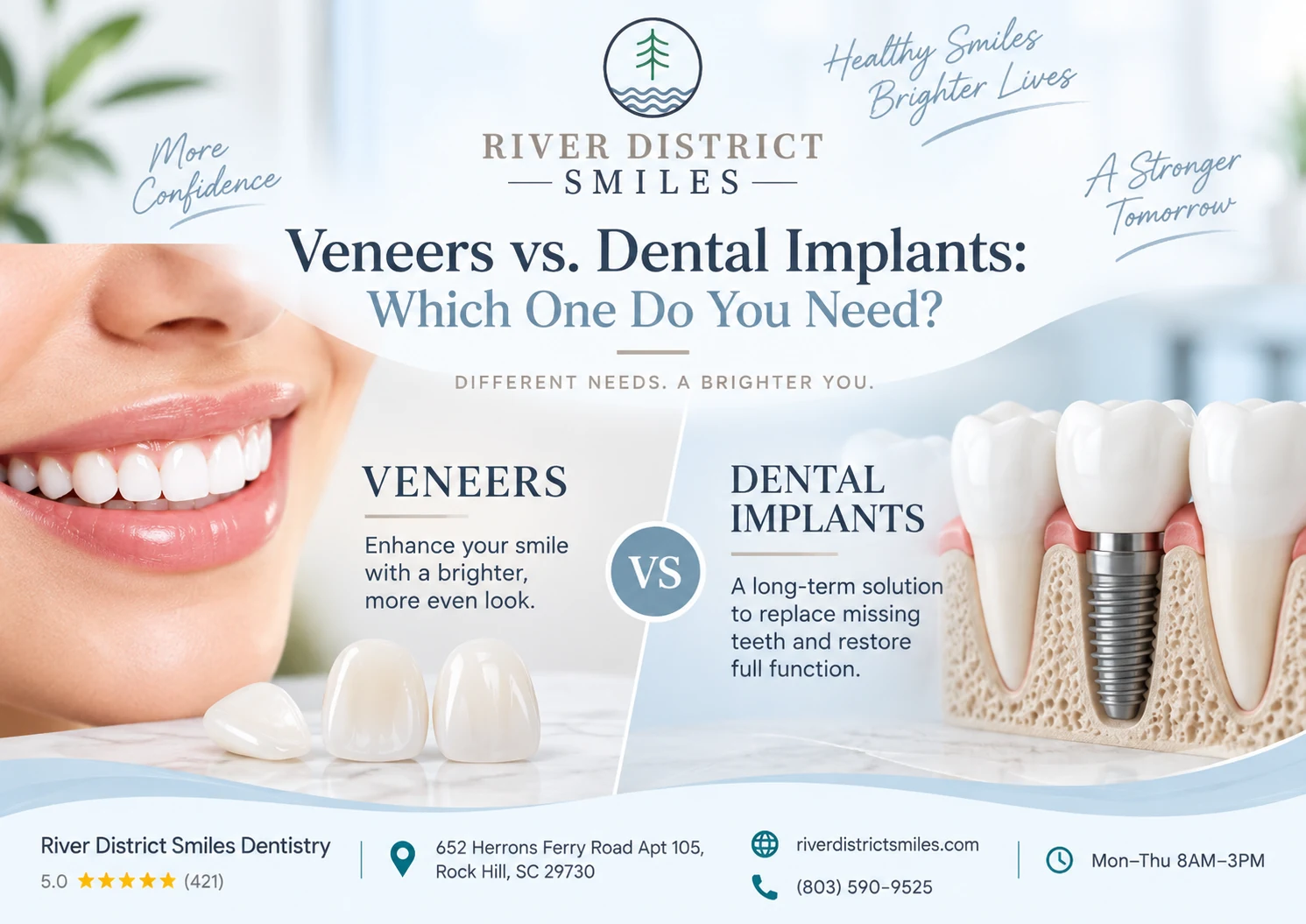
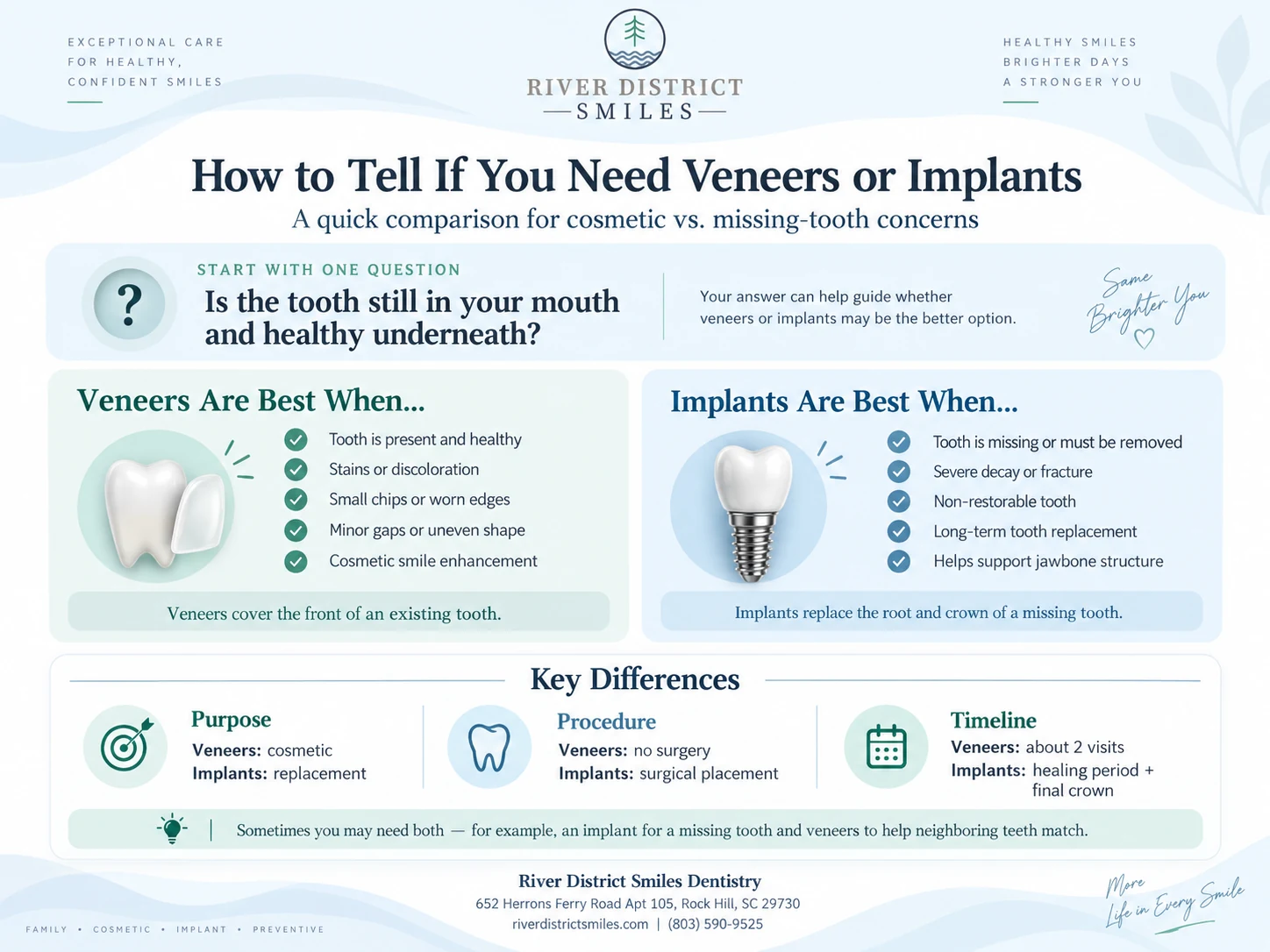
Veneers are a cosmetic fix for teeth that are still healthy and still in your mouth. A veneer is a thin custom shell, usually porcelain, bonded to the front surface of an existing tooth to change its color, shape, length, or size. The tooth underneath is alive and structurally fine — the veneer just covers what shows.
A dental implant is a completely different kind of treatment. It replaces a tooth that’s already gone, or that needs to come out — root and all. A titanium post is placed in the jawbone where the tooth used to be, and once it heals in place, a crown is attached on top to look and function like a natural tooth.
So the real question isn’t “which one is better.” It’s: is the tooth still there, or isn’t it?
Not Sure Which Treatment Fits Your Smile?
Get expert guidance on veneers vs. dental implants. Call today to discuss the right option for your smile.
The Quick Way to Tell Which One You Need
Ask yourself one question: Is the tooth I’m worried about still in my mouth, and is it healthy underneath?
- If yes — the tooth is present, it’s not decayed or fractured below the surface, you just don’t love how it looks — you’re almost certainly looking at veneers. Chips, permanent staining, worn edges, small gaps, or a slightly crooked front tooth are classic veneer territory.
- If no — the tooth is missing, badly broken, so decayed it needs extraction, or a dentist has already told you it can’t be saved — you’re looking at implants. Veneers have nothing to bond to if there’s no healthy tooth structure left, or no tooth at all.
There’s a middle case worth naming, too: sometimes a tooth looks cosmetically fine on the outside but has a problem underneath — a large cavity, a cracked root, an old injury — that a veneer would only hide, not fix. That’s exactly why any veneer conversation should start with an exam, not a shade guide. Placing a veneer over a tooth with unresolved decay can let that problem get worse underneath the shell.
What Veneers Actually Fix
Veneers are meant for teeth that are structurally sound but cosmetically imperfect. Good candidates typically include:
- Teeth stained by medication, age, or old fillings that whitening won’t fully correct
- Chipped or slightly worn front teeth
- Small gaps between teeth
- Teeth that are a bit short, uneven, or oddly shaped
- Minor crowding or rotation you’d rather mask than move with orthodontics
Veneers only cover the visible front surface — they don’t replace the tooth, and they don’t fix what’s happening below the gumline or inside the tooth. They’re also a one-way decision: a small amount of enamel is typically removed to fit the shell properly, so once you’ve prepared a tooth for a veneer, it will need some kind of covering (a veneer or crown) going forward. If you want a deeper look at what that trade-off involves, we’ve written a full breakdown in what are porcelain veneers, and what are their pros and cons.
What Implants Actually Fix
Implants exist for one core problem: a tooth that is no longer there, or won’t be much longer. That includes:
- A tooth already lost to decay, injury, or gum disease
- A tooth that’s fractured at or below the gumline
- A tooth so compromised by infection that extraction is the only option
- Gaps you’ve been living with for a while, including ones causing shifting or bite changes
Because an implant replaces the root, not just the crown, it does something veneers were never designed to do: it gives your jawbone something to hold onto. When a tooth root is missing for good, the bone underneath it gradually resorbs.
An implant post integrates with that bone and helps preserve it, which is part of why implants are usually described as a long-term structural solution rather than a cosmetic one.
If a missing tooth is the situation you’re actually dealing with, our article on what happens if you wait too long to replace missing teeth walks through why timing matters.
Can You Ever Need Both?
Yes — they’re not mutually exclusive. A common real-world case: someone loses one front tooth (needs an implant to replace it) while the teeth next to it are healthy but discolored or slightly uneven (candidates for veneers to match the new implant crown’s shade and shape). In cases like that, the implant restores the missing tooth, and veneers on the neighboring teeth help everything blend together.
Which combination makes sense for your mouth is exactly the kind of thing to sort out at an exam rather than guess at from a search result.
Recovery and Timeline: What’s Actually Different
This is where the two treatments diverge the most.
Veneers typically take two visits. The first is for preparation and impressions (or a digital scan); a temporary veneer may be worn while your permanent ones are custom-made. The second visit is for bonding the finished veneers in place. There’s no surgery and essentially no downtime — most patients go back to normal activities the same day.
Implants involve a healing period that veneers simply don’t have. After the implant post is surgically placed, the bone needs time to fuse to it — a process called osseointegration that commonly takes several months before a permanent crown can be attached, depending on your bone health and the specific case. It’s a longer process than veneers, but it’s what allows an implant to function like a natural tooth root for the long term rather than just sitting on top of the gum.

Do Gums Attach To Dental Implants?
They do not attach to gums, but the gums do surround the dental implant. In the world of dentistry, implants…
Cost is a Real Factor, Too
Veneers are typically priced per tooth and are considered elective/cosmetic, so insurance coverage is limited in most cases. Implants involve more steps — the surgical placement, the healing period, and the final crown which is usually reflected in the overall cost, though insurance sometimes covers a portion when the implant is replacing a tooth lost to decay, injury, or disease rather than for purely cosmetic reasons.
Because pricing depends on your specific case, the most reliable way to get real numbers is a consultation rather than a general estimate.
Frequently Asked Questions
Q: Can veneers be used to replace a missing tooth?
No. A veneer is a thin shell bonded to the front of an existing tooth — it needs a real tooth underneath it to attach to. If a tooth is missing, a veneer isn’t an option; you’d be looking at an implant, a bridge, or another tooth-replacement solution instead.
Q: Are dental implants only for people missing several teeth?
No. Implants can replace a single missing tooth, several teeth, or support a full-arch restoration. The amount of tooth loss doesn’t determine whether implants are an option — it determines how many are needed.
Q: I have one discolored tooth next to a missing one — do I need veneers or an implant?
Likely both, addressing two separate issues: an implant to replace the missing tooth, and a veneer (or two) on the discolored tooth so the final result matches in color and shape. An exam can confirm the right combination for your specific mouth.
Q: Do veneers require surgery like implants do?
No. Veneers are bonded to the existing tooth surface in-office with no incision or healing period involved. Implants require a minor surgical procedure to place the post in the jawbone, followed by a healing phase before the final crown is attached.
Q: Will my dentist tell me if I need a veneer or an implant, or do I have to decide?
You don’t have to self-diagnose. At your exam, we’ll look at whether the tooth in question is present and healthy, or missing/non-restorable, and recommend the option that actually matches what’s happening — not just what you think might look better.
Not Sure Which One Fits Your Situation?
If you’re still not sure whether what you’re dealing with is a cosmetic fix or a missing-tooth problem, that’s a completely normal place to be — it’s exactly why an exam exists.
Dr. Matthew Hubis and Dr. Emily Hubis can look at the tooth (or the gap) in question and tell you plainly whether you’re a candidate for veneers, implants, or something else entirely.
Reach out to River District Smiles at (803) 590-9525, or call our new patient line at (803) 998-2445 if this will be your first visit with us.
Sources:
- https://www.mouthhealthy.org/all-topics-a-z/veneers
- https://www.mouthhealthy.org/all-topics-a-z/implants
- https://my.clevelandclinic.org/health/treatments/10903-dental-implants
Ready to Restore Your Smile?
Whether you need veneers or dental implants, professional care starts with a personalized consultation. Call now.