


Nobody wants to overpay for dental care.
If two offices appear to offer the same crown, implant, filling, or extraction, choosing the lower price can seem like the responsible decision. For some patients, it may be.
But dental estimates that look similar on paper do not always include the same diagnosis, materials, treatment steps, follow-up, or long-term plan.
Cheap dental work is not automatically poor dental work. Dental schools, community health centers, insurance-negotiated fees, and in-house membership plans can all make appropriate care more affordable. The concern is not simply that the price is low.
The concern is whether the lower price comes from:
- Treating the symptom without identifying the cause
- Choosing a repair that is too limited for the damage
- Leaving necessary steps out of the estimate
- Using a treatment that cannot be maintained properly
- Providing little or no follow-up care
- Removing a tooth without considering the cost of replacing it
- Repeating work that was not planned or completed predictably
The least expensive treatment is the one that solves the right problem with the least unnecessary dentistry not necessarily the one with the lowest price today.
A Lower Price Is Not Always a Warning Sign
Before discussing how inexpensive dental work can become costly, it is important to be fair.
There are legitimate ways to receive quality care at a reduced price.
The National Institute of Dental and Craniofacial Research identifies dental schools, dental hygiene schools, community health centers, and other public resources as possible sources of lower-cost care. Dental students in teaching clinics work under the supervision of licensed dentists, although appointments may take longer.
A lower price may also result from:
- An insurance company’s negotiated network fee
- An employer contributing toward dental benefits
- A dental membership plan
- A practice offering a new-patient special
- Treatment performed in a teaching clinic
- A simpler case that genuinely requires less care
- Choosing a reasonable, less expensive material
- Dividing nonurgent treatment into manageable phases
River District Smiles, for example, offers in-house membership options that bundle certain preventive services and provide discounts on eligible treatment. That is a structured way to reduce cost; it is different from reducing the necessary steps of care.
The right question is not, “Why is this office cheaper?”
It is:
“What exactly is included, and will this treatment predictably solve my problem?”
Price and Value Are Not the Same Thing
The price of dental treatment is what you pay for the procedure.
The value depends on:
- Whether the diagnosis is correct
- Whether the treatment fits the condition
- How much healthy tooth structure is preserved
- Whether the restoration functions comfortably
- Whether it is maintainable
- How likely it is to need repair or replacement
- Whether the provider will manage complications
- What happens if the treatment fails
A restoration that costs less initially but must be replaced repeatedly may provide poor value. A more expensive treatment is also not automatically better. Patients can overpay for unnecessary, overly aggressive, or poorly explained care.
Good value usually comes from choosing the most conservative predictable treatment.
That may be a small filling in one situation and a crown in another. It may mean saving a tooth with root canal treatment, or it may mean extracting a tooth that cannot be restored reasonably.
How Cheap Dental Work Can Become Expensive
1. The treatment addresses the pain but not the cause
Dental pain can come from several different sources:
- Tooth decay
- A cracked tooth
- An infected nerve
- Gum disease
- A loose restoration
- Teeth grinding
- A bite problem
- A jaw-muscle or joint condition
A quick repair may temporarily reduce discomfort without addressing the underlying problem.
For example, replacing a filling may not solve the problem if the tooth is cracked. Adjusting the bite may not help if the nerve is infected. Antibiotics may temporarily reduce swelling without removing the source of a dental infection.
The value of the examination is not simply that someone looks inside your mouth. The dentist is determining which tooth is involved, what tissue is damaged, whether the tooth can be restored, and which treatment is likely to last.
Routine dental evaluations also allow patients and providers to discuss individual risks and detect problems before they become harder to manage.
2. Necessary diagnostic steps are left out
An unusually low treatment quote may not include:
- An examination
- Dental X-rays
- Three-dimensional imaging when needed
- Gum measurements
- Photographs or digital scans
- Bite analysis
- Specialist consultation
- Follow-up visits
Not every procedure requires every type of imaging. More testing is not automatically better.
However, complex treatment planned without the information needed to diagnose the condition can create expensive surprises.
Before comparing estimates, ask whether each dentist is working from the same records. A quote given over the phone without an examination may be useful as a broad range, but it cannot account for decay under an existing crown, bone loss around an implant site, a root fracture, or another complication.
3. A filling is placed where the tooth needs more protection
Fillings work well when the damaged area is small enough for the remaining tooth to support the repair. Tooth-colored composite materials can provide good durability for small-to-moderate restorations that withstand normal chewing pressure.
Problems arise when a large filling is chosen only because it costs less, even though too little strong tooth remains.
A tooth with a very large cavity, multiple cracks, or extensive old filling material may flex or fracture under pressure. A crown costs more because it covers and protects the weakened tooth. The American Dental Association describes crowns as restorations used to strengthen weak teeth, restore broken teeth, and cover dental implants.
That does not mean every large filling needs a crown. It means the recommendation should be based on:
- How much tooth remains
- Where the cracks are located
- Whether a chewing cusp is weakened
- The strength of the patient’s bite
- Whether the patient grinds or clenches
- The tooth’s position
- The expected lifespan of each option
Choosing a filling when a crown is reasonably necessary may save money today but increase the risk of the tooth breaking later.
4. The cheapest crown is not designed for the patient’s bite
A crown is not simply a tooth-shaped cap selected from a shelf.
It must fit:
- The prepared tooth
- The contact with neighboring teeth
- The bite against the opposing tooth
- The gumline
- The patient’s functional and cosmetic needs
A poorly fitting crown can contribute to:
- Food trapping
- Gum irritation
- Bite discomfort
- Sensitivity
- Decay at the crown margin
- Chipping or fracture
- Difficulty cleaning
- The need for adjustment or replacement
Crown prices can also differ because of material, laboratory process, case complexity, and the amount of preparation required. River District Smiles notes that crown recommendations depend on the amount of damaged tooth structure, the tooth’s location, the bite, and the patient’s goals.
A higher-priced crown is not guaranteed to fit better. What matters is whether the dentist has completed a proper diagnosis, selected an appropriate material, prepared the tooth carefully, and checked the result.
A Simple Example of Up-Front Price vs. Total Cost
Consider two hypothetical treatment plans for a weakened tooth.
| Lower-cost approach | More protective approach | |
| Initial treatment | $300 filling | $1,200 crown |
| What happens later | Tooth fractures and needs additional care | Crown remains functional |
| Added treatment | $1,500 root canal and new crown | None during the example period |
| Simplified total | $1,800 | $1,200 |
These figures are illustrative, not treatment quotes or guarantees.
The point is not that the crown will always be the better choice. A filling may be completely appropriate in a smaller cavity. The point is that comparing only the initial price can hide the likely cost of repeating or expanding treatment.
The reverse can also happen. Placing a crown on a tooth that could be repaired conservatively with a filling removes more tooth structure and creates a larger expense than necessary.
The goal is not to choose the larger treatment. It is to choose the right-sized treatment.
Root Canal vs. Extraction: The Cheapest Day Is Not Always the Cheapest Plan
Extraction usually costs less initially than root canal treatment and a final restoration.
But extraction and tooth replacement are separate decisions.
After a tooth is removed, replacement may involve:
- A dental implant and crown
- A fixed bridge
- A removable partial denture
- Additional bone grafting
- Temporary teeth
- Multiple appointments
The American Association of Endodontists advises patients to compare the complete cost of extraction and replacement with the cost of saving the natural tooth. Root canal treatment removes infected tissue from inside the tooth, disinfects and seals the canal system, and allows the tooth to be restored afterward.
Root canal treatment is often a good investment when:
- The tooth can be restored predictably
- The crack does not extend through the root
- The tooth has reasonable bone and gum support
- Enough healthy structure remains
- The patient wants to maintain the natural tooth
Extraction may be the better value when:
- The tooth has a severe vertical root fracture
- Decay extends too far below the gumline
- Most supporting bone has been lost
- Too little tooth remains for a predictable restoration
- Previous treatment has repeatedly failed
- Saving the tooth would require extensive care with a poor prognosis
Keeping every tooth at any cost is not good dentistry. Removing every difficult tooth because extraction is cheaper is not good financial planning either.
The Cost of Not Replacing an Extracted Tooth
Not every extracted tooth needs to be replaced. Wisdom teeth generally are not replaced, and there are situations where leaving another space may be reasonable.
However, an open space can sometimes affect:
- Chewing
- Tooth position
- Bite stability
- Appearance
- The amount of bone in the area
- Future replacement options
If an extraction is being recommended, ask for two estimates:
- The cost of removing the tooth
- The cost of the complete replacement plan, if replacement is recommended
This prevents a $300 extraction from being mistaken for the total cost of a treatment plan that may eventually include several thousand dollars of additional care.
Delaying a Small Problem Can Turn It Into a Larger One
Some patients delay treatment because even the lower-priced option feels unaffordable.
There should be no shame in that. Dental treatment competes with housing, food, childcare, transportation, medications, and other real expenses.
But patients deserve to understand what waiting may change.
A small cavity may eventually become:
- A larger filling
- A crown
- A root canal and crown
- An extraction
- A missing tooth that needs replacement
Gingivitis may progress into periodontitis, which damages the gums, ligament, and bone supporting the teeth. Advanced gum disease can lead to loose teeth and tooth loss.
A small crack may spread.
A loose crown may allow decay to develop underneath.
A missing filling may expose the tooth to further damage.
Waiting does not guarantee that the problem will worsen immediately, but dental disease rarely becomes less expensive after more tooth structure or supporting bone has been lost.
A Regular Cleaning Is Not a Cheaper Substitute for Gum Treatment
A routine cleaning is designed to prevent disease in generally healthy gums.
Scaling and root planing, commonly called a deep cleaning, treats plaque and tartar below the gumline when periodontitis is present.
Choosing a routine cleaning only because it costs less may leave the active infection untreated. The teeth may feel cleaner, but the bacteria and hardened deposits deeper around the roots remain.
Periodontal disease ranges from mild gum inflammation to damage involving the soft tissue and bone that support the teeth. In advanced cases, teeth can be lost.
Before agreeing to deep cleaning, ask to see:
- Your gum-pocket measurements
- Areas that bleed
- Tartar visible beneath the gumline
- Areas of bone loss
- Which teeth require treatment
- Which areas remain healthy
A deep cleaning should not be recommended simply because it costs more. A regular cleaning should not be substituted simply because it costs less.
The diagnosis should determine the service.
Cheap Implant Treatment Can Leave Important Costs Out
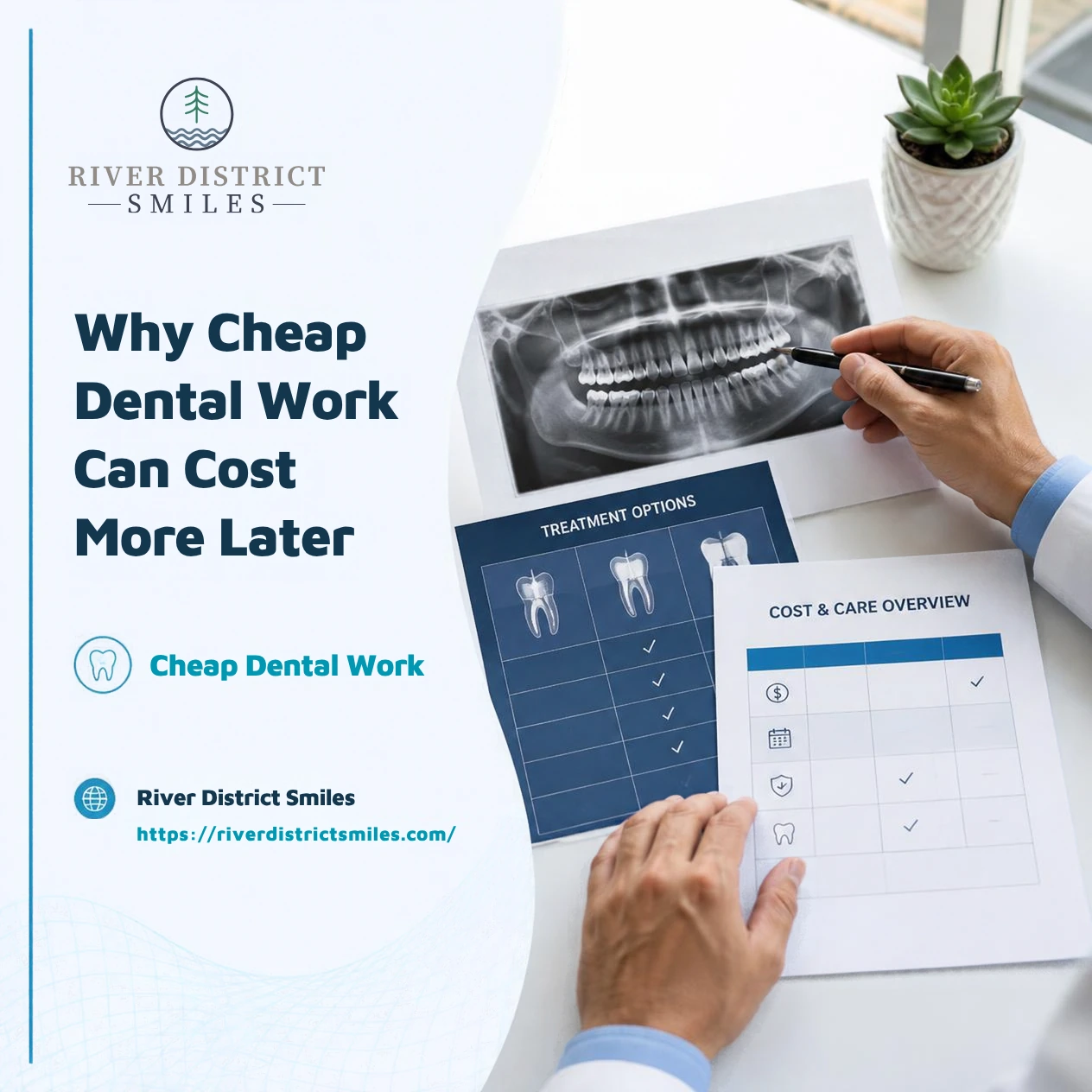
Implant advertisements sometimes promote one low number without explaining whether it includes the full restoration.
An implant plan may involve:
- Examination and imaging
- Tooth extraction
- Bone grafting
- Implant placement
- An abutment or connector
- A temporary tooth
- The final implant crown
- Sedation
- Follow-up visits
- Treatment of complications
- Long-term maintenance
A quoted “implant price” may refer only to the implant placed in the bone not the visible tooth, grafting, or other necessary care.
Before comparing implant prices, ask whether each estimate includes the same stages.
Also ask:
- Who performs each stage?
- Which implant system is being used?
- Will replacement parts be available later?
- Who manages a complication?
- Is the final crown included?
- What maintenance will be required?
- What happens if the implant does not integrate with the bone?
Dental implants can be an effective way to replace missing teeth, but they still require appropriate planning, healthy supporting tissues, and ongoing care.
Cosmetic Work Can Be Expensive to Redo
Cosmetic dental work is not only about making teeth whiter or straighter.
It also affects:
- Bite
- Speech
- Tooth shape
- Gum appearance
- Cleaning
- Lip support
- How much natural enamel is removed
A very low veneer or full-smile quote may not include diagnostic planning, temporary restorations, gum treatment, bite management, or future repairs.
When several visible teeth are being changed, ask to see the proposed shape and proportions before final treatment begins. Depending on the case, that may involve photographs, digital planning, a wax model, trial bonding, or temporary restorations.
River District Smiles describes cosmetic care as beginning with a healthy foundation because untreated decay, gum inflammation, or bite problems can undermine the result.
A patient should also understand whether the treatment is reversible.
Whitening is different from bonding. Bonding is different from veneers. Veneers are different from crowns. The more tooth structure that is altered, the more important the long-term maintenance plan becomes.
Overseas Dental Work and the Cost of Follow-Up
Dental treatment abroad can cost substantially less, and many patients receive acceptable care.
The main financial risk is not simply that the treatment occurs in another country. It is that complications, adjustments, and replacement care may need to be managed after the patient returns home.
The American Dental Association advises patients to consider continuity of care because major dental procedures may require months of healing and follow-up. Surgical complications can include pain, swelling, bleeding, and infection.
The Centers for Disease Control and Prevention also notes that infection-control standards, regulatory oversight, communication, documentation, and follow-up can vary when healthcare is received abroad.
Before traveling for dental treatment, ask:
- Who will handle complications after I return?
- Will I receive complete X-rays and treatment records?
- Which materials and implant components will be used?
- Are replacement components available in the United States?
- How many trips will be required?
- What happens if the final restoration does not fit?
- Who pays for corrective treatment?
- How much travel, lodging, and missed work should be added?
- Does my insurance cover complications from treatment abroad?
The advertised procedure price is only one part of the real cost.
Repeated Repairs Can Remove More Natural Tooth
Every time a filling or crown is replaced, the dentist may need to remove additional damaged or weakened material.
That does not mean restorations should never be replaced. Dental work is not permanent, and even well-made restorations can eventually wear, chip, leak, or develop decay around the edges.
The concern is unnecessary repetition.
A pattern can look like this:
- A small filling is placed.
- The filling fails or decay develops around it.
- A larger filling is needed.
- The remaining tooth weakens or fractures.
- A crown becomes necessary.
- The nerve becomes inflamed or infected.
- Root canal treatment may be needed.
Not every tooth follows that path. Good preventive care and appropriate restorations can interrupt it.
Still, a treatment chosen mainly because it is the lowest price should be evaluated in terms of how much healthy tooth it preserves and what the next step would be if it fails.
Red Flags When Comparing Low-Cost Dental Treatment
A low price alone is not a red flag.
The following deserve additional questions:
No examination is required
A precise final quote for complex treatment should not usually be made without evaluating the teeth, gums, bite, and relevant imaging.
The estimate is not written down
You should be able to see which procedures are included and which may be added later.
The recommendation is the same for everyone
Not every cracked tooth needs a crown. Not every missing tooth needs an implant. Not every patient with jaw pain needs Botox. Treatment should reflect the diagnosis.
The price applies only if you decide immediately
Legitimate scheduling or promotional limits may exist, but patients should not be pressured into irreversible treatment before understanding their options.
Important stages are omitted
Ask whether the quote includes temporary restorations, build-ups, grafting, abutments, final crowns, anesthesia, adjustments, and follow-up.
No alternatives are discussed
Patients should understand reasonable options, including what happens if they delay or decline care.
The office cannot explain materials or providers
It is reasonable to ask which material, appliance, laboratory, or implant system is being used and who will perform each stage.
There is no plan for complications
Even properly completed dental treatment can develop complications. Ask who to contact, what follow-up is included, and how unexpected care is handled.
Questions to Ask Before Choosing the Cheapest Estimate
Bring both estimates and compare them line by line.
Ask:
- What is the exact diagnosis?
- Can you show me the problem on the X-ray or photograph?
- What caused it?
- Is this the most conservative predictable treatment?
- What alternatives are reasonable?
- What happens if I choose the less expensive option?
- What happens if I wait?
- What is included in the price?
- Will I need a crown, graft, temporary tooth, or follow-up procedure?
- Which materials will be used?
- Who will perform each stage?
- Is specialist care included?
- How long is the treatment expected to function?
- What maintenance will it require?
- What is covered if it needs adjustment?
- What would it cost to repair or replace?
- Does insurance apply?
- Are membership discounts or phased treatment available?
- Can I have time to review the plan?
- Can I obtain a second opinion?
A dentist should be able to explain why a treatment is recommended without criticizing another provider or pressuring you.
When the Less Expensive Option Is Reasonable
Sometimes the cheaper option is completely appropriate.
A filling instead of a crown
When the cavity is limited and enough strong tooth remains, a filling may be the more conservative choice.
Bonding instead of veneers
A small chip, gap, or shape concern may be improved with bonding without removing as much enamel.
A bridge or partial denture instead of an implant
An implant is not the only reasonable way to replace a tooth. A bridge or removable appliance may fit the patient’s health, timeline, anatomy, and budget better.
A traditional crown instead of a premium cosmetic material
A highly cosmetic material may offer little additional value on a tooth that is not visible, depending on the bite and clinical needs.
Monitoring instead of immediate treatment
Some early findings can be monitored when the risk is low and the patient can return reliably for follow-up.
A supervised teaching clinic or community clinic
Reduced-cost clinics can provide appropriate care when patients understand that visits may take longer or service availability may be limited.
The less expensive option makes sense when it meets the treatment goal not when it merely postpones the same problem.
What to Do When the Recommended Treatment Is Unaffordable
Tell the dental office before assuming nothing can be done.
Ask whether the plan can be divided into:
- Urgent treatment
- Disease-control treatment
- Definitive restoration
- Cosmetic or elective treatment
- Long-term replacement care
For example, an office may be able to:
- Treat an infection first
- Place a temporary restoration
- Complete one side of the mouth at a time
- Prioritize the tooth with the highest risk
- Monitor a lower-risk area
- Discuss a less expensive material
- Use insurance benefits across plan years
- Apply an in-house membership discount
- Review financing options
- Refer to a teaching or community clinic
Temporary care is not always available or appropriate. A cracked, infected, or severely weakened tooth may become less predictable if final care is postponed.
Still, a clear priority list is better than leaving the office believing that every recommended procedure must happen at once.
The Bottom Line
Cheap dental work can cost more later when the lower price reflects incomplete diagnosis, limited treatment, omitted steps, poor follow-up, or a procedure that is not strong enough for the problem.
But lower-cost care is not automatically lower-quality care.
Insurance-negotiated fees, membership plans, dental schools, community clinics, conservative treatment, and phased care can all reduce expenses responsibly. The National Institute of Dental and Craniofacial Research specifically identifies supervised dental-school clinics and community resources as options for patients seeking more affordable care.
River District Smiles provides general, cosmetic, implant, and restorative care in Rock Hill, with treatment planning focused on the patient’s diagnosis, goals, comfort, and long-term oral health.
The best question is not:
“Which dentist gave me the lowest price?”
It is:
“Which plan solves the right problem, preserves what can reasonably be preserved, and gives me the clearest understanding of what I may need later?”
A good dental visit should leave you knowing what is urgent, what can wait, where you can safely save money, and where a cheaper shortcut may create a larger expense.