



Why a Professional Cleaning Still Matters, Even If You’re Great About Brushing and Flossing
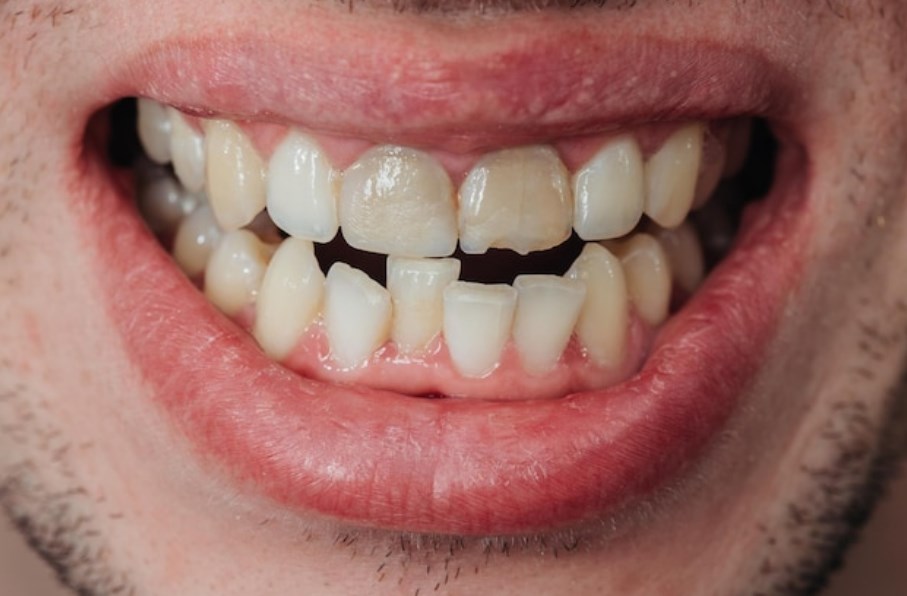
Brushing and flossing keep soft plaque under control day to day, but they can’t touch everything. Once plaque sits on a tooth long enough, it hardens into tartar (also called calculus), a mineralized deposit that bonds to the tooth surface and, especially along and below the gumline, simply cannot be brushed off no matter how diligent you are at home. Only hand instruments or an ultrasonic scaler in a dental office can remove it.
That matters because tartar buildup is what allows gum inflammation to take hold and progress — from mild, reversible gingivitis toward the more serious, bone-damaging stage called periodontitis. A professional cleaning is also a hands-on checkpoint: your hygienist and dentist are looking directly at your gum tissue, checking pocket depths around each tooth, and catching early inflammation, staining, or wear patterns long before you’d notice anything yourself.
There’s also a well-documented, if not fully understood, connection between gum health and the rest of the body. Research has linked chronic gum inflammation to conditions like heart disease and diabetes, the relationship isn’t fully proven to be causal, but it’s consistent enough that keeping gum disease in check is considered good preventive practice, not just a cosmetic concern. You can see the full range of services this covers on our teeth cleaning page.
Worried About Your First Teeth Cleaning?
Feel confident with gentle, professional dental care. Call today and let our team help you get started!
What Actually Happens During a Cleaning, Step by Step
Most routine cleanings take somewhere between 30 minutes and an hour, and follow a pretty consistent sequence:
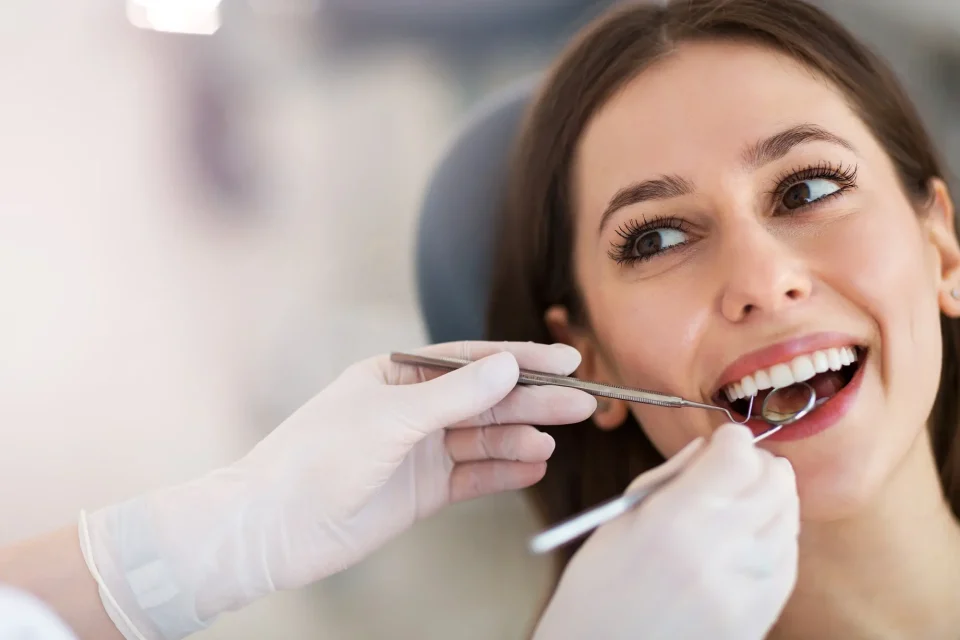
1. A quick visual check. The hygienist uses a small mirror to look around your mouth and note anything that needs the dentist’s attention later.
2. Scaling. Using hand instruments and often an ultrasonic scaler (a tool that uses gentle vibration and a fine water spray to loosen tartar), your hygienist removes plaque and tartar from the tooth surfaces and along the gumline.
3. Polishing. A soft, spinning rubber cup with a gritty polishing paste buffs away surface stains and smooths the enamel, which also makes it a little harder for new plaque to stick in the short term.
4. Flossing. Professional flossing gets between every contact point and lets the hygienist flag any areas that bleed easily — often an early sign of gum inflammation worth watching.
5. Rinse and fluoride. After rinsing away loose debris, most cleanings finish with a fluoride treatment to help re-strengthen enamel.
6. A final look from the dentist. Your dentist typically reviews the visit, checks anything flagged during scaling, and talks through next steps if anything needs follow-up.
If X-rays or a full exam are due, those are usually built into the same visit, see our dental exam page for what that side of the appointment covers.
The Real Different Types of Cleanings
Not every “cleaning” is the same procedure, and the difference matters for what to expect and how it’s billed:
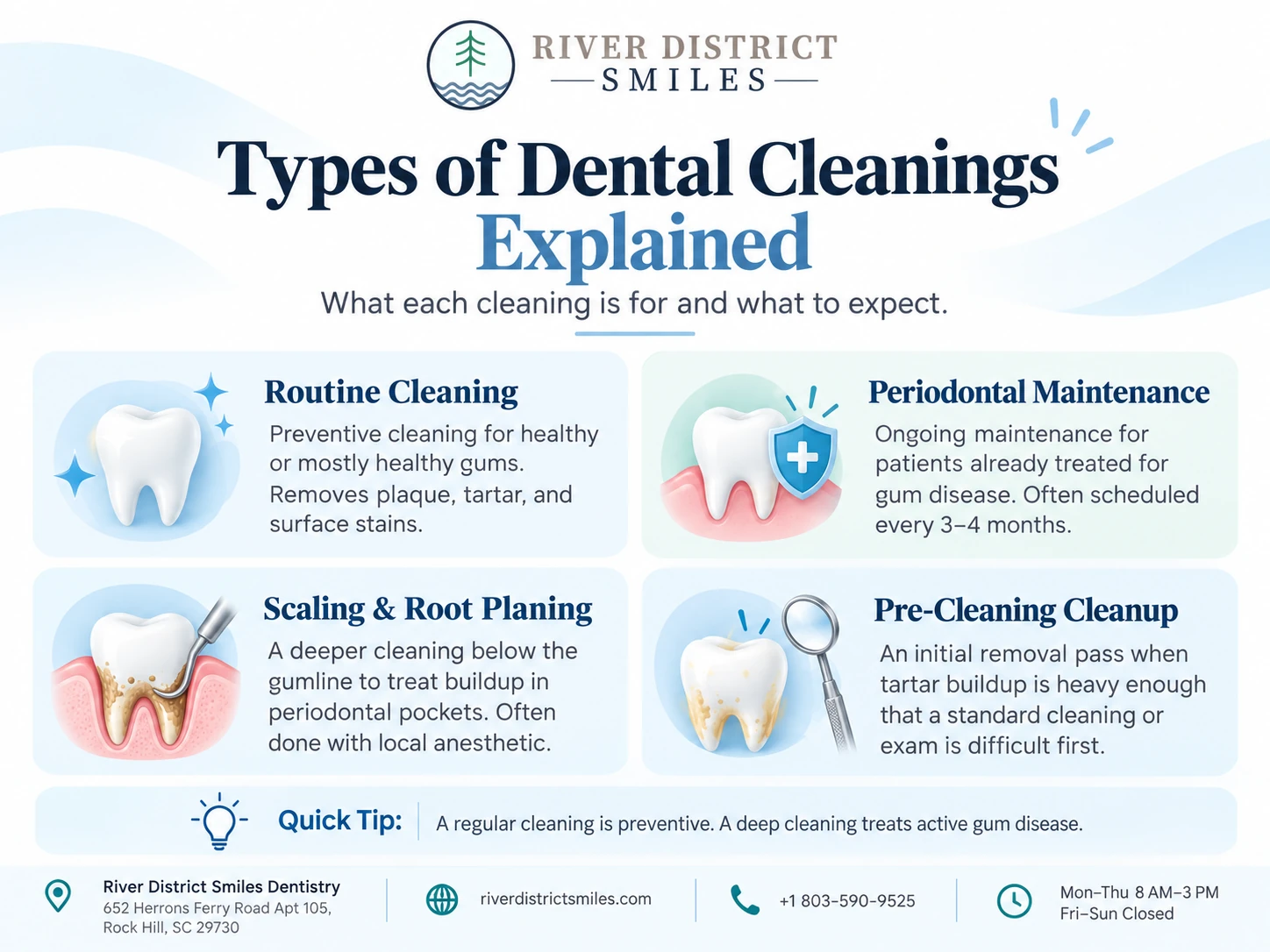
Routine cleaning (prophylaxis). This is the standard cleaning described above, for patients whose gums are healthy or close to it. It’s preventive — the goal is to keep things from ever getting worse.
Periodontal maintenance. For patients who’ve already been treated for gum disease, this is a modified cleaning that goes a bit deeper around the gumline and is usually scheduled more often — every three to four months instead of twice a year — to keep the disease from coming back.
Scaling and root planing (“deep cleaning”). This is a genuinely different, more involved procedure, not just a longer version of a routine cleaning. It’s used when tartar and bacteria have built up in periodontal pockets below the gumline — deep enough that a standard cleaning can’t reach them. Scaling removes that buildup, and root planing smooths the exposed tooth root so gum tissue can reattach more cleanly. Because it’s treating an existing problem rather than just maintaining a healthy mouth, it’s usually done with local anesthetic and sometimes over two or more visits. If you’ve been told you need this, our periodontal services page has more detail on what ongoing gum disease treatment looks like.
A quick pre-cleaning cleanup. Occasionally, if tartar buildup is heavy enough, a hygienist will need to do an initial, more general removal pass before a standard cleaning or exam is even practical. It’s a preliminary step, not a separate ongoing treatment.
What’s Normal in the 24–48 Hours After Your Cleaning
This is the part people are often surprised by: feeling a little “off” for a day or two after a cleaning is completely normal, and it’s usually a sign the cleaning did its job — not that something went wrong.
- Sensitivity to hot, cold, or sweet. Removing tartar can expose small areas of the tooth or root that were previously covered, so temperature sensitivity for a day or two is common. After a routine cleaning this typically settles within 24–72 hours; after a deeper cleaning (scaling and root planing) it can occasionally last closer to a week.
- Tender or slightly bleeding gums. If your hygienist worked on gum tissue that was already a little inflamed, mild tenderness or occasional light bleeding for a day or so is expected as that tissue calms down.
- A “smoother” or almost too-clean feeling. Some patients notice their teeth feel unusually smooth or slightly different right after — that’s the tartar that’s no longer there.
- Give fluoride time to work. If you had a fluoride treatment, avoid eating or drinking for about 30 minutes afterward so it has time to bond to the enamel.
- Go easy for the first day. Sticking to lukewarm (not hot or ice-cold) foods and drinks, and skipping very acidic or sugary things for the first 24 hours, gives freshly cleaned enamel and gum tissue a little breathing room.
None of this should be sharp, severe, or getting worse by the day. If discomfort is significant or still increasing after 3–4 days, that’s worth a call rather than waiting it out, check our office hours page for the best way to reach us.
How Often You Actually Need One
The familiar “every six months” rule is a reasonable default, but it’s not a one-size-fits-all rule — how often you need a cleaning really depends on your individual gum health, your risk of cavities, and whether conditions like gum disease, pregnancy, or a weaker immune response are in the picture. Some patients do fine on a yearly cleaning; others, especially anyone in periodontal maintenance, need one every three to four months to stay ahead of the disease coming back.
The best way to know what’s right for you is to ask at your next visit — Dr. Matthew Hubis and Dr. Emily Hubis set individualized cleaning schedules based on what they actually see in your mouth, not a generic calendar. Cleanings are typically paired with your regular exam; you can see what that visit covers on our regular checkups page. If cost or insurance coverage is a concern, it’s also worth asking about our in-house benefits membership plan, which is built for patients without dental insurance.
Frequently Asked Questions
Q: Does a professional teeth cleaning hurt?
A routine cleaning shouldn’t hurt. You may feel some pressure or mild sensitivity, especially if it’s been a while since your last visit or your gums are a bit inflamed. A deeper cleaning (scaling and root planing) is more involved and is usually done with local anesthetic so it’s comfortable during the appointment, with some soreness expected for a day or two afterward.
Q: Why do I need professional cleanings if I brush and floss well at home?
Home care controls soft plaque, but once plaque hardens into tartar — especially below the gumline — it can only be removed with professional instruments. A cleaning also gives your hygienist and dentist a direct look at your gum health that isn’t possible from a toothbrush’s-eye view.
Q: What’s the actual difference between a regular cleaning and a “deep cleaning”?
A regular cleaning (prophylaxis) is preventive maintenance for healthy or mostly healthy gums. A deep cleaning, scaling and root planing, treats an existing problem: tartar and bacteria trapped in pockets below the gumline that a regular cleaning can’t reach. It’s a different procedure, not just a longer appointment.
Q: Is it normal for my teeth to feel sensitive after a cleaning?
Yes — mild sensitivity to hot, cold, or sweet for a day or two is common and usually means the cleaning removed buildup that was previously insulating the tooth. It typically settles within 24–72 hours. If it’s severe or lasts much longer than that, give us a call.
Q: How soon can I eat or drink after a cleaning?
If you had a fluoride treatment, it’s best to wait about 30 minutes before eating or drinking so the fluoride has time to bond to your enamel. Beyond that, sticking to milder, lukewarm foods for the rest of the day is a good idea if your gums feel tender.
Sources:
- ADA MouthHealthy — https://www.mouthhealthy.org/all-topics-a-z/scaling-and-root-planing
- Mayo Clinic — https://www.mayoclinic.org/healthy-lifestyle/adult-health/in-depth/dental/art-20047475
- Cleveland Clinic — https://my.clevelandclinic.org/health/treatments/11187-dental-check-up
Ready for a Healthier, Cleaner Smile?
Get a professional teeth cleaning that removes plaque and keeps your smile fresh. Call today to book your appointment!