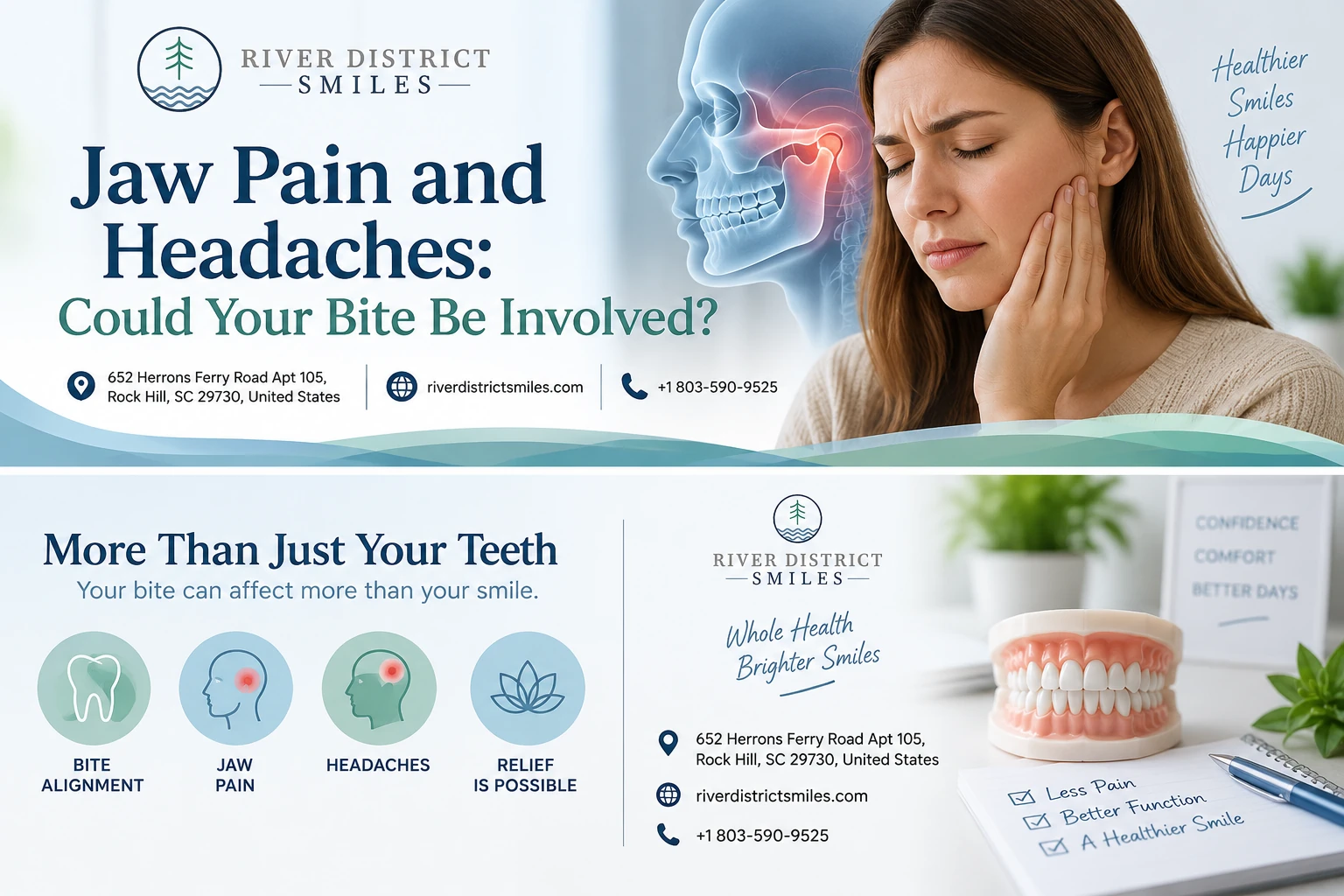


If your jaw feels tight and your headaches seem to begin around your temples, ears, or cheeks, it is reasonable to wonder whether your teeth are part of the problem.
They might be but the answer is usually more complicated than simply having a “bad bite.”
Your bite can contribute to jaw discomfort in certain situations, especially when one tooth contacts too early, a recent restoration feels high, or you are repeatedly clenching and grinding. However, research does not support the idea that an imperfect bite or crooked teeth are the main cause of most temporomandibular disorders.
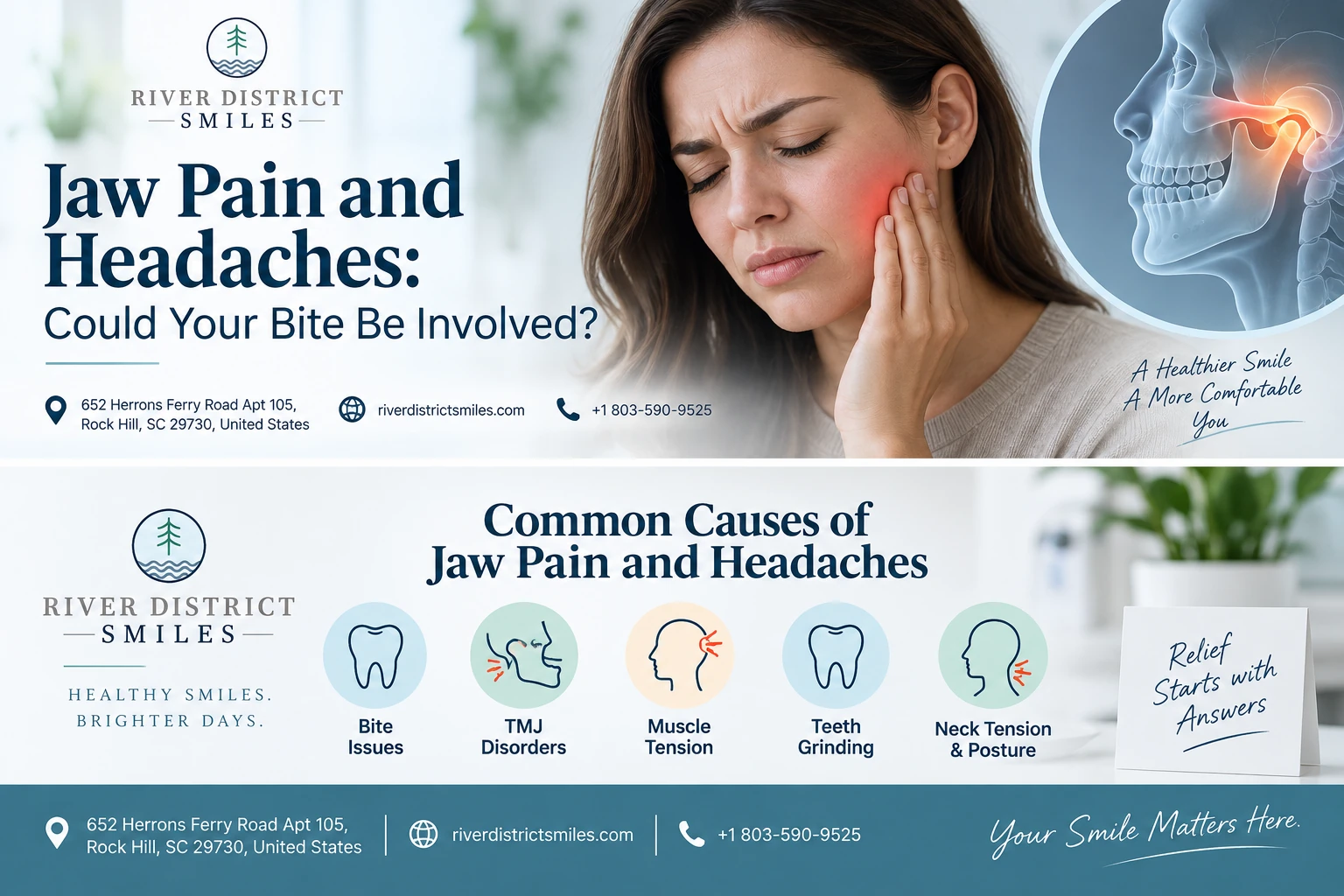
Jaw pain and headaches may instead come from:
- Overworked chewing muscles
- Daytime clenching or nighttime grinding
- A problem within the jaw joint
- A cracked or infected tooth
- A recent filling or crown that changed how the teeth meet
- Neck tension or posture
- A primary headache condition, such as migraine or tension-type headache
- More than one problem occurring at the same time
The next step is not automatically reshaping teeth, starting orthodontic treatment, or assuming every headache is dental. It is identifying whether the pain is coming from the teeth, muscles, jaw joints, or another medical source.
Jaw Pain and Headache Clues at a Glance
| What you notice | What it may suggest |
| Headaches are strongest after waking | Possible nighttime clenching or grinding |
| Jaw muscles feel tired by evening | Daytime clenching, prolonged chewing, or muscle overuse |
| Pain began after a new filling or crown | One restoration may be contacting too heavily |
| Pain increases with chewing | Tooth problem, muscle strain, or jaw-joint irritation |
| Sharp pain in one tooth when biting | Crack, decay, loose filling, or inflammation around the tooth |
| Temples and cheeks feel tender | Overworked chewing muscles |
| Jaw locks or movement is limited | Possible temporomandibular disorder requiring evaluation |
| Clicking occurs without pain | Often common and may not need treatment |
| Headache includes nausea or sensitivity to light | Migraine or another headache disorder may be more likely |
| Jaw pain occurs with chest pressure or shortness of breath | Possible medical emergency |
These patterns are useful clues, not a diagnosis. Pain in the jaw, face, or mouth may or may not be caused by a temporomandibular disorder.
What Does “Your Bite” Actually Mean?
Your bite, also called your occlusion, is the way your upper and lower teeth contact when you close, chew, and move your jaw.
A bite evaluation may consider:
- Which teeth touch first
- How pressure is distributed
- Whether one side contacts more heavily
- Whether a tooth interferes with normal jaw movement
- Missing, worn, broken, or shifting teeth
- Recent fillings, crowns, bridges, or implants
- How your jaw muscles and joints respond during movement
No human bite is perfectly symmetrical. Small differences are common and do not necessarily cause pain.
The important distinction is between:
- A normal variation in the way your teeth meet
- A new or significant contact that causes symptoms
- Muscle or joint pain that happens to occur in someone with an imperfect bite
Those situations should not automatically receive the same treatment.
Can a “Bad Bite” Cause TMD?
Temporomandibular disorders usually shortened to TMDs are a group of more than 30 conditions affecting the jaw joints, chewing muscles, and surrounding tissues. Symptoms can include muscle pain, joint pain, stiffness, limited opening, locking, painful clicking, and changes in how the teeth meet.
For many patients, the exact cause is not clear. Injury can lead to some TMDs, but genetics, stress, pain sensitivity, sleep problems, muscle habits, and other health conditions may also be involved.
The National Institute of Dental and Craniofacial Research states that available research does not support the belief that a bad bite or orthodontic braces cause TMDs.
In plain terms:
- An uneven bite may matter in a specific patient.
- A new dental contact may aggravate a specific tooth or muscle.
- Bite changes can sometimes be a symptom of a jaw-joint problem.
- But simply finding crowding, an overbite, or slightly uneven contacts does not prove that the bite caused the pain.
That distinction matters because treatment that permanently alters healthy teeth cannot easily be reversed.
When the Bite Is More Likely to Be Involved
1. Pain Began After a Filling, Crown, or Bridge
A new restoration may occasionally contact the opposing tooth too early.
You may notice:
- One tooth hits before the others
- The tooth is sore when biting
- Chewing feels uneven
- The jaw feels tired on one side
- You avoid using the treated tooth
- Symptoms began shortly after the dental appointment
A slightly high restoration can sometimes be corrected with a careful adjustment.
However, pain after dental treatment can also come from an inflamed nerve, a crack, deep decay, or irritation around the tooth. The dentist should evaluate the tooth rather than assuming that every post-treatment symptom is a simple bite problem.
Permanent reshaping should be limited to the specific restoration or contact causing the problem not performed broadly throughout the mouth without a clear diagnosis.
2. One Tooth Hurts Under Pressure
A tooth problem can feel like jaw pain.
Pain when biting may be caused by:
- A cracked tooth
- A loose or broken filling
- Decay beneath a restoration
- Inflammation or infection inside the tooth
- A problem in the ligament around the root
- A recent restoration that contacts too heavily
Patients sometimes begin chewing differently to protect the painful tooth. That altered chewing pattern can then make the jaw muscles feel tired or sore.
Treating the tooth may resolve the muscle symptoms without any broader bite treatment.
3. Missing or Severely Worn Teeth Have Changed How You Chew
When teeth are missing, broken, or heavily worn, chewing forces may become concentrated in fewer areas.
Some patients compensate by:
- Chewing primarily on one side
- Moving the jaw differently
- Avoiding harder foods
- Clenching to find a comfortable position
- Overusing certain muscles
This does not mean that replacing every missing tooth will cure headaches. It means the dentist should consider whether loss of function is contributing to the muscle workload.
4. Your Bite Has Changed Suddenly
A sudden change in how the teeth meet deserves evaluation.
Possible causes include:
- A displaced or inflamed jaw joint
- Swelling around a tooth
- Trauma
- A loose restoration
- A broken tooth
- Tooth movement
- Muscle spasm
- An appliance that changed tooth position
A change in how the upper and lower teeth fit together is also recognized as a possible TMD symptom.
The bite change may therefore be the result of the joint or muscle problem rather than its original cause.
Clenching and Grinding Are Often More Important Than Tooth Alignment
Bruxism is the habit of grinding, clenching, or tightly holding the teeth together. It can happen while awake or during sleep.
Severe bruxism may contribute to:
- Jaw-muscle soreness
- Tightness or fatigue
- Headaches
- Facial pain
- Tooth sensitivity
- Flattened or worn teeth
- Chipped or cracked teeth
- Damaged fillings and crowns
The teeth do not need to move visibly for clenching to create a problem.
Simply holding the muscles contracted for extended periods can make them tired and painful. Think about holding a fist tightly for hours: even without moving the hand, the muscles eventually become sore.
Signs you may be clenching while awake
- Your teeth are touching while you work, drive, or concentrate
- Your jaw tightens during stressful situations
- You catch yourself biting down during exercise
- Your cheeks or temples become tired later in the day
- Symptoms are worse after long periods of computer work
Signs you may grind or clench during sleep
- Jaw soreness in the morning
- Morning headaches
- A partner hears grinding
- Teeth look flattened or chipped
- Dental work repeatedly breaks
- You wake with tooth sensitivity
- Your chewing muscles feel enlarged or tender
Stress can play a role, but bruxism is not simply a sign that someone is “too stressed.” Genetics, caffeine, alcohol, smoking, certain medications, and other factors may also contribute.
Where Do Clenching-Related Headaches Usually Hurt?
The temporalis muscles are large chewing muscles located at the sides of the head above the ears.
When these muscles are overworked, patients may feel:
- Pressure in the temples
- A tight band around the head
- Tenderness when pressing the side of the scalp
- Pain that spreads toward the forehead or behind the eyes
- Symptoms after prolonged clenching or chewing
The masseter muscles along the cheeks and jaw angles may also become sore.
A headache that begins around the temples and occurs with jaw tightness is more suggestive of muscle involvement than a headache that occurs with nausea, flashing lights, neurological symptoms, or strong sensitivity to light and sound.
Still, headache patterns overlap. A person can have both TMD-related pain and migraine. A dentist should not assume that every temple headache is caused by the bite.
What Is the Difference Between TMJ and TMD?
The TMJ is the temporomandibular joint itself. You have one in front of each ear.
A TMD is a disorder affecting the joint, chewing muscles, or related tissues.
TMD symptoms may include:
- Jaw-muscle or joint pain
- Pain spreading into the face or neck
- Jaw stiffness
- Limited opening
- Locking
- Painful clicking, popping, or grinding
- A change in how the teeth fit together
Painless clicking is different.
Joint sounds without pain are common, considered normal, and generally do not require treatment.
The presence of a click alone does not mean the joint is being permanently damaged.
Could a Headache Be Coming From a Tooth?
Yes.
A dental problem may cause pain that spreads into the jaw, ear, temple, or side of the face.
Possible causes include:
- A cracked tooth
- Deep decay
- An infected tooth
- An abscess
- A partially erupted wisdom tooth
- Severe gum inflammation
- A loose crown or filling
Dental pain is more likely when the headache or facial pain occurs with:
- Sensitivity to temperature
- Pain when biting
- Swelling
- A bad taste or drainage
- A specific tender tooth
- Pain that wakes you from sleep
- A broken restoration
- Fever
A mouthguard will not treat an infected or cracked tooth. Those conditions need to be ruled out before pain is attributed to clenching or the jaw joint.
Could It Be a Headache Disorder Instead?
Yes.
Migraine, tension-type headache, cluster headache, medication-related headache, sinus or respiratory illness, and several neurological conditions can cause pain in areas that overlap with dental and jaw symptoms.
Consider medical evaluation when:
- Headaches are frequent or worsening
- Light or sound sensitivity is present
- You experience nausea or vomiting
- An aura or visual disturbance occurs
- The headache is not affected by chewing or jaw movement
- Dental and jaw findings do not explain the pattern
- Headaches interfere with work, sleep, or daily activity
Headache is a medical condition in its own right, and people whose headaches affect daily life should discuss them with a physician.
A dentist and physician may need to work together rather than treating the problem as exclusively dental or exclusively medical.
How a Dentist Evaluates Jaw Pain and Headaches
A careful evaluation may include:
Symptom history
The dentist may ask:
- Where does the pain begin?
- Does it occur in the morning or later in the day?
- Is it triggered by chewing?
- Does the jaw lock?
- Did symptoms begin after dental treatment?
- Are headaches accompanied by nausea or light sensitivity?
- Do you clench during the day?
- Has anyone heard you grind at night?
- Have you experienced an injury?
- Has your bite changed?
Tooth evaluation
The dentist may check for:
- Cracks
- Decay
- Infection
- Loose or damaged restorations
- Tooth sensitivity
- Pain during biting
- Excessive wear
- Heavy contact on a new restoration
Muscle examination
The chewing muscles, temples, neck, and face may be checked for tenderness and tightness.
Pain that is reproduced when a muscle is pressed can help identify muscle involvement.
Jaw-joint evaluation
The dentist may assess:
- Range of motion
- Deviation during opening
- Locking
- Painful clicking or grinding
- Joint tenderness
- Whether symptoms occur during movement
Bite evaluation
The dentist may observe how the teeth contact and whether a new restoration, damaged tooth, or missing tooth is affecting function.
Finding an uneven contact does not automatically mean that it should be removed. The finding must match the symptoms and diagnosis.
Imaging
Dental X-rays may help rule out tooth decay, infection, bone problems, or other dental causes.
MRI or CT imaging may occasionally be considered when a specific joint condition is suspected. There is no single standard test that diagnoses every TMD, and imaging is not automatically needed for every patient with jaw discomfort.
What Can You Try at Home First?
Many jaw-muscle and joint symptoms improve with conservative care.
For a short period, you may try:
- Eating softer foods
- Avoiding gum chewing
- Avoiding very wide opening
- Applying heat or cold to the face
- Reducing daytime clenching
- Keeping your teeth apart when you are not eating
- Using short-term over-the-counter pain medication when medically safe for you
- Performing gentle exercises recommended by a qualified clinician
NIDCR recommends beginning with simple, reversible measures because many TMD symptoms are temporary and do not worsen over time.
A useful resting position is:
- Lips together
- Teeth slightly apart
- Tongue resting gently against the roof of the mouth
- Jaw muscles relaxed
Your teeth generally do not need to remain in contact throughout the day.
Would a Night Guard Help?
A night guard or stabilization appliance fits over the teeth.
It may be recommended to:
- Separate and protect the teeth
- Reduce damage from grinding
- Distribute forces
- Provide a more stable surface
- Help some patients reduce muscle activity
For bruxism, an appliance may help protect teeth and restorations even when it does not completely stop the grinding behavior.
For TMD pain, the evidence is less certain. NIDCR notes that there is not strong evidence that intraoral appliances consistently improve TMD pain. Any appliance used for this purpose should not be designed to permanently change the bite, and it should be discontinued and reevaluated if it increases pain.
A guard may be a reasonable fit when:
- There is visible grinding damage
- Teeth or restorations need protection
- The dentist can monitor the fit
- The appliance is reversible
- The patient understands that it is not a guaranteed cure
A guard may be a poor fit when:
- An infected or cracked tooth has not been treated
- The appliance causes new pain
- It changes the bite after removal
- The patient is told it will permanently reposition the jaw without adequate evaluation
- It is being used instead of diagnosing persistent headaches
Should the Dentist Adjust Your Bite?
Sometimes a small, specific adjustment is reasonable.
For example, if a new crown is clearly contracting too heavily and the symptoms begin immediately afterward, correcting that restoration may help.
That is different from broad occlusal adjustment, in which multiple healthy teeth are permanently reshaped to change how the entire bite fits together.
NIDCR advises avoiding treatments that permanently change the teeth or bite for TMD. Its current treatment summary states that occlusal treatments including grinding down teeth, placing crowns to change the bite, and orthodontic treatment for this purpose do not reliably help TMD and may make it worse.
Before agreeing to permanent bite changes, ask:
- What exact diagnosis are we treating?
- Which finding proves that the bite is causing the pain?
- Is the treatment reversible?
- What simpler options have been tried?
- What happens if the symptoms do not improve?
- Should I obtain a second opinion?
This is particularly important when treatment would involve many crowns, extensive reshaping, or orthodontics primarily to treat headaches or TMD.
Can Orthodontic Treatment Fix Jaw Pain?
Orthodontic treatment can improve tooth alignment, cleaning access, appearance, and certain functional bite concerns.
It should not be presented as a predictable cure for TMD or headaches.
NIDCR specifically states that research does not support the belief that orthodontic braces cause TMD. It also advises against using orthodontic treatment as an irreversible TMD intervention because evidence does not show that changing the bite this way reliably treats the disorder.
A patient may still need orthodontic care for separate dental reasons. The jaw symptoms and orthodontic goals should be discussed independently.
Can Physical Therapy Help?
Physical therapy may be useful when pain and restricted movement involve the jaw, neck, posture, or surrounding muscles.
Treatment may include:
- Gentle mobility exercises
- Manual therapy
- Posture work
- Muscle stretching
- Strengthening
- Habit awareness
- Home exercises
NIDCR reports that manual physical therapy has been shown to improve function and relieve pain for some patients with TMD.
Physical therapy may be especially reasonable when:
- The jaw is stiff
- Neck tension accompanies the headaches
- Muscle tenderness is a major finding
- Movement is limited
- Conservative dental care alone has not helped
What About Botox for Jaw Pain?
Botulinum toxin may reduce the activity of overworked chewing muscles. Some patients report improvement in clenching-related muscle tension or headaches after treatment.
River District Smiles offers therapeutic Botox for selected patients with jaw tension, clenching, grinding, and muscle-related headaches.
However, patients should understand the limitations.
NIDCR states that there is not yet conclusive evidence that botulinum toxin injections into the chewing muscles reliably help TMD.
Botox may be more reasonable when:
- Symptoms appear primarily muscular
- The diagnosis is clear
- Conservative options have been discussed
- The patient understands that results are temporary
- The cost and need for repeat treatment are acceptable
- The treatment is not being presented as a permanent cure
It may not be the right choice when pain comes from an infected tooth, a structural joint problem, or another headache disorder.
What About Stress?
Stress does not make pain imaginary.
It can affect muscle tension, clenching behavior, sleep quality, and how strongly the nervous system responds to pain.
Helpful approaches may include:
- Awareness of daytime clenching
- Relaxation exercises
- Improving sleep habits
- Counseling
- Cognitive behavioral therapy
- Biofeedback
- Reducing repetitive jaw habits
NIDCR identifies self-management, cognitive behavioral therapy, and biofeedback among approaches that may help patients manage TMD symptoms.
Discussing stress should not replace a dental and medical evaluation. It is one possible contributor, not a dismissal of the symptoms.
When Should You Call a Dentist?
Arrange a dental evaluation when:
- Jaw pain lasts more than several days
- Symptoms keep returning
- Chewing increases the pain
- You have morning jaw soreness
- Your teeth are worn, chipped, or sensitive
- A filling or crown feels high
- One tooth hurts when you bite
- Your jaw locks or movement is limited
- Clicking or popping is painful
- Your bite has changed
- Headaches occur with jaw tenderness
- Dental work repeatedly breaks
- You suspect nighttime grinding
River District Smiles evaluates dental, muscle, joint, and bite-related factors when patients report jaw discomfort or headaches. The practice also provides custom mouthguards and selected muscle-relaxing treatments when appropriate.
When Is It a Medical Emergency?
Jaw pain is not always dental.
Call 911 when jaw discomfort occurs with possible heart-attack symptoms such as:
- Chest pressure, squeezing, heaviness, or pain
- Shortness of breath
- Cold sweating
- Nausea
- Light-headedness
- Pain spreading into an arm, shoulder, back, neck, or jaw
Jaw discomfort can occur as part of a heart attack, including in patients whose chest symptoms are mild.
Seek emergency medical care for a headache that:
- Begins suddenly and violently
- Is the worst headache you have experienced
- Follows a significant head injury
- Occurs with confusion or loss of consciousness
- Occurs with weakness, speech difficulty, vision changes, or loss of balance
- Occurs with fever and a stiff neck
These symptoms should not be attributed to the bite or jaw muscles.
Questions to Ask at Your Appointment
Ask:
- Is the pain coming from a tooth, muscle, joint, or another source?
- Can you reproduce the pain during the examination?
- Do you see signs of clenching or grinding?
- Is one restoration contacting too heavily?
- Is there a cracked or infected tooth?
- Has my bite changed, or does it only feel different because the joint is irritated?
- Do I need imaging?
- Would self-care be reasonable first?
- Would a night guard protect my teeth?
- Is the proposed appliance designed to change my bite permanently?
- Could physical therapy help?
- Should I also see my physician or a headache specialist?
- What are the risks of adjusting my teeth?
- Is the proposed treatment reversible?
- When should the diagnosis be reconsidered?
A good evaluation should not begin with the assumption that your bite is at fault. It should test that possibility while also ruling out tooth disease, muscle overuse, joint problems, and medical headache conditions.
The Bottom Line
Your bite can be involved in jaw pain and headaches but not always in the way people expect.
A recently placed filling or crown that contacts too heavily may cause localized biting discomfort. Missing, broken, or painful teeth may also change how you chew. More commonly, repeated clenching or grinding overworks the jaw and temple muscles, contributing to jaw soreness and headaches. Severe bruxism is known to cause jaw pain, tired muscles, tooth damage, and headache.
What the evidence does not support is automatically blaming most TMD pain on crooked teeth, an overbite, or a generally imperfect bite. Permanent procedures that reshape teeth, place multiple crowns, or move teeth solely to treat TMD should be approached cautiously.
River District Smiles evaluates the teeth, existing dental work, chewing muscles, jaw movement, and patient history when looking for a dental contribution to headaches or jaw pain. Conservative options may include habit changes, tooth protection, physical therapy coordination, and selected muscle-focused treatment.
The next step is not permanently changing your bite because your jaw hurts.
It is finding out whether the pain begins in a tooth, an overworked muscle, the jaw joint, or a separate headache condition and choosing the most conservative treatment that fits the actual diagnosis.