

Your child takes an elbow to the mouth during basketball.
There is no broken tooth. No dramatic bleeding. Nothing looks crooked.
They finish the game and tell you, “It’s fine. It just feels a little sore.”
So do you actually need to do anything?
Sometimes no treatment is needed.
But a tooth can be injured without looking broken, and that is where a post-game dental check and sometimes a dental X-ray becomes useful.
The short answer is:
If a permanent tooth is tender after a direct hit, feels loose, hurts when biting, has bleeding around the gumline, appears even slightly displaced, or simply feels different from the teeth around it, it is worth having a dentist evaluate it. Whether an X-ray is needed depends on what the examination shows.
Current dental-trauma guidelines recommend imaging for several injuries that can look surprisingly minor from the outside. At the same time, the American Dental Association recommends that X-rays be taken based on clinical need rather than automatically after every incident.
The goal is not to X-ray every athlete who gets bumped in the mouth.
It is to avoid missing the injuries that are difficult to see without one.
Why Can a Tooth Look Normal After an Injury?
A tooth is more than the white crown you see in the mirror.
Below the gumline is a root surrounded by bone and a thin supporting ligament. Inside the tooth is living pulp tissue containing nerves and blood vessels.
A sports impact can affect any of those structures.
That means an athlete can have:
- No visible chip
- No obvious displacement
- No major bleeding
and still have an injured tooth.
One common example is a dental concussion.
That does not mean a brain concussion. In dentistry, a concussed tooth has been hit hard enough to injure the tissues supporting it, but the tooth has not become abnormally loose or moved out of position.
The main clue may simply be that the tooth feels tender when touched or tapped.
For a permanent tooth with this type of injury, International Association of Dental Traumatology guidelines recommend a periapical X-ray as part of the assessment, even though the image itself may initially look normal.
That surprises many parents.
Why take an X-ray if it may look normal?
Because sometimes the value is not finding obvious damage today. It is establishing a baseline that can be compared with later images if the tooth changes.
What Is the Dentist Looking for on an X-Ray?
A dental X-ray after trauma is not simply looking for a cavity.
Depending on the injury, the dentist may be checking for things such as:
- A root fracture
- Changes around the root
- Damage to the socket surrounding the tooth
- Displacement that is difficult to judge clinically
- Injury to nearby bone
- A fractured tooth extending below the gum
- A tooth fragment embedded in the lip or cheek
- Changes that develop during healing
The exact images selected depend on what the dentist suspects.
That may mean one small periapical X-ray.
A more complicated displacement injury may require several views from different angles because a fracture that is invisible from one direction can sometimes become clearer from another.
For example, IADT guidance for a loosened but nondisplaced permanent tooth a subluxation injury recommends multiple radiographic views as part of the initial evaluation.
This is why dental trauma imaging is not simply “X-ray or no X-ray.”
The better question is:
What information does the dentist need to understand this particular injury?
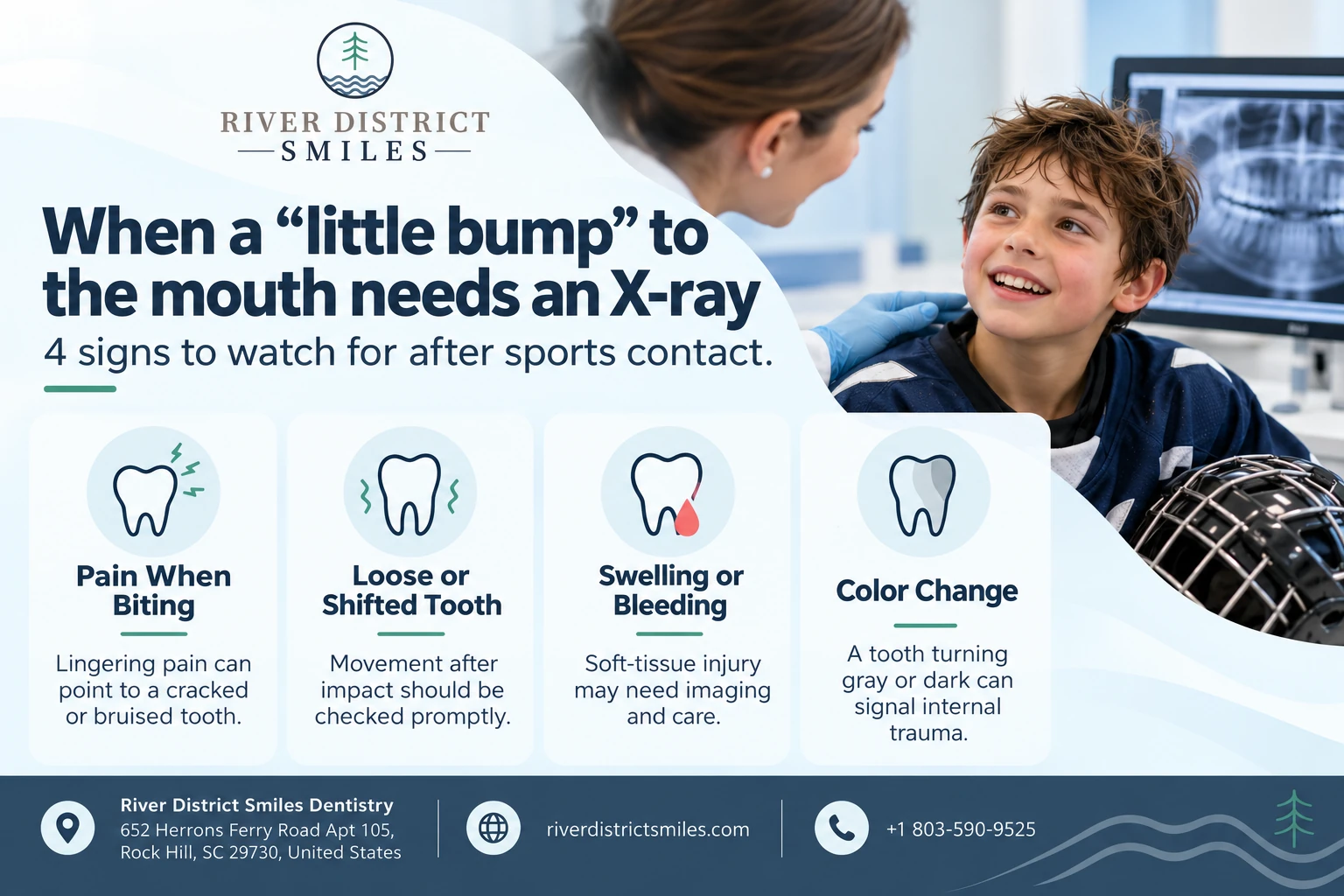
The Five Signs I Would Not Ignore After a Game
A dramatic injury is easy to recognize.
The harder decision comes when everything looks almost normal.
These signs deserve attention.
1. The tooth hurts when your child bites
Pain with biting can mean the tissues around the tooth absorb part of the impact.
It does not automatically mean the tooth is fractured.
But if one tooth suddenly feels “high,” sore, or uncomfortable when the athlete closes their teeth together, I would want to know why.
2. The tooth feels loose
Permanent teeth have a tiny amount of normal physiologic movement.
A tooth that suddenly moves noticeably more than the matching tooth on the other side is different.
Dental-trauma guidelines describe subluxation as an injury in which the tooth becomes more mobile without actually moving out of its normal position. There may also be bleeding where the tooth meets the gum.
That deserves evaluation.
3. There is bleeding around one tooth
A cut lip is easy to understand.
Bleeding specifically from the gumline around an impacted tooth can tell us that the supporting tissues have been injured.
It is one of the findings associated with subluxation.
4. The tooth looks slightly different from before
Do not only look for a tooth hanging dramatically sideways.
Ask:
Does one front tooth suddenly look longer?
Shorter?
Pushed backward?
Pushed toward the lip?
Does the bite feel different?
Small positional changes after trauma matter because displacement injuries can involve the socket and supporting bone.
5. The tooth just feels “weird”
Children and teenagers are not always good at describing dental symptoms.
Sometimes all you get is:
“It feels funny.”
“I notice it when my tongue touches it.”
“It feels different when I bite.”
That may turn out to be nothing serious.
But after a direct sports impact, it is useful information.
You do not need to wait for severe pain before asking a dentist to look.
When Is a Little Chip More Than a Little Chip?
A small enamel chip can be straightforward.
But even when the missing piece looks tiny, the dentist also wants to know whether there was a second injury underneath it.
The IADT guidelines for permanent teeth specifically recommend evaluating an enamel fracture for an associated luxation or root fracture particularly when the tooth is tender. A periapical image is recommended, with additional imaging when other signs or symptoms suggest another injury.
In plain language:
The size of the visible chip does not always tell us how much force the tooth experienced.
If a front tooth lost a tiny corner but is completely comfortable and stable, that is one situation.
If the same tiny chip occurred after a hard collision and the tooth is now sore when touched, that deserves a closer look.
Does Every Hit to a Permanent Tooth Need an X-Ray?
No.
Dental X-rays should be selected based on the patient’s history, clinical examination, symptoms, age, previous imaging, and the condition the dentist is trying to diagnose.
The ADA and American Academy of Oral and Maxillofacial Radiology released updated imaging recommendations in January 2026 emphasizing exactly that approach: perform the clinical assessment first, then order the imaging needed to answer the diagnostic question.
That is an important distinction.
We do not want to take unnecessary images.
We also do not want to avoid a useful image when it could change diagnosis or follow-up.
Dental trauma is one of those situations where a small targeted X-ray may provide information we cannot get simply by looking at the tooth.
What About 3-D Dental Scans?
Most minor sports injuries do not automatically require a CBCT, or three-dimensional dental scan.
Traditional two-dimensional dental X-rays are often the first imaging choice.
Current ADA guidance recommends using CBCT when the additional three-dimensional information is clinically necessary and lower-exposure imaging will not provide the information needed.
So if a parent comes in after a relatively minor bump, the conversation should not begin with:
“We need a 3-D scan.”
It begins with an examination.
Then we choose the smallest amount of imaging that gives us the information we need.
Are Dental X-Rays Safe for Children?
Parents reasonably ask this, particularly if their child already receives routine dental imaging.
Current ADA guidance emphasizes limiting dental imaging to situations where it is clinically justified and optimizing the exposure for the individual patient. The ADA also participates in the Image Gently initiative, which promotes selecting pediatric X-rays based on individual need and using child-appropriate exposure settings.
The practical philosophy is simple:
Do not take an X-ray just because we can. Take it when the information is expected to help diagnose or manage the injury.
That is also why a recent useful image may sometimes matter. Current guidance encourages dentists to consider previous radiographs rather than automatically repeating imaging when existing images can answer the clinical question.
Baby Teeth Are Different
This is an important distinction for younger athletes.
The X-ray recommendations for injured baby teeth are not necessarily the same as those for injured permanent teeth.
For example, current IADT guidance does not recommend a baseline radiograph for a simple concussion injury to a primary tooth when there are no other concerning findings. Imaging may become appropriate if later signs suggest an unfavorable outcome.
For a primary tooth that becomes abnormally mobile after trauma, however, a baseline image may be recommended for diagnosis.
Why the difference?
Because baby teeth have developing permanent teeth underneath them, and treatment decisions must consider both.
This is one reason parents should avoid trying to diagnose the injury themselves based on advice written for adult teeth.
The age of the child and whether the injured tooth is primary or permanent can change the plan.
What If the X-Ray Looks Completely Normal?
That can be good news.
But it does not necessarily mean the dentist was wrong to take it.
Some early trauma injuries do not produce an obvious radiographic change.
A concussed permanent tooth, for example, may have a normal-looking X-ray at the initial visit. The IADT still recommends follow-up because the health of the pulp the living tissue inside the tooth can change after trauma.
The first image provides a comparison point.
If the tooth remains healthy, great.
If symptoms, discoloration, infection, or changes around the root develop later, the dentist now has something to compare against.
Can a Tooth Die Months After Getting Hit?
It can happen, although it certainly does not happen after every injury.
A strong impact can disrupt the blood supply or damage the pulp inside a tooth.
Sometimes the tooth recovers.
Sometimes complications develop later.
That is why the post-game dental check is not only about whether a tooth needs treatment that afternoon.
For certain permanent-tooth injuries, IADT recommendations call for clinical and radiographic follow-up over months and sometimes longer rather than assuming the tooth is permanently fine because the first visit was reassuring.
Parents should watch for changes such as:
- Increasing pain
- Swelling near the tooth
- A pimple-like bump on the gum
- Increasing mobility
- Persistent pain when biting
- A tooth becoming noticeably darker
- New sensitivity or other symptoms
One detail is important: color change alone does not diagnose what is happening inside a traumatized tooth.
The dentist considers the whole picture, including symptoms, examination findings, pulp testing when appropriate, and imaging.
What Happens During a Post-Game Dental Check?
For a relatively minor injury, the appointment may be much simpler than parents expect.
At River District Smiles, an emergency evaluation begins with a discussion of what happened and an examination of the affected area. Digital imaging may then be used when necessary to identify fractures or other problems that are not immediately visible.
The dentist may check:
- Whether the tooth has moved
- Whether it is loose
- Where it is tender
- Whether the bite has changed
- Whether there is a fracture
- The gums and surrounding soft tissue
- Neighboring teeth
- The condition of any existing fillings, bonding, veneers, or crowns
Depending on the injury, a small digital X-ray may be taken.
And sometimes the conclusion will simply be:
Nothing needs to be repaired today. We need to monitor it.
That is still a useful diagnosis.
Does Every Injured Tooth Need Treatment?
No.
This is one of the reassuring parts of dental-trauma care.
A permanent tooth that has been concussed but remains stable generally does not require a filling, crown, or root canal simply because it was hit.
IADT recommendations for a concussed permanent tooth call for monitoring rather than active treatment when there are no additional complications.
Similarly, many loosened teeth do not automatically need major treatment. A flexible splint may be considered when mobility or biting tenderness is significant, but some injuries primarily require observation and follow-up.
The purpose of getting the tooth checked is not to manufacture a procedure.
It is to establish what happened and determine whether intervention is actually necessary.
When Should You Call the Dentist After the Game?
I would contact a dentist promptly when a sports impact leaves:
- A chipped or broken permanent tooth
- A loose tooth
- A displaced tooth
- Bleeding around the base of a tooth
- Persistent tenderness
- Pain when biting
- A change in the athlete’s bite
- A lost filling, crown, or restoration
- A tooth that has been completely knocked out
River District Smiles lists broken and chipped teeth, knocked-out teeth, pain with chewing, damaged restorations, and other dental injuries among the concerns appropriate for an emergency dental evaluation.
Same-day care may be possible depending on the condition and schedule.
When Is This Bigger Than a Dental Emergency?
Sometimes the tooth is not the most important injury.
Seek emergency medical care for signs such as:
- Loss of consciousness
- Serious head trauma
- Difficulty breathing
- Difficulty swallowing
- Uncontrolled bleeding
- Severe or rapidly spreading facial swelling
- A suspected jaw or facial fracture
River District Smiles specifically advises emergency medical evaluation for these situations rather than treating them as routine dental-office emergencies.
If an athlete takes a hard hit to the head or face, do not become so focused on saving a tooth that you overlook a potentially serious medical injury.
What About a Knocked-Out Permanent Tooth?
That is no longer a “watch and see” situation.
An avulsed or completely knocked-out permanent tooth is one of the most time-sensitive dental injuries.
The International Association of Dental Traumatology describes prompt and appropriate emergency management as important to achieving the best possible outcome.
If a permanent tooth is knocked out:
Handle it by the crown rather than the root.
Do not scrub the root.
Keep the tooth from drying out.
Seek dental care immediately.
For parents, coaches, and athletes who want a reliable first-aid resource on their phone, the IADT also provides the free ToothSOS app with guidance for knocked-out, loosened, displaced, and broken teeth.
A Simple Rule for Parents After a Sports Collision
You do not need to diagnose a concussion injury, subluxation, luxation, or root fracture from the bleachers.
Use a simpler test.
After the game, ask:
Does this tooth look, move, bite, or feel different than it did before the impact?
If the answer is yes, let a dentist examine it.
Sometimes the recommendation will be a small X-ray and follow-up.
Sometimes no X-ray will be necessary.
Sometimes treatment is needed immediately.
The point is to base that decision on the actual injury rather than how dramatic or undramatic it looked from the stands.
The Bottom Line
Most little bumps to the mouth do not turn into major dental problems.
But the absence of a broken tooth does not prove that nothing happened.
Permanent teeth can sustain injuries to the root, pulp, socket, and supporting tissues while looking essentially normal from across the room.
That is why a tooth that becomes tender, loose, displaced, painful when biting, or simply different after a sports impact deserves attention.
At River District Smiles, digital X-rays can be used when the examination suggests imaging would help identify damage that cannot be seen clinically.
The goal is not to X-ray every bump.
And it is not to turn every sports collision into emergency dental treatment.
It is to identify the small percentage of seemingly minor injuries where seeing below the surface changes what we do next.
If a tooth took a hit and something about it no longer feels normal, the safest next step is not guessing from the sidelines.
It is finding out what actually happened.