



Most people considering Botox at the dentist are trying to solve one of two problems.
They may want to soften forehead lines, frown lines, or a gummy smile. Or they may be dealing with jaw clenching, tight facial muscles, recurring headaches, or discomfort around the temporomandibular joints.
The cost can be confusing because Botox is not usually priced as one standard procedure.
A reasonable national planning figure for botulinum toxin injections is about $435 per treatment session. Some appointments cost less, while treatments involving several cosmetic areas or larger jaw muscles can cost considerably more. The American Society of Plastic Surgeons reports an average physician fee of $435, although that figure does not include every possible consultation, facility, or follow-up charge.
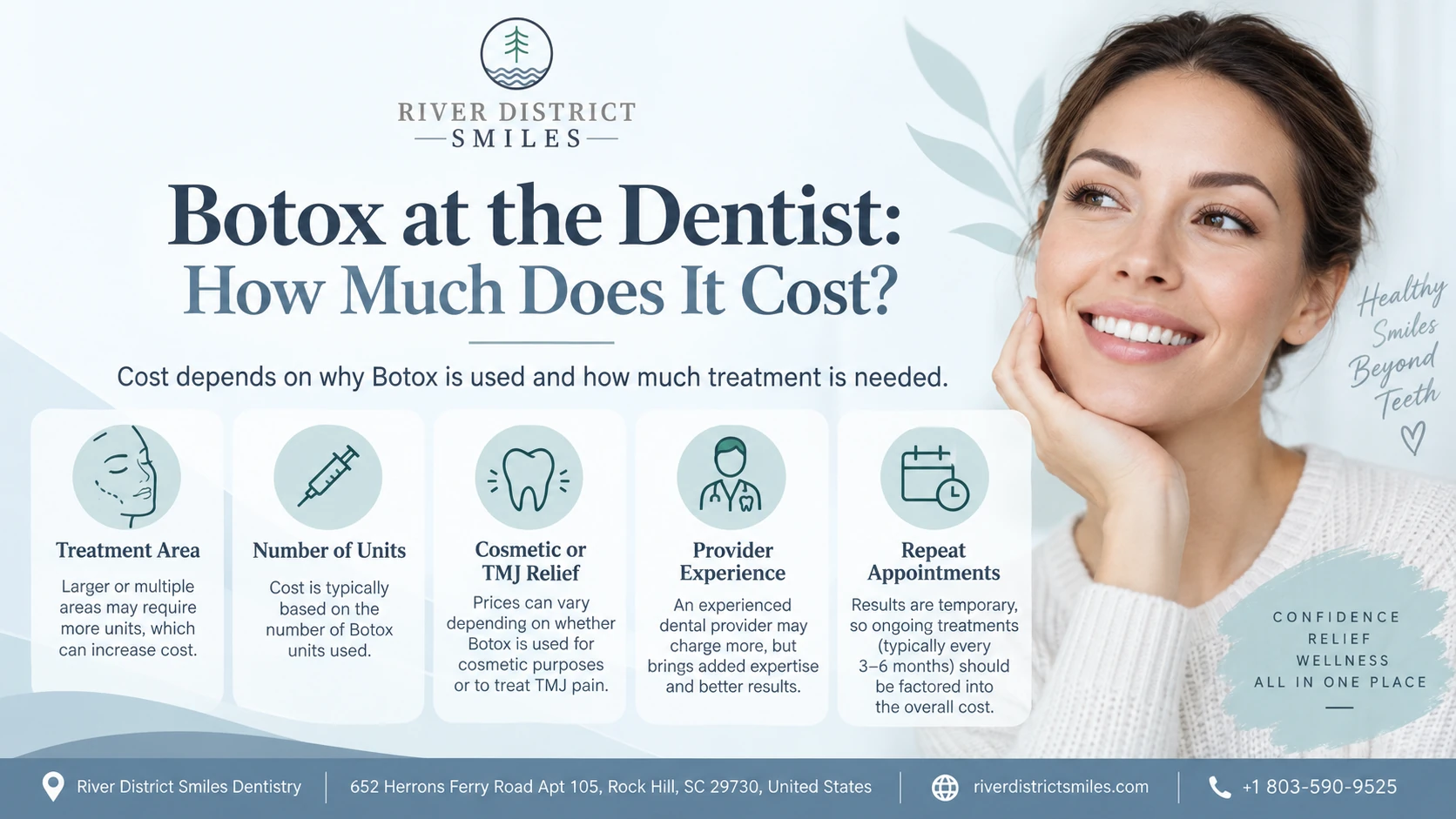
Your actual price depends mainly on:
- Why you are receiving Botox
- Which muscles are being treated
- How many units are needed
- Whether both sides of the face are treated
- The product being used
- The provider’s training and treatment approach
- Whether insurance contributes anything
- How often the treatment must be repeated
The most useful question is not simply, “How much is Botox?”
It is:
“How many units are being recommended, what problem are those units intended to treat, and what will the complete visit cost?”
Botox Cost at a Glance
| Cost factor | What to expect |
| National average treatment fee | Approximately $435 |
| Pricing method | Usually per unit or per treatment area |
| Small cosmetic treatment | Usually costs less than treating several areas |
| Large jaw-muscle treatment | May cost more because larger muscles may require more product |
| Insurance for cosmetic treatment | Usually not covered |
| Insurance for jaw pain or clenching | Sometimes possible, but frequently limited or denied |
| How long results last | Commonly about three to four months |
| Ongoing cost | Often three or four treatment sessions per year |
River District Smiles reports that most patients experience results for approximately three to four months, although duration varies with muscle activity and the individual treatment plan.
Using the national $435 average only as an illustration, three treatments per year would equal about $1,305, while four treatments would equal about $1,740.
That does not mean every patient will pay those amounts. It shows why the long-term cost matters more than the price of the first appointment.
Why Is Botox Priced by the Unit?
Botox is measured in units rather than by the number of needle injections.
A provider may place several small injections into one muscle group, but those injections are simply distributing the total prescribed number of units.
For example, at an illustrative price of $12 per unit:
| Units used | Illustrative total |
| 20 units | $240 |
| 30 units | $360 |
| 40 units | $480 |
| 60 units | $720 |
| 80 units | $960 |
These figures are examples, not River District Smiles’ prices or a recommendation for how many units a patient needs.
A low per-unit price is not automatically a better value. The final result also depends on whether the provider:
- Correctly identifies the muscles causing the problem
- Uses an appropriate total dose
- Places the injections accurately
- Creates a natural balance between both sides
- Avoids weakening muscles that should remain active
- Provides appropriate follow-up care
When comparing prices, ask for the expected total number of units and total treatment cost, not only the advertised price per unit.
Botox Units Are Not the Same Across Every Brand
Patients often use “Botox” as a general name for several wrinkle-relaxing products.
Botox is a specific brand of onabotulinumtoxinA. Other botulinum toxin products include Dysport, Xeomin, Jeuveau, Daxxify, and Letybo.
The unit numbers cannot be compared directly between brands. The FDA states that Botox units are specific to that product and are not interchangeable with units from other botulinum toxin preparations.
That means a price of $5 per unit for one product cannot automatically be compared with $12 per unit for another.
Before treatment, ask:
- Which product are you using?
- How many units of that product do you recommend?
- Is pricing based on units or treatment areas?
- What is the complete cost?
- Is a follow-up adjustment included?
Cosmetic Botox vs. Therapeutic Dental Botox
Botox at a dental office may be used for cosmetic goals, jaw-muscle concerns, or both.
These treatments can have very different prices because they involve different muscles and different amounts of product.
Cosmetic Botox
Cosmetic treatment works by temporarily reducing activity in selected facial muscles. It is commonly used for concerns such as:
- Frown lines between the eyebrows
- Forehead lines
- Crow’s feet
- A gummy smile
- Certain lines around the mouth
- Chin dimpling
- An overly strong or square-looking jawline
The FDA-approved cosmetic uses and doses vary by treatment area. For example, the FDA labeling for Botox Cosmetic describes a total of 20 units for treatment of moderate-to-severe frown lines between the eyebrows. That does not mean every cosmetic concern uses 20 units or that every patient needs the same amount.
Cosmetic pricing usually increases when more areas are treated during the same visit.
A patient treating one small area will generally use fewer units than someone treating the forehead, frown lines, crow’s feet, and jawline together.
Botox for Jaw Clenching, Bruxism, or Muscle-Related Pain
Dental Botox may also be injected into muscles such as the masseters or temporalis muscles.
These muscles help close the jaw. When they remain overactive, some patients experience:
- Jaw tightness
- Muscle fatigue
- Tenderness along the cheeks or temples
- Headaches associated with clenching
- Strong bite forces
- Enlarged masseter muscles
- Damage related to grinding or clenching
River District Smiles offers Botox for facial aesthetics as well as concerns such as TMJ-related discomfort, tense jaw muscles, and headaches that may improve when those muscles relax.
Jaw-muscle treatment may cost more than a small cosmetic area because the masseters are large, strong muscles and both sides of the face are commonly treated.
The recommended number of units should be based on your anatomy, muscle strength, symptoms, and treatment goals not a standard package applied to every patient.
Is Botox FDA-Approved for TMJ Disorders or Bruxism?
Botox is FDA-approved for several cosmetic and medical uses, including certain facial lines, chronic migraine, muscle-spasm disorders, excessive underarm sweating, and other specific conditions.
TMJ disorders and bruxism are not listed as FDA-approved indications in the current Botox prescribing information. Treatment for these dental concerns is therefore generally considered off-label.
Off-label use does not automatically mean improper or unsafe treatment. It means the medication is being used for a condition or treatment area that is not specifically included in its FDA approval.
Patients should still understand that the evidence is not equally strong for every type of jaw pain.
A systematic review published in the Journal of the American Dental Association found important uncertainty about botulinum toxin for temporomandibular disorders and bruxism because the available studies had significant limitations. More recent reviews continue to report possible benefits for selected patients while noting that the evidence is mixed and treatment protocols vary.
In plain terms:
Botox may help some muscle-related jaw symptoms, but it is not a proven solution for every person with “TMJ pain.”
Why Diagnosis Matters Before Discussing Price
“TMJ” is often used as a general term for almost any pain near the jaw.
That pain can come from:
- Overworked chewing muscles
- Nighttime grinding or daytime clenching
- A problem inside the jaw joint
- Joint arthritis
- A displaced or damaged joint disc
- A cracked tooth
- A dental infection
- An uneven bite
- Sinus pressure
- A headache disorder
- Referred pain from another area
Botox reduces muscle activity. It does not repair a cracked tooth, eliminate an infection, rebuild a damaged joint, or correct every bite problem.
This is one reason receiving Botox from a dentist may be useful when the concern involves the jaw. A dental evaluation can help separate muscle-related symptoms from tooth, gum, bite, or joint problems before injections are recommended.
Paying for Botox without identifying the source of the pain can lead to an expensive treatment that does not address the real problem.
What Are You Paying For?
The price of Botox treatment involves more than the medication itself.
The examination and consultation
Before treatment, the provider should discuss:
- Your symptoms and goals
- How long the problem has been present
- Previous dental or medical treatment
- Current medications
- Allergies and health conditions
- Whether pain comes from the muscles, teeth, or joints
- Whether Botox is a reasonable option
- Alternatives that may be more appropriate
For cosmetic treatment, the provider should also evaluate facial movement at rest and during expression.
Ask whether the consultation fee is included, charged separately, or credited toward treatment.
The product
Authentic prescription botulinum toxin is a major part of the treatment cost.
Extremely low prices deserve careful questions. Patients should know which product is being used, whether it is FDA-approved, and who obtained and prepared it.
The FDA has warned about unapproved and counterfeit botulinum toxin products. Receiving treatment from a qualified healthcare provider using an approved, properly sourced product is more important than finding the lowest advertised unit price.
The number of units
The product cost increases as more units are used.
The required dose may be affected by:
- Muscle size
- Muscle strength
- The number of areas treated
- Whether treatment is cosmetic or therapeutic
- Whether the goal is subtle softening or stronger relaxation
- Previous response to treatment
- The need to maintain facial balance
More units are not automatically better. Too little may produce limited results, while too much may cause unwanted weakness or an unnatural appearance.
The provider’s knowledge of facial anatomy
Accurate placement matters.
A few millimeters can affect which muscle receives the medication. Poor placement can lead to asymmetry, difficulty using nearby muscles, an altered smile, or a result that does not address the intended problem.
The fee reflects the provider’s evaluation, treatment planning, injection technique, and ability to manage complications not only the amount of liquid used.
Follow-up care
Botox does not create its full visible or therapeutic effect immediately.
Practices may schedule a follow-up after the medication has had time to take effect. Ask whether that visit is included and what happens if one side responds differently from the other.
A follow-up should not automatically mean adding more units. The provider needs to evaluate the result and decide whether adjustment is appropriate.
Does Dental Insurance Cover Botox?
Cosmetic Botox
Dental and medical insurance generally do not cover Botox when it is used only to improve appearance.
You should expect cosmetic treatment to be self-pay. GoodRx notes that health insurance does not usually cover Botox for aesthetic purposes.
Botox for jaw pain or clenching
Coverage is less predictable when Botox is recommended for jaw clenching, bruxism, or a temporomandibular disorder.
Because these uses are generally off-label, many dental and medical plans exclude them. Some plans may consider coverage in limited circumstances, but they may require:
- A specific diagnosis
- Documentation of symptoms
- A history of conservative treatment
- Prior authorization
- Treatment by a particular type of provider
- Evidence that other treatments have failed
Do not assume that describing the treatment as “medical” means insurance will pay.
Before treatment, ask:
- Which insurance plan will be billed medical or dental?
- Is prior authorization required?
- Is the treatment considered covered, excluded, or experimental?
- Will the provider submit the claim?
- What will I owe if the claim is denied?
- Is the quoted fee due before insurance responds?
Manufacturer savings programs may help eligible commercially insured patients with certain covered medical uses, but they generally do not reimburse treatment that the insurance plan classifies as not covered. Eligibility restrictions and maximum benefits apply.
Will Botox Replace a Night Guard?
Usually, no.
Botox and a night guard do different jobs.
Botox reduces the strength or activity of selected muscles. A night guard creates a physical barrier between the teeth and may help protect them from wear or fracture.
Botox may reduce clenching force for some patients, but it does not physically cover the teeth. A person who has already worn, cracked, or damaged teeth may still need a guard or restorative dental treatment.
A useful comparison is:
| Botox | Night guard |
| Reduces activity in selected muscles | Creates a protective barrier between teeth |
| Requires repeat injections | Requires replacement if worn or damaged |
| May reduce muscle tightness | May limit tooth wear and restoration damage |
| Does not repair damaged teeth | Does not stop the muscles from activating |
| Effects commonly last a few months | Can last years with proper care |
For some patients, the two treatments may be used together. For others, one may be more appropriate than the other.
When Botox May Not Be the Best First Option
Botox may not be the best starting point when:
- The pain is coming from an infected or cracked tooth
- The main problem is inside the jaw joint rather than the muscles
- Symptoms have not been properly diagnosed
- A conservative treatment has not yet been tried
- The patient expects a permanent cure
- The patient cannot reasonably maintain repeat treatments
- Weakening the muscle may interfere with chewing or facial function
- The expected benefit does not justify the ongoing cost
Conservative care may include:
- Adjusting daytime clenching habits
- Physical therapy
- Stress-management strategies
- Improving sleep
- A properly fitted night guard
- Medication when appropriate
- Treating damaged teeth
- Addressing an underlying joint condition
The least invasive option that is likely to work is often a reasonable place to begin.
How Long Does Botox Last?
Botox is temporary.
River District Smiles states that results usually last approximately three to four months, depending on muscle activity and the patient’s treatment plan.
Some patients notice that the effect wears off sooner during their first treatment. Others may maintain the result longer.
The need for repeat treatment is important when comparing cost.
A $400 treatment repeated four times per year costs $1,600 annually. A $700 treatment repeated three times per year costs $2,100 annually.
Before proceeding, ask:
- How long do you expect my result to last?
- How frequently would I need treatment?
- What is the likely yearly cost?
- Will I need the same number of units each time?
- Is there a point when you would stop treatment if it is not helping?
What Are the Risks?
Most side effects are temporary, but Botox is still a prescription medication.
Possible effects may include:
- Bruising
- Swelling or soreness at injection sites
- Headache
- Temporary muscle weakness
- Facial asymmetry
- An altered smile
- Difficulty chewing certain foods
- Drooping of a nearby facial area
- A result that feels too strong or too subtle
The FDA prescribing information also carries a boxed warning that botulinum toxin effects can rarely spread beyond the injection area. Patients should seek immediate medical attention for symptoms such as difficulty breathing, speaking, or swallowing.
Before treatment, tell the provider about:
- Previous reactions to botulinum toxin
- Neuromuscular conditions
- Problems swallowing
- Current medications and supplements
- Blood-thinning medication
- Pregnancy or breastfeeding
- Infection or irritation near the proposed injection sites
- Recent botulinum toxin treatment from another provider
The provider needs to know when, where, and which product was previously injected.
Questions to Ask Before Paying for Botox
Before agreeing to treatment, ask:
- What do you believe is causing my symptoms?
- Is this treatment cosmetic, therapeutic, or both?
- Is this an FDA-approved or off-label use?
- Which product will you use?
- How many units do you recommend?
- How much does each unit cost?
- What is the complete treatment price?
- Is the consultation included?
- Is follow-up care included?
- How long should the result last?
- What alternatives should I consider?
- Will I still need a night guard or other treatment?
- What side effects should I watch for?
- What happens if the treatment does not help?
- What should I expect to spend over a full year?
A good consultation should make both the treatment and the cost understandable.
The Bottom Line
The national average physician fee for botulinum toxin injections is approximately $435 per session, but Botox at the dentist can cost less or significantly more depending on the number of units and the muscles being treated.
Small cosmetic treatments generally require fewer units. Treating large jaw muscles on both sides may require more product and may therefore cost more. Cosmetic Botox is normally self-pay, while coverage for clenching or TMJ-related symptoms is uncertain and frequently limited.
River District Smiles offers Botox in Rock Hill for selected cosmetic concerns and muscle-related symptoms such as jaw tension and headaches. The practice reports that results commonly last three to four months and bases treatment on the patient’s individual goals and muscle activity.
The next step is not choosing treatment based only on a low per-unit price. It is making sure the right muscles are being treated for the right reason and that you understand the total cost, realistic benefit, risks, and alternatives before proceeding.