


When an athlete breaks a front tooth during a game, the question is not simply, “Can you fix it?”
The better questions are:
Can the tooth be saved?
How quickly does treatment need to happen?
Will the repair hold up when the athlete returns to play?
Does the bite need to be checked?
Should the athlete be wearing a different mouthguard before getting back on the field?
That is where sports dentistry is different from simply repairing a chipped tooth.
Sports dentistry focuses on preventing and managing oral injuries connected with athletics and exercise. It can involve mouthguards, dental trauma, emergency treatment, restorative dentistry, return-to-play considerations, and the effects that training habits can have on teeth and gums. The American Dental Association and Academy for Sports Dentistry have recently expanded collaboration and continuing education around this area of care.
One clarification matters, though.
Sports dentistry is not currently one of the 12 dental specialties formally recognized by the National Commission on Recognition of Dental Specialties and Certifying Boards. It is better described as a focused area of dental practice requiring knowledge about the particular risks athletes face.
At River District Smiles, that distinction matters because Drs. Matthew and Emily Hubis are general dentists. The practice does not publicly claim to be the official dentist of a professional sports team. What it does provide is something useful to athletes at many levels: prevention, treatment of sports-related dental injuries, same-day emergency availability when scheduling permits, modern restorative dentistry, and guidance about protecting teeth before the next collision happens.
What Does a Sports Dentist Actually Do?
Most people associate sports dentistry with mouthguards.
Mouthguards are important, but they are only one piece.
Athletic dental care can involve:
- Preventing fractured and knocked-out teeth
- Helping an athlete choose an appropriate mouthguard
- Managing chipped or broken teeth
- Treating teeth that have been loosened or displaced
- Responding to a knocked-out permanent tooth
- Evaluating jaw and soft-tissue injuries
- Repairing damaged fillings, crowns, and other restorations
- Monitoring injured teeth over time
- Recognizing enamel erosion or cavity risk related to sports nutrition
- Considering how a dental repair will function under future athletic stress
The ADA recommends properly fitted mouthguards for many sports and recreational activities where there is a meaningful risk of dental trauma not only football and boxing, but activities including basketball, lacrosse, soccer, wrestling, baseball, cycling, gymnastics, skateboarding, volleyball and others.
The important point is that athletes can injure their mouths in far more ways than taking a helmet directly to the teeth.
Falls, elbows, balls, sticks, collisions, equipment, and even repetitive clenching can all create problems.
Why Treating an Athlete Can Require Different Thinking
A small chip in the front tooth of someone who works at a desk and the same chip in a competitive basketball player may look identical in the dental chair.
Their situations are not necessarily identical.
The athlete may be returning to an environment where the tooth could be hit again within days.
That changes the conversation.
We may need to think about:
- How much natural tooth remains
- Whether the nerve is involved
- Whether the tooth has loosened
- The patient’s bite
- The likelihood of another impact
- Whether a mouthguard fits over the repaired area
- Whether a temporary or definitive repair makes more sense immediately
- How the tooth should be monitored afterward
Sometimes a conservative repair is all that is needed.
Sometimes the visible chip is the least important part of the injury.
That is why an examination matters after significant dental trauma even when the tooth does not hurt much.
A Chipped Tooth Is Not Always a Cosmetic Problem
Front teeth are commonly damaged during sports.
A minor enamel chip may be primarily an appearance issue and may sometimes be smoothed or repaired with bonding.
A deeper fracture can expose dentin, involve the nerve, or extend below the visible surface.
There may also be damage to the root or supporting tissues that you cannot see in a mirror.
River District Smiles evaluates chipped, cracked, fractured, and otherwise injured teeth and may use digital imaging when appropriate to better understand what has happened beneath the surface.
Treatment might include bonding, a filling, a crown, monitoring, extraction when a tooth cannot be predictably saved, or referral when the injury requires care outside the practice.
The important part is not choosing the biggest treatment.
It is determining how much damage actually occurred.
A Knocked-Out Tooth Changes Everything
A completely knocked-out permanent tooth is one of the clearest examples of why sports-related dental knowledge matters.
This is time-sensitive.
If a permanent tooth is knocked out, handle it by the crown the portion you normally see in the mouth not by the root.
If it is dirty, gently rinse it. Do not scrub the root or scrape tissue away.
If the tooth cannot be safely repositioned, keep it moist and contact a dentist immediately.
River District Smiles specifically lists knocked-out teeth and sports-related dental trauma among the problems handled through its emergency dental service, with same-day appointments offered whenever scheduling permits.
For serious facial trauma, suspected jaw fracture, loss of consciousness, uncontrolled bleeding, or difficulty breathing or swallowing, the emergency department is the appropriate first stop rather than a dental office.
That distinction matters.
A dentist is often the right place for an injured tooth.
A hospital is the right place when the injury extends beyond the tooth and may threaten the patient’s overall safety.
Where Mouthguards Fit Into the Picture
The best sports dental injury is the one that never happens.
That is why mouthguards receive so much attention.
The ADA recognizes the preventive value of appropriately fitted mouthguards for athletic and recreational activities that carry dental-injury risk.
But “wear a mouthguard” is not the entire answer.
A guard also has to:
- Fit securely
- Stay in place during activity
- Be comfortable enough that the athlete actually wears it
- Allow reasonable breathing and communication
- Accommodate braces or changing teeth when necessary
- Remain in good condition
- Be appropriate for the athlete’s sport and level of contact
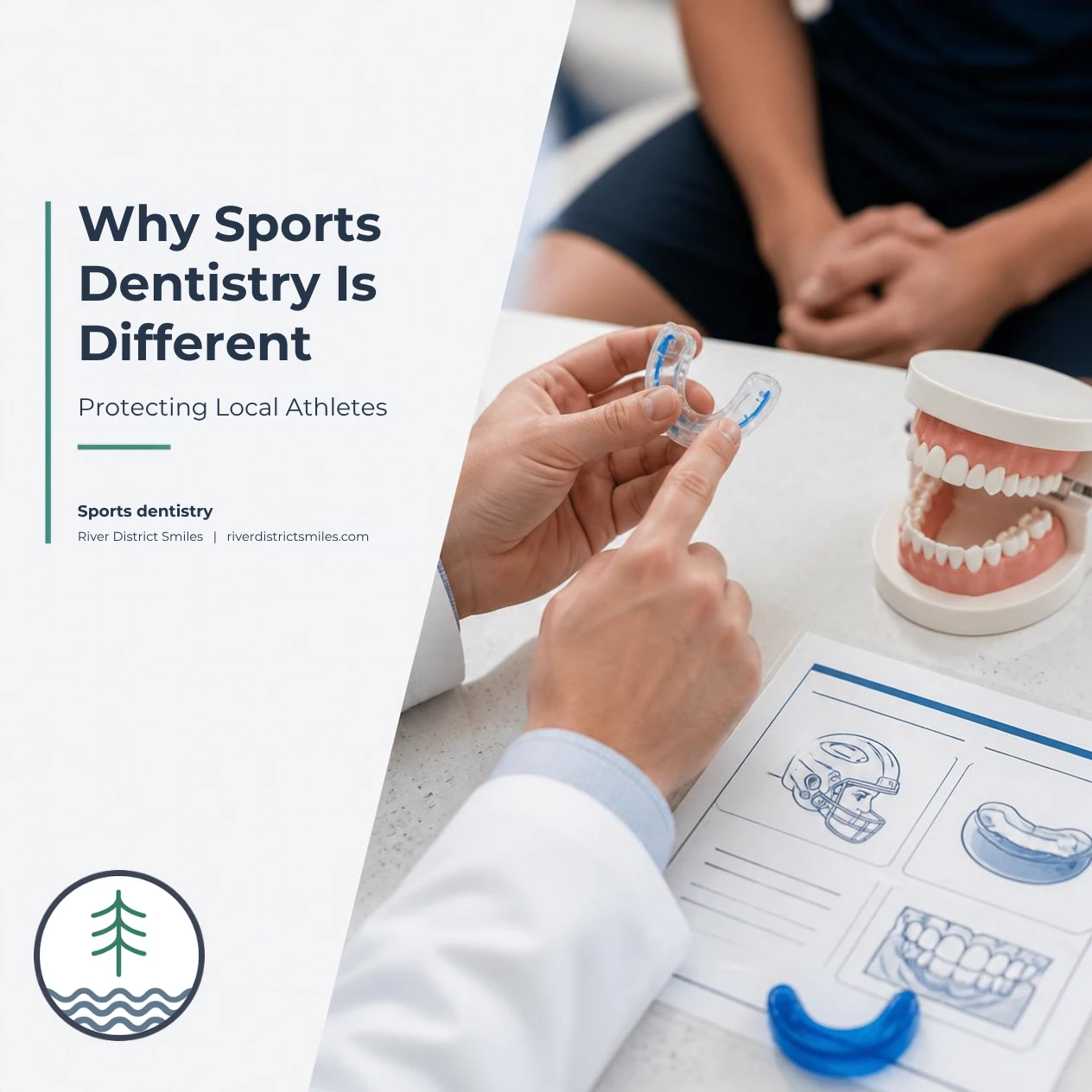
A boil-and-bite mouthguard can be perfectly reasonable for some athletes.
A custom-fabricated guard can make more sense when fit, retention, comfort, dental work, orthodontics, or repeated impacts are concerns.
There is no useful prize for owning the most expensive guard.
The goal is having an appropriate guard that the athlete will consistently wear.
Is a Custom Mouthguard Worth the Extra Cost?
This is where parents often want a straightforward answer.
For every athlete? No.
A properly fitted over-the-counter guard may be adequate for many recreational players.
A custom option becomes more appealing when an athlete:
- Competes frequently
- Plays a collision or contact sport
- Has difficulty keeping stock guards in place
- Constantly chews through mouthguards
- Has significant restorative dental work
- Has an unusual bite
- Needs additional consideration because of orthodontic treatment
- Finds bulky guards difficult to tolerate
The tradeoff is cost.
Custom guards require professional fabrication and therefore generally cost more than store-bought products.
What you are paying for is individual fit not a guarantee that injury becomes impossible.
No mouthguard can promise that a tooth will never break.
Sports Dentistry Also Happens Before Anything Gets Hit
Not every athletic dental problem is caused by trauma.
Endurance runners, cyclists, triathletes, and other high-volume athletes can have a completely different set of concerns.
Frequent sports drinks, carbohydrate gels, chews, mouth breathing, dehydration, and reduced saliva can expose teeth to repeated sugar and acid challenges.
An athlete can therefore have excellent fitness and still develop:
- New cavities
- Enamel erosion
- Increasing sensitivity
- Dry mouth
- Gum irritation
- Wear from clenching or grinding
This is another reason sports dentistry is broader than mouthguards.
A useful dental conversation might involve both protecting a soccer player’s front teeth and helping a marathoner adjust how frequently acidic sports drinks contact enamel.
Neither conversation requires telling the athlete to stop doing the sport.
The goal is protecting oral health without unnecessarily interfering with performance.
What Happens When an Athlete Breaks a Crown or Filling?
Natural teeth are not the only things that can be damaged during sports.
An impact may also fracture or dislodge:
- Fillings
- Bonding
- Veneers
- Crowns
- Bridges
When that happens, the first question is whether the underlying tooth has also been injured.
Simply replacing what fell off without understanding why it failed can miss the bigger problem.
River District Smiles evaluates lost and damaged restorations as part of its emergency dental care. Depending on the condition of the remaining tooth, treatment may involve repairing or replacing the restoration or choosing another treatment.
That is especially important for athletes returning to contact activity.
A restoration needs to work with the patient’s bite and withstand normal function, and the athlete may also need additional protection against another impact.
Can River District Smiles Fix a Broken Tooth the Same Day?
Sometimes.
River District Smiles offers same-day emergency evaluations when scheduling allows, and certain emergency procedures may be completed during that visit depending on the injury and treatment required.
The practice also uses CEREC technology for selected restorative cases.
For an appropriate crown case, the tooth can be digitally scanned and the crown designed, milled, adjusted, and placed during the same appointment rather than automatically requiring a temporary crown and a second visit.
That does not mean every broken sports tooth receives a same-day crown.
Sometimes the tooth needs monitoring.
Sometimes bonding makes more sense.
Sometimes the nerve or root has been injured.
Sometimes another type of restoration is more appropriate.
And sometimes referral is necessary.
The advantage of technology is having more options not using the same option for everybody.
Why the Bite Matters After an Injury
Athletes often focus on how a repaired front tooth looks.
Dentists also care about how it contacts the opposing teeth.
A beautiful restoration that hits too heavily when you bite, clench, or move your jaw can create another problem.
For an athlete who clenches during heavy lifting or competition, bite forces can be substantial.
That means restoring the tooth is partly an aesthetic job and partly an engineering problem.
The repair needs to fit into the rest of the mouth.
River District Smiles’ crown workflow specifically includes evaluating the bite, neighboring teeth, available space, shape, contacts, comfort, and appearance before final placement.
That type of planning is important whether the patient plays professional sports, high-school football, weekend pickleball, or no organized sport at all.
Does River District Smiles Treat Professional Athletes?
River District Smiles’ public materials do not currently identify the practice as an official team dentist for a professional sports franchise, and we would not suggest otherwise without evidence.
What the practice does publicly document is treatment for sports-related dental injuries, recommendations for mouthguard protection, emergency appointments, modern restorative dentistry, and care for patients throughout Rock Hill and nearby communities.
That makes the more useful question:
Does an athlete need an official professional-team dentist to receive appropriate care for a sports-related dental problem?
Usually, no.
Many athletic dental concerns fall within comprehensive general dentistry. The key is recognizing when the injury can be managed in the dental office and when another specialist or medical team needs to become involved.
Is Sports Dentistry Actually a Specialty?
Technically, not in the formal U.S. specialty-recognition sense.
The National Commission currently recognizes 12 dental specialties, and sports dentistry is not among them.
At the same time, sports dentistry is a recognized area of professional education and clinical interest.
The Academy for Sports Dentistry offers education and certification programs, and in 2025 the ADA and Academy announced a collaboration aimed at increasing sports-dentistry education and awareness. The Academy’s training covers topics such as athletic trauma prevention, mouthguard fabrication, emergency preparedness, scanning, suturing, and collaboration between dentists and athletic trainers.
So the most accurate way to put it is:
Sports dentistry is not a formally recognized dental specialty, but caring for athletes creates a distinct set of preventive and treatment considerations.
What Should an Athlete Ask Their Dentist?
You do not need a complicated checklist.
A few good questions can tell you a lot:
- Is my current mouthguard protecting me adequately?
- Does my dental work change what kind of guard I should use?
- What should I do if this repaired tooth is hit again?
- Is this chip only cosmetic, or did the deeper tooth get injured?
- How quickly could I be seen if a tooth is knocked out?
- Are my sports drinks or gels contributing to enamel wear?
- Do you see signs that I clench or grind during training?
- Does this injury need monitoring even if it feels normal now?
A good answer should help you understand risk, not make you afraid to play.
When Should You Call After a Sports Injury?
Contact a dentist promptly if you have:
- A knocked-out permanent tooth
- A loose or displaced tooth
- A deep fracture
- Persistent bleeding around a tooth
- Significant sensitivity after an impact
- Pain when biting
- A broken crown or filling
- A tooth that suddenly looks darker after trauma
- Swelling
- A chipped tooth with a large missing section
Very small chips without pain may not require emergency treatment, but they are still worth mentioning.
And remember that some dental trauma has delayed consequences.
A tooth can survive the initial impact and develop problems later, which is why follow-up may be recommended after a significant injury.
The Bottom Line
Sports dentistry is not about convincing every athlete to buy a custom mouthguard.
And it is not about repairing a front tooth as quickly as possible so someone can immediately get back on the field.
It is about seeing the whole situation:
What was injured? Can we prevent more damage? What is the most conservative predictable repair? How should the athlete protect it going forward? And does anyone else need to be involved?
River District Smiles approaches sports-related dental injuries through comprehensive general and emergency dentistry, including preventive mouthguard guidance, treatment of chipped and broken teeth, care for knocked-out teeth, digital diagnostics, and same-day restorative options when appropriate.
Whether you compete for a living, play for your school, train seriously on weekends, or simply enjoy being active around Rock Hill, the goal is the same.
Protect the natural teeth whenever possible.
And when something does happen, find out what was actually damaged before deciding what comes next.