


If you are buying a mouthguard for football, lacrosse, basketball, wrestling, boxing, or another contact sport, you may notice something interesting on the packaging:
“$10,000 dental warranty.”
“$35,000 dental warranty.”
Sometimes even “$50,000 dental warranty.”
That sounds reassuring. It can also sound a lot like dental insurance.
It is not.
The short answer is that a mouthguard warranty is usually a limited manufacturer warranty with very specific conditions. It is not a dental insurance policy, and it does not guarantee that every chipped, broken, or knocked-out tooth will be paid for.
There is another important distinction if you are specifically considering an Impact Mouthguards product: as of September 2026, Impact’s published terms state that its mouthguards are provided without guarantees or warranty.
That does not tell you whether an Impact mouthguard fits well or protects well. It simply means you should not buy one assuming there is a dental-injury reimbursement policy behind it.
Here is what athletes and parents should know before treating any mouthguard warranty as financial protection.
What Is a Dental Warranty on a Mouthguard?
A dental warranty is generally an agreement from the mouthguard manufacturer to reimburse certain dental expenses if a qualifying injury happens while the guard is being worn correctly.
The important word is qualifying.
These warranties tend to include rules about:
- Which mouthguard models qualify
- How the guard must be fitted
- Where the injury occurs
- Whether the activity was supervised
- How quickly treatment must begin
- How quickly the claim must be submitted
- Which teeth and treatments qualify
- How much the company will pay per tooth
- Whether other insurance must pay first
So when you see “$50,000 dental warranty,” that number should not be read as:
“If my child gets hit in the mouth, this company will pay up to $50,000.”
The actual contract can be much narrower.
A Real Example: What a $50,000 Warranty Can Require
Shock Doctor currently advertises limited dental warranties on certain mouthguards, including a $50,000 warranty on some products.
But the company’s warranty terms contain conditions.
For a qualifying claim, Shock Doctor says the dental injury must occur while a properly fitted guard is being used during a supervised athletic contest or coach-supervised training session. The company also requires written notice within 30 days, dental documentation, verification from a coach or official, and return of the mouthguard for inspection. Certain costs and situations are excluded.
That is a limited warranty, not blanket dental coverage.
Other manufacturers use similar structures.
For example, the Delta Dental-branded athletic mouthguard currently includes a limited warranty of up to $10,000 per incident, but reimbursement is limited to the lesser of the actual qualifying dental expense or $300 per injured or replaced tooth.
Battle Sports also advertises a limited dental warranty, but its terms say payments may be reduced by insurance benefits available for the same injury.
The dollar amount on the front of the package is therefore only one piece of the story.
Does Impact Mouthguards Have a Dental Warranty?
If by “Impact” you mean Impact Mouthguards, this is where reading the company’s actual terms matters.
Impact says it wants customers to be satisfied with the fit and appearance of their guards and will make adjustments when needed.
But its current terms also state that the product is provided without guarantees or warranty.
In other words:
A fit-adjustment policy is not the same thing as a dental-injury warranty.
That distinction is easy to miss when comparing mouthguards online.
Impact currently lists QuickFIT guards around the $40–$70 range and some CustomFIT options around $125, depending on design and customization.
Those products should be evaluated based on fit, comfort, construction, appropriate use, and whether the athlete will actually wear the guard not on an assumption that the company will pay a future dental bill.
Is a Mouthguard Warranty the Same as Dental Insurance?
No.
Dental insurance is a formal benefit plan that pays according to the coverage, deductible, annual maximum, exclusions, network rules, and percentages in your policy.
A manufacturer’s dental warranty is a contract tied to a particular product.
Here is the practical difference:
| Mouthguard warranty | Dental insurance |
| Comes with a specific product | Comes from an insurer or benefit plan |
| Usually applies only to specific injuries and circumstances | May cover many different dental services |
| Can require proof that the mouthguard was properly worn | Coverage is governed by your insurance contract |
| Often has strict claim deadlines | Claims follow the insurer’s normal process |
| May have a maximum per tooth or incident | May have deductibles, coinsurance and annual maximums |
| May exclude certain treatments entirely | Covered treatments vary by plan |
| Usually lasts for a defined warranty period | Continues while the policy remains active |
The two can sometimes interact, but they are not interchangeable.
Will Dental Insurance Pay for the Mouthguard Itself?
Sometimes, but you should not assume it will.
The American Dental Association recommends that comprehensive dental benefit plans include athletic mouthguards among preventive services.
That is a recommendation not a guarantee that your plan covers one.
For example, Cigna notes that athletic mouthguards are generally not covered under some of its dental plans and tells members to check their individual plan documents.
Other plans may provide some benefit.
That is why it is worth asking your insurer a very specific question before having a custom sports guard made:
“Does my plan cover CDT code D9941, fabrication of an athletic mouthguard?”
That tends to get you a more useful answer than simply asking, “Do you cover mouthguards?”
Also ask:
- Is there an age limit?
- Is there a frequency limit?
- Is there a deductible?
- What percentage is covered?
- Do I need a predetermination?
- Is there a maximum allowable fee?
- Does the dentist need to be in network?
River District Smiles works with a variety of dental insurance plans and can help patients understand how their particular benefits may apply, but the final coverage decision belongs to the insurer and depends on the individual plan.
What About FSA or HSA Money?
This can be another option worth checking.
Some health savings and flexible spending account rules allow reimbursement for sports mouthguards as protective medical equipment.
For example, Cigna’s current eligible-expense guidance lists sports mouthguards as reimbursable expenses for applicable HSA, HRA and FSA accounts.
Your particular account rules still matter, so keep your receipt and verify eligibility rather than assuming.
What Should Matter More Than the Warranty Amount?
The warranty is worth understanding.
It should not be the first thing you use to choose a mouthguard.
From a dental standpoint, I would care more about whether the guard:
- Fits securely
- Stays in place without constant biting
- Covers and protects the teeth appropriately
- Is comfortable enough that the athlete will wear it
- Allows reasonable breathing and communication
- Is appropriate for braces or other dental work
- Is replaced when it becomes damaged or no longer fits
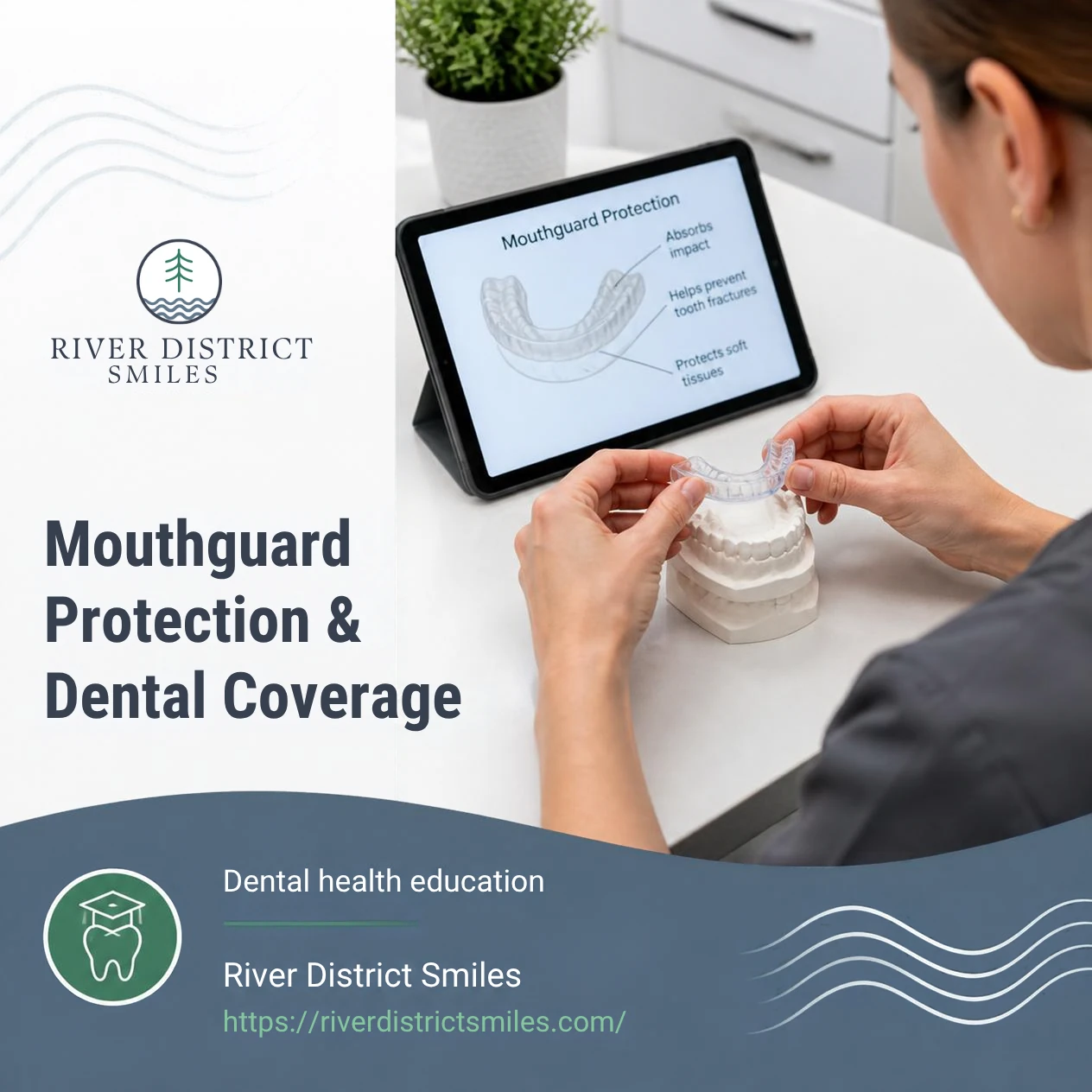
The ADA recognizes three general categories of athletic mouthguards and notes differences in cost, adaptability, comfort, fit and protection. Custom mouthguards are made from an individual impression or model of the patient’s teeth. Properly fitted boil-and-bite guards can also be appropriate, and some have earned the ADA Seal of Acceptance by meeting specified safety and performance requirements.
The most expensive guard is not automatically the right guard for every athlete.
But a huge warranty number does not automatically make one guard safer, either.
Custom Mouthguard vs. Store-Bought: Where Does the Warranty Fit?
This is where parents sometimes get stuck.
A store-bought mouthguard may cost considerably less and may come with an impressive-looking dental warranty.
A professionally fabricated custom mouthguard generally costs more because it is made specifically around the athlete’s teeth and bite.
The ADA notes that custom guards offer individual customization and can provide excellent fit and adaptability, although they are generally the most expensive category.
The decision is usually less about “Which one has the biggest warranty?” and more about:
Will this athlete wear it consistently, and does it fit well enough to do its job?
A $15 mouthguard sitting in a gym bag protects nothing.
Neither does a $150 custom guard if the athlete refuses to wear it.
What If Your Child Has Braces?
Do not treat this as a normal mouthguard purchase.
Teeth move during orthodontic treatment, which means the guard needs room to accommodate that movement. The appliance also needs to protect the lips and cheeks from being driven against brackets during an impact.
Some products are specifically designed for orthodontic use.
But warranty coverage may also change when braces are involved. For example, some limited dental warranties exclude orthodontic treatment from reimbursement.
If your child has braces, loose teeth, bridges, implants, or other significant dental work, it is worth discussing the guard with a dentist or orthodontist instead of relying solely on an online fitting kit.
Impact itself specifically warns people undergoing fixed orthodontic treatment or those with loose teeth or bridgework not to take their own dental impression using its kit.
What Happens If a Tooth Gets Knocked Out Anyway?
No mouthguard can promise that a dental injury will never happen.
A properly fitted mouthguard reduces risk; it does not create an invisible force field around the teeth.
If a permanent tooth is completely knocked out, time matters.
Handle the tooth by the crown rather than the root. If it is dirty, gently rinse it without scrubbing. If possible, the tooth can sometimes be repositioned in the socket; otherwise it should be kept moist while emergency dental care is sought promptly.
A broken, displaced, or knocked-out tooth is also not the moment to start reading warranty paperwork.
Get the athlete treated first.
Then save:
- The mouthguard
- Purchase receipt
- Packaging and warranty information
- Photos if appropriate
- Dental treatment records
- Coach or official documentation
- Insurance explanation of benefits
Those may become important if you later file a manufacturer’s warranty claim.
River District Smiles recommends mouthguards as a preventive measure for activities where dental trauma is possible and provides care for dental injuries when accidents do occur.
So Is a Dental Warranty Worth Anything?
It can be.
If two mouthguards both fit the athlete well and provide appropriate protection, a clear dental warranty may be a useful extra benefit.
But I would treat it as a secondary financial safeguard, not a substitute for:
- A properly fitting mouthguard
- Dental insurance
- Emergency savings
- Prompt treatment after an injury
And before paying more because one package advertises a large warranty, read the actual terms.
Look for:
- Maximum per tooth, not just maximum per incident.
- Eligible sports and activities.
- Whether practices must be coach-supervised.
- Fitting requirements.
- How quickly the injury must be reported.
- How quickly dental care must be completed.
- Treatments that are excluded.
- Whether insurance payments reduce the warranty payment.
- How long the warranty lasts.
- Whether registration or proof of purchase is required.
That information tells you far more than the big number printed on the box.
The Bottom Line
A sports mouthguard is there to protect teeth.
A dental warranty is there to define what the manufacturer may pay after protection fails under certain qualifying circumstances.
Those are two very different things.
And if you are specifically considering an Impact Mouthguards product, its current published terms do not provide the type of dental-injury warranty offered by some other mouthguard manufacturers.
That does not automatically make it a poor mouthguard. It simply means you should evaluate it for what it actually offers rather than assuming there is insurance attached to it.
If your child plays a contact sport and you are unsure whether a store-bought guard fits adequately, whether braces change the equation, or whether your dental benefits contribute toward a custom guard, those are reasonable questions to bring to a dental visit.
The best mouthguard is not the one with the biggest number on the package. It is one that fits properly, provides appropriate protection, and actually stays in the athlete’s mouth when the impact happens.