

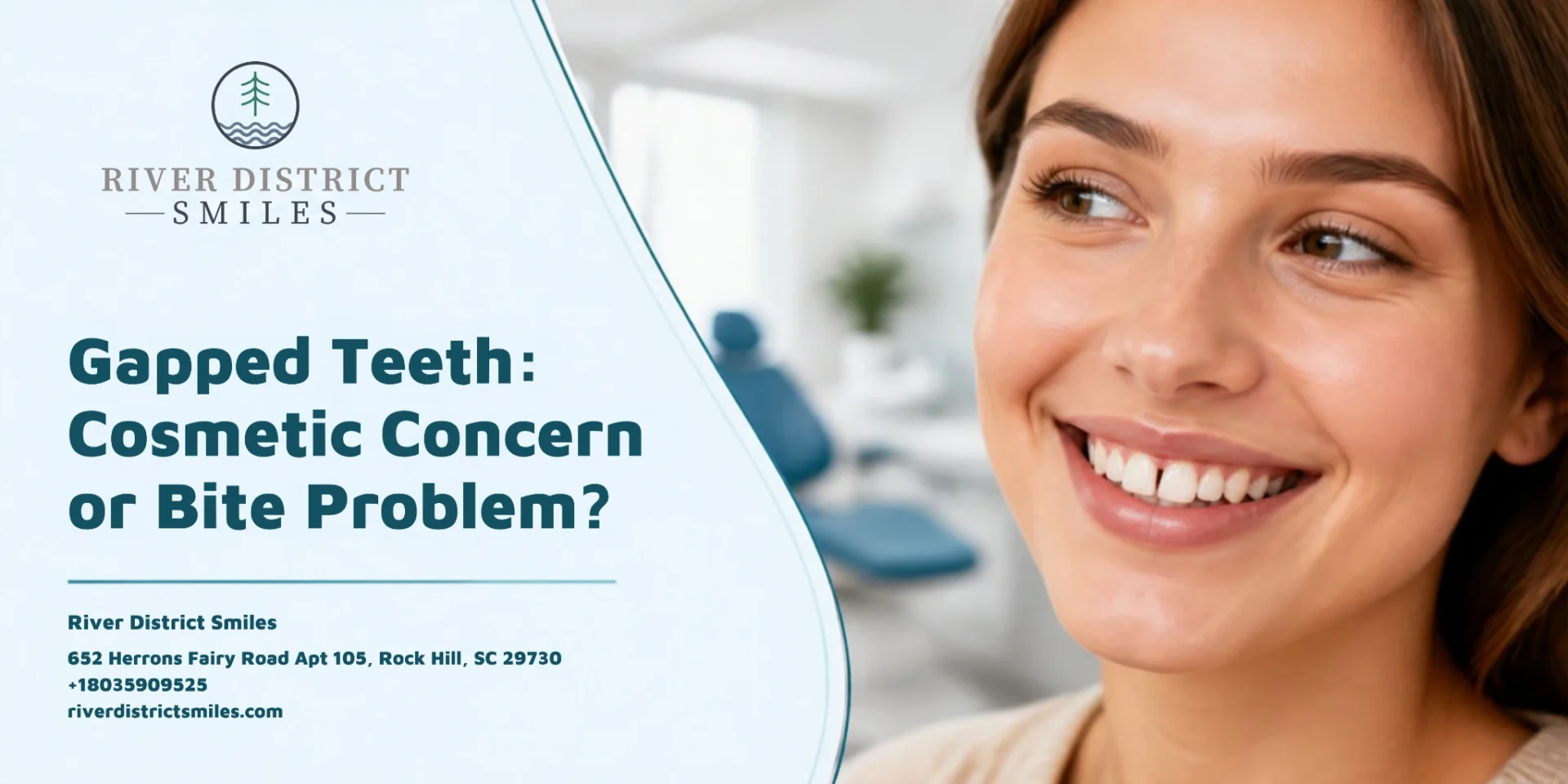


If you have had a small space between your front teeth for years and it has never bothered you, you may not need to do anything about it.
If that space has recently appeared, keeps getting wider, traps food, or comes with changes in your bite, that is a different conversation.
The short answer is that gapped teeth can be purely cosmetic, but they can also be a sign of tooth-size differences, missing teeth, shifting teeth, gum disease, or a larger bite-alignment issue.
The important question is not simply whether there is a gap.
It is why the gap is there.
Once we understand the cause, we can decide whether leaving it alone, closing it with bonding or veneers, moving the teeth orthodontically, or addressing another underlying problem makes the most sense.
The American Association of Orthodontists notes that some dental spacing is primarily cosmetic, while other spacing can affect bite function, speech, food trapping, or long-term tooth alignment.
What Is a Gap Between Teeth?
Dentists call a space between two adjacent teeth a diastema.
The classic example is a space between the two upper front teeth, but spacing can happen almost anywhere.
You may have one obvious gap or small spaces distributed throughout the mouth.
Some people naturally have teeth that are slightly smaller relative to the size of their jaw. If there is simply more room than the teeth require, spaces can remain between them.
Other gaps develop because a tooth is missing, teeth have shifted, childhood habits affected alignment, or changes in the supporting gums and bone allowed teeth to move.
That is why two people with gaps that look almost identical in a photograph can need completely different advice.
When Is a Gap Mostly Cosmetic?
A gap is more likely to be primarily cosmetic when it has been stable for years and the surrounding teeth and gums are healthy.
For example, imagine an adult with a small space between the two upper front teeth.
The teeth are healthy.
The gums are healthy.
The bite feels comfortable.
Food does not constantly become trapped.
The space has not changed.
The patient simply does not like how it looks in photographs.
That is largely an appearance decision.
There is no dental rule saying every small space must be closed.
If you like your gap, it is part of your smile.
If you dislike it, cosmetic or orthodontic options can be discussed.
The AAO specifically notes that not all spacing requires treatment and that some gaps are purely cosmetic.
When Can a Gap Be Part of a Bite Problem?
Spacing deserves more attention when it occurs alongside abnormal tooth or jaw relationships.
You may notice that the upper and lower teeth do not meet comfortably, certain teeth do not contact at all, your front teeth protrude, or chewing feels uneven.
That falls into the broader category dentists call malocclusion, meaning the teeth or jaws do not meet in an ideal relationship.
The ADA explains that orthodontic treatment may be used when teeth are spaced too far apart or when the upper and lower teeth do not meet properly. Bite problems can affect chewing, speech, tooth wear, gums, and jaw function in some patients.
This does not mean every gap creates a bad bite.
It means that if spacing is only one piece of a larger alignment problem, simply filling the visible space may not solve the actual issue.
Why Do People Develop Gapped Teeth?
There is no single cause.
One of the simplest causes is a mismatch between tooth size and jaw size. Smaller teeth in a relatively wider arch naturally leave more space.
Missing teeth can create another type of gap. Once a tooth is lost, the neighboring teeth may gradually shift toward the open space, which can change both alignment and bite relationships.
Childhood habits such as prolonged thumb sucking or tongue-pressure patterns can also affect alignment in developing mouths.
And in adults, new spacing can sometimes develop because the supporting gums and bone around the teeth have changed.
The AAO includes tooth-to-jaw size differences, missing teeth, childhood habits, and gum or bone loss among common contributors to dental spacing.
Understanding which category you fall into determines what kind of treatment—if any—makes sense.
A New Gap in an Adult Deserves More Attention
This is one of the situations I would not treat as “just cosmetic” without an examination.
If you have always had a front-tooth gap, that is one thing.
If you are 45 and suddenly notice a space that did not exist two years ago, I want to know why the teeth are moving.
Periodontal disease can damage the bone and tissues that support teeth. As that support changes, adult teeth may become loose, shift position, or begin separating.
The ADA lists permanent teeth becoming loose or separating, as well as changes in the way the teeth fit together, among potential warning signs of gum disease.
That does not mean every new gap means you have periodontal disease.
Teeth can shift for other reasons.
But new or widening spacing in an adult is worth evaluating before anyone simply closes the gap cosmetically.
If the teeth are moving because their foundation is unhealthy, treating the foundation comes first.
What About Gaps in Children?
Spacing in children needs to be viewed differently from spacing in adults.
Children’s mouths are still developing.
Baby teeth fall out, permanent teeth erupt, jaws grow, and tooth positions change.
Some spaces that look concerning at one stage of development can change significantly as more permanent teeth come in.
The AAO notes that some spacing in children is normal during dental development and may simply need monitoring, while persistent or more significant spacing may benefit from orthodontic evaluation.
This is another reason not to compare a child’s smile directly with an adult smile.
The dentist needs to know which teeth have erupted, what is still developing, and whether the spacing is following a normal pattern.
Can a Gap Make Cleaning Harder?
Sometimes.
A small, healthy front-tooth gap may actually be relatively easy to clean.
But larger or irregular spaces can trap food near the gums.
That can become particularly annoying when food repeatedly packs into the same area after meals.
The AAO identifies food trapping as one of the practical problems some patients experience with dental spacing.
The answer is not automatically orthodontics.
Sometimes adjusting your brushing and interdental cleaning technique is enough.
But if food continually packs into a particular space and irritates the gum, it is worth examining the shape, position, and contact of the teeth to understand why.
Can a Gap Affect Speech?
It can in some people.
The position of the front teeth influences the way the tongue and airflow work during certain speech sounds.
Larger spaces or broader alignment problems may affect pronunciation for some patients, although many people with front-tooth gaps have no speech problem whatsoever.
The AAO includes speech concerns among the possible functional effects of significant dental spacing.
If you have always spoken normally with a gap, closing it is unlikely to be medically necessary simply because somebody tells you gaps “cause speech problems.”
Again, the individual situation matters.
What Are the Main Ways to Close a Gap?
There is no single “best” treatment for gapped teeth.
The right option depends on whether the issue is tooth position, tooth size, tooth shape, missing teeth, gum health, or some combination.
| Treatment | Usually makes sense when | Main tradeoff |
| Leave it alone | Gap is stable, healthy, and does not bother you | Appearance remains unchanged |
| Dental bonding | Small cosmetic gap or undersized/uneven teeth | Resin can stain, wear, or chip over time |
| Veneers | Small gaps plus concerns about shape, color, or symmetry | Higher cost and usually some permanent enamel alteration |
| Clear aligners | Teeth need to physically move to close spacing | Takes months and requires consistent wear |
| Braces | Spacing occurs with more complex bite or alignment problems | More visible and harder to clean around during treatment |
| Tooth replacement | Gap exists because a permanent tooth is missing | Requires restorative treatment rather than simply moving or enlarging nearby teeth |
| Gum treatment first | Spacing is related to periodontal disease or loss of support | Cosmetic closure must wait until the underlying condition is stable |
That table explains why “How do I close my gap?” is sometimes the wrong first question.
The better first question is:
What created the space?
Option 1: Do Nothing
This is a legitimate dental option.
If your gap is healthy, stable, and comfortable, you do not have to close it.
There is no requirement that every smile conform to one specific shape.
Some people consider their front-tooth space an important part of their appearance.
If there is no functional or health reason for treatment and you like your smile, monitoring the space at routine dental visits may be all that is necessary.
Cosmetic treatment should be something you choose because you want the change—not something you are pressured into because your natural smile does not look like somebody else’s.
Option 2: Dental Bonding
Bonding can be a conservative choice for a small cosmetic space.
Tooth-colored composite resin is added to the sides of the teeth and carefully shaped so the teeth appear slightly wider, reducing or closing the gap.
River District Smiles uses dental bonding for small gaps and other subtle cosmetic changes. The practice describes it as a relatively quick and affordable option compared with more involved cosmetic treatment.
When bonding tends to make sense
Bonding is particularly useful when the teeth are already in a reasonable position but are slightly too narrow or irregularly shaped.
Instead of moving the teeth, we change their proportions.
The tradeoff
Composite resin is not as resistant to staining, wear, and chipping as porcelain.
River District Smiles notes that bonding may require maintenance over time, particularly depending on bite forces and habits.
If you grind your teeth or the proposed additions would become very wide, another treatment may produce a more predictable result.
Option 3: Porcelain or Ceramic Veneers
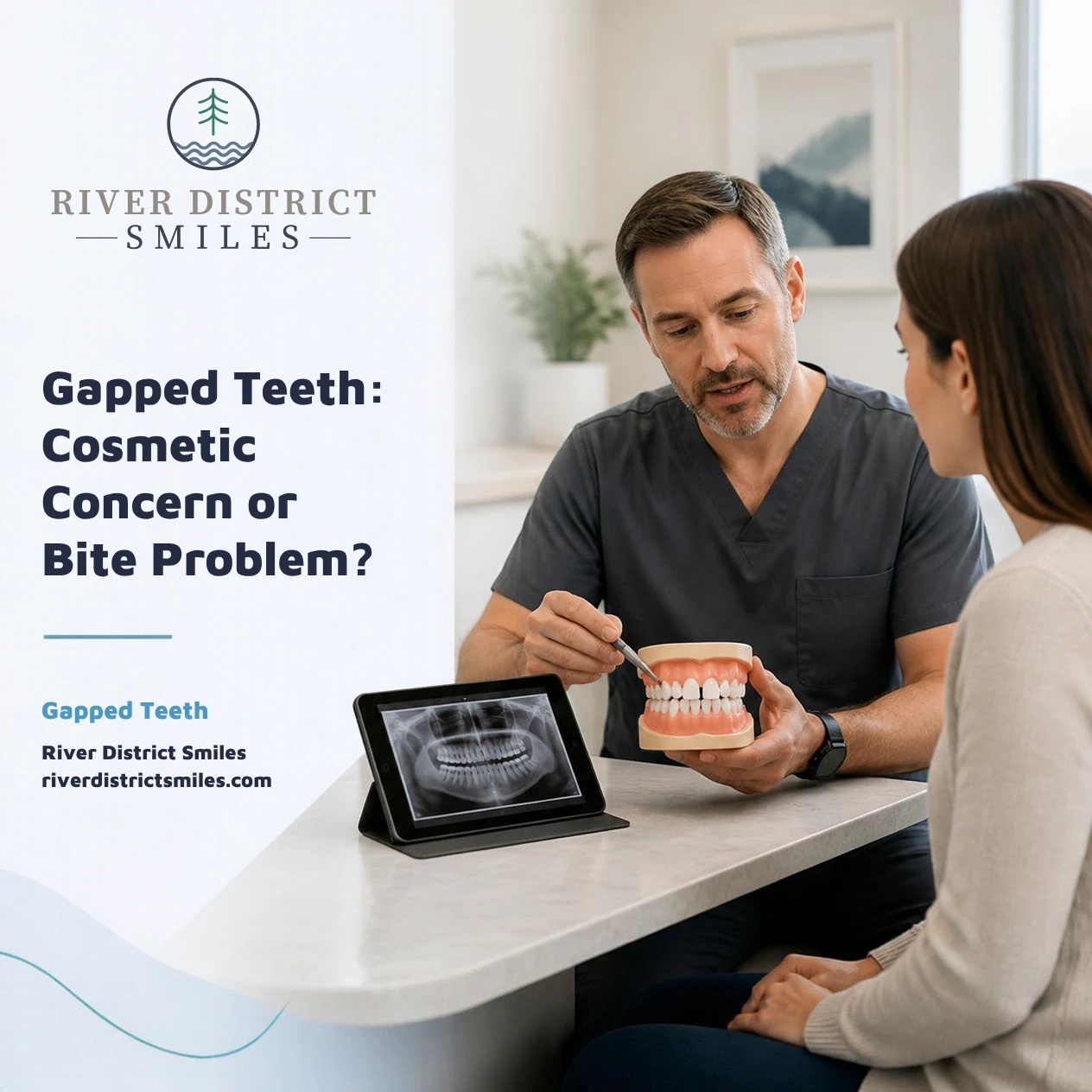
Veneers can close small spaces while simultaneously changing tooth shape, proportion, color, and symmetry.
River District Smiles specifically includes small gaps among the concerns that veneers may address.
This is useful when the problem is not only the space.
For example, you may have two small front teeth with a gap plus uneven edges and discoloration.
Closing the gap with orthodontics would move the teeth, but it would not make small teeth larger or change their color.
Veneers can address several cosmetic concerns at the same time.
The tradeoff is that veneers generally cost more than bonding and often require removal of some enamel.
That makes them a more significant commitment.
For a tiny gap between two otherwise beautiful, healthy teeth, veneers may be more treatment than you actually need.
Option 4: Clear Aligners
When the teeth themselves need to move, orthodontic treatment is usually a more logical approach than simply making them wider.
River District Smiles uses SureSmile clear aligners for mild to moderate spacing and selected bite-alignment concerns.
Clear aligners gradually reposition the teeth through a planned series of removable trays.
They make particular sense when you have several spaces or when the front-tooth gap is part of broader alignment concerns.
The advantage is that we are changing the position of the teeth rather than adding restorative material to healthy enamel.
The tradeoff is time and compliance.
River District Smiles advises SureSmile patients to wear the trays approximately 20 to 22 hours per day, and treatment length depends on how much movement is required.
When Are Braces a Better Choice?
Clear aligners work very well for many spacing cases.
They are not the answer to every orthodontic problem.
When spacing occurs with a complicated bite, severe tooth movement, significant rotations, or other more difficult orthodontic mechanics, traditional braces or specialist orthodontic care may be more appropriate.
River District Smiles describes SureSmile as particularly useful for mild to moderate crowding and spacing, while more complicated bite problems may require another orthodontic approach.
The goal is not to force every patient into the treatment they originally asked for.
It is to use the method that can move the teeth predictably.
What If the “Gap” Is Actually a Missing Tooth?
That is an entirely different problem.
If a permanent tooth is missing, closing the space orthodontically may occasionally be part of treatment, but many patients instead need to replace the missing tooth.
Options may include a bridge, dental implant, or removable prosthesis depending on which tooth is missing and the condition of the surrounding mouth.
The ADA notes that missing teeth can affect chewing and speech, and nearby teeth may shift over time.
River District Smiles offers bridges and dental implants as options for replacing missing teeth.
This is why you should not automatically make the teeth on either side of a missing-tooth space wider with bonding or veneers.
First we need to decide whether that space should actually contain a tooth.
Why Closing a Gap Without Understanding the Cause Can Backfire
Imagine that two front teeth have gradually separated because gum disease has weakened their support.
You place bonding between them.
The gap disappears.
But the periodontal disease remains.
The teeth may continue to move, creating new spaces or putting stress on the restorations.
Or imagine a patient whose front-tooth space is part of a larger bite problem.
Making each tooth wider may hide the visible gap while leaving the bite unchanged.
That is why River District Smiles’ cosmetic evaluation includes assessing tooth structure, spacing, and bite alignment before recommending treatment.
Cosmetic dentistry should improve the appearance without ignoring the mechanics underneath it.
Will a Closed Gap Stay Closed Forever?
Not automatically.
Teeth can move.
This is particularly important after orthodontic treatment.
Once braces or clear aligners have closed spaces, retainers help hold the teeth in their new positions.
The AAO emphasizes retainer wear because gaps can reopen after orthodontic treatment if the teeth are allowed to shift.
River District Smiles likewise advises patients that retainers are needed after SureSmile treatment to maintain the new alignment.
Bonding and veneers have a different maintenance issue.
They do not depend on retainers to remain attached, but the restorative material itself can wear, stain, chip, or eventually require replacement.
Every option has maintenance.
The question is which kind of maintenance you prefer.
What Does It Cost to Close Gapped Teeth?
There is a large difference between adding bonding to two front teeth and completing comprehensive orthodontic treatment.
Bonding is generally one of the lower-cost cosmetic approaches because it can often be completed directly in the mouth without laboratory-made restorations. River District Smiles describes bonding as a more affordable option for subtle changes such as closing small gaps.
Veneers cost more because they involve customized restorations, planning, and laboratory or ceramic fabrication. The total depends heavily on how many teeth are being treated.
SureSmile orthodontic treatment generally costs several thousand dollars at River District Smiles, with final pricing affected by the complexity of the case, number of aligners, treatment length, and what is included in the treatment plan.
That is why treatment price should follow diagnosis.
You do not want to compare a two-tooth bonding estimate against an orthodontic estimate as though they are two versions of the same procedure.
One makes teeth wider.
The other moves them.
Will Dental Insurance Pay to Close a Gap?
It depends on why treatment is being performed and on your specific plan.
Purely cosmetic bonding or veneers are commonly excluded from dental insurance.
Orthodontic coverage varies significantly between plans and may include age restrictions, lifetime maximums, or no adult orthodontic benefit at all.
Treatment for gum disease or replacement of a missing tooth may fall under very different benefit categories.
Before choosing treatment primarily based on insurance, find out exactly what your plan covers.
A cheaper treatment is not necessarily better value if it addresses the appearance but not the cause.
How Do You Know Which Option Makes Sense?
Start by separating three different issues.
Tooth position: Are the teeth in the wrong place?
Tooth proportion: Are the teeth correctly positioned but too small or unusually shaped?
Underlying health: Is gum disease, missing teeth, or another dental problem creating the spacing?
If the teeth are healthy and positioned well but simply small, bonding or veneers may make sense.
If the teeth need to move, aligners or braces may be more appropriate.
If the gap exists because a tooth is missing, tooth replacement may need to be considered.
And if new spacing is related to periodontal disease, that disease needs to be stabilized before the cosmetic question becomes the priority.
That is the decision tree.
When Should a Gap Be Evaluated?
A long-standing, stable gap is rarely a dental emergency.
But I would have spacing evaluated if the gap is new, getting larger, trapping food repeatedly, associated with loose teeth or bleeding gums, changing your bite, affecting chewing or speech, or simply bothering you enough that you are considering treatment.
The AAO similarly recommends evaluation for gaps that are increasing, causing food trapping, affecting biting, or creating speech concerns.
You may find out that nothing needs to be done.
That is still useful information.
The Bottom Line
A gap between your teeth is not automatically a dental problem.
Sometimes it is simply part of the way your smile developed.
If it is healthy, stable, and does not bother you, leaving it alone can be completely reasonable.
But a gap deserves more attention when it is new, widening, associated with missing teeth, accompanied by gum problems, or part of a larger bite issue.
That is why the best treatment for gapped teeth cannot be chosen from a photograph alone.
River District Smiles offers several options depending on what is creating the space, including dental bonding, veneers, SureSmile clear aligners, and restorative treatment for missing teeth.
The next step is not automatically closing the gap.
It is finding out whether the space is mainly about appearance, tooth position, tooth shape, or something happening underneath the gums.
Once you know why the gap is there, choosing what to do about it becomes much simpler.