

Maybe the tooth was knocked out playing hockey in high school.
Maybe you broke a front tooth during college basketball, had it repaired, and have spent the last 15 years replacing bonding and crowns.
Or maybe an old football injury led to a root canal that worked well for decades but now the tooth has finally reached the point where it cannot predictably be saved.
Sports injuries do not always end when your playing career does.
Sometimes the long-term dental consequences show up years later.
The short answer is that dental implants can be an excellent way to replace teeth lost because of old sports injuries but trauma cases can be more complicated than simply putting an implant where the tooth used to be.
The age of the injury, amount of remaining bone, condition of the gums, position of nearby teeth, previous root canals or surgeries, and whether you still participate in contact sports can all change the treatment plan.
At River District Smiles, dental implant treatment ranges from replacing one missing tooth to restoring multiple teeth or an entire arch. The important first step is figuring out what the old injury left behind and which replacement actually makes sense now.
Why Do Old Sports Injuries Cause Problems Years Later?
A sports injury can damage more than the visible part of a tooth.
Depending on the original impact, there may have been injury to:
- The tooth nerve
- The root
- The bone supporting the tooth
- The ligament around the root
- The gum tissue
- Nearby teeth
- The bite
Sometimes the tooth is lost immediately.
Other times it survives.
A dentist may perform a root canal, rebuild the tooth with bonding, place a crown, stabilize it, or simply monitor it.
That treatment can work very well for years.
But a severely traumatized tooth may eventually fracture, develop problems around the root, or lose enough supporting structure that another repair stops being predictable.
That does not mean the earlier treatment “failed.”
Sometimes it simply bought many additional years for the natural tooth.
When the remaining tooth can no longer be predictably restored, that is when an implant may enter the conversation.
Can You Get a Dental Implant Years After Losing a Tooth?
Often, yes.
There is no rule saying a dental implant has to be placed immediately after the sports injury.
People routinely explore implants months or years after losing a tooth.
The bigger issue is what has happened to the jawbone during that time.
Bone depends partly on stimulation from the roots of natural teeth. After a tooth is removed or lost, the ridge in that area can gradually change in width and shape.
The American Association of Oral and Maxillofacial Surgeons notes that adequate bone volume and density are important for stable implant placement and that bone preservation can help support future implant treatment.
So if you lost a front tooth playing lacrosse 20 years ago, an implant may still be possible.
We just cannot assume the site looks exactly the way it did 20 years ago.
Does an Old Sports Injury Mean You Will Need a Bone Graft?
Not automatically.
This is one of the places where patients hear the word “implant” and immediately assume several additional surgeries are coming.
Some people have plenty of bone for straightforward implant placement.
Others do not.
Bone grafting may be considered when there is not enough bone in the right position to support the implant or create the desired contour around the final tooth.
AAOMS describes bone grafting as a way to replace missing bone or provide a scaffold on which the patient’s own bone can grow. It is used in implant treatment as well as reconstruction after facial trauma.
Trauma cases may be more likely to involve bone reconstruction because the original injury itself can damage the ridge.
Research on implant treatment after traumatic tooth loss reflects that complexity. In one systematic review, bone augmentation was performed at 60 of the 120 implant sites studied. The authors also emphasized that the overall evidence base for trauma-related implant treatment remains limited.
That does not mean 50% of former athletes will need grafting.
It means traumatic tooth loss often requires individualized planning.
Your X-rays and 3-D imaging, when indicated, tell us much more about your situation than statistics do.
What If the Tooth Is Still There but Has Been Root Canaled?
Do not assume it needs to come out just because it has had a root canal.
A root-canaled tooth that is healthy, structurally sound, comfortable, and restorable may continue functioning for many years.
Implants are not automatically “better” than natural teeth.
If the tooth can be predictably maintained, preserving it may still be the better treatment.
The implant conversation becomes more relevant when the tooth has problems such as:
- A vertical root fracture
- Severe structural loss
- Repeated restorative failure
- A fracture extending too far below the gum
- Persistent infection that cannot be predictably treated
- Inadequate remaining support
- A prognosis poor enough that further treatment would offer little long-term value
That is why the first appointment should not begin with choosing an implant brand.
It should begin with a simpler question:
Can this tooth still be saved predictably?
If the answer is yes, we discuss what saving it requires.
If the answer is no, then we discuss replacement options.
Implant vs. Bridge: Which Makes More Sense After a Sports Injury?
Both can be reasonable.
A traditional bridge replaces a missing tooth by using neighboring teeth for support.
A single dental implant replaces the missing tooth independently, using an implant in the jawbone with a crown on top. River District Smiles offers single-tooth implants specifically for patients who want to replace a tooth without relying on adjacent teeth for support.
The decision becomes especially interesting in an old trauma case.
An implant may make more sense when:
- The neighboring teeth are healthy and you would prefer not to prepare them for crowns.
- There is adequate bone or bone can be predictably reconstructed.
- You want an independently supported replacement.
- The overall health of the mouth makes implant treatment appropriate.
A bridge may make more sense when:
- The neighboring teeth already need crowns.
- Implant surgery is not appropriate or desired.
- Bone reconstruction would make the implant process substantially more involved.
- Medical, anatomical, time, or budget considerations favor a bridge.
Neither option is automatically superior in every situation.
A good treatment plan looks at the condition of all three areas: the missing tooth site and the teeth on either side of it.
What If the Injury Happened to a Front Tooth?
Front-tooth implant cases deserve careful planning because the final result has to do more than withstand chewing.
It has to look natural.
The implant has to be positioned so the eventual crown emerges in the right place. The surrounding bone and gum tissue affect how natural the tooth looks, particularly near the gumline.
Old trauma can complicate that because previous surgery, bone loss, scarring, root fractures, or years of missing-tooth space can change the anatomy.
A recent review of implant rehabilitation after facial trauma emphasized that successful reconstruction can involve careful timing, bone and soft-tissue management, orthodontics, restorative dentistry, and sometimes several disciplines working together.
That does not mean every old front-tooth injury becomes a complex reconstruction.
It does mean that “Can you put an implant there?” and “Can you make that implant tooth look natural?” are two separate questions.
Both should be part of the treatment plan.
Do Implants Work Well After Traumatic Tooth Loss?
Available research is encouraging, but it is important not to oversell what we know.
A systematic review examining implants used after traumatic tooth loss included 96 patients and 120 implants. Implant survival was reported at 97% after an average follow-up of about 3.5 years, with high patient satisfaction regarding aesthetics. However, the authors specifically described the quality of evidence as limited.
A newer retrospective study followed 56 implants replacing front teeth lost to trauma and reported 100% implant and restoration survival in the studied group over follow-up periods ranging from one to 9.5 years.
Those results are useful.
They are not a personal guarantee.
Implant success still depends on factors such as:
- Bone and gum health
- Implant position
- Oral hygiene
- Smoking status
- Medical health
- Bite forces
- Maintenance
- The complexity of the original injury
That is why it is more useful to talk about your prognosis than a generic success percentage.
What Does the Dental Implant Process Actually Involve?
For many patients, there are several phases.
1. Evaluation
The dentist evaluates the missing tooth site, gums, bite, neighboring teeth, medical history, and available bone.
Digital imaging may be needed to understand the anatomy and plan implant position.
River District Smiles describes implant consultations as including evaluation of the teeth, gums, bite, and jawbone before a personalized treatment plan is created.
2. Preparatory treatment, if needed
This could include:
- Removing a failing tooth
- Treating gum disease
- Bone grafting
- Allowing an infected area to heal
- Managing another dental problem before implant placement
Not everyone needs these steps.
3. Implant placement
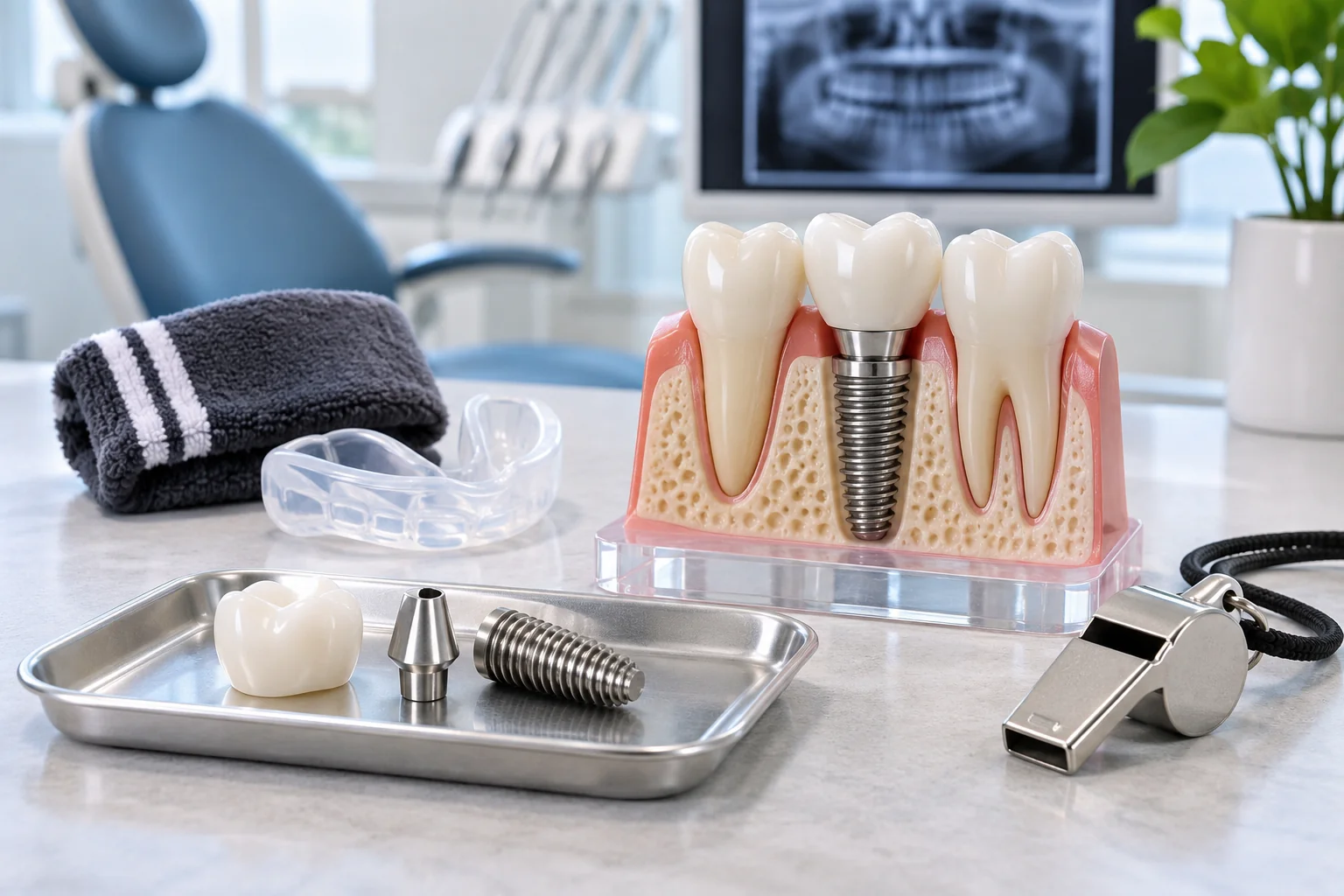
The dental implant is positioned in the jawbone.
The implant then needs time to integrate with the surrounding bone.
AAOMS explains that new bone cells grow and attach around the implant over a period of months, creating the stability needed before the final restoration is placed.
4. Final restoration
Once healing is adequate, the implant receives the restoration that replaces the visible tooth.
For one tooth, that is typically a crown.
For several missing teeth, implants may support a bridge.
For patients missing an entire arch, implants may support a full-arch restoration.
River District Smiles provides single-tooth, multi-tooth, full-mouth, and All-on-X implant options depending on the patient’s needs.
Can You Get a Tooth the Same Day as the Implant?
Sometimes a temporary tooth can be provided quickly.
But same-day teeth and fully healed implants do not mean the same thing.
Even when a temporary restoration is placed immediately, the implant still needs biological healing.
That period matters.
An implant can initially feel solid while the bone around it is still going through the process of integration.
AAOMS notes that early implant healing commonly involves a softer diet and avoiding unnecessary pressure on the surgical site while osseointegration progresses.
For former athletes, this is particularly important if “retired” actually means:
“I still play men’s league hockey twice a week.”
Tell your dentist.
Your activity level can affect the advice you receive during healing.
Can You Return to Contact Sports With a Dental Implant?
Having an implant does not automatically mean you can never play contact sports again.
It does mean the implant and its restoration deserve protection.
An implant-supported crown can still be damaged by trauma.
The crown can fracture. Components can be damaged. The surrounding tissues can be injured. And a sufficiently severe facial impact can affect far more than the implant.
The ADA recommends properly fitted mouthguards for recreational and competitive activities with significant risk of oral trauma, including hockey, football, basketball, lacrosse, boxing, soccer, martial arts and many others.
If you still participate in contact or high-impact sports after an implant, ask about a mouthguard.
A custom guard may be particularly worth considering when you have spent significant time and money reconstructing a previously injured front tooth.
The point is not that an implant is fragile.
It is that no dental restoration is indestructible.
What If You Grind or Clench Your Teeth?
This deserves attention too.
Former athletes sometimes continue habits developed during competition or weight training, including heavy clenching.
Other people grind while sleeping without realizing it.
Dental implants do not have the same periodontal ligament that cushions a natural tooth, so the dentist needs to consider how forces are distributed across the restoration and the rest of the bite.
If there is evidence of significant grinding or clenching, your treatment plan may include discussion of a nightguard or other protective strategy.
This is different from an athletic mouthguard.
An athletic mouthguard protects against impact during sports.
A nightguard is designed for a different type of force.
Do not assume one appliance automatically replaces the other.
What If the Teeth Have Shifted Since the Injury?
This is common when a tooth has been missing for a long time.
Nearby teeth may tilt or move into space. The opposing tooth can also change position when it no longer has a tooth to bite against.
AAOMS notes that neighboring teeth can shift or tilt after tooth loss, which can create bite problems and complicate future restoration.
Sometimes there is still enough room for an implant crown.
Sometimes there is not.
In more complicated cases, orthodontic treatment may be considered before implant placement to recreate appropriate space.
This is another reason not to assume:
“I have a gap, so an implant just goes into the gap.”
We need enough bone and enough restorative space in the correct position.
How Much Does a Dental Implant Cost?
For former athletes, cost often becomes part of the decision because the old injury may already have required years of previous dental work.
River District Smiles currently estimates that a single dental implant typically costs about $3,000 to $6,000, including the implant, abutment, and crown.
Replacing multiple teeth or an entire arch can range from roughly $10,000 to $30,000 or more, depending on the restoration and complexity.
Those numbers are useful starting points, not quotes for every patient.
An old sports-injury case may cost more if it requires:
- Extraction of a failing tooth
- Bone grafting
- Additional imaging
- Temporary restorations
- Treatment of neighboring teeth
- Multiple implants
- More complex aesthetic work
On the other hand, a straightforward single-tooth site with adequate bone may stay much closer to the simpler end of the process.
This is why “How much is an implant?” and “How much will my implant treatment cost?” are different questions.
A treatment estimate should show you what is actually included.
Does Dental Insurance Cover Implants?
Sometimes.
Dental insurance varies considerably.
A plan may contribute toward:
- The extraction
- Bone grafting
- The implant
- The abutment
- The final crown
Or it may cover only some of those components.
Annual maximums can also become important because implant treatment frequently spans several phases.
River District Smiles notes that its team reviews insurance considerations, payment options, and financing during implant planning.
Before treatment begins, it is reasonable to ask:
- Which parts of the treatment are covered?
- What is my annual maximum?
- Is there a waiting period?
- Does my plan exclude implants?
- Would treatment crossing two benefit years change my coverage?
- Are grafting or temporary restorations separate charges?
- What happens if the surgical plan changes?
You should understand the financial plan before you are halfway through the clinical plan.
Is an Implant Always Worth It for a Missing Back Tooth?
Not automatically.
This is another situation where the right answer depends on the person rather than the treatment.
Replacing a missing back tooth may improve chewing, help maintain the bite, or prevent other restorative problems.
But the recommendation depends on:
- Which tooth is missing
- How the opposing teeth function
- How many other teeth are present
- The condition of the neighboring teeth
- Bone availability
- Your bite
- Your goals
- Your budget
Some former athletes have lived comfortably with a missing back tooth for years.
Others notice difficulty chewing or changes in their bite.
A dentist should be able to explain what is likely to happen in your particular mouth if the space is restored versus left alone.
What If Several Teeth Were Damaged Over the Years?
Not every sports-related dental history involves one dramatic missing front tooth.
Some former athletes have a collection of smaller problems:
- One missing tooth
- Two heavily crowned teeth
- Worn enamel
- Old bonding
- A bridge that is nearing replacement
- Several root canals
- Bite changes
- Teeth fractured at different times
At that point, placing one implant without looking at the rest of the mouth may not solve the larger problem.
River District Smiles also offers multi-tooth implants and full-mouth restorative approaches for patients with more extensive tooth loss or damage.
The key is sequencing.
What needs to be saved?
What needs to be replaced?
What can reasonably be left alone?
Which treatment needs to happen first?
A comprehensive plan should answer those questions before major dentistry begins.
What If You Have Been Told You Do Not Have Enough Bone?
That does not automatically mean implant treatment is impossible.
Sometimes bone grafting can rebuild enough support for conventional implant placement.
In severe cases, specialized implant approaches exist that use different anatomy.
AAOMS notes that patients with severe bone loss may still have options, although these situations can require more specialized surgical evaluation.
River District Smiles likewise notes that patients previously told they lacked adequate bone may still have options involving grafting, All-on-X treatment, or other full-mouth designs depending on their anatomy.
The important word is may.
An implant consultation should determine whether those approaches are reasonable for you rather than simply promising that everybody can receive implants.
Are Implants Maintenance-Free?
No.
This is one of the biggest misconceptions about replacing natural teeth.
An implant cannot develop a cavity.
But the gum and bone around an implant still need to remain healthy.
You still need:
- Daily cleaning
- Professional preventive care
- Monitoring of the implant and restoration
- Attention to gum inflammation
- Evaluation if something feels loose or uncomfortable
River District Smiles notes that long-term implant care depends on good oral hygiene and regular dental visits.
If you spent years maintaining a repaired sports-injured tooth, think of an implant the same way:
The treatment may solve the missing-tooth problem.
It does not eliminate the need for dental care.
When Is an Implant Probably Not the Best First Choice?
An implant may not be the right immediate step when:
- The natural tooth can still be predictably saved.
- Active gum disease needs treatment first.
- The site does not have adequate bone and you do not want grafting.
- A medical condition makes elective implant surgery inappropriate.
- Smoking or another risk factor meaningfully affects the prognosis.
- A bridge would make more sense because the adjacent teeth already need significant restoration.
- Your expectations about timing or appearance do not match what the anatomy allows.
River District Smiles lists healthy gums, adequate bone support, stable overall oral health, good hygiene, and the ability to undergo routine dental treatment among the factors considered when evaluating implant candidates.
Sometimes the right answer is:
“Yes, an implant makes sense.”
Sometimes it is:
“Yes, but we need to prepare the site first.”
And sometimes it is:
“There is another option that makes more sense here.”
That is what an implant consultation is supposed to sort out.
The Former Athlete’s Implant Checklist
If you are considering replacing a tooth that was originally damaged during sports, these are the questions I would want answered before treatment:
- Can the existing tooth still be saved predictably?
- How much bone is actually present at the site?
- Will I need bone grafting, and why?
- Is an implant or bridge more conservative in my situation?
- Has the old injury changed the gums or neighboring teeth?
- Is there enough space for a natural-looking implant crown?
- What will I wear while the implant heals?
- How many appointments and procedures are realistically involved?
- What is the total expected cost not just the implant placement fee?
- If I still play contact sports, how should I protect the final restoration?
You should be able to get clear answers.
The Bottom Line
Losing a tooth during sports can feel like an event from another lifetime.
The dental consequences sometimes are not.
A tooth repaired at 18 can become the tooth you are making decisions about again at 40 or 50.
If that tooth can still be saved predictably, keeping the natural tooth may remain the right choice.
If it cannot, a dental implant can provide an independently supported replacement that restores appearance and chewing without requiring neighboring healthy teeth to support a bridge.
But old trauma can change the amount of bone, gum tissue, space, and restorative options available.
That is why the right first step is not simply deciding that you “want an implant.”
It is determining what the old injury has left us to work with.
River District Smiles provides implant treatment in Rock Hill for single missing teeth, multiple teeth, and full-arch situations, with treatment planning based on the patient’s bone support, bite, oral health, goals, and budget.
And if you still lace up the skates, step onto the court, coach from the sidelines and occasionally join practice, or refuse to admit that the men’s league counts as retirement, mention that too.
Your new tooth should be planned for the life you actually live.
A good implant consultation should leave you understanding what can be saved, what needs to be replaced, what the process will cost, and what it will take to protect the result long after the old sports injury is finally behind you.