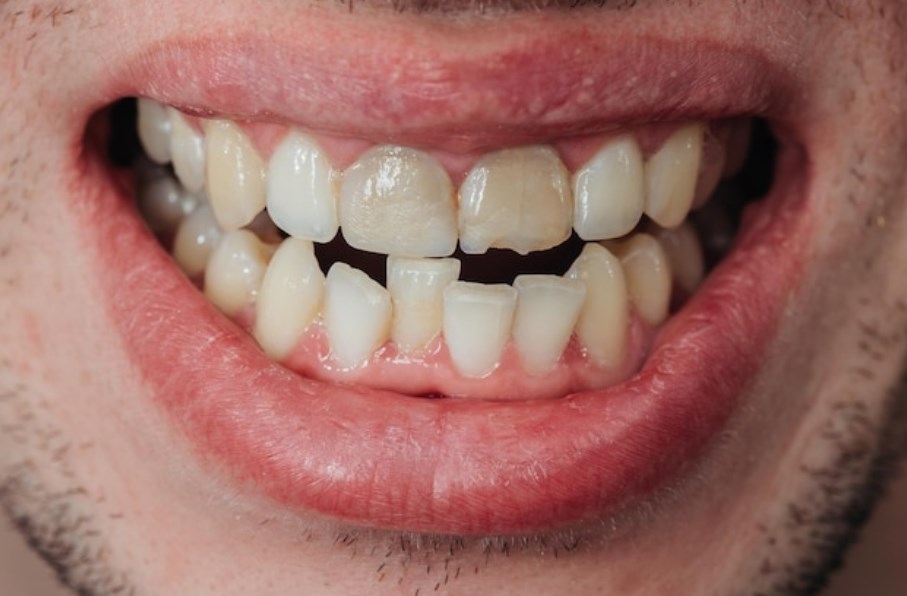


If you suddenly notice that one of your adult teeth moves when you touch it with your tongue, it is understandable to worry that the tooth is going to fall out.
That is possible in advanced cases, but it is not the only outcome.
The short answer is that a loose permanent tooth is not considered normal. It can be caused by gum disease, an injury, loss of supporting bone, or another problem affecting the tooth or the tissues around it. Some loose teeth can be stabilized and kept. Others have lost too much support to save predictably.
The important thing is not to keep testing how loose it is.
It is to find out why it is moving.
At River District Smiles, a loose tooth can be evaluated with an examination and, when appropriate, digital X-rays to look at the root, surrounding bone, infection, and other problems that are not visible from the surface. Same-day emergency appointments are available when scheduling allows for urgent dental problems.
Are Adult Teeth Supposed to Move at All?
Teeth are not fused directly to your jawbone.
Each natural tooth is supported by a thin periodontal ligament that connects the root to the surrounding bone. Because of that ligament, teeth can have a tiny amount of normal movement.
That is very different from a tooth that suddenly:
- Rocks when you touch it
- Moves when you chew
- Feels different from neighboring teeth
- Has shifted position
- Feels taller or “higher” when you bite
- Has developed a visible gap
- Seems progressively looser over time
A permanent tooth with noticeable new mobility deserves an examination.
The question is not simply how loose is it?
We also need to know what has happened to the bone, gums, root, and surrounding tissues.
The Most Common Concern: Gum Disease
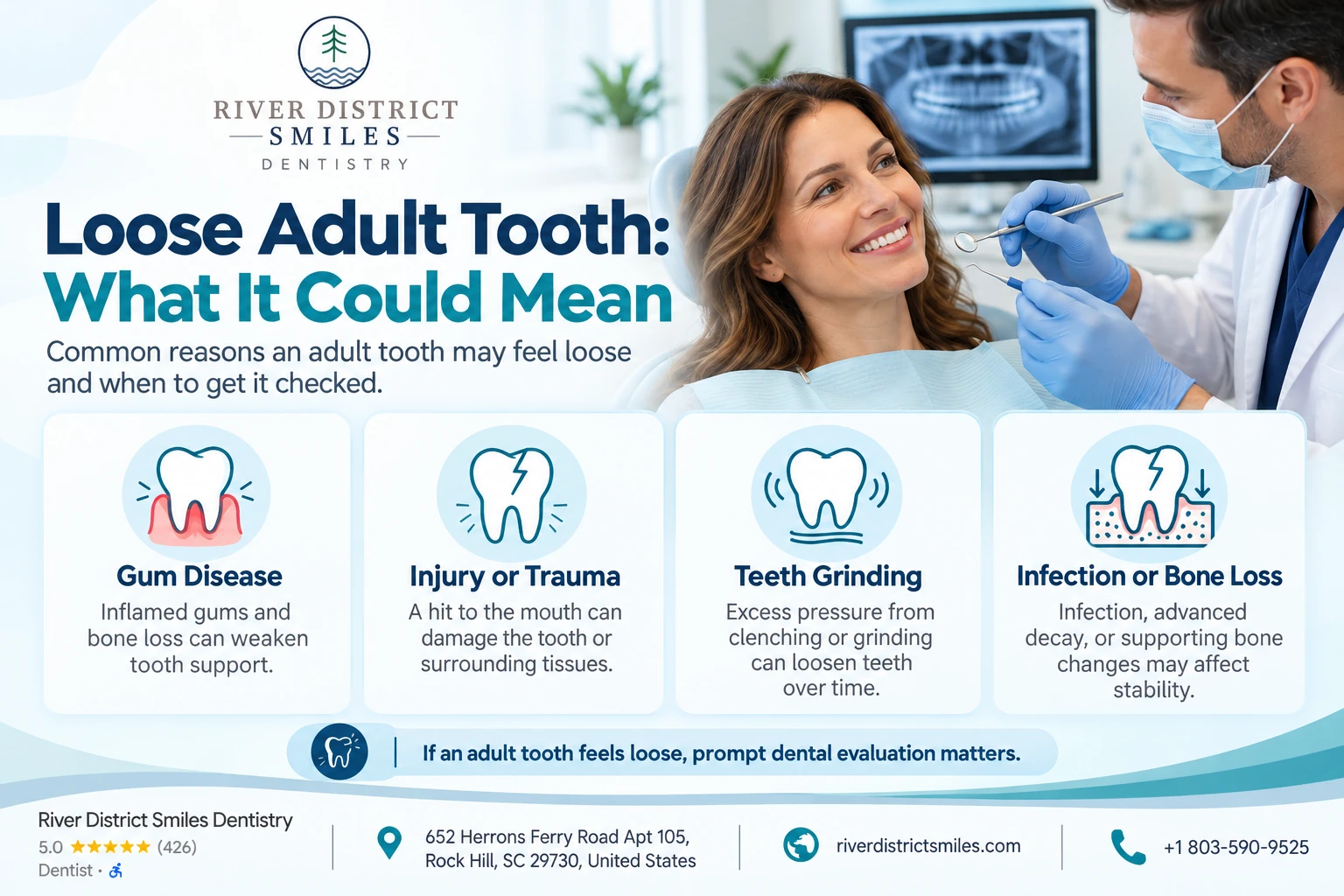
One of the major causes of loose adult teeth is periodontitis, or advanced gum disease.
Periodontitis damages the structures that hold teeth in place, including the periodontal ligament and the bone surrounding the roots. As support is lost, teeth can eventually become mobile or change position. The ADA estimates that roughly 42% of U.S. adults age 30 and older who still have teeth have some form of periodontitis.
This process is often less dramatic than people expect.
Gum disease can progress without severe tooth pain.
You may notice:
- Bleeding when brushing or flossing
- Red or swollen gums
- Receding gums
- Persistent bad breath
- A bad taste
- Teeth appearing longer
- Gaps developing between teeth
- A change in your bite
- One or more teeth becoming loose
The ADA specifically lists loose or separating permanent teeth and changes in the bite among warning signs of gum disease.
So if a tooth is gradually getting looser and your gums have also been bleeding or receding, periodontal disease moves higher on the list of possibilities.
Does a Loose Tooth Mean the Gum Disease Is Severe?
Mobility can indicate that some supporting tissue or bone has already been lost.
But you cannot determine the severity simply by wiggling the tooth.
A periodontal evaluation looks at more than movement.
The dentist may assess:
- Gum-pocket depths
- Bleeding
- Gum recession
- Plaque and tartar
- Tooth mobility
- Bone levels on X-rays
- Which teeth are affected
- The way the teeth contact when you bite
Periodontitis is currently classified according to factors such as severity, extent, bone and attachment loss, and risk of progression.
That matters because a slightly mobile tooth with treatable periodontal disease is very different from a tooth that has lost most of its supporting bone.
You need the whole picture before deciding whether the tooth can be saved.
Can a Loose Tooth Tighten Up After Gum Treatment?
Sometimes mobility can improve when inflammation is controlled and the remaining support is stabilized.
But periodontal treatment cannot simply regenerate every bit of bone that has already been lost.
The goal of periodontal treatment is to control the bacterial biofilm and create an environment that can be maintained more successfully. Treatment may be nonsurgical or surgical depending on the individual case.
For some patients, treatment may begin with scaling and root planing a deep cleaning below the gumline.
The ADA explains that scaling and root planing removes plaque and tartar from periodontal pockets and smooths root surfaces when ordinary cleaning is no longer enough to address disease below the gumline.
The realistic question is not:
“Will this tooth become exactly like it was before?”
It is:
“Is there enough healthy support left to maintain this tooth predictably once the disease is controlled?”
Sometimes the answer is yes.
Sometimes it is not.
A Loose Tooth After an Injury Is a Different Problem
If the tooth becomes mobile after a fall, sports collision, accident, or blow to the face, trauma becomes the more likely explanation.
A tooth does not have to be knocked completely out to sustain a meaningful injury.
Dental trauma can stretch or damage the ligament around the root, fracture the root, or partially displace the tooth from its socket.
The International Association of Dental Traumatology classifies several types of these injuries and emphasizes that accurate diagnosis, treatment, and follow-up improve the likelihood of a favorable result.
A tooth can look nearly normal and still be injured.
After trauma, watch for:
- New looseness
- Bleeding around the gumline
- Pain when biting
- Tenderness when the tooth is touched
- A change in tooth position
- A bite that suddenly feels different
- Chipping or cracking
- Later color change
Do not wait for the tooth to become extremely painful before having it evaluated.
What Should You Do With a Loose Tooth After an Accident?
First, stop testing it.
People naturally want to push the tooth with their tongue every few minutes to see whether it is “still loose.”
That repeatedly stresses an already injured area.
Until you can be examined:
- Avoid biting hard foods with the affected tooth.
- Choose softer foods.
- Keep the area reasonably clean.
- Do not deliberately wiggle the tooth.
- Contact your dentist promptly.
Traumatic permanent-tooth injuries can require anything from monitoring to repositioning and temporary stabilization depending on the type and severity of injury. IADT guidelines emphasize the importance of diagnosis and follow-up because different injury patterns require different management.
River District Smiles includes dental trauma among the conditions evaluated through its emergency dental service and may use digital X-rays when needed to identify fractures or other damage that cannot be seen directly.
Does a Loose Tooth Need to Be Splinted?
Sometimes but not every loose tooth needs a splint.
A dental splint temporarily connects an injured tooth to neighboring teeth to give the supporting tissues a more stable environment while they heal.
Whether that is appropriate depends heavily on why the tooth is loose.
A recently injured tooth that has been displaced is different from a tooth that is mobile because advanced periodontal disease has removed much of its bone support.
That is why buying a temporary repair product or trying to stabilize the tooth yourself is not a good substitute for diagnosis.
The dentist first needs to understand the injury.
Could a Dental Infection Make a Tooth Feel Loose?
It can be part of the picture.
A dental abscess is an infection that can develop because of decay, periodontal disease, or a cracked tooth. Infection may involve the tissues and bone around a tooth and can cause symptoms including pain, swelling, gum redness, bad taste, or fever.
A tooth with infection may also feel tender when biting or seem different in its socket.
If looseness comes with:
- Significant toothache
- Swelling
- Drainage
- A pimple-like bump on the gum
- Bad taste
- Fever
- Facial swelling
do not simply watch it for a few weeks.
The cause needs to be identified.
Depending on where the infection originates, treatment might involve periodontal treatment, root canal treatment, drainage, restoration of the tooth, or extraction when the tooth cannot be saved.
River District Smiles evaluates dental infections, swelling, severe tooth pain, and pain when chewing as urgent dental concerns.
Does Every Loose Tooth With an Infection Need to Be Pulled?
No.
This is an important distinction.
An infected tooth is not automatically a hopeless tooth.
If infection comes from inside the tooth and the tooth remains structurally restorable with adequate periodontal support, root canal treatment may sometimes eliminate the infection while allowing the tooth to remain.
The American Association of Endodontists describes root canal treatment as one approach for removing bacteria from an infected root canal system so the tooth can continue functioning after restoration.
If the problem comes primarily from periodontal disease, gum treatment may be more important.
If there is a severe fracture, advanced bone loss, or very poor remaining support, extraction may become the more predictable option.
The diagnosis determines the treatment not the fact that the tooth moves.
Can Teeth Grinding Make a Tooth Loose?
Heavy clenching or grinding can create substantial forces on teeth and can contribute to problems such as wear, cracks, tenderness, and bite-related discomfort.
But if a permanent tooth is noticeably loose, I would not assume grinding is the only explanation without checking its periodontal support and looking for other causes.
This is especially important when the same tooth also has:
- Gum recession
- Bone loss
- A fracture
- Previous trauma
- A large restoration
- Pain when biting
Your dentist may evaluate your bite and grinding habits as part of the overall picture, particularly if the tooth is already compromised.
The key is not blaming every mobile tooth on clenching before looking at the tissues holding it in place.
Could Osteoporosis Make Teeth Loose?
Osteoporosis affects bone throughout the body, including the jaws, and oral health can be affected by reduced bone density.
The ADA notes that osteoporosis in the jaw may be associated with teeth becoming loose or being lost.
That said, a loose tooth should not automatically be blamed on osteoporosis.
Periodontal disease and local dental problems still need to be evaluated.
Also tell your dentist if you take medications used to treat osteoporosis, particularly antiresorptive medications. The ADA advises patients not to stop these medications without discussing the decision with their physician.
Your medical history can change treatment planning, but it does not replace a dental diagnosis.
What If Only One Tooth Is Loose?
One mobile tooth can sometimes point us toward a more localized problem.
Possibilities may include:
- Recent trauma
- A localized periodontal defect
- A root fracture
- Infection around that tooth
- Structural damage
- A problem with the way that tooth is receiving biting forces
If several teeth are becoming loose or separating, generalized periodontal disease becomes particularly important to rule out.
Neither pattern can be diagnosed reliably at home.
This is where targeted X-rays and a periodontal examination become useful.
What If Several Teeth Are Moving?
Multiple teeth developing mobility together is more concerning for loss of supporting tissue or bone.
Advanced periodontal disease is one of the major conditions dentists consider.
The ADA describes periodontitis as a chronic inflammatory disease that can destroy the gingiva, periodontal ligament, and alveolar bone supporting teeth, ultimately leading to tooth mobility and tooth loss.
You may also notice spaces opening that were not there before.
Do not assume this is simply normal aging.
Adult teeth can shift over time, but new mobility or rapidly changing spacing deserves evaluation.
Will an X-Ray Show Why My Tooth Is Loose?
It can provide important information, although an X-ray is only one part of the diagnosis.
Dental imaging may show:
- Bone loss around the root
- Infection near a root tip
- Certain fractures
- Decay
- Problems with existing dental work
- Changes in the surrounding structures
River District Smiles uses digital X-rays during emergency evaluations when appropriate to investigate decay, fractures, infection, or other conditions that are not immediately visible.
The dentist then combines those images with the clinical examination.
For example, the X-ray may show substantial periodontal bone loss, but the dentist still needs to measure the gums and determine how mobile the tooth actually is.
Diagnosis is usually the combination of what we see, feel, measure, and image.
Can a Loose Adult Tooth Be Saved?
Yes, some can.
Whether yours can be saved depends primarily on the cause and how much healthy tooth and supporting tissue remain.
A tooth may have a better prognosis when:
- The looseness developed recently after a treatable injury
- Periodontal disease can be controlled and adequate support remains
- Infection can be treated
- There is no catastrophic root fracture
- The tooth remains structurally restorable
The prognosis becomes less favorable when:
- Most of the supporting bone has been lost
- The tooth has extreme mobility
- There is a severe root fracture
- The tooth is structurally non-restorable
- Infection and periodontal destruction are extensive
- Maintaining the tooth would require repeated treatment with a very poor expected outcome
The goal should not be to save a tooth at any cost.
It should be to preserve it when preservation has a reasonable chance of giving you a useful, maintainable tooth.
What Treatments Might Be Recommended?
There is no single treatment called “fixing a loose tooth.”
Treatment follows the cause.
If gum disease is responsible
Treatment may involve periodontal therapy such as scaling and root planing, improved home care, periodontal maintenance, or more advanced periodontal treatment depending on severity.
If trauma is responsible
Treatment can range from observation to repositioning or temporary stabilization, followed by monitoring.
If infection inside the tooth is responsible
Root canal therapy or other endodontic treatment may sometimes allow the tooth to be retained.
If the tooth cannot be predictably saved
Extraction may eventually be recommended.
After healing, replacement options could include a dental implant, bridge, or removable option depending on the site and the rest of your mouth.
The treatment plan should make sense in sequence.
Diagnose first.
Stabilize what can be stabilized.
Then decide whether replacement is actually necessary.
Is Pulling the Tooth Sometimes the Better Decision?
Yes.
Dentistry should preserve natural teeth when doing so is reasonable.
But “save the tooth” is not automatically the right answer if the prognosis is extremely poor.
Imagine a tooth with severe bone loss that moves significantly, repeatedly becomes infected, and has little chance of becoming comfortable and maintainable.
Spending substantial money and time trying to keep that tooth for a few additional months may provide less value than removing it and planning a predictable replacement.
On the other hand, extracting a tooth that could have been stabilized with appropriate treatment creates an irreversible problem.
That is why prognosis matters.
Ask your dentist:
How much support does this tooth have?
What would treatment involve?
What is the realistic chance of keeping it?
What happens if we do nothing?
What would replacement involve if it cannot be saved?
Those questions are more useful than simply asking, “Can you pull it today?”
How Much Does Treatment for a Loose Tooth Cost?
There is no meaningful single price because the symptom can represent very different problems.
A patient may need only:
- An exam
- X-rays
- Monitoring
Another patient may need periodontal deep cleaning.
Another may need root canal treatment and a crown.
Another may need extraction and later tooth replacement.
River District Smiles states that emergency dental costs depend on the condition causing the problem and the treatment required, and the practice discusses anticipated fees, applicable insurance benefits, and payment options before proceeding with recommended care.
This is why asking “How much does it cost to fix a loose tooth?” before knowing the cause usually produces an unhelpful answer.
The first cost to understand is the diagnostic visit.
Then you can compare real treatment options.
Should You Try to Tighten a Loose Tooth at Home?
No.
Do not:
- Repeatedly wiggle it
- Tie anything around it
- Attempt to glue it
- Push a displaced tooth forcefully into position
- Bite hard foods to “test” it
- Ignore increasing mobility because it does not hurt
Keep the area clean and avoid unnecessary force until you have been evaluated.
If the looseness followed a significant injury, seek prompt dental attention. ADA guidance recommends seeing a dentist as soon as possible after dental trauma, particularly when permanent teeth are affected.
When Does a Loose Tooth Need Same-Day Attention?
I would contact a dentist promptly if the tooth:
- Became loose after an injury
- Suddenly developed noticeable mobility
- Has moved out of position
- Is painful when biting
- Is associated with significant swelling
- Has pus or drainage nearby
- Has severe or worsening pain
- Is accompanied by fever
- Is becoming rapidly looser
- Is part of an area with uncontrolled bleeding
River District Smiles treats dental trauma, infection, swelling, severe pain, and pain with chewing as problems that may require urgent evaluation, with same-day appointments offered whenever scheduling allows.
When Should You Go to the ER Instead of the Dentist?
Most isolated loose teeth belong in a dental office.
There are exceptions.
Seek emergency medical attention for:
- Difficulty breathing
- Difficulty swallowing
- Severe or rapidly spreading facial swelling
- Uncontrolled bleeding
- Suspected jaw or facial fracture
- Serious head trauma
- Loss of consciousness
River District Smiles specifically directs patients with those symptoms toward emergency medical care rather than routine dental emergency treatment.
The tooth matters.
Your overall safety matters more.
What If the Tooth Comes All the Way Out?
A completely knocked-out permanent tooth is a true dental emergency.
Handle it by the crown, the part normally visible in your mouth not the root.
Do not scrub it.
If it is dirty, rinse it gently.
If possible, it may be carefully repositioned into the socket. Otherwise, keep it moist, such as in milk, and seek immediate dental care.
Both the ADA and International Association of Dental Traumatology emphasize prompt management because time can affect the prognosis of an avulsed permanent tooth.
Do not reinsert a knocked-out baby tooth.
What If the Tooth Is Loose but Does Not Hurt?
Still have it checked.
This is especially important with gum disease.
Periodontal disease can progress with surprisingly little pain, which is one reason patients sometimes do not realize how much support has been lost until a tooth starts moving.
The ADA notes that gum disease is often painless and that loose or separating teeth can be a warning sign.
Pain tells us something is wrong.
The absence of pain does not prove everything is healthy.
Can You Prevent Adult Teeth From Becoming Loose?
Not every cause is preventable.
Accidents happen.
But several steps reduce common risks:
- Brush twice daily with fluoride toothpaste.
- Clean between the teeth every day.
- Attend preventive dental visits based on your individual risk.
- Treat gum disease rather than waiting until teeth become mobile.
- Avoid tobacco use.
- Wear an appropriate mouthguard during activities with dental-injury risk.
- Have persistent swelling, pain, or infection evaluated.
- Mention changes in your bite or tooth position at dental visits.
River District Smiles includes periodontal evaluations and needed X-rays as part of its preventive approach, and it also maintains a periodontal membership option for patients who require more frequent periodontal maintenance.
The earlier loss of support is identified, the more options you generally have.
The Bottom Line
A loose adult tooth is a symptom, not a diagnosis.
For one person, it may be a tooth that was bumped during a basketball game and needs time and monitoring.
For another, it may be the first obvious sign that periodontal disease has already damaged the bone supporting several teeth.
For someone else, infection or structural damage may be involved.
That is why the right first step is not trying to tighten the tooth yourself or assuming it has to be pulled.
It is finding out what is allowing the tooth to move.
River District Smiles can evaluate loose, injured, painful, or infected teeth in Rock Hill using a clinical examination and digital imaging when appropriate, with same-day emergency appointments available when the schedule allows.
If the tooth can be kept predictably, the treatment plan should explain what it will take to stabilize and maintain it.
If it cannot, you should understand why and what your replacement options would be before making an irreversible decision.
If you notice a permanent tooth becoming loose, especially if the change is new or getting worse, do not keep testing it with your tongue and waiting to see how far it moves. The useful next step is finding out what is happening to the support underneath it.