


Maybe one front tooth has always looked smaller than the other.
Maybe the edges are uneven.
Maybe a tooth is slightly pointed, narrow, worn, or shaped differently enough that your eye goes straight to it every time you smile.
The natural question is often:
“Do I need a veneer for this?”
Sometimes you do.
Quite often, you do not.
The short answer is that many minor tooth-shape concerns can be improved conservatively with polishing, subtle reshaping, or dental bonding. Veneers become more useful when you need a larger change in shape, color, size, or symmetry. Crowns are generally better reserved for teeth that also need significant structural protection.
The goal should not be to remove healthy tooth structure simply because a more aggressive treatment is available.
At River District Smiles, cosmetic options include bonding and tooth reshaping, veneers, and other individualized treatments intended to improve shape and symmetry.
The real decision is:
How much change do you want and how much healthy tooth needs to be altered to create it?
What Does “Misshapen Tooth” Actually Mean?
It can describe several very different situations.
A tooth may be:
- Smaller than the corresponding tooth on the other side
- Narrow or slightly pointed
- Rotated in a way that changes its apparent shape
- Uneven along the biting edge
- Worn down from grinding
- Chipped from an old injury
- Naturally asymmetric
- Too short relative to neighboring teeth
- Disproportionately wide or long
- Irregular because of previous dental work
Those differences matter because the solution for a small tooth is not necessarily the solution for a crooked tooth.
If a tooth is too small, we may need to add material.
If the problem is one tiny rough corner, we may only need to smooth it.
If the tooth looks misshapen because it is rotated, moving the tooth orthodontically may make more sense than covering it.
If the tooth is badly worn or fractured, structural strength becomes more important than cosmetics.
That is why diagnosis comes before choosing the cosmetic procedure.
What Does “Conservative” Mean in Cosmetic Dentistry?
Usually, it means preserving as much healthy natural tooth structure as we reasonably can.
That does not always mean choosing the procedure with the lowest price or the shortest appointment.
It means asking:
Can we achieve a predictable result without removing more healthy enamel than necessary?
A useful way to think about treatment is as a ladder.
For a healthy tooth with a minor shape concern, we might move through options like:
- Leave it alone
- Minor polishing or contouring
- Dental bonding
- Orthodontic movement when position is the real issue
- Veneer
- Crown when the tooth also needs structural reinforcement
You do not automatically start at the bottom of that list.
The condition of the tooth determines where you belong.
Option 1: Leave the Tooth Alone
This sometimes gets overlooked in cosmetic dentistry.
If the tooth is healthy and the shape difference does not bother you very much, no treatment may be necessary.
Natural teeth are not perfectly identical.
One front tooth may have a slightly different edge or contour from the other without anything being wrong.
Cosmetic treatment should solve something that matters to you.
It should not create a problem where none existed.
If a patient tells me:
“I notice it occasionally, but I really don’t care that much,”
then leaving healthy enamel untouched can be a very reasonable choice.
Option 2: Minor Tooth Reshaping or Contouring
Sometimes there is actually too much tooth in one small area.
Maybe one edge is slightly longer.
Maybe a tiny corner looks pointed.
Maybe there is a rough enamel irregularity that catches your eye or bothers your tongue.
In those cases, very small amounts of enamel can sometimes be carefully smoothed or reshaped.
River District Smiles includes tooth reshaping and contouring among its conservative cosmetic approaches.
Best fit
Contouring tends to make the most sense when:
- The change needed is very small
- The enamel is healthy
- The tooth does not need material added
- The bite will remain stable
- The concern is mostly an edge or minor surface irregularity
Tradeoff
Enamel that is removed does not grow back.
Even though the amount may be very small, reshaping should still be deliberate.
That is also why contouring is not the answer for a tooth that is already too small, too short, or badly worn.
Removing more teeth would move us in the wrong direction.
Option 3: Dental Bonding
For many isolated misshapen front teeth, bonding is one of the first treatments worth considering.
Dental bonding uses tooth-colored composite resin that is placed directly onto the tooth and sculpted to change its shape.
River District Smiles describes bonding as an option for uneven teeth, small gaps, chips, and rough edges, often with little treatment compared with veneers.
Bonding may allow us to:
- Widen a narrow tooth
- Lengthen a slightly short tooth
- Round a pointed edge
- Rebuild a chipped corner
- Improve symmetry between two front teeth
- Close a small space
- Make an irregular outline appear smoother
Why bonding is relatively conservative
Instead of removing substantial tooth structure and covering the tooth, we are often adding material to what is already there.
For selected cases, little or no enamel removal may be needed.
That can make bonding especially appealing when the tooth itself is healthy and the concern is small.
What is the downside?
Composite resin is not indestructible.
River District Smiles notes that bonding can wear, stain, or chip over time, particularly in people with heavy biting forces or habits such as grinding, chewing ice, nail biting, or using teeth as tools.
A bonded front tooth may eventually need polishing, repair, or replacement.
That does not make bonding a poor treatment.
It simply means the most conservative option may also require more maintenance than porcelain.
What About a Small or “Peg-Shaped” Lateral Incisor?
This is a classic example where conservative treatment can work very well.
Some people naturally develop an upper lateral incisor—the tooth beside the central front tooth—that is noticeably smaller or narrower than normal.
It may look pointed or leave extra space around it.
If the tooth is otherwise healthy and reasonably positioned, bonding can sometimes add enough width and length to create better proportion.
A veneer can also accomplish that.
The choice depends on:
- How much size needs to be added
- Tooth color
- Existing enamel
- Bite
- Desired longevity
- How much maintenance you are comfortable with
- Whether neighboring teeth also need cosmetic treatment
For a very small change, bonding may preserve more natural enamel.
For a larger aesthetic transformation involving several teeth, veneers may become more predictable.
What If the Tooth Is Actually Crooked Rather Than Misshapen?
This distinction matters.
Imagine a tooth that looks narrow from the front because it is rotated.
Technically, the tooth may be a completely normal size and shape.
It is simply facing the wrong direction.
You could add bonding or a veneer to make the visible surface look more balanced.
But sometimes the more logical treatment is to move the tooth.
Clear aligners or braces can change tooth position without covering healthy enamel simply to disguise the rotation.
River District Smiles offers SureSmile clear aligners for appropriate spacing and alignment concerns.
That does not mean orthodontics is always more conservative in terms of time or cost.
Aligner treatment can take months, while bonding might take one visit.
But biologically, moving a healthy tooth may sometimes make more sense than reshaping it extensively.
This is where your priorities matter.
Option 4: Veneers
A veneer is a thin restoration placed over the visible front surface of a tooth.
Veneers can change:
- Shape
- Width
- Length
- Color
- Surface appearance
- Symmetry
River District Smiles uses veneers for concerns including uneven shapes, worn edges, chips, gaps, and discoloration.
The ADA’s MouthHealthy guidance similarly lists misshapen, chipped, stained, and irregular teeth among common reasons patients consider veneers.
When veneers become more attractive
A veneer may make more sense when:
- The tooth needs a larger shape change
- Bonding would require a large volume of composite
- You also want to change the color
- Several neighboring teeth need coordinated cosmetic changes
- Existing bonding repeatedly chips or stains
- You want a more durable ceramic surface
- The tooth remains structurally healthy enough that a crown is unnecessary
The important tradeoff
Veneers usually require removal of some natural enamel.
The ADA specifically advises patients that veneer treatment is not considered reversible once enamel has been removed.
That is why I would not automatically recommend porcelain for every tiny irregularity.
If we can achieve a result you like by adding a little bonding to an otherwise healthy tooth, that may be the more conservative starting point.
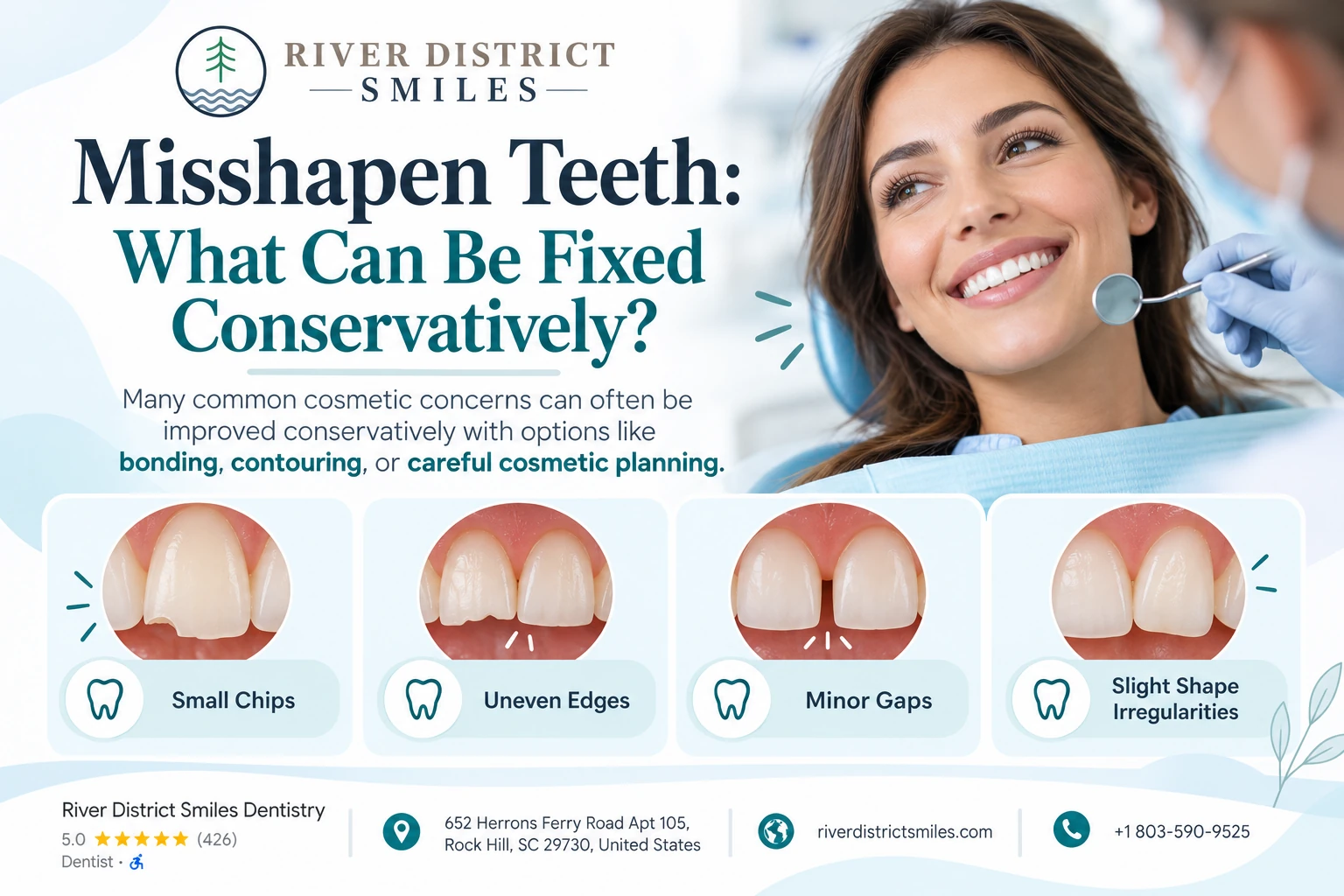
Bonding vs. Veneer for a Misshapen Tooth
Here is the practical comparison.
| Dental bonding | Veneer | |
| Tooth reduction | Often minimal | Usually requires some enamel removal |
| Treatment time | Often one visit | Usually involves more planning/fabrication |
| Initial cost | Generally lower | Generally higher |
| Shape change | Good for small to moderate changes | Better for larger, highly controlled changes |
| Color change | Some ability | Stronger ability to change color |
| Stain resistance | Lower | Porcelain generally resists staining better |
| Repairability | Usually relatively easy to repair | Repair may be more involved |
| Longevity | May need maintenance sooner | Often lasts longer with good care |
| Best use | Conservative isolated refinements | Broader cosmetic transformation |
Neither treatment wins automatically.
The question is how much change you actually need.
When Is a Crown Necessary?
A crown covers much more of the tooth than a veneer.
That makes it useful when the tooth needs structural protection, not simply a minor cosmetic change.
River District Smiles lists reasons such as substantial fractures, significant tooth wear, large existing fillings, weakened teeth, and major loss of natural tooth structure as situations where crowns may be considered.
A crown can also improve shape and color.
But River District Smiles specifically notes that a crown should not automatically be the first choice for a purely cosmetic concern when a healthier tooth could be managed with a more conservative option.
That is an important principle.
If somebody has a healthy but slightly undersized front tooth, removing enough tooth structure for a full crown may be unnecessary.
If the same tooth has already fractured badly, contains a large restoration, and needs reinforcement, the balance changes.
What If the Shape Problem Comes From Grinding?
Then changing the shape alone may not solve the problem.
Suppose your front teeth used to be longer and more even, but years of clenching or grinding have flattened their edges.
Bonding can rebuild the missing length.
Veneers or crowns may also restore shape in selected cases.
But if the grinding forces continue, the new dentistry is exposed to the same forces that damaged the natural teeth.
River District Smiles notes that bonding is more vulnerable to chipping in patients with heavy bite habits and that significantly worn teeth may sometimes require broader restorative protection.
In that situation, a good plan needs to address both:
What do we use to rebuild the tooth?
and
Why did the tooth wear down in the first place?
Otherwise, we may create a beautiful result without addressing what threatens it.
What If the Tooth Is Misshapen Because It Chipped?
A minor chip is one of the clearest situations where conservative dentistry makes sense.
River District Smiles describes several levels of treatment depending on the amount of tooth lost. A tiny superficial enamel irregularity may only need smoothing, while small to moderate front-tooth chips can often be rebuilt with bonding. Larger structural fractures may require veneers, fillings, crowns, or other treatment.
The visible size of the chip is not the only factor.
We also look at:
- Sensitivity
- Whether the deeper dentin is exposed
- Whether there is a crack
- How much healthy enamel remains
- Bite forces
- Tooth location
A chipped tooth should be restored based on what it needs structurally—not simply on which option produces the most dramatic cosmetic change.
Can Whitening Fix a Misshapen Tooth?
Whitening changes color.
It does not change shape.
But sometimes color makes the shape difference look more obvious.
For example, if one tooth appears slightly irregular and the entire smile is also darker than you would like, whitening first can sometimes help us understand how much shape correction you actually want afterward.
It also matters when bonding or veneers are being planned because restorative materials do not whiten the way natural enamel does.
The ADA notes that whitening and restorative cosmetic procedures accomplish different things: whitening changes natural tooth color, while bonding, veneers, and crowns can change shape.
That sequence should be discussed before cosmetic work begins.
What Is the Most Conservative Option for Uneven Front Edges?
It depends on whether we need to remove or add.
If one edge is only slightly too long, minimal contouring may be enough.
If the neighboring tooth is too short because of a chip or natural shape, bonding may make more sense because we can add length rather than shorten a healthy tooth to match it.
This is an important cosmetic principle.
Sometimes patients come in asking us to “file down the longer tooth.”
But the better result may be adding a small amount to the shorter tooth.
The goal should be symmetry with the least unnecessary loss of healthy enamel.
How Much Does Conservative Cosmetic Treatment Cost?
Cost varies widely because “fixing the shape” can describe anything from a few minutes of contouring to multiple ceramic restorations.
In general:
- Minor reshaping is usually one of the lower-cost approaches.
- Bonding generally costs less than porcelain veneers.
- Veneers are a larger investment because of the materials and fabrication involved.
- Crowns generally cost more than direct bonding and are used when more structural treatment is required.
River District Smiles has previously cited broad national planning ranges of approximately $288–$915 per tooth for bonding, $500–$2,895 for veneers, and $800–$2,500 for crowns, depending on case complexity and material. These are not River District Smiles’ quoted fees.
What matters when comparing prices is whether you are comparing treatments that solve the same problem.
A $400 bonding procedure and a $1,500 veneer are not simply cheaper and more expensive versions of the same thing.
They involve different amounts of tooth preparation, different materials, different longevity, and different maintenance.
Will Insurance Pay to Fix a Misshapen Tooth?
If treatment is purely cosmetic, insurance often does not pay.
The ADA notes, for example, that veneers are commonly considered cosmetic and may not be covered unless there is a medical or restorative reason for treatment.
Coverage can be different when the tooth is damaged by trauma, decay, fracture, or another condition requiring restoration.
The important question to ask is not simply:
“Does my plan cover bonding?”
Ask:
“Is this particular treatment being classified as cosmetic or restorative under my plan?”
That distinction can make a significant difference.
When Is Conservative Treatment Not Enough?
Sometimes the least invasive option is not the most predictable option.
Bonding may not be a good long-term choice if:
- A large portion of the tooth is missing
- The tooth is structurally weak
- There is very little healthy enamel available
- A crack extends deeper into the tooth
- Heavy bite forces repeatedly break previous bonding
- The tooth has a large existing restoration
- A major color and shape change is required
- The tooth needs protection rather than only cosmetic improvement
In those cases, a veneer, onlay, crown, or another restorative approach may be more appropriate.
Being conservative does not mean choosing an undersized treatment that is likely to fail.
It means choosing the least extensive treatment that can still provide a predictable result.
That same philosophy appears in River District Smiles’ guidance on chipped teeth and crowns.
Five Questions to Ask Before Changing the Shape of a Tooth
Before agreeing to cosmetic treatment, I would want clear answers to these:
- Is this tooth healthy, or is there also structural damage?
- Can the result be achieved with bonding instead of a veneer?
- How much natural enamel would need to be removed?
- Is the tooth actually misshapen, or is its position creating the appearance problem?
- What maintenance or replacement should I expect over time?
I would add a sixth if a crown is being recommended for a healthy-looking tooth:
Why does this tooth need full coverage instead of a smaller restoration?
There may be a very good reason.
You should understand what it is.
The Bottom Line
Misshapen teeth do not all need the same solution.
A tiny irregular edge may need nothing more than careful contouring.
A narrow or slightly undersized tooth may be improved with bonding.
A rotated tooth may be better treated by moving it.
A tooth requiring a bigger change in color, shape, or symmetry may be a good candidate for a veneer.
And a badly weakened tooth may need a crown for reasons that go beyond appearance.
River District Smiles offers bonding, reshaping, veneers, orthodontic options, and restorative dentistry depending on what the tooth actually needs.
If you only remember one thing, make it this:
Healthy enamel is valuable. Do not remove more of it than necessary just to correct a small cosmetic concern.
The best cosmetic plan is not necessarily the one that changes the tooth the most.
It is the one that gives you the improvement you want while preserving as much healthy natural tooth as the situation allows.