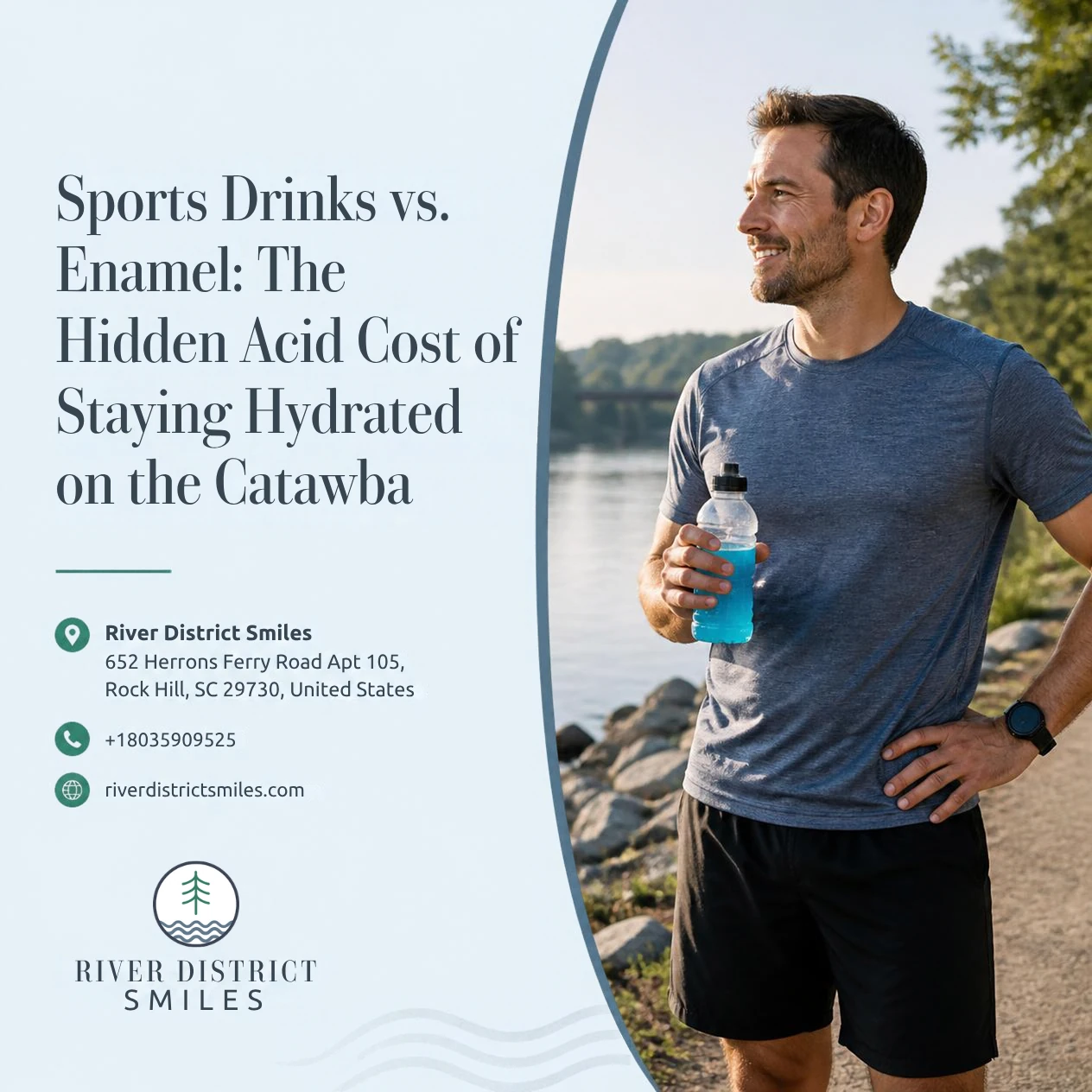


If you are spending a hot afternoon kayaking the Catawba, biking the Riverwalk, running the trail, or simply being outside for a few hours, bringing something to drink is a smart decision.
The question is whether that drink needs to be a sports drink.
The short answer is this: sports drinks can be useful during longer, harder activity, but many are acidic enough to gradually wear away tooth enamel especially when you sip them repeatedly over several hours.
That does not mean you need to give up electrolyte drinks. It means how often you drink them, how long they stay around your teeth, and what you do afterward matter more than most people realize.
The Catawba River Trail at Riverwalk gives Rock Hill residents plenty of reasons to be outside, including walking, running, cycling, and access to canoeing and kayaking. If a sports drink is part of your routine while you are out there, here is what is worth knowing.
The Hidden Problem Is Not Just Sugar
Most people already know sugary drinks can contribute to cavities.
Sports drinks create another issue that is easier to miss: acidity.
Dental erosion happens when acid chemically dissolves minerals from the surface of your teeth. Unlike a cavity, which involves bacteria feeding on carbohydrates and producing acid, erosion can happen directly from an acidic drink.
The American Dental Association notes that many sports drinks and other acidic beverages have pH levels in the range of roughly 2.0 to 3.5, and frequent exposure increases the risk of erosive tooth wear. Laboratory studies have also found that many commonly available sports drinks can soften or erode enamel.
That distinction matters because it means:
Sugar can increase your cavity risk. Acid can wear down enamel.
A drink can potentially do both.
What Actually Happens to Enamel?
Enamel is the hard outer layer protecting your teeth.
When an acidic drink repeatedly contacts enamel, the surface temporarily becomes softer as minerals are dissolved. Your saliva normally helps neutralize those acids and allows the mouth to recover.
Problems are more likely when the next acidic sip arrives before that recovery has had much time to happen.
Think about the difference between these two situations.
You finish a sports drink with lunch and then drink water for the rest of the afternoon.
Compare that with putting the same drink in a bottle and taking a sip every five or ten minutes during a three-hour paddle.
The total amount may be similar, but your teeth experience the second situation very differently.
The ADA specifically points to frequency, drinking pattern, and the amount of time acidic beverages remain in contact with the teeth as important factors in erosion.
In plain terms, all-day sipping is usually harder on enamel than drinking the same beverage during a defined period and then switching back to water.
Why Exercise Can Make the Problem Worse
There is another reason this matters when you are outdoors.
During strenuous exercise, your mouth may become dry. You may breathe through your mouth more, sweat heavily, or simply produce less saliva.
Saliva is one of your teeth’s natural defenses against acid.
The ADA notes that frequent sports-drink consumption combined with dehydration or reduced salivary flow during strenuous activity may increase the risk of erosion.
So the exact time you are most likely to reach for a sports drink can also be a time when your mouth is less capable of neutralizing it.
Are Sugar-Free Electrolyte Drinks Better for Your Teeth?
They can be better in one respect, but they are not automatically harmless.
Removing sugar reduces one of the things cavity-causing bacteria use for fuel.
But sugar-free does not necessarily mean acid-free.
If a zero-sugar sports drink contains citric acid or other acids and has a low pH, it may still contribute to enamel erosion. Research cited by the ADA has found that acidity itself not simply the type of sweetener is an important concern with erosive drinks.
That is why a label saying “zero sugar” should not be interpreted as “safe to sip continuously all day.”
Do You Actually Need a Sports Drink?
Sometimes, yes.
Sports drinks exist for a legitimate reason. During prolonged exercise, they can replace fluids and electrolytes while providing carbohydrates for energy.
For many shorter activities, however, plain water is usually enough.
Mayo Clinic guidance notes that water works well for hydration around exercise and that sports drinks may become useful during activity lasting longer than about an hour because they can provide electrolytes and carbohydrates.
That is a useful way to think about a day around the Catawba.
A casual walk along Riverwalk probably does not create the same hydration demands as a long bike ride, hard run, or several hours of paddling in summer heat.
The decision should be based on the intensity and duration of your activity, your sweat loss, the weather, and any individual medical considerations not simply because a beverage is marketed for exercise.
How to Drink Sports Drinks Without Being So Hard on Your Enamel
You do not need a complicated dental routine every time you exercise.
A few habits make a meaningful difference.
Make water your default drink
If you do not specifically need carbohydrates and electrolytes, water is the simplest option for both hydration and your teeth.
For longer activity, you can still carry water even if you also bring an electrolyte beverage.
Avoid nursing one bottle for hours
The repeated acid exposure is part of the problem.
When a sports drink makes sense, drink it during the period when you actually need it rather than casually sipping it for the rest of the afternoon.
Do not swish it around your mouth
There is no benefit to holding a sports drink around your teeth.
Drink it and swallow it.
The ADA recommends limiting behaviors that increase contact between acidic drinks and tooth surfaces.
Consider using a straw
When practical, a straw positioned toward the back of the mouth can reduce how much of the drink bathes the front teeth.
It is not a perfect shield, but it can reduce unnecessary contact.
Rinse with plain water afterward
This may be the easiest habit to add.
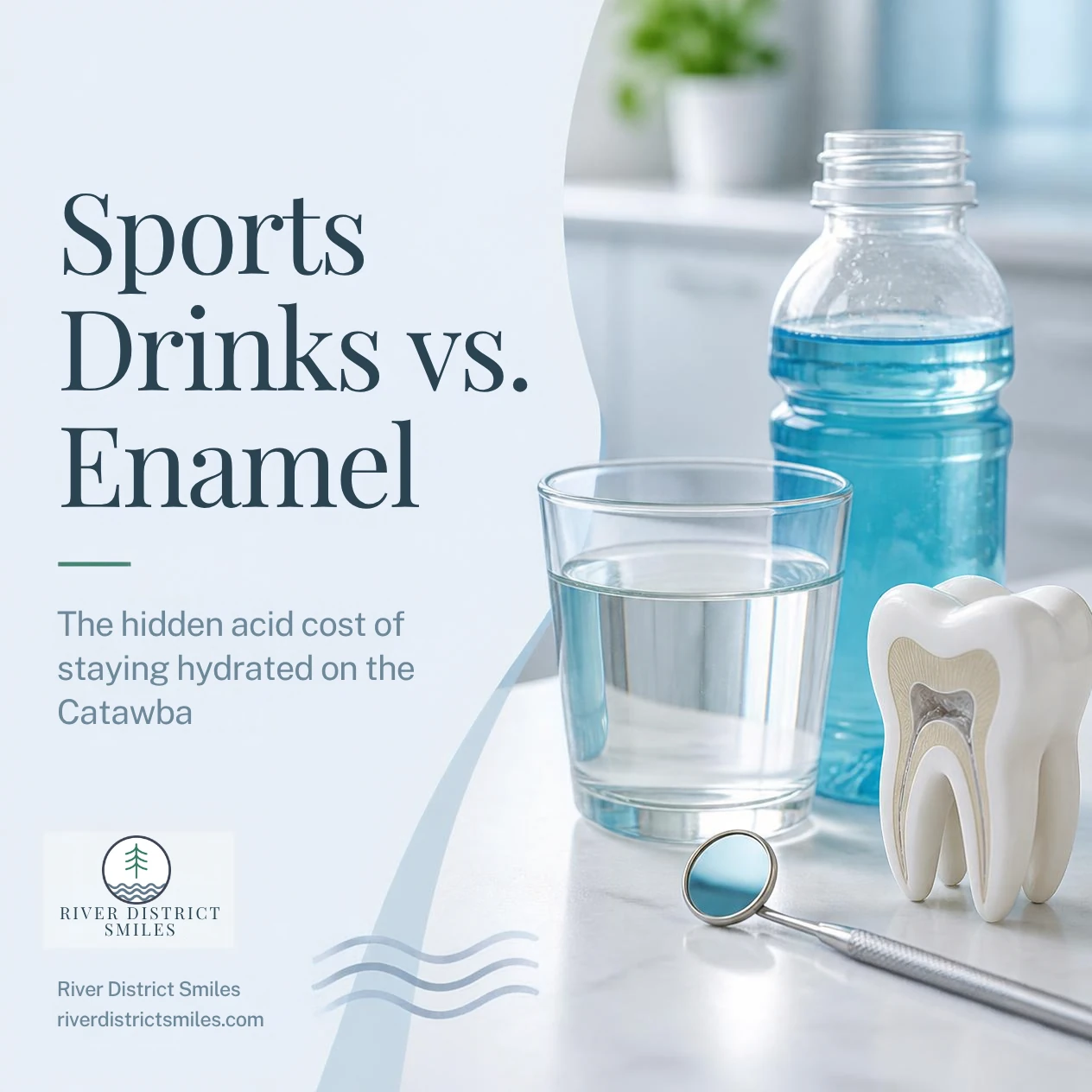
After finishing an acidic drink, take a few swallows of water or rinse your mouth with water. The goal is simply to help clear some of the remaining acid.
Do not immediately scrub your teeth
Brushing right after an acidic drink sounds responsible, but it can be counterproductive because the enamel surface may still be softened.
Rinse with water instead and give your saliva time to neutralize the mouth before brushing. ADA guidance for athletes recommends waiting roughly 30 to 60 minutes after sports drinks before brushing.
Keep using fluoride toothpaste
Fluoride remains an important part of protecting teeth and supporting remineralization.
That does not make acidic beverages harmless, but consistent brushing with fluoride toothpaste is still one of the basic ways to protect enamel and reduce cavity risk.
What About Electrolyte Powders and Tablets?
Do not assume powders are automatically safer than bottled sports drinks.
What matters is the finished beverage.
If a powder creates a strongly acidic drink particularly one containing citric acid it can create many of the same concerns.
Flavor also does not tell you much. Lemon, berry, tropical, and other flavors may differ substantially in their chemistry.
Even pH alone does not tell the entire story. Researchers also look at factors such as how much acid a drink contains and how easily that acidity can be neutralized.
For most patients, there is no need to turn grocery shopping into a chemistry experiment. The practical rule is simpler:
If you regularly drink flavored electrolyte beverages, limit prolonged exposure and keep water in the rotation.
How Do You Know If Acid Is Already Affecting Your Teeth?
Early enamel erosion can be difficult to notice yourself.
Over time, you may experience:
- Increasing sensitivity to cold drinks
- Teeth that look smoother or shinier than before
- Flattening or small “cups” in biting surfaces
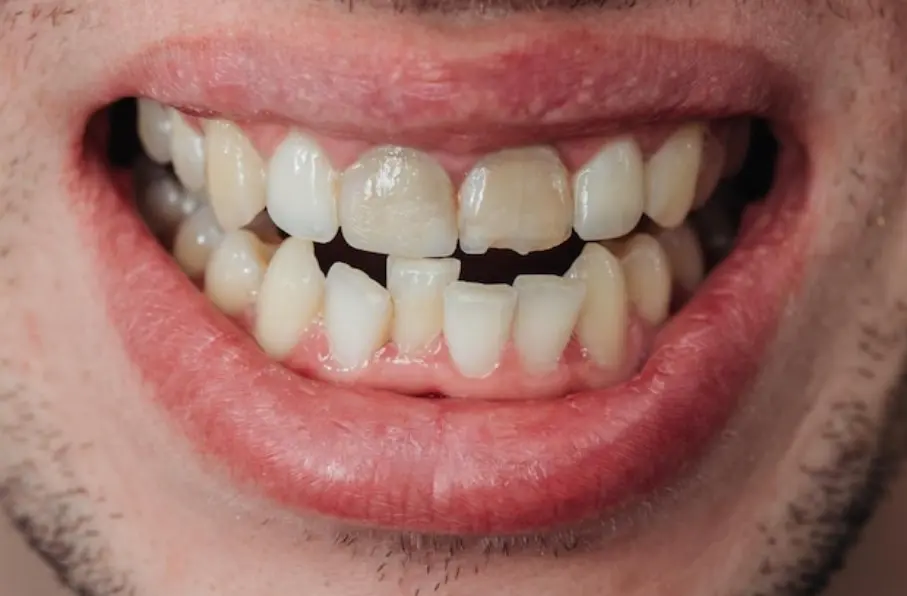
- Thin or translucent-looking edges
- More yellow showing through as enamel becomes thinner
- Teeth that seem to chip or wear more easily
The ADA notes that enamel erosion is progressive and that actual loss of tooth structure is irreversible, which makes early identification valuable.
That does not mean every sensitive tooth has acid erosion.
Grinding, gum recession, cavities, cracked teeth, aggressive brushing, and other problems can cause similar symptoms.
An exam helps separate them.
What Happens If Enamel Erosion Is Already Present?
Treatment depends on how much tooth structure has been lost.
Very early wear may simply need monitoring, changes in beverage habits, fluoride exposure, and treatment for sensitivity.
If more substantial tooth structure has been lost, restorative treatment may eventually be needed. Depending on the location and severity, that could include bonding, fillings, veneers, or crowns.
This is also where cost begins to matter.
Changing how you drink an acidic beverage costs almost nothing. Rebuilding lost tooth structure can become considerably more involved.
That does not mean everyone who drinks sports drinks is headed toward dental work. It means prevention is much easier than trying to replace enamel once enough of it is gone.
So Should You Stop Drinking Sports Drinks?
For most people, that is not necessary.
A sports drink used appropriately during a long, demanding workout is very different from carrying one around all day because it tastes better than water.
If you only remember one thing, make it this:
Your teeth usually handle occasional acid exposure much better than frequent acid exposure.
Use sports drinks when they actually serve a purpose. Drink water between them. Avoid swishing and prolonged sipping. Rinse with water afterward, and do not rush to brush immediately.
You can stay hydrated without treating every outdoor afternoon like an endurance event.
When Should You Ask a Dentist About Enamel Wear?
Bring it up at your next dental visit if you have noticed increasing sensitivity, changes in the shape or color of your teeth, worn biting surfaces, or a long-standing habit of sipping sports drinks, energy drinks, flavored waters, or other acidic beverages throughout the day.
At River District Smiles, preventive visits include evaluating the teeth and gums for issues such as enamel wear and catching concerns before they become more difficult to manage.
And because our Rock Hill office is right near the Catawba and Riverwalk area, we understand that getting outside is part of life here.
The goal is not to tell you that you can never have a sports drink.
It is to make sure the way you stay hydrated is not quietly creating another problem.
A good dental visit should leave you understanding whether enamel wear is actually happening, what may be causing it, and what if anything you need to change.