

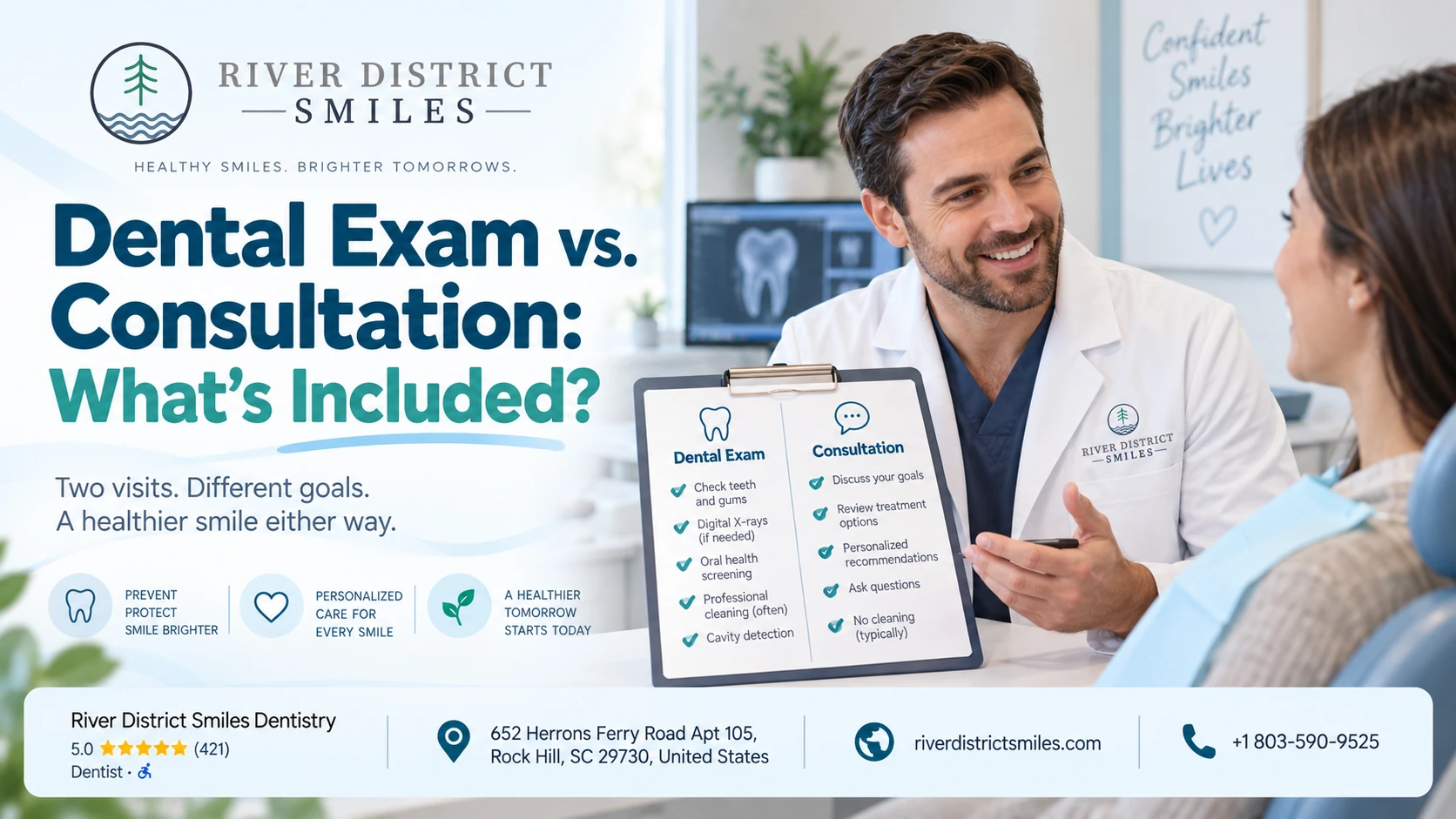


When you call a dental office, you may be offered a dental exam, a consultation, or both. The terms can sound interchangeable, but they usually describe different types of appointments.
A dental exam is designed to evaluate your overall oral health. A consultation is usually focused on one concern, treatment, or decision.
In plain terms, schedule a dental exam when you need a complete picture of your teeth, gums, and mouth. Schedule a consultation when you already have a specific goal such as dental implants, clear aligners, veneers, or a second opinion and want to discuss your options.
The exact services included vary by office, so it is worth asking what will happen during the visit and whether X-rays, scans, or treatment planning carry separate fees.
What is a dental exam?
A dental exam is a clinical evaluation of your oral health.
During the appointment, the dentist looks for problems that may not yet be causing pain, as well as concerns you have already noticed. At River District Smiles, dental exams are presented as preventive visits focused on early detection, clear explanations, and long-term oral health.
A dental exam may include an evaluation of:
- Cavities and weakened enamel
- Existing fillings, crowns, bridges, or implants
- Cracked, worn, or broken teeth
- Gum inflammation and periodontal disease
- Tooth mobility
- Your bite and jaw movement
- Areas of tenderness or swelling
- The tongue, cheeks, lips, palate, and other soft tissues
- Signs that may require additional oral-cancer evaluation
- Changes shown on appropriate dental X-rays
A comprehensive clinical examination of the mouth remains an important part of identifying suspicious oral changes and deciding whether follow-up or further testing is needed.
What is a dental consultation?
A consultation is usually a focused conversation and evaluation related to a particular concern or treatment.
For example, you might schedule a consultation because you want to know:
- Whether you qualify for dental implants
- Whether clear aligners can correct your bite
- What can be done about chipped or discolored front teeth
- Whether a painful tooth needs a root canal or extraction
- Which denture option would be most stable
- Whether another dentist’s treatment recommendation makes sense
- What a smile makeover could realistically include
The dentist will listen to what is bothering you, examine the relevant area, discuss possible treatments, and explain the likely next steps.
A consultation is not always a substitute for a complete exam. If the dentist does not have enough diagnostic information to make a safe recommendation, you may need a full examination, X-rays, photographs, scans, or other records before receiving a final treatment plan.
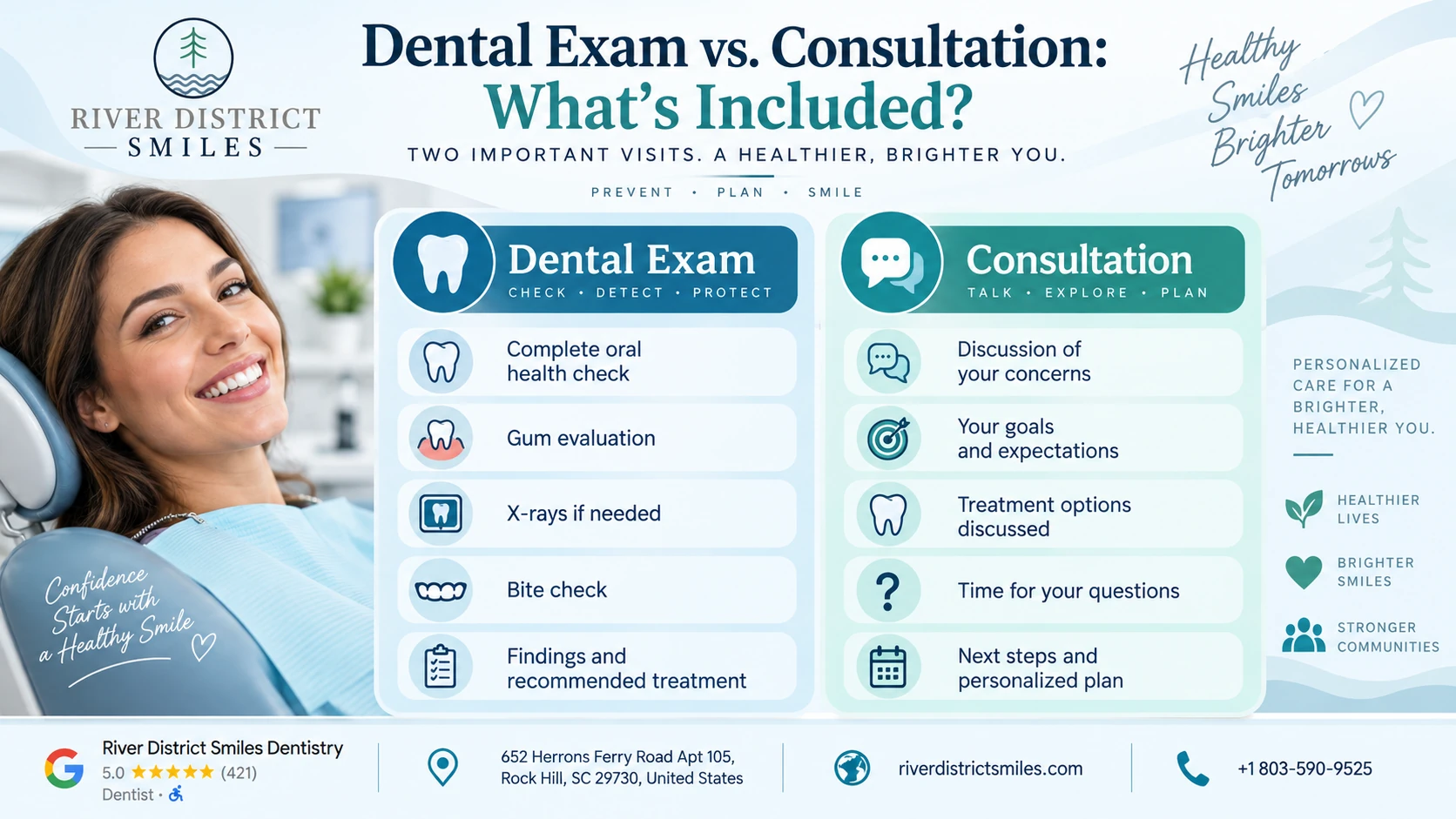
Dental exam vs. consultation at a glance
| Dental exam | Consultation |
| Evaluates your overall oral health | Focuses on a particular concern or treatment |
| Often part of preventive or new-patient care | Often used for implants, cosmetics, aligners, dentures, or second opinions |
| Reviews teeth, gums, bite, and oral tissues | Reviews the area related to your goal |
| May identify problems you did not know were present | Helps you compare treatment options |
| May be paired with a cleaning | Usually does not automatically include a cleaning |
| May include routine diagnostic X-rays when needed | May require focused X-rays, scans, or photographs |
| Produces a general diagnosis and care plan | Produces a focused recommendation or planning pathway |
What is included in a comprehensive dental exam?
A comprehensive exam is often recommended for a new patient or someone who has not received dental care in several years.
It commonly includes the following.
Review of your medical and dental history
Your dentist needs to know about:
- Current medications
- Allergies
- Major health conditions
- Previous surgeries
- Pregnancy
- Tobacco or nicotine use
- Past dental treatment
- Dental anxiety
- Previous complications with anesthesia
- Pain, sensitivity, bleeding, or other current symptoms
Medical history matters because conditions such as diabetes, heart disease, bleeding disorders, dry mouth, and immune-system problems can affect dental care.
River District Smiles asks new patients to provide registration, medical-history, and dental-history information before or during their first visit.
Examination of the teeth
The dentist checks each tooth for signs of:
- Decay
- Cracks
- Erosion
- Wear
- Leaking restorations
- Loose crowns or fillings
- Infection
- Previous root canal treatment
- Structural weakness
Not every cavity or crack is visible without imaging, which is one reason X-rays may be recommended.
Gum evaluation
A periodontal evaluation may include measuring the spaces around the teeth and checking for:
- Bleeding
- Inflammation
- Gum recession
- Tartar beneath the gums
- Bone loss
- Loose or shifting teeth
This helps distinguish generally healthy gums, gingivitis, and periodontitis. The distinction also determines whether you need a routine cleaning, deep cleaning, periodontal maintenance, or another form of care.
Bite and jaw evaluation
The dentist may look at how your upper and lower teeth fit together and ask about:
- Jaw pain
- Clicking or locking
- Headaches
- Grinding or clenching
- Uneven tooth wear
- Difficulty chewing
- Teeth that hit before the others
A detailed jaw-joint or bite analysis may require a separate focused appointment, but a general review is often part of the exam.
Examination of the mouth and surrounding tissues
The dentist may examine the:
- Tongue
- Floor of the mouth
- Roof of the mouth
- Cheeks
- Lips
- Gums
- Throat area
- Jaw and neck
The purpose is to look for sores, unusual color changes, lumps, persistent irritated areas, or other findings that may need monitoring or further evaluation. Regular dental examinations can help identify suspicious oral changes at an earlier stage.
X-rays when clinically necessary
X-rays help reveal conditions that cannot be fully evaluated by looking in the mouth, including:
- Cavities between teeth
- Bone loss
- Infections around tooth roots
- Impacted teeth
- Certain fractures
- Developing teeth
- Problems beneath existing restorations
X-rays should not simply be taken on the same schedule for every patient. The ADA states that the need and frequency should be based on the individual’s age, oral health, disease risk, history, signs, and symptoms.
Recent X-rays from another dentist may sometimes be useful, although new images may still be needed if the existing ones are incomplete, outdated, unclear, or do not show the area being evaluated.
Does a dental exam include cleaning?
Sometimes, but not automatically.
An examination and a cleaning are separate services, even when they are scheduled during the same visit.
The exam determines the health of your teeth and gums. The cleaning removes plaque, tartar, and some external stain.
A routine cleaning may be completed at the same appointment when:
- Enough time has been scheduled
- Your gums are generally healthy
- You do not need periodontal treatment
- The necessary diagnostic records are available
- The office schedules new-patient cleanings and exams together
A cleaning may be postponed when:
- You have significant gum disease
- More diagnostic information is needed
- The appointment was scheduled only as a consultation
- You need a deep cleaning rather than a routine cleaning
- An urgent problem needs to be addressed first
Before your appointment, ask whether the scheduled visit includes both the exam and the cleaning.
What is included in a treatment consultation?
The contents depend on the treatment being considered.
Dental implant consultation
An implant consultation may include:
- Review of the missing or failing tooth
- Examination of the gums and bite
- Discussion of implants, bridges, and removable options
- X-rays or 3D imaging
- Evaluation of available bone
- Review of medical risk factors
- Discussion of grafting, extractions, healing time, and cost
- A preliminary treatment sequence
A final implant plan may not be possible until appropriate imaging has been completed.
Cosmetic dentistry consultation
A cosmetic consultation may include:
- Discussion of what you would like to change
- Evaluation of tooth color, shape, size, and alignment
- Review of your bite and gum health
- Photographs or digital scans
- Comparison of whitening, bonding, veneers, crowns, or aligners
- Discussion of how much natural tooth structure each option requires
- A phased estimate
A responsible cosmetic consultation also checks whether cavities, gum disease, or bite problems should be treated first.
Clear-aligner consultation
An aligner consultation may include:
- Evaluation of crowding and spacing
- Review of how the upper and lower teeth fit
- Photographs or digital scans
- Discussion of expected treatment length
- Review of limitations and alternative treatments
- Retainer planning
- A preliminary cost estimate
Some tooth movements require further records before the dentist can confirm that clear aligners are the right option.
Emergency or problem-focused consultation
A problem-focused visit may evaluate:
- Tooth pain
- Swelling
- A broken tooth
- A lost crown or filling
- Sensitivity
- A suspicious gum area
- A specific second-opinion question
This visit may lead directly to treatment, or the dentist may first provide temporary care and schedule a more complete appointment.
Will a consultation include X-rays?
It depends on the concern.
The dentist may need X-rays if you are discussing:
- A painful tooth
- Root canal treatment
- An extraction
- Dental implants
- Bone loss
- Wisdom teeth
- A cracked tooth
- A problem beneath a crown
- Full-mouth reconstruction
A purely introductory conversation may not require imaging. However, the dentist may only be able to discuss broad possibilities and not give a final diagnosis without examining the teeth and reviewing appropriate records.
Dental imaging is most useful when ordered for a specific clinical reason rather than automatically.
Is a consultation free?
Some dental offices offer complimentary consultations for selected elective services. Others charge for the dentist’s time, examination, imaging, or treatment planning.
A free consultation may include:
- A conversation about your goals
- A brief visual assessment
- General treatment categories
- A broad cost discussion
- An explanation of the next diagnostic steps
It may not include:
- A comprehensive diagnosis
- Full-mouth X-rays
- A 3D scan
- Detailed measurements
- A written final treatment plan
- A cleaning
- Same-day treatment
A paid consultation may be more detailed, but price alone does not tell you what is included.
Ask the office:
- Is there a consultation fee?
- Does the fee include an examination?
- Are X-rays or scans separate?
- Will I receive a written treatment plan?
- Is the fee applied toward treatment?
- Will my insurance be billed?
River District Smiles notes that costs depend on the type and complexity of the service, and that patients receive estimates based on the care being considered.
How much does a dental exam cost?
The cost of a dental exam varies according to:
- Whether you are a new or existing patient
- Whether the exam is comprehensive, periodic, or problem-focused
- Which X-rays are needed
- Whether a cleaning is included
- Whether fluoride or other preventive services are provided
- Insurance coverage
- Local fees
A simple problem-focused exam generally costs less than a comprehensive new-patient visit with a full set of diagnostic records.
When comparing prices, ask for the complete expected visit cost rather than only the examination fee. An advertised low-cost exam may not include X-rays, a cleaning, or additional diagnostic tests.
Does insurance cover exams and consultations?
Many dental insurance plans cover routine or periodic examinations as preventive or diagnostic care, subject to frequency limits and network rules.
Consultations are less predictable. Coverage may depend on:
- How the appointment is coded
- Whether the visit is diagnostic or elective
- The treatment being discussed
- Whether imaging is performed
- Whether the dentist is in network
- Your deductible and annual maximum
Cosmetic consultations may not be covered because the planned treatment is elective. Implant or surgical consultations may receive partial coverage when they are medically and dentally necessary, but benefits vary.
Ask for a pretreatment estimate when the visit will involve expensive imaging or detailed planning.
Can you receive treatment at the consultation?
Possibly, but it should not be assumed.
Same-day treatment is more likely when:
- The problem is straightforward
- The office has enough appointment time
- The necessary X-rays are available
- Your medical history has been reviewed
- You understand the treatment and cost
- The dentist can safely provide definitive care
Treatment may need to be scheduled later when:
- Insurance authorization is required
- A specialist is involved
- Laboratory work is needed
- A 3D scan or additional records are required
- Several treatment options need to be considered
- Your gums or another active condition must be treated first
- You need time to review financing or consent information
A consultation is often the planning visit, not the procedure itself.
Which appointment should a new patient schedule?
A comprehensive exam is usually the best starting point when you:
- Need a new regular dentist
- Have not had dental care recently
- Want a full evaluation
- Need preventive care
- Have several concerns
- Are unsure what treatment you need
A focused consultation may be appropriate when you:
- Already receive routine care elsewhere
- Want a second opinion
- Are researching one specific treatment
- Have been referred for a particular service
- Need an evaluation of one urgent problem
If you want both a complete examination and a discussion of a major treatment, tell the office when scheduling. A larger appointment may be needed.
Can a dentist give you an exact treatment price during a consultation?
Sometimes, but not always.
A straightforward treatment may be priced after an examination and basic X-rays. More complex care may require:
- A 3D scan
- Digital impressions
- Photographs
- Gum measurements
- Diagnostic models
- Laboratory input
- Review by another dental specialist
- Insurance verification
You may initially receive a range or phased estimate. The dentist should explain what could change the price and which parts of the plan are optional.
Before agreeing to treatment, ask whether the estimate includes:
- Diagnostic records
- The procedure itself
- Anesthesia or sedation
- Temporary restorations
- Laboratory fees
- Final restorations
- Follow-up appointments
- Retainers or protective appliances
- Possible additional procedures
What should you bring to the appointment?
Bring or provide:
- A current medication list
- Your medical history
- Dental insurance information
- Identification
- Recent dental X-rays, when available
- Details about previous dental treatment
- A list of your main concerns
- Questions about treatment, timing, and cost
For a second opinion, bring the existing treatment plan and any available images. The second dentist may still recommend new records if the originals do not provide enough information.
Questions to ask when scheduling
To avoid surprises, ask:
- Am I scheduling an exam or a consultation?
- Is this a complete or problem-focused examination?
- Is cleaning included?
- Will I need X-rays?
- How long is the appointment?
- What is the expected cost?
- Will insurance be billed?
- Will I receive a treatment estimate?
- Is treatment likely to be completed the same day?
- Should I request records from my previous dentist?
The scheduling team can only reserve the correct amount of time when they understand what you are hoping to accomplish.
Dental exam vs. consultation: which one do you need?
Schedule a dental exam when:
- You want a complete oral-health evaluation
- You are due for preventive care
- You are establishing care with a new dentist
- You have not had an exam in several years
- You have multiple concerns
- You want to know whether you have cavities or gum disease
Schedule a consultation when:
- You want to discuss one specific treatment
- You need a second opinion
- You are comparing implants, bridges, or dentures
- You are considering veneers, whitening, or aligners
- You have already been diagnosed and want to review your choices
- You need focused planning before a major procedure
Ask for both when:
- You are a new patient considering extensive treatment
- You have several missing or failing teeth
- You want cosmetic treatment but have not had a recent exam
- You need a full diagnosis before comparing treatment options
The bottom line
A dental exam evaluates the overall health of your teeth, gums, bite, and mouth. A consultation focuses on a specific concern, procedure, or decision.
The two appointments may overlap, but they are not always interchangeable. A consultation can help you understand possible treatment paths, while an exam provides the diagnostic foundation needed to make those recommendations safely.
River District Smiles provides preventive dental exams, new-patient care, and focused consultations for general, cosmetic, implant, and specialty concerns in Rock Hill. Its stated approach emphasizes personal attention, modern technology, and clear explanations so patients understand their choices before proceeding.
The best first step is to tell the office what you hope to learn or accomplish. That makes it easier to schedule the right visit, gather the right records, and give you a useful answer rather than an appointment that does not fully address your concern.