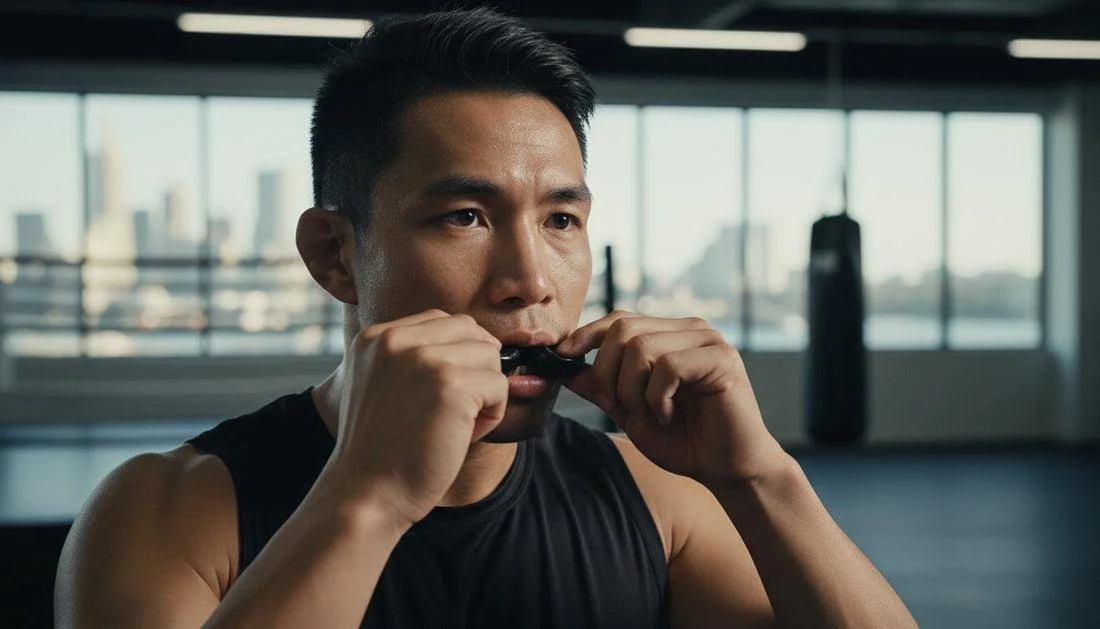


If you have ever watched an athlete pull out their mouthguard between every play because they “can’t breathe with it in,” you already understand the problem.
A mouthguard only protects your teeth when it stays in your mouth.
That is why newer sports guards are increasingly marketed around airflow, thin profiles, custom digital fitting, ventilation channels, and even claims of improved athletic performance.
Some of those improvements are meaningful.
Some of the marketing gets ahead of the science.
The short answer is this: a properly fitted mouthguard can make breathing, speaking, and competing more comfortable than a bulky or poorly fitting guard. But there is not strong enough evidence to promise that a “breathable” mouthguard will make you faster, stronger, or improve your endurance.
The more realistic advantage is that a well-designed guard can provide protection without becoming something the athlete constantly fights against.
That can matter considerably in football, hockey, lacrosse, basketball, martial arts, wrestling, and other high-intensity sports.
Why Do Some Mouthguards Feel Like They Make It Harder to Breathe?
A mouthguard takes up physical space inside the mouth.
If it is thick, loose, poorly molded, or requires constant biting to keep it from falling out, the athlete becomes very aware of it.
That can create several complaints:
- “I can’t catch my breath.”
- “I can’t talk with it in.”
- “I have to bite down the whole time.”
- “It makes me gag.”
- “I take it out between every play.”
Stock mouthguards are particularly prone to this problem because they are made in generic sizes rather than adapted to an individual athlete.
The American Dental Association notes that stock guards often require the athlete to keep the mouth closed to hold them in position and considers them the least effective category because of their generic fit and poor retention.
That gives us an important distinction:
Sometimes the problem is not the fact that the athlete is wearing a mouthguard. It is the fact that the mouthguard does not fit well.
What Does “Breathable Mouthguard” Actually Mean?
There is no single dental definition for a “breathable” mouthguard.
Manufacturers may use the term to describe several different design features.
Those can include:
- Built-in airflow channels
- Front ventilation openings
- A thinner profile in selected areas
- Less bulky material behind the front teeth
- More precise adaptation around individual teeth
- Improved retention so the athlete does not have to clench
- Bite designs intended to leave more room for airflow
Some guards emphasize vents.
Others achieve comfort mainly through a more precise custom fit.
And those are not necessarily the same thing.
A large hole through a mouthguard does not automatically make it a better mouthguard if the rest of the design compromises protection, fit, or durability.
The primary job is still protecting the teeth and surrounding tissues.
Does Better Airflow Actually Improve Athletic Performance?
This is where the answer becomes more nuanced.
Researchers have studied whether mouthguards affect:
- Oxygen consumption
- Ventilation
- Heart rate
- Running performance
- Agility
- Power
- Strength
- Jump height
- Perceived breathing difficulty
The results are mixed.
A 2023 systematic review examined 41 studies involving 852 athletes. Overall, the researchers found some evidence of improved athletic performance in particular tests while wearing mouthguards, with custom guards generally performing better than other types.
But the researchers also cautioned that the studies used very different testing methods and often lacked important methodological detail.
An earlier systematic review reached a more conservative conclusion: custom-made mouthguards generally did not hurt athletic performance, but the evidence did not clearly establish consistent performance enhancement either.
That distinction matters.
There is better support for saying:
“A properly fitted mouthguard should not have to compromise your performance.”
There is much less support for saying:
“This mouthguard will make you a better athlete.”
What About Vented Mouthguards Specifically?
Researchers have tested those too.
One study compared recreationally trained men exercising with no mouthguard, a traditional mouthguard, and an over-the-counter vented mouthguard.
The vented model produced some differences in physiological measurements and a small improvement in one vertical-jump test.
But it did not improve oxygen uptake, and both mouthguards were perceived by participants as negatively affecting breathability, comfort, and communication compared with wearing no mouthguard.
That does not mean vents are useless.
It means one ventilation channel should not be marketed as though it has been scientifically proven to increase endurance.
There are too many variables:
- The athlete
- The sport
- Mouthguard thickness
- Jaw position
- Fitness level
- Guard retention
- Exercise intensity
- How breathing is measured
- The specific guard design
A product label cannot eliminate those differences.
Can Any Mouthguard Slightly Reduce Airflow?
Potentially, yes.
A systematic review and meta-analysis looking specifically at cardiopulmonary performance found that maximum oxygen uptake and maximum ventilation were somewhat higher when athletes exercised without mouthguards than when they wore them.
That is worth acknowledging.
Putting an appliance inside the mouth may affect airflow to some degree.
But that does not mean athletes should skip mouthguards in sports where dental trauma is a serious risk.
The more practical goal is to choose a protective guard that minimizes unnecessary interference.
That is one area where better fit and design become important.
Custom Fit May Matter More Than a Big Air Vent
Imagine two mouthguards.
One has a prominent “high-flow breathing channel” on the front of the package but moves around whenever the athlete opens their mouth.
The other has no dramatic vent but stays securely over the upper teeth without requiring constant clenching.
Which one is actually easier to play in?
Quite often, the second.
The ADA describes an ideal mouthguard as one that is accurately adapted, stays comfortably and securely in position, uses resilient material, and adequately absorbs impact energy.
The Academy for Sports Dentistry similarly emphasizes:
- Retention
- Appropriate thickness
- Sport-specific design
- Balanced bite contact
- Protection of teeth and surrounding tissues
- Speech requirements appropriate to the athlete’s sport
Its current position is that properly fitted custom guards should account for the athlete’s dental anatomy and the demands of the specific sport.
In other words, breathability is important.
It just should not be considered in isolation.
Why Does Retention Matter So Much?
A mouthguard that stays in place allows the athlete to relax their jaw more naturally.
A loose guard may force the athlete to continually bite down to retain it.
Try running while consciously clenching your teeth for ten minutes.
You can understand why athletes dislike it.
Better retention can also make communication easier because the athlete is not constantly repositioning the guard with their tongue.
For sports such as football, basketball, hockey, and lacrosse, that matters.
Players need to communicate during active play.
A guard that repeatedly has to be removed to talk is less likely to be worn consistently.
The Academy for Sports Dentistry specifically includes speech requirements among the considerations in the design of a properly fitted athletic guard.
Does a Thinner Mouthguard Breathe Better?
It may feel less bulky.
That does not automatically make thinner better.
A mouthguard also needs enough material in appropriate locations to absorb and redistribute impact forces.
The Academy for Sports Dentistry recommends adequate thickness for this purpose and specifically identifies at least 3 mm in certain impact areas for properly fitted custom mouthguards.
This creates a real engineering tradeoff.
We want:
Enough material to protect the athlete.
But not:
So much unnecessary bulk that the athlete hates wearing it.
A well-designed custom guard can vary its contours based on anatomy and sport rather than simply making the entire appliance equally thick.
That is very different from assuming that the thinnest guard is automatically the best.
What Makes a Mouthguard “High Tech”?
There are actually several technologies hiding under that label.
Digital scanning
Instead of taking a traditional impression with dental material, some custom-mouthguard workflows use an intraoral digital scanner to create a three-dimensional model of the teeth.
The Academy for Sports Dentistry notes that digital impressions can provide detailed records while improving patient comfort and simplifying storage of the athlete’s dental model.
Pressure-laminated fabrication
Higher-impact custom guards can be made using multiple layers of material pressed together under heat and pressure.
The Academy describes these multilayer pressure-laminated designs as particularly appropriate for high-impact activities such as football, hockey, and boxing.
Sport-specific thickness
A boxer and a volleyball player do not necessarily need identical designs.
Customization can account for differences in expected impact, speaking requirements, dental anatomy, orthodontic appliances, and other factors.
Smart sensors
The newest mouthguard technology goes beyond teeth.
Some “smart” guards contain sensors that measure head acceleration during impacts.
The ADA notes that World Rugby began requiring certain smart mouthguards in training and matches in 2024 to provide impact information that can help medical personnel identify athletes who may need evaluation.
That is legitimate technology.
But it is important to understand what it does.
A sensor-equipped guard detects or measures impact. It does not make the athlete stronger or immune to concussion.
Can a Mouthguard Prevent a Concussion?
Do not choose a guard based on that promise alone.
Mouthguards clearly have an established role in reducing dental and orofacial injuries.
The evidence surrounding concussion prevention is much less certain.
The ADA notes that some research has found associations between mouthguard use and lower concussion rates, while other research has not demonstrated a significant preventive effect. Additional research is still needed.
The Academy for Sports Dentistry likewise supports continued research into both concussion prevention and performance enhancement rather than treating either claim as settled science.
So if a mouthguard package makes very confident brain-protection claims, read the wording carefully.
Dental protection has much stronger evidence behind it.
Do Jaw Position and Clenching Make Athletes Stronger?
This is another popular high-tech mouthguard claim.
Some sports appliances are designed around a particular bite or jaw position, with claims involving strength, balance, muscle recruitment, or power.
Research into these ideas is ongoing.
The Academy for Sports Dentistry continues to offer professional education on various bite-position and performance concepts, but its formal position supports continued validated research into performance enhancement rather than declaring those effects definitively proven.
For patients, that means keeping your expectations reasonable.
A mouthguard may be designed very carefully around your bite.
That is not the same as guaranteeing:
- A faster 40-yard dash
- A harder punch
- A heavier squat
- Better balance
- More endurance
If those improvements happen, great.
They should not be the primary reason you protect your teeth.
Does a Custom Mouthguard Feel Better Than a Boil-and-Bite?
For many athletes, yes.
The ADA notes that custom mouthguards can offer excellent adaptability and fit. Research cited by the ADA has also found improved comfort and wearability with dentist-made custom guards.
But this does not mean boil-and-bite guards are useless.
A properly fitted mouth-formed guard can still provide meaningful protection.
In fact, certain over-the-counter boil-and-bite mouthguards have earned the ADA Seal of Acceptance by demonstrating safety and meeting specified impact, tear-resistance, hardness, and other requirements.
The practical comparison is:
| Guard type | Main advantage | Main compromise |
| Stock | Low cost and immediately available | Weakest fit and retention |
| Boil-and-bite | Affordable with some customization | Fit varies significantly depending on product and molding |
| Vented boil-and-bite | May reduce bulk or provide dedicated airflow channels | Performance benefits are not guaranteed |
| Custom | Individualized retention, comfort and sport-specific design | Higher cost and requires professional fabrication |
| Smart mouthguard | Can add impact-monitoring technology | More expensive and does not eliminate injury risk |
There is no need to turn every recreational athlete into a custom-mouthguard patient.
But when an athlete refuses to wear their current guard because it is bulky, loose, or difficult to tolerate, upgrading the fit can make sense.
Is a Custom Mouthguard Worth Paying More For?
This depends on the athlete.
A reasonably fitted boil-and-bite guard may make plenty of sense for someone who participates casually.
The argument for a custom design gets stronger when the athlete:
- Plays a high-impact sport
- Trains or competes frequently
- Has previously injured a tooth
- Has crowns, bonding, implants, or other dental work
- Has unusual dental anatomy
- Cannot keep an over-the-counter guard in position
- Constantly removes their current guard to breathe or communicate
- Finds traditional guards intolerably bulky
- Competes at a level where small comfort differences matter
Custom mouthguards cost more because they require individualized records and professional fabrication. The ADA specifically identifies price as one of their disadvantages compared with stock and boil-and-bite options.
That additional expense should buy better fit and appropriate customization—not an unsupported promise that the athlete will suddenly perform better.
What About Athletes With Braces?
A mouthguard needs even more careful fitting when teeth are actively moving.
A guard for fixed braces must allow room for orthodontic appliances and changes in tooth position while still protecting the lips and cheeks from being driven against brackets.
For athletes using removable clear aligners, the aligners themselves should not simply be treated as athletic mouthguards.
This is another example of why individual fit matters more than whatever performance language appears on the packaging.
Your orthodontic appliances, restorations, bite, and sport all affect what an appropriate design looks like.
The Most Important Performance Feature May Be Compliance
This sounds less exciting than “high-flow oxygen technology,” but it may matter more.
The ADA makes a simple point in its mouthguard guidance:
For a mouthguard to work, the athlete has to wear it.
A protective device that lives in the equipment bag does not protect anything.
That makes comfort part of injury prevention.
If better design means the athlete:
- Leaves the guard in
- Stops chewing it constantly
- Can communicate normally
- Does not have to clench to hold it
- Can tolerate it during hard conditioning
then that design has provided a meaningful benefit even if it never adds one pound to a bench press or one inch to a vertical jump.
What Should You Look for Instead of Performance Marketing?
Rather than starting with the biggest claim on the package, ask more practical questions.
Does it stay in place?
The athlete should not have to continuously clench to retain it.
Can the athlete breathe comfortably?
No mouthguard is completely invisible, but breathing should not feel unnecessarily restricted.
Can the athlete communicate?
This matters particularly in team sports.
Is there adequate protective material?
Extremely thin does not automatically mean better.
Does it fit the athlete’s current teeth?
This is particularly important for teenagers, whose mouths can continue changing.
Is it appropriate for the sport?
A low-contact recreational sport and competitive boxing do not necessarily call for identical mouthguard construction.
Will the athlete actually wear it?
This may be the most important question of all.
What If Your Athlete Keeps Taking Their Guard Out?
Do not immediately assume they are being difficult.
Ask why.
If the answer is:
“It falls down.”
“I can’t talk.”
“I feel like I’m gagging.”
“I have to bite it constantly.”
then you may have a fit problem rather than an attitude problem.
That is worth addressing.
The Academy for Sports Dentistry recommends that properly fitted custom mouthguards be designed around the individual’s dental condition, sport, jaw relationship, orthodontic or restorative work, and communication demands.
Sometimes a better-fitting guard solves the problem.
Sometimes an appropriately fitted boil-and-bite product is enough.
The point is to find the reason the athlete cannot tolerate the current one.
What River District Smiles Looks for in Sports Protection
River District Smiles recommends mouthguards for people participating in sports or activities where dental trauma can occur. The practice also treats chipped, fractured, and knocked-out teeth when sports injuries get through that protection.
The same patient-first principle applies when choosing a guard.
The most advanced option is not automatically the right one.
The goal is to match protection to:
- The athlete’s teeth
- Existing dental work
- The sport
- Level of contact
- Comfort
- Fit
- Age
- Orthodontic status
- How consistently the athlete will wear it
If an athlete already has bonding, crowns, implants, braces, or a previous sports-related tooth injury, discussing the mouthguard with a dentist becomes particularly useful.
When Does “High Tech” Actually Matter?
Technology is valuable when it solves a real problem.
Digital scanning can improve customization.
Pressure-laminated materials can allow sport-specific construction.
A thoughtfully designed ventilation system may reduce unnecessary bulk.
Smart sensors can provide medical staff with additional impact data.
Precise fit can reduce the need to clench simply to keep the guard in place.
Those are real advances.
But technology becomes marketing when it makes a leap from:
“This design may be more comfortable and less intrusive.”
to:
“This will improve your athletic performance.”
Current research does not justify making that promise to every athlete.
The Bottom Line
A modern mouthguard should not feel like a brick wedged between your teeth.
Better materials, digital scanning, customized thickness, improved retention, and thoughtful airflow design can make today’s guards far easier to tolerate than a poorly fitted stock mouthpiece.
And that matters.
A comfortable athlete is more likely to leave the guard where it belongs.
But if you are buying a $100, $200, or more sophisticated mouthguard because you expect it to improve oxygen delivery, strength, speed, or endurance, look carefully at the evidence behind that specific claim.
Research suggests that well-fitted mouthguards particularly custom designs can generally be worn without meaningfully compromising athletic performance, and some studies have found performance improvements in selected tests. But the overall evidence is too inconsistent to promise a competitive advantage.
That is not a reason to dismiss high-tech mouthguards.
It is a reason to value them for the right things:
Protection. Fit. Retention. Comfort. Communication. And breathability is good enough that the athlete keeps wearing the guard when the game gets hard.
At River District Smiles, the goal is not to sell an athlete a performance shortcut.
It is to help protect the teeth they already have while allowing them to compete comfortably.
If your current mouthguard spends more time in your hand than in your mouth, the next step is not necessarily buying the one with the biggest airflow claim.
It is figuring out why the current guard is not working and choosing a better-fitting solution from there.