
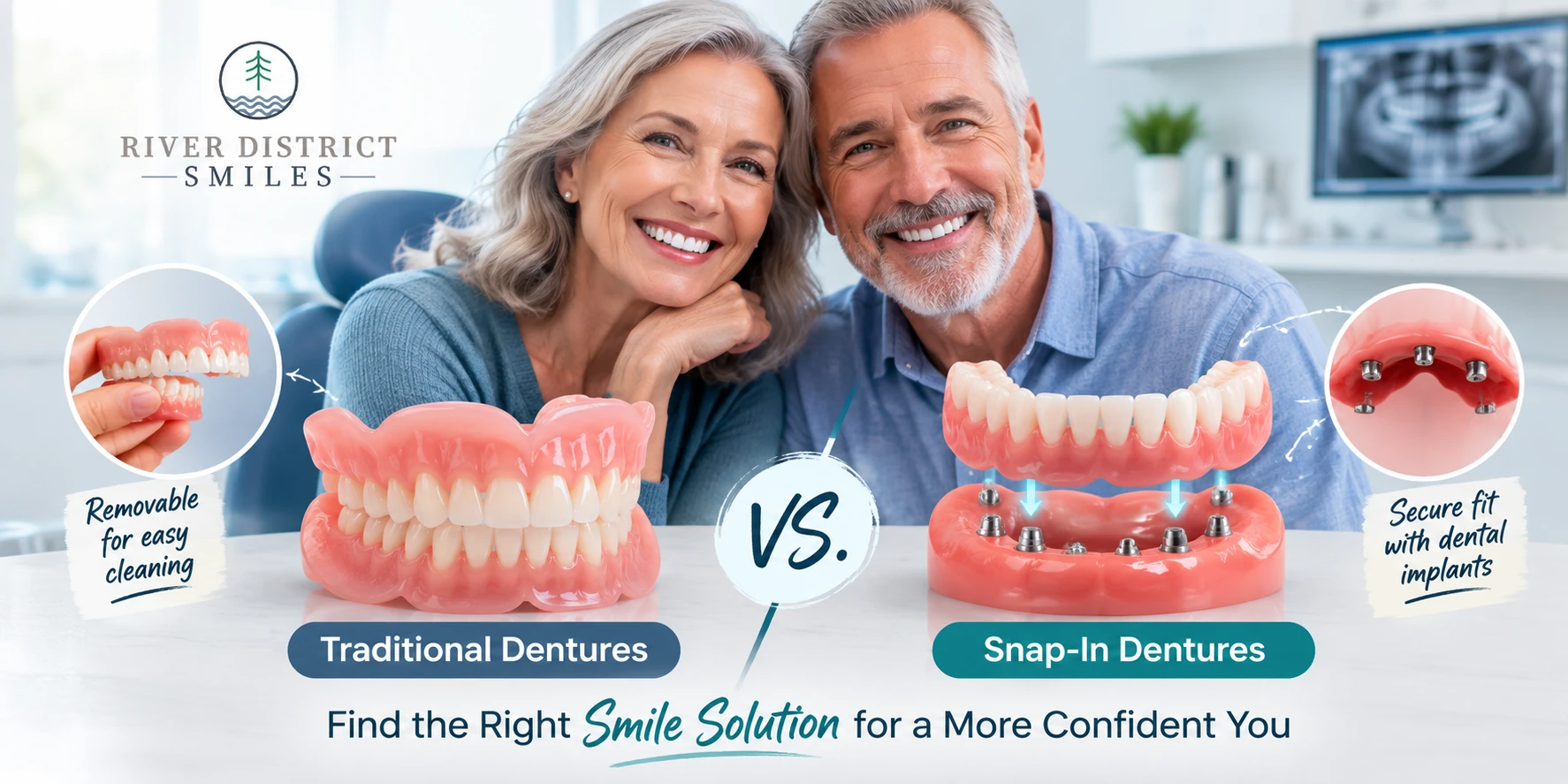


Traditional dentures and snap-in dentures both replace missing teeth, but they do not feel, function, or stay in place the same way. Traditional dentures rest on the gums and rely on suction, fit, and sometimes adhesive. Snap-in dentures attach to dental implants for added stability. Both options can restore your smile, but the right choice depends on your oral health, bone structure, lifestyle, budget, and long-term expectations.
A comprehensive dental examination helps determine which option is most appropriate based on your oral health, bone support, and treatment goals. One of the biggest misconceptions is that one option is automatically “better” for everyone. Dentistry doesn’t work that way. The best solution is the one that fits the patient, not the one that sounds most impressive in an advertisement.
Some people do very well with traditional dentures. Others want greater stability and fewer concerns about movement. The real differences come down to support, comfort, maintenance, cost, and how each option fits into everyday life.
Find the Right Denture Fit
Traditional or snap-in? Get professional guidance and choose the solution that works best for your smile. Call today.
What Are Traditional Dentures?
Traditional dentures are removable dental appliances designed to replace several missing teeth or a complete arch of teeth. Full dentures replace all of the teeth in the upper or lower jaw, while partial dentures replace only the missing teeth.
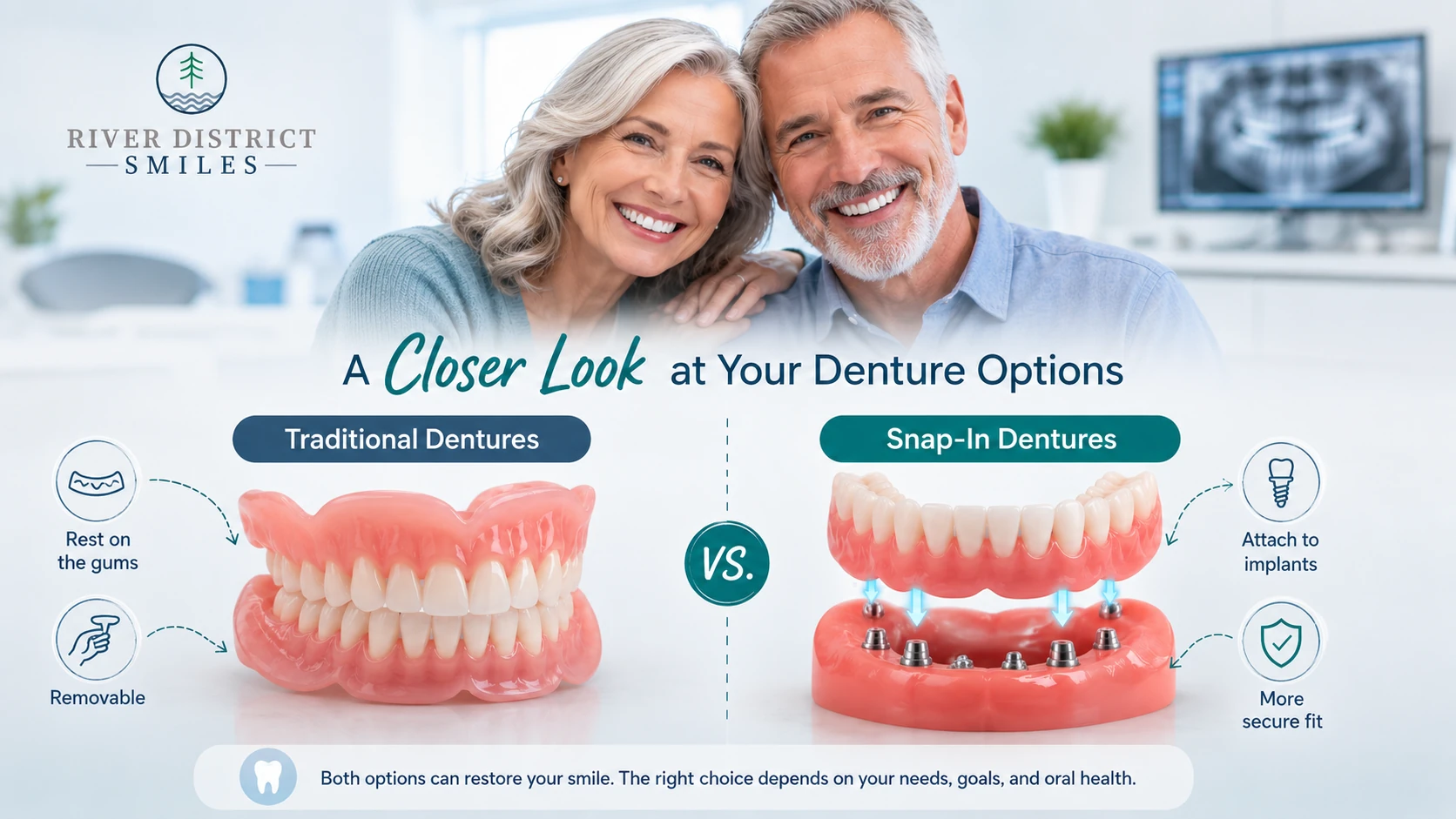
A traditional full denture sits directly on the gums. The upper denture often gains support from suction against the roof of the mouth, while the lower denture relies more heavily on the shape of the jaw, surrounding muscles, and a precise fit.
Traditional dentures usually include:
- A gum-colored acrylic base
- Artificial teeth made from durable dental materials
- A customized shape designed to fit your mouth
- A removable design for daily cleaning and maintenance
For many patients, traditional dentures remain a practical and effective solution. They are widely available, typically cost less than implant-supported options, and do not require implant surgery.
That said, they also come with a learning curve.
Eating, speaking, and smiling may feel different at first. The muscles of the cheeks and tongue need time to adapt. Some people adjust quickly, while others benefit from several follow-up appointments for minor adjustments.
What Are Snap-In Dentures?
Snap-in dentures are removable dentures that attach to dental implants placed in the jawbone. They are also commonly called implant-retained dentures or implant-supported removable dentures.
The implants act like anchors. Small attachment components on the denture connect to matching attachments on the implants, allowing the denture to securely snap into place.
Snap-in dentures are still removable. They are different from permanently fixed implant bridges, which remain attached and are removed only by a dental professional.
A snap-in denture system may include:
- Two or more dental implants
- Attachment components
- A custom removable denture
- Ongoing maintenance of both the denture and implants
The number of implants varies from patient to patient. Some lower snap-in dentures use two implants, while others use four or more. Upper dentures often require additional implants because the upper jaw experiences different chewing forces and has less dense bone.
The primary advantage is greater stability while still maintaining the convenience of a removable appliance.
How Traditional Dentures and Snap-In Dentures Stay in Place
Traditional dentures rest directly on the gums. Snap-in dentures attach to dental implants.
That one difference influences nearly everything else, including chewing ability, speech, confidence, comfort, and stability.
A well-fitting traditional denture can feel secure, particularly in the upper jaw. However, it may still shift slightly while eating certain foods, laughing, coughing, or speaking. Lower dentures are generally more challenging because the tongue and floor of the mouth are constantly moving.
Snap-in dentures are far less likely to move because the implants help hold them securely in place.
That does not mean they feel exactly like natural teeth. They are still removable prosthetic appliances. However, many patients find the additional stability to be a significant improvement.
Imagine placing a rug on a smooth floor versus securing it with non-slip grips. The rug is the same, but the support underneath changes the entire experience.
Eating With Traditional Dentures vs. Snap-In Dentures
Food is one of the biggest reasons patients compare these two treatment options.
Traditional dentures restore much of a person’s ability to chew, but certain foods may still require extra care. Tough meats, sticky candy, hard nuts, and raw vegetables can be more challenging.
Patients often need to:
- Cut food into smaller pieces
- Chew evenly on both sides
- Avoid biting directly with the front teeth
- Use denture adhesive when recommended
- Gradually introduce harder foods
Snap-in dentures generally provide better chewing stability because they are anchored to implants. Many patients feel more confident eating a wider variety of foods.
However, they do not provide unlimited chewing power. Hard foods can still damage artificial teeth or place unnecessary stress on the denture and implants.
You still should not use them to chew ice, open packages, or attempt anything your natural teeth should never have been used for.
Which Option Feels More Comfortable?
Comfort depends on fit, gum health, bone shape, and individual sensitivity.
Traditional dentures distribute chewing pressure across the gums. If the denture no longer fits properly, it may create sore spots, rubbing, or irritation.
Even a high-quality denture can become uncomfortable over time as the jaw naturally changes shape after tooth loss.
Snap-in dentures receive support from dental implants, reducing much of the movement and pressure placed directly on the gums. Many patients experience fewer problems with slipping or rubbing.
However, healthy gum tissue around the implants remains essential. Poor oral hygiene can lead to irritation or infection.
Neither option is maintenance-free. Long-term comfort depends on proper design, regular professional adjustments, and consistent daily care.
Do Snap-In Dentures Improve Speech?
Missing teeth can affect pronunciation, and both types of dentures can help restore clearer speech.
Traditional dentures may initially make sounds like “s,” “f,” or “th” more challenging while your tongue and facial muscles adjust.
Because snap-in dentures are generally more stable, some patients find speaking feels more natural and predictable.
Regardless of the type of denture you choose, there is usually an adjustment period. Reading aloud, practicing difficult words, and speaking slowly often help improve speech more quickly.
Talking to yourself in the mirror may feel a little unusual, but it is much better than discovering your new pronunciation during an important conversation.
Cost Differences Between Traditional Dentures and Snap-In Dentures
Cost is one of the most significant differences between these options.
Traditional dentures generally have a lower upfront cost because they do not require implant surgery, implant components, or specialized attachment systems.
The total cost of traditional dentures may depend on:
- Whether you need full or partial dentures
- The materials selected
- The number of tooth extractions required
- Whether immediate dentures are needed
- The level of customization
- Follow-up adjustments
Snap-in dentures usually involve a greater investment because treatment may include:
- Dental implant surgery
- Diagnostic imaging
- Bone grafting, if necessary
- Temporary dentures
- Implant attachment components
- The final denture
- Follow-up care
It is important to compare the complete treatment plan rather than focusing only on the denture itself.
An advertised starting price may not include extractions, imaging, sedation, implants, attachment components, or the final restoration.
Snap-In Dentures Require Surgery
Traditional dentures do not require implant surgery. Although some patients need tooth extractions beforehand, the denture itself simply rests on the gums.
Snap-in dentures require dental implants that are surgically placed into the jawbone. The implants generally need time to heal and integrate with the surrounding bone before supporting the final denture.
Treatment may involve:
- Comprehensive evaluation and imaging
- Tooth extractions, if necessary
- Bone grafting, if needed
- Implant placement
- Healing
- Placement of the final denture
Healing times vary from patient to patient, and some treatment plans require several months before the final denture can be attached.
Surgery should not automatically discourage patients, but implant treatment should be viewed as a carefully planned process rather than a quick solution.
How Bone Loss Affects Traditional and Snap-In Dentures
After natural teeth are lost, the jawbone gradually shrinks because it no longer receives stimulation from tooth roots.
Traditional dentures rest on top of the gums and do not replace that stimulation. As the jaw changes, the denture may loosen and eventually require relining, adjustment, or replacement.
Dental implants transfer chewing forces into the jawbone, which may help preserve bone around the implant sites. Maintaining healthy bone can also contribute to a more stable denture over the long term.
It is important to understand that implants do not completely prevent bone loss throughout the jaw. Bone can still remodel in areas where implants are not present.
Cleaning and Maintaining Traditional Dentures vs. Snap-In Dentures
Traditional dentures should be removed and cleaned every day.
Daily care typically includes:
- Brushing the denture with a denture-safe brush
- Cleaning the gums and tongue
- Soaking the denture as recommended
- Rinsing after meals
- Attending regular dental checkups
Snap-in dentures require all of those steps plus careful cleaning around the implant attachments.
Your dentist may recommend specialized brushes, flossing aids, or water flossers to help clean around the implants.
The attachment inserts can also wear over time and require replacement. If the denture begins to feel less secure, replacing these components often restores the fit.
Traditional dentures also require periodic:
- Adjustments
- Relines
- Repairs
- Replacement after years of wear
Neither option should be neglected simply because it is removable.

All-on-X Dental Implants Cost: What Patients Should Know
Most people look into All-on-X dental implants because they are tired of missing teeth, failing teeth, or dentures that move…
Which Denture Option Looks More Natural?
Both traditional dentures and snap-in dentures can be made to look remarkably natural.
The final appearance depends more on the quality of the materials, tooth selection, gum shading, and craftsmanship than whether implants are used.
A beautifully made traditional denture can look outstanding. Likewise, an implant-supported denture can still appear artificial if it is poorly designed.
Patients should participate in selecting details such as:
- Tooth shape
- Tooth color
- Smile width
- Gum shade
- Tooth arrangement
The most natural smiles are not always perfectly white or perfectly symmetrical.
Real teeth have character. Small variations often make a smile appear more authentic.
Which Option Is More Durable?
Snap-in dentures generally provide greater stability, but stability and durability are not exactly the same thing.
The denture itself can still wear, crack, or break. Artificial teeth may wear down over time, particularly in patients who grind or clench.
Attachment components also require periodic maintenance.
Dental implants can last many years with proper care, but the removable denture may eventually require repairs or replacement.
Traditional dentures also wear over time, and natural changes in the jaw can affect their fit even if the denture itself remains intact.
Long-term success depends on:
- Daily cleaning
- Routine dental visits
- Avoiding damaging habits
- Managing teeth grinding
- Maintaining healthy gums
- Replacing worn components when needed
A greater investment does not make any dental appliance indestructible.
Who Might Prefer Traditional Dentures?
Traditional dentures may be an excellent option for patients who:
- Prefer a lower upfront cost
- Want to avoid implant surgery
- Have limited bone volume
- Need a quicker tooth replacement solution
- Have medical conditions that complicate implant treatment
- Are comfortable wearing a removable appliance
Traditional dentures may also serve as a temporary solution during healing or before future implant treatment.
They sometimes receive an unfair reputation. A properly designed, well-maintained denture can restore appearance and function very effectively.
Many problems begin only after the denture fit changes and adjustments are delayed.
Who Might Prefer Snap-In Dentures?
Snap-in dentures may be a good choice for patients who:
- Want improved stability
- Struggle with loose lower dentures
- Want less dependence on adhesive
- Have adequate bone for implant placement
- Are willing to undergo implant surgery
- Can commit to long-term implant maintenance
- Want greater confidence while eating and speaking
They are especially popular among patients who have worn traditional dentures and become frustrated by movement.
However, the ideal candidate is not simply someone who wants implants. Patients must also be committed to maintaining healthy gums and attending regular follow-up visits.
Implants are durable, but they are not self-cleaning.
Is Denture Adhesive Still Needed?
Traditional denture wearers often use adhesive for additional security, especially if the fit has changed slightly.
Needing occasional adhesive is not unusual. However, relying on large amounts of adhesive every day often indicates that the denture should be professionally evaluated.
Snap-in dentures typically require little or no adhesive because the implants provide most of the retention.
That can be a major advantage for patients who dislike the taste, mess, or routine of denture adhesive.
If a snap-in denture begins feeling loose, worn attachment inserts may simply need replacement rather than adhesive.
Which Option Is Better?
Neither treatment is automatically better for every patient.
Traditional dentures may be ideal for someone seeking an affordable, non-surgical solution. Snap-in dentures may be a better choice for someone who prioritizes stability and is comfortable with implant surgery and a greater financial investment.
The decision should consider:
- Oral health
- Bone structure
- Budget
- Medical history
- Personal expectations
- Oral hygiene habits
- Desired level of stability
It also helps to maintain realistic expectations.
Traditional dentures will not feel exactly like natural teeth, and snap-in dentures still have limitations. Understanding those differences helps patients make more confident, informed decisions.
Frequently Asked Questions
What is the biggest difference between traditional dentures and snap-in dentures?
Traditional dentures rest directly on the gums, while snap-in dentures attach to dental implants. This provides greater stability during eating and speaking.
Are snap-in dentures worth the extra cost?
Many patients believe they are because they provide greater stability, comfort, and confidence. Whether they are worth the investment depends on your oral health, lifestyle, goals, and budget.
Do snap-in dentures come out at night?
Yes. Most snap-in dentures are removable and should be taken out daily for cleaning unless your dentist recommends a different routine.
Can I switch from traditional dentures to snap-in dentures later?
In many cases, yes. Patients who currently wear traditional dentures may become candidates for snap-in dentures after a comprehensive dental evaluation.
Which option lasts longer?
Both traditional dentures and snap-in dentures require maintenance over time. Dental implants can last many years with proper care, while dentures and attachment components may eventually need repairs, adjustments, or replacement.
Find the Fit That Feels Right at River District Smiles
Choosing between traditional dentures and snap-in dentures is not about selecting the newest technology or the more expensive treatment. It is about finding the solution that best supports your comfort, oral health, lifestyle, and long-term goals.
At River District Smiles, we’ll evaluate your oral health, discuss your goals, answer your questions, and help you understand which option is most likely to provide the comfort and function you’re looking for. Together, we’ll create a personalized treatment plan that fits your needs and helps you smile with confidence.
Whether you choose a dependable traditional denture or the added stability of snap-in dentures, our team is here to help you make an informed decision every step of the way.
Tired of Dentures That Move?
Snap-in dentures may offer the secure fit you’ve been looking for. Call now to explore your options.