

If you wake up with a tight jaw, sore temples, or teeth that feel like they have been working all night, you may eventually hear two very different treatment suggestions:
Get a night guard.
Or try Botox.
They are sometimes discussed as if they do the same job.
They do not.
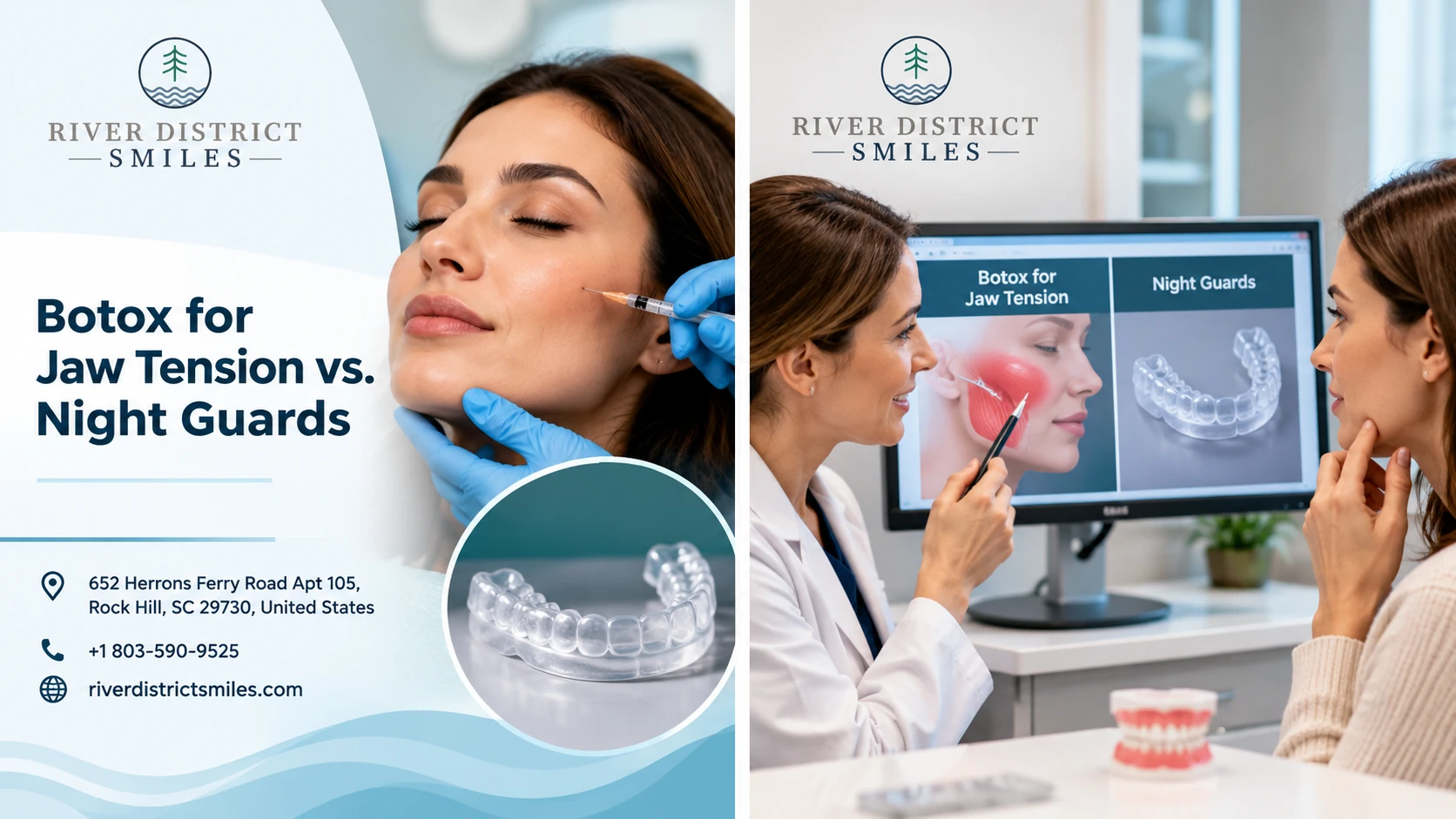
The short answer is that a night guard mainly creates a protective barrier between your teeth and may help some people manage clenching-related symptoms. Botox reduces the strength of selected jaw muscles for a temporary period.
For some patients, a night guard makes more sense.
For others with significant muscle-related tension, Botox may be worth discussing.
And occasionally the two are used together because they address different parts of the problem.
But there is an important caution: Botox is not FDA-approved specifically to treat temporomandibular disorders or bruxism, and current evidence for TMD pain is mixed. The National Institute of Dental and Craniofacial Research recommends beginning with conservative, reversible treatments and notes that it remains unclear how effective botulinum toxin is for TMD symptoms.
At River District Smiles, Botox is offered for selected patients with jaw tension, clenching, bruxism, and other facial-muscle concerns. The right starting point, however, is figuring out whether your symptoms are actually coming from overworked muscles in the first place.
First: Jaw Tension, Bruxism, and TMD Are Not the Same Thing
These terms often get mixed together.
Bruxism
Bruxism means clenching or grinding your teeth.
It can occur while you are awake or while you sleep.
The National Institute of Dental and Craniofacial Research notes that more severe bruxism can contribute to tooth damage, jaw soreness, headaches, and tired jaw muscles.
Jaw tension
Jaw tension is more of a symptom.
You may notice:
- Tight cheek muscles
- Tender temples
- Morning jaw fatigue
- Soreness after concentrating or driving
- Headaches around the temples
- A feeling that you cannot fully relax your jaw
Clenching can cause that tension, but it is not the only possible cause.
TMD
Temporomandibular disorders, or TMDs, are a broader group of conditions involving the jaw joints, chewing muscles, or both.
Symptoms can include:
- Jaw or facial pain
- Limited opening
- Pain while chewing
- Clicking or popping
- Jaw locking
- Muscle tenderness
And importantly, painless clicking by itself is common and often does not require treatment. NIDCR specifically advises that jaw sounds without pain are frequent and generally do not need treatment.
That is why simply saying, “My jaw clicks, so should I get Botox?” skips an important diagnostic step.
What Does a Night Guard Actually Do?
A night guard is a removable appliance worn over the teeth, usually while sleeping.
You may also hear it called:
- Occlusal splint
- Bruxism splint
- Stabilization splint
- Bite guard
- Intraoral appliance
Its most obvious job is mechanical.
It separates the upper and lower teeth so they are not grinding directly against each other.
That can be useful when someone is showing signs such as:
- Flattened teeth
- Chipped enamel
- Worn restorations
- Cracked teeth
- Morning tooth soreness
- Heavy nighttime grinding
NIDCR lists mouth guards among possible bruxism treatments, noting that they can separate the teeth to help prevent tooth damage and may reduce muscle activity in some people.
But there is an important limitation.
A Night Guard Does Not Necessarily Stop You From Clenching
This is probably the biggest misunderstanding about night guards.
A night guard does not switch off your jaw muscles.
You may still clench against the appliance.
River District Smiles makes this same distinction in its guidance for patients with tooth sensitivity and bruxism: a night guard may protect the teeth, but it does not automatically eliminate the underlying muscle activity.
That means somebody can wear a guard faithfully and still wake up with tired muscles.
The teeth may be better protected while the muscle problem continues.
For that patient, we may need to look beyond the appliance.
Does a Night Guard Help Jaw Pain?
It can help some people.
But the evidence is not as clean as many patients assume.
NIDCR says there is limited evidence about how effectively intraoral appliances improve TMD pain. If an appliance is used, it should not be designed to permanently change the bite, and patients should stop and seek advice if it makes pain worse.
A 2024 Cochrane review involving 57 randomized trials also concluded that the evidence for occlusal splints and other occlusal treatments in TMD remains uncertain. Some types of splints may reduce muscle pain while chewing, but confidence in the evidence is low.
That does not make night guards useless.
It means we should be precise about why we are prescribing one.
Protecting teeth from grinding is a different goal from promising that a splint will cure chronic jaw pain.
What Does Botox Do Differently?
Botox onabotulinumtoxinA temporarily reduces signaling between nerves and the muscles into which it is injected.
When selected chewing muscles are treated, those muscles cannot contract with the same strength.
For a patient whose symptoms are driven heavily by overactive jaw muscles, that reduction in force may mean:
- Less muscle tightness
- Less intense clenching
- Reduced morning soreness
- Less tenderness in the masseter muscles
- Less muscle-related facial tension
River District Smiles offers Botox for patients with jaw tension and clenching and describes treatment as targeting overactive facial and chewing muscles after evaluating jaw movement and muscle activity.
That sounds very different from a night guard because it is.
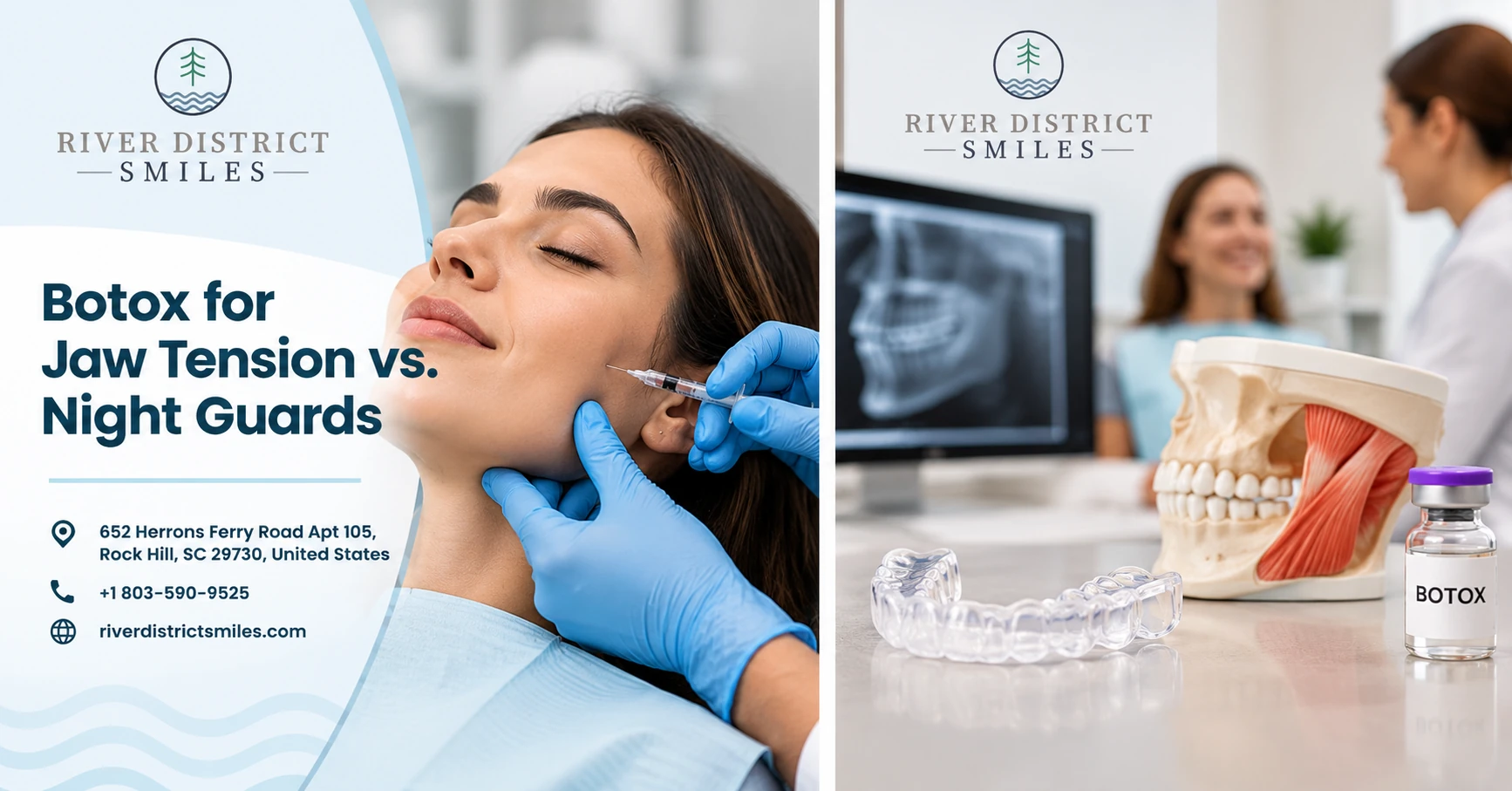
The night guard sits between the teeth. Botox acts on muscle contraction.
Does Botox Stop Teeth Grinding Completely?
Not necessarily.
The goal is generally to reduce the intensity of muscle contraction rather than paralyze normal chewing muscles.
You still need to talk, chew, swallow, and move your jaw normally.
The amount injected and the muscles selected therefore matter.
River District Smiles describes its approach as individualized according to muscle strength, facial movement, and the patient’s symptoms.
Research into botulinum toxin for sleep bruxism has found some promising results, including reductions in pain and bruxism activity in selected studies, but the evidence base remains small and inconsistent. A 2024 systematic review included only nine randomized trials totaling 137 participants and described the findings as preliminary because of substantial differences among the studies.
So I would not tell a patient:
“Botox will stop your grinding.”
A more accurate expectation is:
It may reduce the force generated by the muscles involved.
Is Botox Proven to Treat TMD?
Not conclusively.
This deserves to be stated clearly because TMD treatment attracts a lot of confident marketing.
NIDCR says botulinum toxin type A is FDA-approved for certain medical conditions, but not for TMDs, and studies examining it for TMD have produced mixed results.
A systematic review and meta-analysis of 14 randomized controlled trials found that botulinum toxin was not significantly better than placebo for several TMD outcomes, including pain reduction, maximum mouth opening, bruxism events, and bite force. The authors concluded that better-quality research is needed.
Other reviews have found more encouraging results in selected patients, especially those with sleep-bruxism-related muscle symptoms.
So the honest answer is:
Some patients report meaningful relief, and some clinical trials show benefit, but Botox is not an established cure for every form of TMD.
That distinction is important at River District Smiles because the practice does offer the treatment. Offering it should not mean pretending the evidence is stronger than it is.
Why Is Botox for Jaw Tension Considered Off-Label?
The FDA approves medications for specific uses.
Botox has multiple FDA-approved medical and cosmetic indications.
Treatment of TMD or ordinary bruxism is not currently one of those approved indications. NIDCR specifically identifies its use for TMD as outside FDA approval.
Off-label treatment is not the same thing as illegal or automatically inappropriate.
Medications are commonly prescribed off-label when clinicians believe the available evidence, patient circumstances, and risk-benefit balance justify the use.
But patients should know when that is what is happening.
That conversation should include:
- What symptom we are trying to improve
- Why the clinician believes muscle activity is contributing
- What evidence exists
- What alternatives are available
- Possible adverse effects
- How long the benefit may last
- The fact that repeat treatment may be necessary
Informed consent matters more not less when a medication is being used outside its FDA-approved indication.
Botox vs. Night Guard: The Practical Difference
| Night guard | Botox | |
| Primary action | Creates a barrier between teeth | Temporarily reduces muscle contraction |
| Protects enamel from tooth-on-tooth grinding | Yes | Indirectly may reduce force, but does not physically cover teeth |
| Directly reduces jaw-muscle strength | No | Yes |
| Stops clenching completely | Not necessarily | Not necessarily |
| Reversible | Yes; simply stop wearing it | Yes, but effects wear off gradually |
| Ongoing treatment | Appliance may eventually need replacement | Usually requires repeat injections if continued |
| Helps every TMD | No | No |
| FDA-approved specifically for TMD/bruxism | Device use depends on indication/design | No |
| Main drawback | Can feel bulky; may not relieve muscle pain | Injections, temporary effects, cost, potential adverse effects |
| Most useful when | Tooth protection is a major concern | Significant muscle-driven tension is suspected |
The table makes one thing clear:
These are not really competing versions of the same treatment.
Who Is a Good Candidate for a Night Guard?
A night guard becomes particularly reasonable when we see evidence that your teeth are absorbing excessive grinding or clenching forces.
That can include:
- Flattened biting edges
- Chipped teeth
- Cracks
- Worn enamel
- Broken fillings
- Damaged crowns
- Morning tooth soreness
- A partner hearing grinding at night
River District Smiles notes that bruxism can wear enamel, create small cracks, and damage dental restorations.
A guard may also be appealing because it is conservative and reversible.
You wear it.
We monitor it.
If it creates discomfort or worsens symptoms, we reassess rather than permanently changing your teeth or bite.
That conservative approach is consistent with NIDCR’s recommendations for TMD care.
Who Might Consider Botox?
Botox becomes a more reasonable discussion when the problem appears strongly muscle-driven.
For example, someone may have:
- Very prominent or tender masseter muscles
- Significant clenching
- Persistent morning jaw tightness
- Muscle-related facial soreness
- Tension that has not improved adequately with simpler measures
- Significant discomfort despite protecting the teeth with a guard
At River District Smiles, jaw movement and facial muscle activity are evaluated before Botox is planned rather than treating every patient with the same injection pattern.
The important phrase is consider Botox.
Not everyone with jaw pain is a Botox patient.
When Is Botox Probably the Wrong First Step?
If the source of your pain has not been diagnosed, starting with injections may skip the most important part of care.
Jaw pain can come from many sources.
For example:
- Muscle overuse
- A joint disorder
- Arthritis
- Injury
- Tooth infection
- Cracked teeth
- Sinus-related pain
- Nerve pain
- Other facial-pain conditions
NIDCR cautions that jaw, mouth, and facial pain may or may not actually be caused by a TMD and that other conditions sometimes need to be ruled out.
Botox makes the most biological sense when the target problem involves overactive muscles.
It is much less logical to inject a muscle simply because someone heard a click in their joint.
What If My Jaw Clicks but Does Not Hurt?
You may not need either treatment.
This surprises people.
Jaw clicking and popping are common.
NIDCR specifically states that TMJ sounds without pain occur frequently and generally do not require treatment.
If you can eat comfortably, open normally, and have no pain, locking, or progressive functional problems, the click alone may simply be something to monitor.
That is very different from:
“My jaw locks are closed twice a week.”
or:
“I cannot chew without pain.”
Symptoms matter more than the sound.
What Should Be Tried Before Botox?
For many uncomplicated muscle-related TMD symptoms, conservative care makes sense first.
NIDCR recommends beginning with simple measures such as:
- Softer foods temporarily
- Heat or cold
- Gentle jaw exercises
- Short-term over-the-counter anti-inflammatory medications when medically appropriate
- Reducing clenching
- Avoiding gum chewing
- Self-management strategies
Other options may include physical therapy, behavioral strategies, or an intraoral appliance depending on the diagnosis.
The principle is simple:
Start with treatments that are reversible and low-risk when those treatments are appropriate for the problem.
Botox can still enter the conversation later.
Daytime Clenching Is Easy to Miss
Not all grinding happens while you sleep.
Many people clench while:
- Driving
- Working at a computer
- Exercising
- Concentrating
- Dealing with stress
- Playing video games
- Sitting in traffic
NIDCR notes that awake bruxism is actually common and recommends behavioral strategies aimed at changing resting jaw position and increasing awareness of clenching habits.
Your relaxed jaw position should generally have the teeth slightly apart rather than clenched together.
If you catch yourself holding your teeth together all afternoon, a night guard cannot solve that daytime habit because the guard is sitting on your nightstand.
That does not necessarily mean Botox is required either.
Sometimes awareness and behavior modification are an important part of treatment.
What If Stress Is Driving the Clenching?
Then treating the muscles without addressing the trigger may provide incomplete relief.
Stress does not cause every case of bruxism.
But NIDCR includes stress management among possible strategies for people with grinding and clenching.
That does not mean someone should be told:
“You’re stressed. Just relax.”
That is not useful advice.
A practical plan may involve several pieces:
- Dental protection for the teeth
- Awareness of daytime jaw position
- Improved sleep
- Physical therapy
- Stress-management strategies
- Treatment of damaged teeth
- Botox in selected cases
It does not have to be one treatment or nothing.
Can Botox and a Night Guard Be Used Together?
Yes, in selected patients.
This combination makes sense conceptually because each treatment addresses a different concern.
The guard protects the teeth from direct tooth-on-tooth contact.
Botox can reduce muscle force.
For someone who has already damaged teeth from grinding and also has significant muscular pain, using both may be reasonable after evaluation.
But using both does not automatically mean the problem is being “treated twice as well.”
Each one should have a specific purpose.
Ask:
Why do I need the guard?
Why do I need the injections?
You should get two different answers.
How Long Does Botox for Jaw Tension Last?
The effect is temporary.
River District Smiles states that its Botox results generally last around three to four months, though the exact duration varies according to the patient and muscle activity.
That creates an important long-term tradeoff.
A night guard is an appliance you may use repeatedly until it wears out or no longer fits.
Botox requires another treatment when the effect fades if you want to maintain the muscle-reducing effect.
For some patients, that ongoing commitment is worthwhile.
For others, it is not.
What Are the Risks of Botox?
Botox is a medication, not simply a cosmetic add-on.
Possible localized effects from injections into facial or jaw muscles can include:
- Injection-site discomfort
- Bruising
- Temporary muscle weakness
- Changes in smile or facial symmetry
- Altered chewing sensation
In one systematic review of botulinum toxin for sleep bruxism, reported adverse effects included injection-site pain and temporary cosmetic changes in the smile in individual trials.
Botulinum toxin products also carry an FDA boxed warning about the rare possibility of toxin effects spreading beyond the injection area, potentially producing swallowing, speech, or breathing problems.
That does not mean those serious complications are common after jaw-muscle injections.
It does mean Botox should be treated as a medication with real risks rather than something completely casual.
Will Botox Make It Hard to Chew?
The goal is not to eliminate your ability to chew.
The masseter and other jaw muscles still need to function.
But because the treatment intentionally reduces muscle activity, temporary chewing weakness or fatigue is possible, especially depending on dose and injection placement.
That is why treatment should be individualized rather than based on how many units somebody on social media says they received.
Muscle size, anatomy, symptoms, and treatment goals differ.
River District Smiles says it assesses facial movement, jaw function, and muscle strength before determining its injection pattern.
Which Option Costs More?
Over time, Botox will usually involve a different cost pattern from a night guard.
A custom night guard is generally an upfront appliance expense, although it can eventually require adjustment or replacement.
Botox is a recurring treatment because its effects wear off.
River District Smiles currently offers a Botox membership listed at $80 per month, which includes 25 units four times per year and a discount on additional units. The amount needed for a particular therapeutic or cosmetic treatment varies, so patients should ask whether the membership structure and included units fit their specific treatment plan.
The practice’s public site does not currently list a specific fee for a custom night guard.
Insurance coverage also varies.
A dental plan may contribute toward a night guard depending on diagnosis and benefits.
Coverage for Botox used for jaw tension or TMD may be more difficult because this is an off-label indication and coverage rules differ significantly.
Before starting recurring treatment, ask for the expected annual cost rather than focusing only on the price of one appointment.
Which Is Better for Protecting Dental Work?
A night guard has the more direct role.
If you have:
- Veneers
- Crowns
- Large fillings
- Bonding
- Heavily worn teeth
and you grind at night, placing a physical barrier between the upper and lower teeth can protect those restorations from direct grinding contact.
Botox may reduce the forces generated, but it does not put protective material over the restorations.
This is one reason the treatments may occasionally complement rather than replace each other.
Could Jaw Tension Actually Be Related to Sleep Apnea?
Sometimes nighttime grinding exists alongside sleep-disordered breathing.
That does not mean everyone who grinds has sleep apnea.
But symptoms such as:
- Loud snoring
- Witnessed pauses in breathing
- Waking gasping
- Significant daytime sleepiness
- Morning headaches
- Poor-quality sleep
deserve a separate conversation.
River District Smiles provides sleep-apnea evaluation and oral appliance therapy for appropriate patients and notes that sleep apnea appliances are different from ordinary night guards. A sleep appliance repositions the jaw to help maintain airflow; a night guard is primarily intended to protect teeth.
That distinction matters.
Buying a grinding guard does not treat obstructive sleep apnea.
So Which Should You Try First?
For many patients, the answer begins with diagnosis rather than choosing between products.
If your teeth are visibly wearing or cracking, protecting them may make a night guard a very reasonable part of treatment.
If the primary complaint is severe muscle tightness despite appropriate conservative care, Botox may be worth discussing.
If the main symptom is joint locking, significant joint pain, or something that does not appear muscle-driven, neither may be the complete answer.
And if you only have painless clicking, treatment may not be necessary at all.
A simple way to think about it is:
Consider a night guard when:
- Tooth wear is a major concern.
- Restorations are being damaged.
- You grind during sleep.
- You want a reversible mechanical form of protection.
- Your dentist believes a splint is appropriate for your specific symptoms.
Consider discussing Botox when:
- Muscle tension is a major part of the problem.
- The jaw muscles are persistently overactive or painful.
- Simpler conservative measures have not provided adequate relief.
- You understand that the effect is temporary.
- You understand that treatment for TMD or bruxism is off-label and evidence is mixed.
Consider both when:
You have significant muscle-driven clenching and teeth or restorations that need physical protection.
Questions to Ask Before Choosing Either Treatment
Before buying a guard or agreeing to injections, ask:
- What do you think is actually causing my jaw symptoms?
- Is the problem mainly muscular, joint-related, dental, or a combination?
- Am I showing physical signs of grinding on my teeth?
- What is the night guard supposed to accomplish in my case?
- Is the proposed appliance designed to permanently change my bite?
- Why are you recommending Botox rather than simpler treatment first?
- Do you consider my Botox use off-label?
- What side effects should I know about?
- How often would I need injections?
- What would this treatment realistically cost over one year?
You should be able to understand the answers without needing a dental degree.
The Bottom Line
Botox and night guards solve different problems.
A night guard primarily protects the teeth and may help some patients manage symptoms, but it does not necessarily stop the muscles from clenching.
Botox works in the opposite direction: it reduces the strength of selected muscles, but it does not physically protect tooth surfaces and its effect wears off.
Neither is a universal treatment for TMD.
NIDCR recommends conservative, reversible care first for many temporomandibular disorders and specifically notes that evidence for botulinum toxin treatment remains inconclusive.
River District Smiles offers Botox for selected patients with jaw tension and clenching while also recognizing the role of night guards in protecting teeth from grinding-related damage.
If you wake up every morning with a sore jaw, the next step should not be choosing whichever treatment sounds newer.
It should be figuring out what your jaw muscles, joints, and teeth are actually telling us.
A good treatment plan should explain what we are trying to protect, what we are trying to relax, and why the recommended option makes sense for your particular symptoms.