


If your teeth look darker than they used to, it is tempting to assume whitening is the answer.
Sometimes it is.
Sometimes a professional cleaning is enough.
And sometimes no amount of whitening toothpaste or strips will solve the real problem because the color is coming from inside the tooth rather than sitting on its surface.
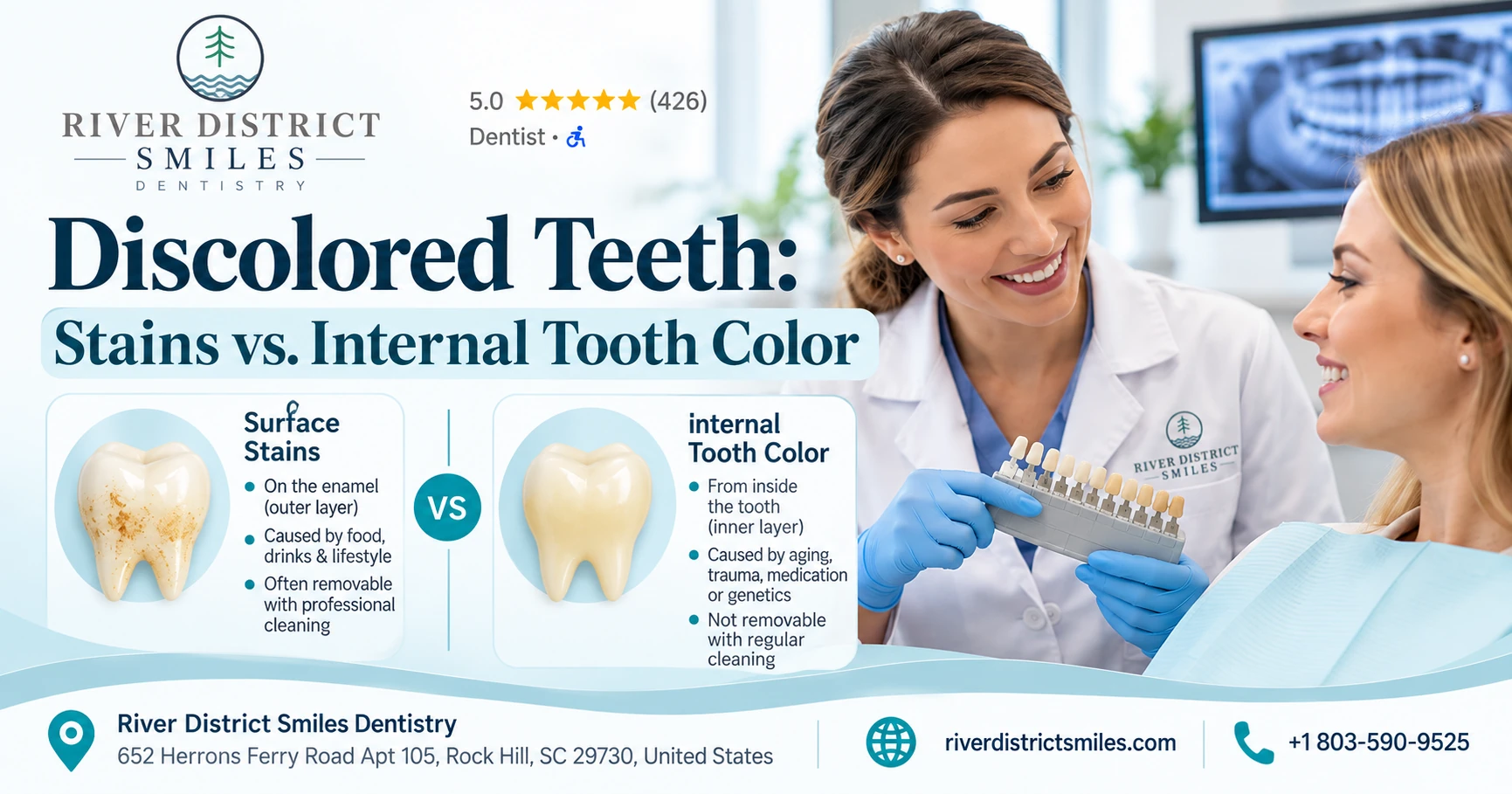
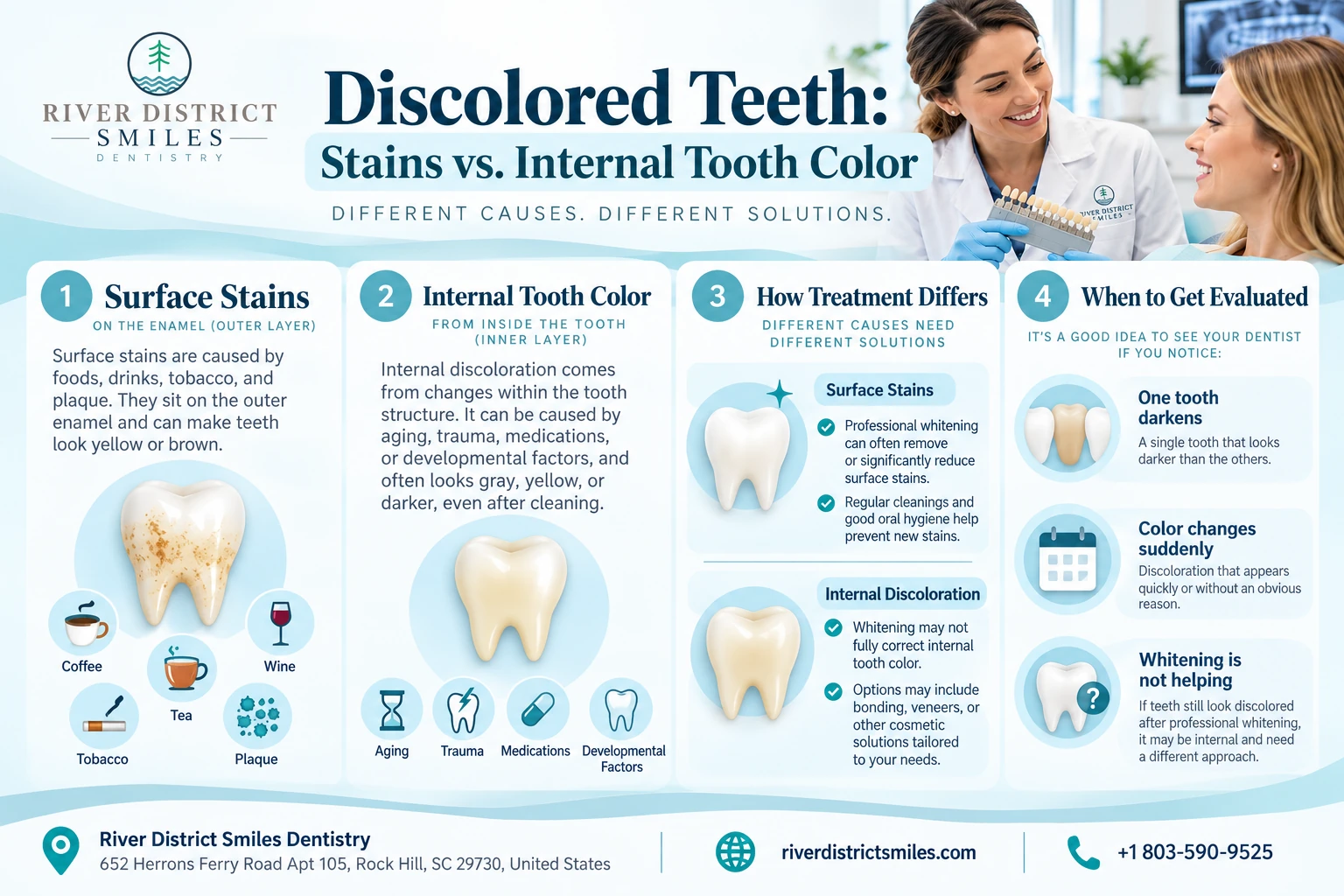
The short answer is that tooth discoloration generally falls into two categories: extrinsic stains on the outside of the tooth and intrinsic discoloration within the enamel or dentin. Some teeth have a combination of both.
That distinction matters because treatment changes depending on the cause.
Coffee stains and a tooth that darkened after being hit during a basketball game may both look brown or yellow in the mirror, but they are very different dental situations.
At River District Smiles, the first step is not automatically whitening the teeth. It is understanding why they changed color. The practice evaluates both surface staining and deeper discoloration and offers whitening, bonding, veneers, crowns, and other options when appropriate.
What Is the Difference Between Surface Stains and Internal Discoloration?
Dentists generally describe discoloration as extrinsic, intrinsic, or a combination of both.
Extrinsic stains collect on the outside of enamel.
Common causes include:
- Coffee
- Tea
- Red wine
- Cola
- Darkly pigmented foods
- Tobacco
- Certain environmental exposures
The ADA notes that these colored compounds can accumulate on the enamel surface and are often easier to reduce through cleaning, polishing, stain-removing toothpaste, or whitening treatment.
Intrinsic discoloration develops within the tooth structure.
Possible causes include:
- Natural aging
- Trauma
- Tooth-development changes
- Certain medications taken while teeth were developing
- Fluorosis
- Changes in the pulp or nerve of a tooth
- Some existing dental materials
- The natural color of dentin beneath enamel
Intrinsic discoloration can be more challenging because brushing harder does not remove something that is inside the tooth.
How Can You Tell Which Type You Have?
You usually cannot diagnose it perfectly from a mirror.
But there are clues.
Surface stain is more likely when:
Several teeth have become darker together.
The color developed gradually.
You drink coffee, tea, wine, cola, or other deeply colored beverages regularly.
The discoloration appears brownish or yellow on exposed surfaces.
Your teeth look noticeably brighter after a professional cleaning.
Internal color is more likely when:
One tooth is much darker than the others.
The discoloration followed an injury.
The teeth have always had a gray, brown, or banded appearance.
Whitening products have done very little.
There are white, brown, or mottled areas within the enamel.
The color seems to come through the tooth rather than sit on top of it.
A dental examination can help determine which pattern is present before you spend money trying treatments that may not address it.
The ADA specifically recommends evaluating the cause of discoloration before bleaching because different kinds of staining respond differently to whitening.
If My Teeth Are Yellow, Is That Usually a Surface Stain?
Not necessarily.
Teeth naturally become more yellow with age even if you have excellent brushing habits.
The outer enamel layer is somewhat translucent. Beneath it is dentin, which is naturally more yellow.
As teeth age, enamel can become thinner and more translucent, allowing more of that underlying dentin color to show through. The ADA identifies aging as a common cause of intrinsic darkening.
That means somebody can brush extremely well and still notice their teeth becoming warmer or yellower over time.
It is not automatically poor hygiene.
The good news is that age-related yellowing often responds reasonably well to peroxide-based whitening because whitening agents can penetrate the enamel and influence color within the tooth.
What Does a Professional Cleaning Actually Whiten?
A cleaning and teeth whitening are different procedures.
Professional cleaning removes plaque, tartar, and some external staining.
If your teeth are darker mainly because of coffee or tobacco deposits on the surface, they may look noticeably brighter after cleaning.
But a cleaning does not chemically bleach the natural color of enamel and dentin.
That is where whitening treatment is different.
Whitening uses agents such as hydrogen peroxide or carbamide peroxide to break down colored compounds within the tooth and make the overall shade appear lighter.
A useful way to think about it is:
Cleaning removes what is on the tooth.
Whitening changes the color showing through the tooth.
Sometimes a patient really only needs the first one.
Do Whitening Toothpastes Work?
They can help with surface stains.
They generally do much less for the natural internal shade of the tooth.
The ADA explains that whitening toothpastes typically use abrasives or polishing agents to help remove external staining. Unlike peroxide bleaching products, most do not substantially change intrinsic tooth color.
That makes them reasonable for maintaining a brighter appearance after coffee, tea, or other everyday staining.
But if your teeth are naturally dark yellow, gray, or internally stained, brushing harder with whitening toothpaste is unlikely to produce a dramatic change.
Aggressive brushing can also create other problems.
Whiter teeth should not come at the expense of irritated gums or unnecessary enamel wear.
When Does Professional Whitening Make Sense?
Whitening generally makes the most sense when the teeth are healthy and the primary concern is color.
River District Smiles currently offers both in-office and dentist-supervised at-home whitening options. The practice describes whitening as especially appropriate for natural teeth with staining or age-related yellowing rather than teeth whose appearance is primarily affected by structural damage or restorations.
Whitening is often a good fit when:
- Several natural teeth are darker than you would like
- Coffee, tea, wine, or tobacco have contributed to discoloration
- Teeth have yellowed with age
- You want to improve color without changing tooth shape
- Your gums and teeth are otherwise healthy
Whitening may be a poor fit when:
- One tooth has suddenly become dark
- The front teeth contain multiple crowns or veneers
- There is untreated decay
- There is significant gum disease
- The discoloration comes from trauma
- Deep intrinsic staining is unlikely to respond predictably
The point of an exam before whitening is not to make a simple cosmetic treatment complicated.
It is to make sure whitening is actually the right tool.
How Much Does Professional Whitening Cost?
River District Smiles currently cites typical planning ranges of approximately $300 to $800 for in-office professional whitening and roughly $200 to $400 for dentist-supervised take-home whitening, depending on the product and treatment required. Those figures are general estimates rather than a guaranteed individual quote.
Over-the-counter products cost less.
That can make them reasonable for mild discoloration.
The tradeoff is usually lower concentrations, less customization, and less ability to account for sensitivity or uneven tooth color.
The best value depends on what is actually causing the discoloration.
A $40 box of whitening strips is not inexpensive if the problem they are being asked to fix will never respond to them.
Why Is One Dark Tooth Different?
A single tooth that becomes noticeably darker than the teeth beside it deserves more attention than generalized staining.
Especially if the change occurred after trauma.
A blow to a tooth can damage the pulp—the living tissue inside it—even when the tooth never visibly broke.
The ADA notes that trauma can cause a tooth to darken as internal tissues respond to the injury.
A single dark tooth can have several possible explanations, including:
- Previous trauma
- Changes in the pulp
- Previous root canal treatment
- Internal bleeding after injury
- Decay
- Existing restorative materials
- Developmental differences
That is why I would not start by placing a whitening strip over one suddenly gray tooth.
First find out whether the tooth is healthy.
Does a Dark Tooth After Trauma Mean the Nerve Is Dead?
Not automatically.
Color is one piece of information.
The dentist may also consider:
- History of injury
- Pain
- Sensitivity
- Swelling
- Tenderness when biting
- Examination findings
- Pulp testing when appropriate
- Dental X-rays
A tooth can change color after trauma without immediately needing a root canal.
On the other hand, discoloration can sometimes accompany pulp injury or loss of vitality.
The correct treatment depends on the diagnosis, not on the shade alone.
This is why a tooth that becomes dark after a sports injury or accident should be evaluated rather than treated purely as a cosmetic concern.
What If the Dark Tooth Already Had a Root Canal?
A root-canaled front tooth can sometimes remain darker than its neighbors.
That does not necessarily mean the root canal caused the discoloration.
The American Association of Endodontists notes that a tooth that was already dark before root canal treatment may remain mismatched afterward, and internal bleaching can sometimes be considered.
Internal bleaching is different from putting whitening gel on the outside of all the teeth.
The whitening material is placed within an appropriately treated non-vital tooth under professional care.
The ADA also recognizes intracoronal or internal bleaching as an option for selected non-vital discolored teeth.
This is a specialized situation.
It is not something to attempt with a home whitening product.
What About Tetracycline Staining?
Certain antibiotics taken during tooth development can produce intrinsic discoloration.
Tetracycline staining can appear gray, brown, yellow, or banded across the teeth.
This type of discoloration can be much more difficult to whiten than ordinary coffee staining.
The ADA notes that tetracycline-related discoloration may respond to peroxide bleaching, but treatment can require a much longer course than ordinary whitening sometimes several months.
That is an important expectation.
If somebody has deep developmental staining, one quick whitening appointment may not create the result they expect.
For severe cases, veneers or another cosmetic approach may ultimately provide a more predictable color change.
What Is Fluorosis?
Fluorosis develops while teeth are forming and can produce changes in enamel appearance.
These may range from subtle white markings to more noticeable mottled or brown areas.
Because the discoloration is built into the enamel, it behaves differently from surface stain.
Treatment depends on severity.
Options can include:
- Observation
- Whitening
- Enamel microabrasion
- Bonding
- Veneers
The ADA notes that whitening may make some fluorosis-related discoloration less noticeable, but the response varies depending on the type and color of the defect.
This is another example where diagnosis helps avoid over-treating.
A mild enamel defect does not automatically require porcelain.
Can Whitening Fix Every Kind of Intrinsic Stain?
No.
This is where the simple “surface stain versus internal stain” distinction needs a little nuance.
People often hear that whitening only removes surface stains.
That is not completely accurate.
Peroxide whitening can penetrate enamel and dentin, so it can improve some intrinsic discoloration.
The more useful rule is:
Surface stains are usually easier to remove. Internal discoloration is less predictable and depends heavily on its cause.
Age-related yellowing may respond well.
Certain developmental stains may improve only partially.
A dark non-vital tooth may require internal bleaching.
A crown will not whiten at all.
Severe discoloration may ultimately be better masked with bonding or porcelain.
The cause matters more than the label alone.
Why Won’t My Crown Whiten?
Because whitening agents change the color of natural tooth structure.
They do not change the shade of porcelain, ceramic, composite fillings, veneers, or crowns.
The ADA specifically cautions patients that existing tooth-colored restorations will not lighten during bleaching.
This can create an unexpected problem.
Imagine your two front teeth contain crowns that currently match the surrounding teeth.
You whiten all of the natural teeth by several shades.
Now the crowns may look noticeably darker because their color has not changed.
That does not mean whitening failed.
It means the treatment worked on the natural teeth but not on the restorations.
Should You Whiten Before Getting Bonding, Veneers, or Crowns?
Often, yes if whitening is part of the final cosmetic plan.
Once composite or porcelain is matched to your current tooth color, that restoration does not later whiten with your natural teeth.
So if you know you want lighter teeth overall, it can make sense to establish the desired natural tooth shade first and then match the future restorations accordingly.
The exact timing matters because recently whitened teeth may need a short waiting period before certain bonding procedures.
This is one reason cosmetic treatment works best when planned as a sequence rather than a collection of separate procedures.
When Does Dental Bonding Make Sense for Discoloration?
Bonding can work well for localized discoloration when whitening is unlikely to provide enough correction and the tooth otherwise requires only a small cosmetic change.
Tooth-colored resin is applied to the visible surface and shaped to blend with surrounding teeth.
River District Smiles offers bonding as a conservative cosmetic option for selected appearance concerns.
Bonding can be particularly appealing when:
- One small area is discolored
- A tooth also has a minor chip
- The color difference is limited
- You want to avoid more extensive porcelain treatment
The tradeoff is that composite can stain and wear over time.
For deeper, broader color changes, porcelain may provide more predictable masking.
When Do Veneers Make More Sense?
Veneers become more attractive when discoloration is severe or when color is only one of several cosmetic problems.
River District Smiles lists dark staining and internal discoloration among concerns that may be treated with veneers.
Veneers can simultaneously change:
- Color
- Shape
- Length
- Width
- Symmetry
That is useful when whitening alone cannot provide the desired result.
For example, someone may have dark tetracycline staining plus chipped edges and uneven tooth proportions.
Whitening addresses only color.
Veneers can address several issues together.
The tradeoff is that veneers are more invasive and expensive than whitening.
River District Smiles currently cites general ranges of approximately $800 to $2,500 per tooth for veneers in its whitening-versus-veneers discussion.
For healthy teeth with ordinary staining, that is usually more dentistry than necessary.
What About Crowns?
Crowns can completely cover discoloration.
But color alone is not usually a good reason to remove enough healthy tooth structure for a full crown when more conservative options can work.
A crown becomes more logical when the tooth also needs structural restoration.
For example:
- A large fracture
- Extensive decay
- A major existing filling
- Significant weakening
- Severe wear
- A tooth that already requires full coverage for restorative reasons
The cosmetic improvement then becomes part of the restoration.
If the tooth is healthy and the only problem is color, whitening, bonding, or a veneer may preserve more natural structure.
Surface Stains vs. Internal Color: A Practical Comparison
| What you notice | Likely explanation | Treatments commonly considered |
| Coffee or tea staining on several teeth | Extrinsic surface stain | Cleaning, whitening toothpaste, bleaching |
| General yellowing with age | Increasing visibility of dentin plus accumulated stain | Professional or home whitening |
| One tooth suddenly darker after an injury | Possible internal trauma-related change | Dental examination first; treatment depends on pulp health |
| Gray or brown banding since childhood | Developmental or medication-related intrinsic staining | Prolonged whitening, bonding, or veneers |
| White or mottled enamel patches | Developmental enamel changes or fluorosis among possible causes | Evaluation, whitening, microabrasion, bonding, veneers depending on severity |
| Dark root-canaled front tooth | Internal discoloration of a non-vital tooth | Internal bleaching or restorative treatment in selected cases |
| Dark crown surrounded by lighter teeth | Restoration no longer matches | Crown replacement if appearance warrants it |
| One small discolored area plus a chip | Localized tooth defect | Bonding may be appropriate |
The purpose of this table is not to diagnose your teeth from home.
It is to show why one whitening product cannot solve every kind of discoloration.
Is Professional Whitening Safe?
For appropriately selected patients, tooth whitening is a commonly used conservative cosmetic treatment.
The most frequent side effects are temporary tooth sensitivity and gum irritation.
River District Smiles says its professional whitening process is adjusted according to the patient’s enamel, sensitivity, oral health, and desired shade, with gum protection used during in-office treatment.
Sensitivity does not necessarily mean damage is occurring.
But if you already have significant sensitivity, exposed roots, cavities, cracked teeth, or gum problems, those concerns should be evaluated before you bleach.
What About Charcoal, Baking Soda, Lemon Juice, or “Natural” Whitening?
Be careful with home remedies that promise to remove stains by aggressively scrubbing or exposing teeth to acids.
The ADA notes that there is not reliable evidence supporting popular remedies such as turmeric or oil pulling for tooth whitening and recommends proven products rather than untested approaches.
Acidic DIY treatments are particularly concerning because acid can contribute to enamel erosion.
Trying to make a tooth look whiter by damaging the surface is not a useful trade.
If you want an over-the-counter option, products with the ADA Seal of Acceptance are a more evidence-based place to start.
What If My Teeth Look Darker Near the Gumline?
This can happen for several reasons.
The enamel becomes naturally thinner toward certain parts of the tooth, allowing underlying dentin to influence the color.
Root exposure from gum recession can also make parts of the tooth appear more yellow because root surfaces do not look identical to enamel.
Plaque, tartar, and external stain may contribute as well.
That is another case where simply buying stronger whitening gel may not answer the question.
A dental examination can determine whether you are seeing:
- Natural anatomy
- Stain
- Gum recession
- Exposed root structure
- Decay
- An existing restoration
Treatment should match the cause.
When Should Discoloration Be Checked Rather Than Just Whitened?
General gradual yellowing is usually not urgent.
But I would want a dentist to evaluate discoloration if:
- One tooth suddenly becomes darker
- The color change follows an injury
- The tooth also hurts
- There is swelling near the tooth
- You have pain when biting
- A previously root-canaled tooth changes appearance
- There is a new dark spot that could represent decay
- The discoloration is occurring around an old restoration
- You are unsure whether the tooth is healthy enough to bleach
The ADA specifically emphasizes clinical and, when appropriate, radiographic examination for single-tooth discoloration because identifying the cause is essential to choosing the correct treatment.
Which Option Is the Most Conservative?
If your teeth are healthy and only the color bothers you, whitening is usually the least invasive meaningful cosmetic treatment because no tooth structure has to be removed.
River District Smiles makes the same distinction in its comparison of whitening and veneers: whitening is generally the more conservative choice for healthy natural teeth whose main problem is discoloration, while veneers make more sense when deep staining or structural concerns require more than a color change.
If the stain is truly external, even whitening may be more than you need.
A professional cleaning could be enough.
The treatment ladder often looks like this:
- Professional cleaning for removable surface stain
- Whitening for appropriate natural tooth discoloration
- Internal bleaching for selected root-canaled dark teeth
- Bonding for localized color correction
- Veneers for severe discoloration or combined cosmetic concerns
- Crowns when structural damage also requires full coverage
The idea is not to move down the list as far as possible.
It is to stop at the least invasive treatment that predictably solves the problem.
The Bottom Line
“Discolored teeth” is not one diagnosis.
Coffee stains on the enamel are different from natural yellow dentin.
A gray tooth after trauma is different from generalized aging.
A crown that no longer matches cannot be bleached the way natural enamel can.
And deep developmental discoloration may require a very different plan from ordinary surface stain.
River District Smiles offers professional whitening for appropriate natural teeth as well as bonding, veneers, and other cosmetic and restorative options when whitening is not enough.
If you only remember one thing, make it this:
Do not choose the whitening treatment before you know what kind of discoloration you are trying to treat.
Sometimes the answer is cleaning.
Sometimes it is whitening.
Sometimes it is a veneer.
And if one tooth has suddenly turned dark, the right first step may not be cosmetic treatment at all.
It may simply be finding out whether that tooth is healthy.
A good dental visit should leave you understanding where the color is coming from, which treatments can realistically change it, and how much tooth structure, if any, needs to be altered to get the result you want.