

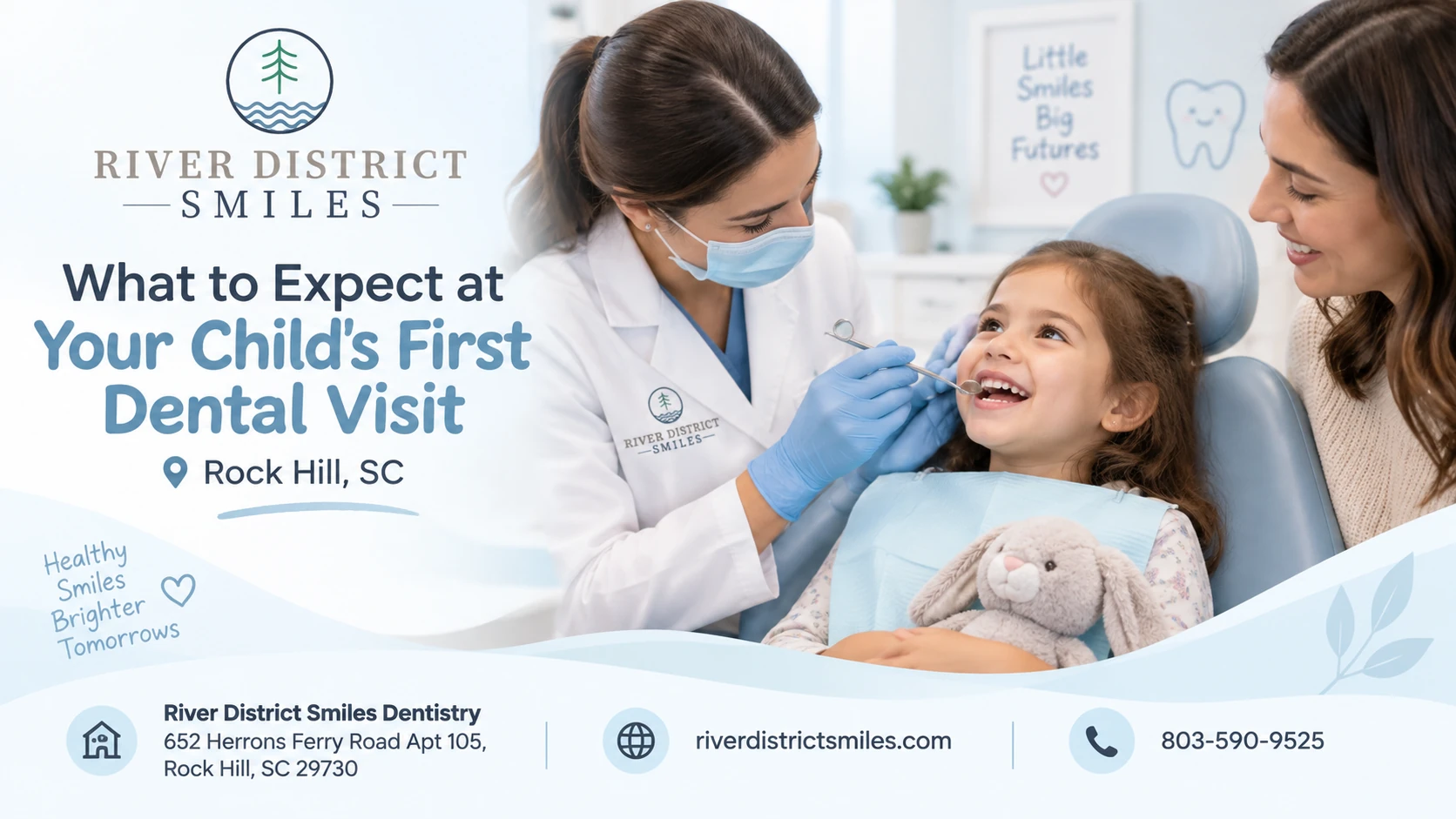


If you’re doing the math on toddler milestones and wondering where “first dental visit” fits in, here’s the short answer: sooner than most parents expect. The American Academy of Pediatric Dentistry and the American Dental Association both recommend a child see a dentist by their first birthday, or within six months of that first tooth breaking through — whichever happens first. That’s not a typo. Long before your child has a full set of teeth, before they can talk, sometimes before they can walk, it’s already time for a checkup.
That surprises a lot of parents, and understandably so — a generation ago, “wait until age three” was common advice. The guidance changed because dentists learned that catching problems (or better yet, preventing them) is far easier when you start early, and because that first visit is really about setting up healthy habits before anything goes wrong, not about reacting to a problem that’s already there.
At River District Smiles, our Pediatric Dentistry team follows this same age-one-or-first-tooth guidance, so if your little one already has a tooth (or several) and you haven’t scheduled anything yet, you’re not behind — but now’s a good time to call.
Ready for Their First Dental Visit?
Give your child a comfortable, positive start to lifelong dental care. Call now to book their appointment.
What Actually Happens at the First Visit
Here’s the part that tends to calm parents down the most: kids first dentist visit in Rock Hill, SC is short, low-key, and not really about “fixing” anything. For an infant or young toddler, it typically includes:
- A quick, gentle exam — the dentist checks how the teeth and jaw are developing, looks for any early signs of decay or issues with the bite, and takes a look at the gums and soft tissue.
- A conversation with you, not just your child. Most of the appointment is actually spent talking with parents — about brushing technique, thumb-sucking or pacifier habits, teething, bottle or sippy-cup use, and diet choices that affect little teeth.
- A look at cavity risk. Some kids are more prone to early decay than others (family history, diet, and fluoride exposure all play a role), and the dentist will flag anything worth watching.
- A light cleaning and fluoride, if appropriate — not every first visit needs this, but it’s on the table if there are already teeth to work with.
For most infants, this whole exam happens with your child sitting on your lap, facing you, while the dentist looks from the other side — it’s called a “knee-to-knee” exam, and it’s designed to feel more like a hug than a procedure. There’s no drilling, no needles, nothing scary. If your toddler cries or squirms, that’s completely normal and not a sign anything went wrong.
How to Make It Easy on Everyone
A few small things go a long way toward a smooth first appointment:
- Talk about it like something normal, not a big event — kids pick up on parental anxiety fast, so a relaxed “we’re going to go see the tooth doctor” beats over-explaining or over-hyping it.
- Time it around naps and meals. A well-rested, recently-fed toddler is a much easier patient than an overtired or hungry one. Late morning tends to work better than end-of-day for most families.
- Fill out new-patient paperwork ahead of time if you can, so you’re not juggling forms and a wiggly toddler in the waiting room. You can find River District Smiles’ patient forms here.
- Bring a comfort item — a favorite stuffed animal or small toy can make the chair feel a lot less foreign.
- Skip the “it won’t hurt” pep talk. Kids remember the word “hurt” more than the reassurance around it. Simpler is better: “the dentist is going to count your teeth.”
If you’ve never actually walked through a River District Smiles appointment before — for a child or an adult — our Your First Visit page walks through what to expect when you arrive, and our Office Hours page has our location and scheduling details.

Why Starting Early Actually Makes a Difference
It’s tempting to think a one-year-old with just a few teeth doesn’t have much for a dentist to check. In practice, starting early does two things that matter a lot down the road:
First, it catches small issues while they’re still small. Early tooth decay in baby teeth can often be managed with simple, non-invasive options — a fluoride varnish, a change in diet or brushing habits — instead of needing a filling later because it went unnoticed.
Second, and just as important: it builds the relationship. A child whose first dental memories are calm and low-pressure tends to carry that comfort into future visits. A child whose first dental experience happens at age four or five, already in pain from a cavity, has a much harder road ahead — both in treatment and in how they feel about going to the dentist for the rest of their life.
This is also exactly why establishing what dentists call a “dental home” early matters — one familiar practice that gets to know your child’s mouth, habits, and growth over time, rather than starting from scratch at every visit or only showing up when something hurts.

Why Choosing a Family Dentist Can Be the Key to Stronger Family Bonds
If you’ve ever sat in a waiting room with a toddler on your lap, a teenager on their phone, and…

What Comes After the First Visit
Once your child has their first checkup, the plan from there is usually pretty simple: routine visits every six months, similar to what we recommend for the rest of the family through our Regular Checkups care. As your child grows, those visits start to include things like sealants once molars come in, and monitoring for orthodontic concerns as adult teeth arrive.
Frequently Asked Questions
Q: My child doesn’t have any teeth yet — do we still need to go by age one?
Yes. Even before teeth fully erupt, the dentist checks gum health, jaw development, and can spot early risk factors like a tongue-tie or feeding habits that might affect future teeth. It’s also a good time to get comfortable with the office before there’s any urgency.
Q: What if my child already has a cavity and this is their first visit?
That’s still a completely normal reason to come in, and it happens more often than you’d think. The dentist will explain your options in plain terms — for baby teeth, treatment is often more conservative than parents expect. The sooner it’s addressed, the simpler it usually is.
Q: Will my child be scared or cry during the exam?
Some do, especially very young toddlers meeting a new person and a new environment for the first time. That’s expected and doesn’t mean anything went wrong. Our team is used to working with wiggly, unsure toddlers and keeps things calm and quick.
Q: Can I stay in the room with my child?
Yes — for a first visit, especially with an infant or young toddler, you’ll likely be right there with them the whole time, often with your child on your lap for the exam.
Q: How is a pediatric dentist different from our family’s regular dentist?
Pediatric dentistry focuses specifically on the developmental, behavioral, and comfort needs of children as they grow. At River District Smiles, our Pediatric Dentistry care is built around exactly that, while still keeping your child on the same practice’s radar as the rest of your family.
Sources:
- AAPD, “The Importance of the Age One Dental Visit” — https://www.aapd.org/globalassets/media/policy-center/year1visit.pdf
- ADA MouthHealthy, “First Dental Visit for Baby” — https://www.mouthhealthy.org/life-stages/babies-and-kids/first-dental-visit-for-baby
Is It Time for Their First Visit?
Help your child feel comfortable and confident at the dentist from day one. Call now to schedule in Rock Hill.