

If you are choosing a dentist for your child, you may wonder whether you need a pediatric dentist or whether the family dentist you already see can handle your child’s care.
For many families, either option can work very well.
The difference is not that one dentist treats children and the other does not.
The short answer is that pediatric dentists complete additional specialty training focused specifically on infants, children, teenagers, behavior guidance, and patients with special health care needs. Family dentists are general dentists who may treat patients of all ages, often allowing parents and children to receive care in the same practice.
A healthy, cooperative child with routine dental needs may do extremely well with a family dentist who enjoys treating children.
A very young child with extensive dental needs, significant anxiety, complex medical or developmental needs, or difficulty tolerating treatment may benefit from the additional training and environment available through a pediatric dental specialist.
At River District Smiles, children, teens, adults, and older adults are all seen within the same Rock Hill practice. The office provides age-appropriate preventive and restorative care for children while allowing families to keep much of their dental care under one roof.
The better question is therefore not:
“Which kind of dentist is better?”
It is:
“Which setting is the best fit for my child right now?”
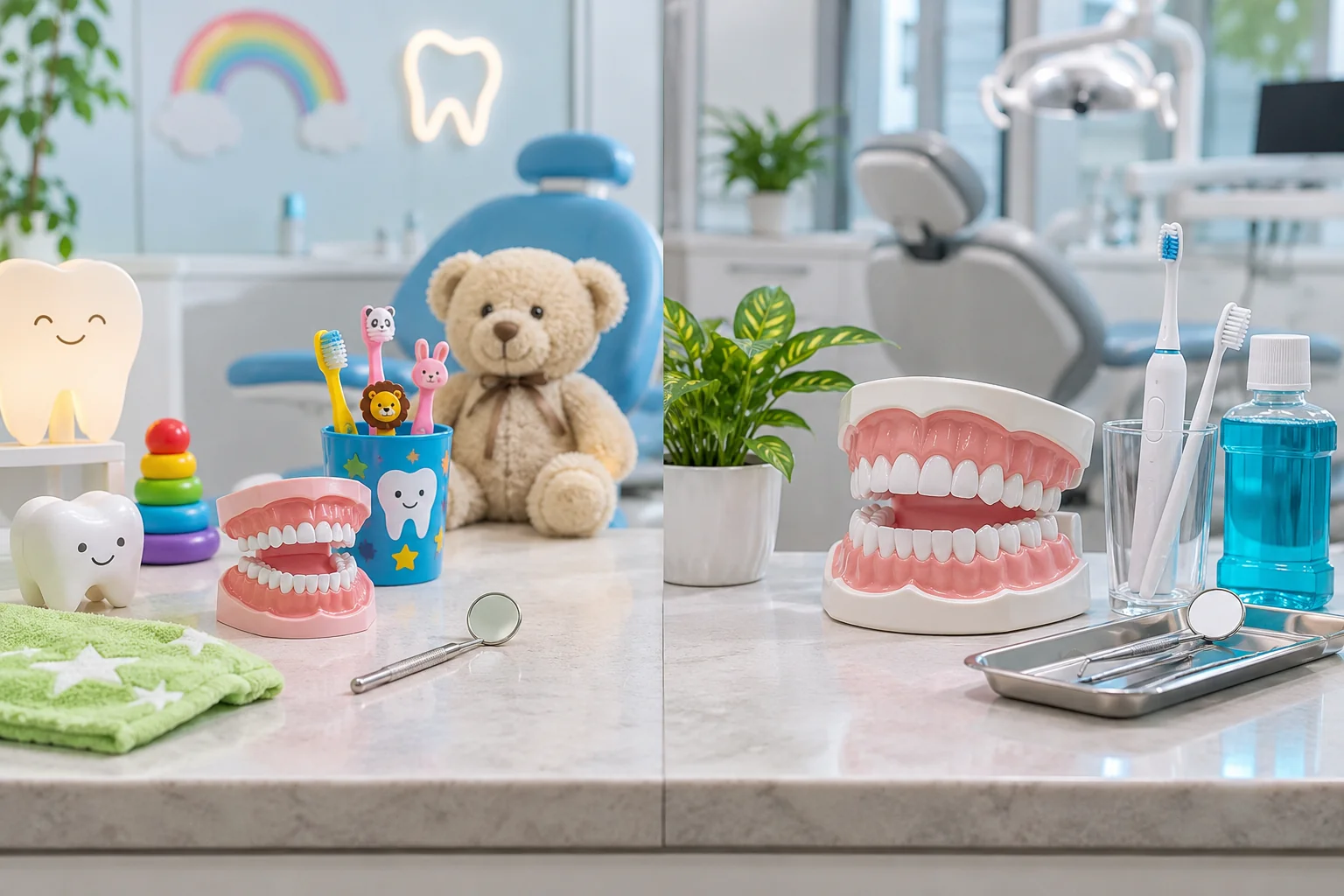
Pediatric or Family Dentist? Make the Right Choice!
Find the right dental care for your child's needs. Call today for professional guidance!
What Is a Pediatric Dentist?
A pediatric dentist is a dentist who has completed dental school and then continued into formal specialty training focused on caring for children.
The American Dental Association recognizes pediatric dentistry as an age-defined dental specialty providing preventive and therapeutic care for infants and children through adolescence, including patients with special health care needs. Accredited pediatric dental specialty programs require at least 24 months of additional full-time training after dental school.
That additional training commonly includes experience with:
- Infant oral health
- Child development
- Behavior guidance
- Dental trauma
- Pediatric restorative dentistry
- Growth and development
- Children with complex medical conditions
- Patients with developmental, sensory, behavioral, or physical differences
- Sedation and hospital-based care in applicable settings
A pediatric dentist’s entire clinical environment is generally centered around children.
That can be particularly useful for patients who need more than an ordinary cleaning and exam.
What Is a Family Dentist?
“Family dentist” is generally a description of the type of patients a general dental practice sees rather than a separately recognized dental specialty.
A family dental office may care for:
- Young children
- Teenagers
- Parents
- Grandparents
- Older adults
That can make care convenient.
Parents and children may receive preventive visits at the same office. The dentist can become familiar with the family’s dental history over time, and the child does not necessarily need to transition to another practice when adulthood begins.
River District Smiles describes itself as providing general and family dentistry for patients of all ages, including children and teens.
The important point is that general dentists vary.
Some treat many children and enjoy pediatric care.
Others focus primarily on adults and refer younger or more complicated pediatric patients to specialists.
That is completely reasonable.
Is a Pediatric Dentist More Qualified to Treat Children?
A pediatric dentist has more specialized postdoctoral training specifically focused on children.
That is a factual difference.
But that does not mean a child automatically receives better care from a pediatric specialist for every routine dental need.
A family dentist who routinely treats children may be very comfortable providing:
- Exams
- Cleanings
- Fluoride treatments
- Dental sealants
- X-rays
- Small fillings
- Oral-hygiene instruction
- Monitoring dental development
- Emergency evaluations
The child’s needs determine how important the additional specialization becomes.
A cooperative 10-year-old coming in for a routine cleaning is a very different situation from a frightened 3-year-old who needs several cavities treated.
What Are the Advantages of a Family Dentist?
For many families, convenience is the biggest advantage.
The whole family can use one office
Parents do not have to manage separate dental offices for themselves and their children.
Appointments may sometimes be coordinated on the same day.
River District Smiles specifically provides care for children, teens, adults, and older adults within one practice.
Your child can stay with the same practice
Children eventually become adults.
At a family practice, there may be no need for a formal transition when a teenager reaches a certain age.
That continuity can be particularly valuable for children who already know and trust the dental team.
Parents may already trust the dentist
If you have had a good experience yourself, bringing your child to the same office can feel more comfortable.
Young children also notice how their parents behave around dental care.
Seeing a parent comfortably visit the same office can sometimes help make dentistry feel more routine.
The dentist sees the family’s dental history
Certain patterns—such as high cavity risk, enamel problems, missing teeth, bite issues, or gum disease tendencies—may occur in families.
Having one dental team care for multiple family members can provide useful context.
What Are the Advantages of a Pediatric Dentist?
The additional specialty training becomes especially useful when a child’s dental or behavioral needs are more complicated.
Their training is entirely child-focused
Pediatric dental specialty programs provide concentrated training in infant, child, and adolescent oral health.
That includes not only treating smaller teeth but understanding how children develop emotionally and physically.
They have extensive behavior-guidance experience
A 3-year-old who refuses to open their mouth cannot simply be treated like a small adult.
Some children need more time, different communication strategies, desensitization, or advanced behavior-management approaches.
Pediatric training places significant emphasis on these situations.
They routinely treat children with special health care needs
The American Academy of Pediatric Dentistry defines special health care needs broadly to include physical, developmental, mental, sensory, behavioral, cognitive, and emotional conditions that may require additional adaptations or specialized services.
Pediatric dentists receive dedicated training in caring for these patients.
They may offer more advanced pediatric sedation or hospital-based options
Not every pediatric dental office provides the same sedation services.
But pediatric specialty programs commonly include training in advanced behavior guidance, sedation, medically complex patients, and hospital-based dental care.
This becomes more important when a child cannot safely or comfortably complete necessary treatment in a standard dental setting.
Pediatric Dentist vs. Family Dentist at a Glance
| Family dentist | Pediatric dentist | |
| Dental school | Yes | Yes |
| Additional pediatric specialty residency | Not required | Minimum 24 months |
| Treats children | Often | Yes, primary focus |
| Treats adults | Usually | Usually focused on children/adolescents, with some exceptions |
| Routine cleanings and exams | Yes | Yes |
| Basic cavity treatment | Often | Yes |
| Advanced child behavior guidance | Varies by dentist | Major focus of specialty training |
| Special health care needs | Varies by practice | Major component of training |
| Advanced pediatric sedation | Varies | More commonly part of specialty training/environment |
| Whole-family care | Major advantage | Usually child-focused |
| Need to transition as child becomes adult | Usually no | Often, although some patients with special needs remain longer |
Neither column is universally better.
The child sitting in the chair matters more than the label on the door.
When Is a Family Dentist Usually a Good Fit?
A family dentist may be an excellent choice when your child:
- Is reasonably comfortable at dental visits
- Needs routine preventive care
- Has relatively straightforward cavities or restorative needs
- Likes visiting the same office as their parents
- Has already developed a good relationship with the dental team
- Does not require specialized behavior-management or medical accommodations
River District Smiles offers gentle, age-appropriate care for infants, children, and teenagers, including routine cleanings and early cavity treatment.
The practice also has a children’s play area, video games, TVs in treatment rooms, blankets, and pillows intended to make visits feel more comfortable for families.
For many children, that kind of family environment is enough.
When Might a Pediatric Dentist Be the Better Fit?
There are situations where specialist care deserves serious consideration.
Your child is extremely young and needs significant treatment
Treating a cooperative 8-year-old and treating a frightened 2- or 3-year-old are very different experiences.
If a very young child has extensive decay or another condition requiring several procedures, pediatric specialty experience can be valuable.
Dental anxiety is preventing treatment
Some anxiety is common.
But if repeated attempts at necessary care have failed because your child cannot tolerate treatment, a pediatric dentist may have additional behavior-management or sedation options.
Your child has significant developmental or sensory needs
Children with autism spectrum disorders, sensory sensitivities, cognitive differences, physical disabilities, or other special health care needs may require adaptations beyond those used during an ordinary appointment.
The AAPD notes that patients with special health care needs can face increased oral-health risks and may require behavioral, sensory, medical, or treatment modifications.
Some family dentists are excellent at providing this care.
Others appropriately refer to pediatric specialists.
Your child has complicated dental trauma
Falls, sports accidents, and other injuries can damage developing teeth.
Pediatric specialists receive additional training involving dental trauma and the interaction between baby teeth, permanent teeth, and facial growth.
Your child may need advanced sedation or treatment in a hospital setting
Some children cannot safely or practically complete extensive dental care while awake in an ordinary office.
That does not automatically mean general anesthesia is required.
But when advanced behavior management becomes necessary, a pediatric dental setting may offer resources that a typical family practice does not.
Does My Baby Really Need a Dentist?
Yes, although the first visits are usually very simple.
The American Academy of Pediatric Dentistry recommends establishing a dental home no later than 12 months of age.
That surprises parents because a 1-year-old may only have a few teeth.
The point is not that the baby needs a long cleaning.
An early visit can help parents understand:
- Brushing emerging teeth
- Fluoride
- Feeding and cavity risk
- Bottle and cup habits
- Thumb or pacifier habits
- Teething
- What to do after dental injuries
- What normal tooth development looks like
It also gives the child an opportunity to become familiar with dental visits before there is a painful problem.
A family dentist who routinely treats very young children can provide this care.
So can a pediatric dentist.

Tooth Enamel Erosion: Causes, Prevention, and Treatment Options
One of the most common threats to your oral health is tooth enamel erosion. Enamel, the protective outer layer of…

Does My Child Need a Pediatric Dentist Just Because They Have Cavities?
No.
Many family dentists routinely treat cavities in children.
The important considerations are:
- The child’s age
- Number of cavities
- Depth of decay
- Cooperation
- Anxiety
- Medical history
- Whether treatment can be completed safely and comfortably
One small cavity in a relaxed 9-year-old may be very straightforward.
Seven cavities in a frightened preschooler create a very different treatment challenge.
The diagnosis may be the same—decay.
The management is not.
What If My Child Is Afraid of the Dentist?
Start by telling the office before the visit.
Do not wait until your child is already crying in the chair.
A family dentist who regularly treats children should have strategies for introducing the environment gradually and communicating in age-appropriate language.
River District Smiles describes its pediatric services as focused on gentle, age-appropriate care designed to help children feel relaxed and confident at visits.
If your child remains unable to tolerate necessary treatment despite reasonable efforts, referral to a pediatric dentist can be appropriate.
Referral is not a failure.
Sometimes the more specialized environment is simply a better fit.
Should Parents Stay in the Treatment Room?
There is no universal rule.
Some children behave better with a parent close by.
Others become more anxious when they continuously look to their parent for reassurance.
Dental practices also have different policies depending on the child’s age, treatment, available space, and behavior-management approach.
The useful question is not:
“Should all parents stay?”
It is:
“What helps this particular child receive safe, calm care?”
If this issue matters to you, ask about the office’s approach before the appointment.
What About Children With Autism or Sensory Sensitivities?
This is a good example of why matching the patient to the environment matters.
A child may be sensitive to:
- Bright lights
- Dental sounds
- Tastes
- Textures
- Reclining in the chair
- Unexpected touch
- Changes in routine
Some children benefit from pre-visit tours, shortened appointments, visual explanations, gradual desensitization, or specific sensory accommodations.
The AAPD recognizes sensory, behavioral, developmental, cognitive, and emotional differences as part of the broad spectrum of special health care needs that can require additional adaptations during dental care.
Ask the family dentist what accommodations they routinely provide.
If the child’s needs exceed what that practice can reasonably support, pediatric specialty care may be more appropriate.
What About ADHD?
ADHD alone does not automatically require a pediatric dentist.
Many children with ADHD do very well in family dental practices.
Practical accommodations might include:
- Shorter morning appointments
- Clear, simple instructions
- Small breaks
- Reduced waiting time
- Explaining one step at a time
What matters is the individual child’s ability to tolerate care.
If behavior or anxiety repeatedly makes treatment impossible, additional pediatric expertise may become useful.
What If My Child Has Significant Medical Problems?
Tell the dental office before the visit.
Medical conditions can affect:
- Medication choices
- Bleeding
- Infection risk
- Sedation safety
- Appointment timing
- Communication with physicians
- The type of dental setting that is appropriate
The AAPD notes that children with complex medical conditions may require consultation and coordinated care among dental and medical providers.
Some family dentists are comfortable managing medically complex children.
Others will recommend a pediatric dentist or hospital-based program.
That referral should be viewed as appropriate risk management, not a lack of concern.
Is a Pediatric Dental Office Automatically Better for Nervous Children?
Not automatically.
A colorful office and child-sized chairs can help.
But relationships matter too.
A calm family dentist who knows your child well may provide a better experience than starting over somewhere new.
On the other hand, pediatric practices treat frightened and behaviorally challenging children every day. Their teams may have greater experience with children who struggle significantly with dental care.
This is why the choice should be individualized.
Ask yourself:
Does my child currently receive the care they need comfortably and safely?
If yes, there may be no reason to change.
Will a Family Dentist Know When to Refer?
A good one should.
General dentistry includes recognizing when a patient’s needs extend beyond the dentist’s training, comfort, equipment, or clinical environment.
Referral might be appropriate for:
- Complex pediatric dental trauma
- Severe anxiety
- Extensive treatment in a very young child
- Advanced sedation needs
- Significant special health care needs
- Unusual developmental conditions
- Treatment that cannot be completed safely in the current office
The purpose of referral is not to send away difficult patients.
It is to make sure the child receives care in the setting best equipped to provide it.
Does a Pediatric Dentist Cost More?
Not necessarily, although costs can differ between offices.
The procedure being performed, insurance network, sedation requirements, facility fees, and complexity of care all influence cost.
A routine cleaning at a pediatric practice may not be dramatically different from one at a family practice.
A child who requires sedation or hospital-based treatment, however, may have substantially different expenses because the care itself is more complex.
Before choosing based only on price, ask:
- Is the dentist in the network?
- What preventive services are covered?
- Is fluoride covered?
- Are sealants covered?
- What is my share for fillings?
- Is sedation covered?
- Are there separate anesthesia or facility fees?
The least expensive appointment is not necessarily the least expensive long-term plan if your child cannot complete the required treatment there.
Can Siblings and Parents All Go to River District Smiles?
Yes.
One of the advantages of River District Smiles’ model is that it provides general and family dentistry for patients across age groups rather than limiting the practice to children.
That can make sense for families who value:
- One dental home
- Coordinated scheduling
- Familiarity with the same team
- Fewer transitions as children grow up
River District Smiles also offers pediatric dental care specifically designed around age-appropriate communication and prevention.
That combination makes a family practice a reasonable starting point for many children.
How Do You Know If Your Family Dentist Is Good With Kids?
You can learn a lot before committing to treatment.
Ask:
- What ages of children do you routinely see?
- How do you handle a child who becomes afraid?
- Can parents accompany young children?
- What happens if my child cannot complete treatment?
- Do you offer nitrous oxide or other anxiety-management options?
- When do you refer to a pediatric dentist?
- How do you care for children with sensory or developmental needs?
- How do you manage dental emergencies involving baby and permanent teeth?
A practice does not need to claim it can handle every possible situation.
In fact, knowing when to refer is often a sign of thoughtful care.
When Should Your Child Switch From a Pediatric Dentist to a Family or Adult Dentist?
There is no universal birthday.
Pediatric dentistry is designed primarily for infants, children, and adolescents, but transition can vary.
The AAPD specifically recognizes the importance of coordinated transition to adult dental care, particularly for patients with special health care needs. Some individuals with complex needs may appropriately remain with pediatric dental providers longer because of established relationships and specialized care requirements.
For most teenagers, the transition can be based on:
- Comfort
- Dental needs
- Maturity
- Orthodontic status
- Availability of an appropriate adult provider
A family practice removes much of this transition because the same office already treats adults.
So Which One Should You Choose?
For a healthy child with ordinary preventive and restorative needs, you do not necessarily need to search for a specialist solely because the patient is young.
A family dentist who treats children regularly can be a very good fit.
A pediatric dentist becomes particularly valuable when the child needs the additional expertise associated with:
- Very young age
- Significant anxiety
- Complex treatment
- Special health care needs
- Advanced behavior guidance
- Sedation
- Hospital-based care
Neither option is a downgrade from the other.
They serve overlapping but somewhat different needs.
The Bottom Line
Pediatric dentists and family dentists can both provide excellent care for children.
The main difference is training and focus.
A pediatric dentist completes at least two additional years of specialty education centered on infants, children, adolescents, behavior guidance, and special health care needs.
A family dentist provides general dental care across age groups and may allow parents and children to stay within the same practice throughout life.
River District Smiles follows the family-practice model while also providing dedicated, age-appropriate pediatric care for infants, children, and teens in its Rock Hill office.
If your child is comfortable, receiving the care they need, and developing a good relationship with their family dentist, there may be no reason to change.
If dental treatment has become difficult because of age, anxiety, medical complexity, developmental needs, or the amount of care required, a pediatric specialist may be the better environment.
The goal is not finding the dentist with the better title. It is finding the dental home where your child can receive appropriate care safely, comfortably, and consistently.
Give Your Child the Best Start to a Healthy Smile!
Choose trusted dental care for growing smiles. Call now to book your child's dental visit!