

A chipped tooth can create two very different situations.
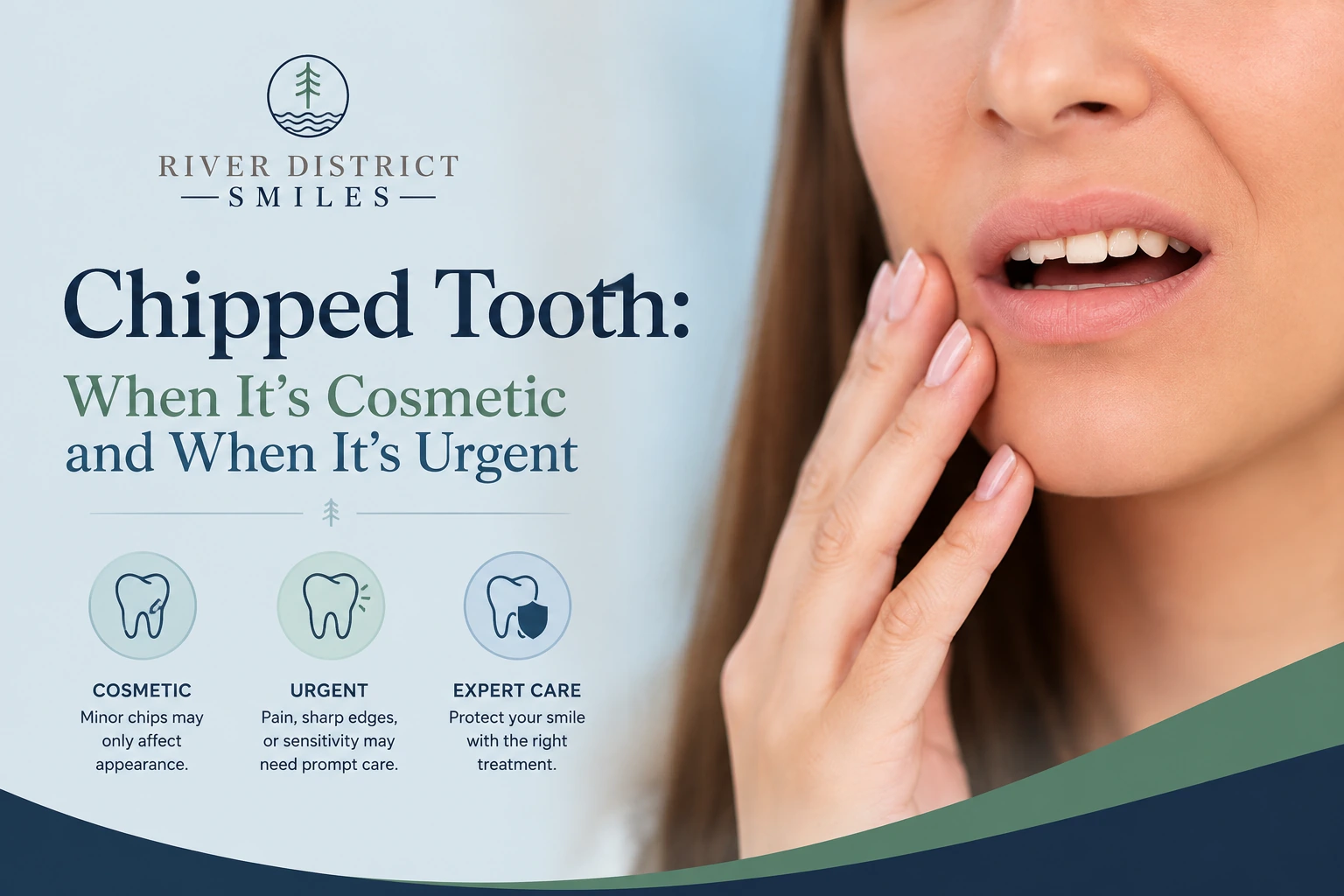
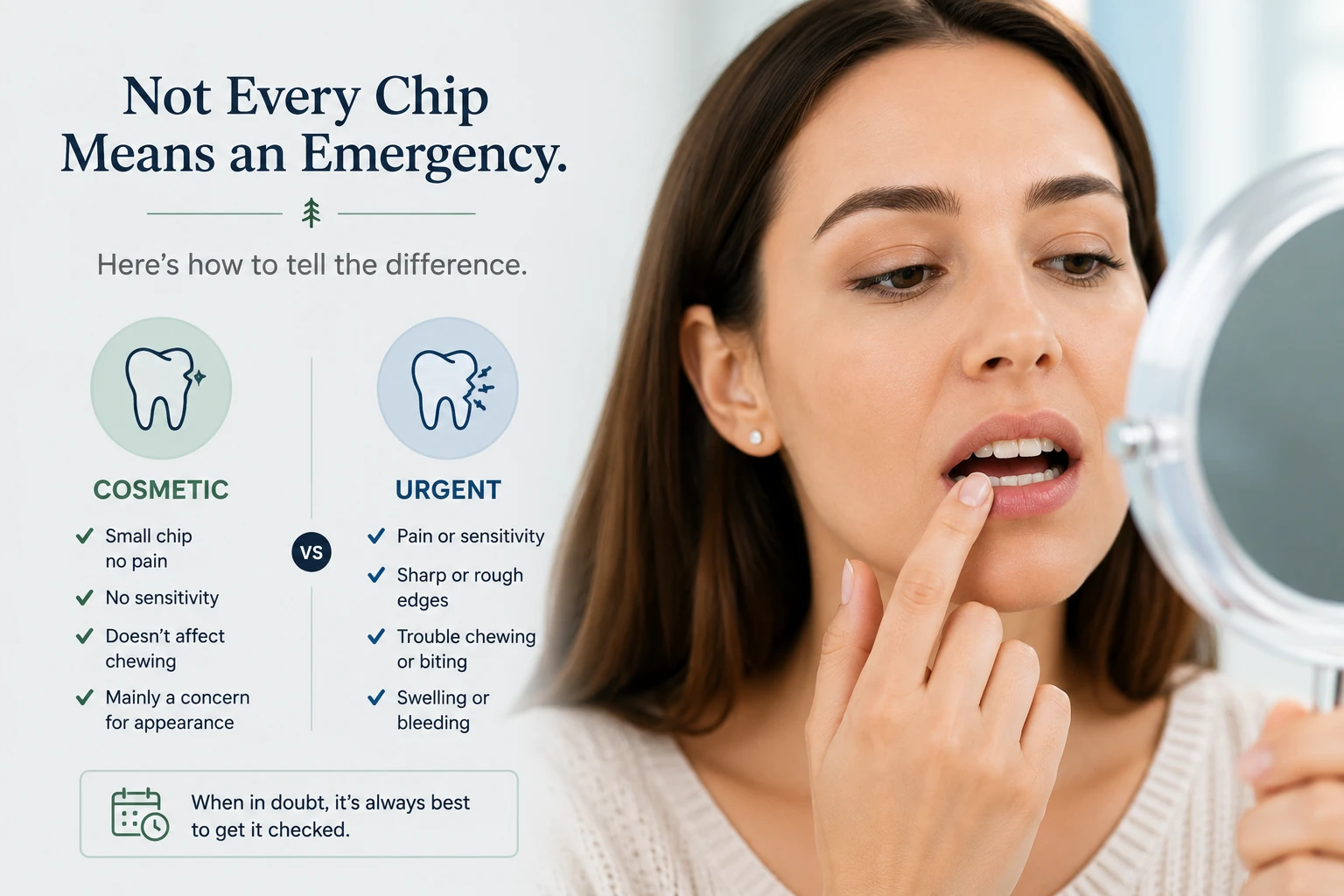
Sometimes, a tiny piece of enamel breaks from a front tooth. It feels rough and looks uneven, but there is no pain, bleeding, or sensitivity. That is usually more of a cosmetic concern than an immediate emergency.
Other times, the “chip” is actually part of a deeper fracture. The tooth may hurt when you bite, react strongly to temperature, bleed from the center, feel loose, or break after an injury. That situation needs prompt dental attention.
The practical answer is this: a small, painless enamel chip can usually wait for a regular dental appointment, but a painful, sensitive, loose, bleeding, or significantly broken tooth should be evaluated quickly.
Even when the problem appears cosmetic, it is still worth having a dentist examine it. A small chip may have a deeper crack nearby, and sharp or weakened edges can sometimes continue breaking under pressure.
The seriousness of a dental injury depends on how much tooth structure was lost and whether the deeper layers or supporting tissues were affected.
Chipped Your Tooth? Don’t Wait
A small chip can hide a bigger dental problem. Call now for prompt care and protect your smile.
Is Your Chipped Tooth Urgent?
Use this as a general guide while arranging dental care.
| What You Notice | Likely Urgency |
| Tiny rough edge with no pain | Usually not an emergency, but schedule an examination |
| Small visible chip on a front tooth | Often cosmetic unless it is sensitive or worsening |
| Brief sensitivity to cold or air | Schedule care soon |
| Pain when biting or releasing your bite | Prompt evaluation is recommended |
| Persistent throbbing or spontaneous pain | Urgent dental visit |
| Yellow inner tooth structure is visible | The chip has reached dentin; arrange prompt care |
| Pink or red area is visible inside the tooth | Possible pulp exposure; seek same-day care |
| Tooth is loose or has moved position | Same-day dental evaluation |
| Significant facial or gum swelling | Urgent dental care |
| Fever with swelling or dental pain | Urgent evaluation |
| Difficulty breathing or swallowing | Medical emergency; go to an emergency department |
A slightly chipped tooth may be able to wait until an appointment can be scheduled, while severe fractures, displaced teeth, uncontrolled bleeding, or major facial trauma require faster care.
When a Chipped Tooth Is Mostly Cosmetic
A chip is more likely to be cosmetic when:
- Only a small amount of enamel is missing
- The tooth does not hurt
- There is no lingering sensitivity
- The tooth is not loose
- You can bite normally
- There is no swelling or bleeding
- The damage has not continued spreading
- The main concern is the tooth’s shape or appearance
Enamel is the hard outer covering of a tooth. A superficial enamel chip may leave a rough edge without exposing the more sensitive tissue underneath.
Depending on its size and location, the dentist may simply smooth the edge or restore it with tooth-colored bonding.
“Cosmetic” does not mean imaginary or unimportant.
A visible chip in a front tooth can affect how comfortable you feel smiling, speaking, laughing, or being photographed. It simply means the tooth may not be in immediate biological danger.
When a Chip May Be More Than Cosmetic
A tooth has several layers:
- Enamel: The hard outer surface
- Dentin: The softer yellowish layer underneath
- Pulp: The center containing nerves and blood vessels
The deeper the break extends, the more likely the tooth is to become painful or require protective treatment.
The Tooth Is Sensitive
Cold air, water, sweets, or temperature changes may irritate exposed dentin.
Brief sensitivity does not automatically mean the inner tissue has been permanently damaged.
However, pain that continues after the cold source is removed deserves prompt evaluation because the tissue inside the tooth may be irritated or inflamed.
It Hurts When You Bite
Pain during chewing, particularly when you release biting pressure, is a common warning sign of a cracked tooth.
A crack can move slightly under pressure and irritate the tissue inside the tooth. The pain may come and go, making the problem difficult to identify without a dental examination.
Do not assume the tooth is healthy simply because it does not hurt all the time.
A Large Piece Is Missing
A large break may weaken a chewing cusp or expose dentin or deeper tissue.
Even when the tooth is not currently painful, there may not be enough healthy structure remaining to support a small filling reliably.
A crown or another protective restoration may be needed to strengthen the tooth and reduce the risk of additional fracture.
The Center Looks Pink or Red
A pink or red area inside a broken tooth can indicate that the pulp has been exposed.
This deserves prompt attention because bacteria can enter the inner portion of the tooth, and the exposed tissue may be painful or bleed.
The dentist can evaluate the depth of the injury, determine whether the tooth remains restorable, and discuss the appropriate next step. If care beyond the services available at the practice is necessary, referral to an appropriate dental specialist may be recommended.
The Tooth Has Changed Position
A tooth that looks pushed backward, forward, sideways, or deeper into the gum has experienced more than a simple chip.
The ligament, bone, tooth structure, or nerve supply may also have been injured.
Traumatic displacement should be evaluated promptly even if the tooth does not hurt very much at first.
The Tooth Is Becoming Darker
A tooth may become darker after an injury if the tissue inside has been damaged.
Color change alone does not tell the entire story, but it is a reason to contact a dentist, especially when discoloration occurs with pain, swelling, tenderness, or a bump on the gum.
Chip or Crack: What Is the Difference?
Patients often use “chipped,” “cracked,” and “broken” to describe the same dental problem.
Clinically, they can mean different things.
A chip usually involves a piece breaking away from the outer portion of the tooth.
A crack is a line that may extend deeper through the tooth and sometimes toward the gumline or below it. Cracks may be difficult to see and can cause unpredictable pain during chewing or temperature changes.
A tooth can also have both problems.
For example, part of a chewing cusp may break away because a deeper crack was already present.
This is why a dentist may recommend an X-ray, bite testing, magnification, light testing, or another evaluation even when the missing piece appears small.
Dental X-rays do not show every crack directly. They can still provide useful information about decay, the surrounding bone, tooth structure, and signs of infection or other complications.
What to Do Immediately After Chipping a Tooth
Rinse Your Mouth Gently
Use water to remove debris and check whether the area is bleeding.
Avoid aggressive rinsing when the injury is significant or the area is actively bleeding.
Save the Broken Piece
If you can find the tooth fragment, rinse it gently and bring it with you to the dental appointment.
In certain situations, part of the original tooth may be useful during treatment. Even when the fragment cannot be reused, it can help the dentist understand how much structure was lost.
Protect Your Tongue and Cheek
A sharp broken edge can repeatedly cut your tongue or the inside of your cheek.
Orthodontic wax from a pharmacy can temporarily cover the rough area.
This is only a short-term measure and should not replace a dental examination.
Avoid Chewing on That Side
Choose softer foods and avoid:
- Ice
- Hard candy
- Popcorn kernels
- Nuts with hard shells
- Tough or sticky foods
- Biting directly into food with the damaged tooth
Hard foods and heavy chewing pressure can cause a weakened edge or existing crack to extend farther.
Use a Cold Compress if Swelling Is Present
Apply a wrapped cold pack to the outside of your face for short intervals.
Do not place aspirin directly against the tooth or gum. Aspirin can irritate oral tissue and does not correct the source of dental pain.
Call the Dental Office
When you call, describe:
- Which tooth is involved
- How the injury happened
- How much tooth appears to be missing
- Whether there is pain or sensitivity
- Whether the tooth feels loose
- Whether there is swelling or bleeding
- Whether you can bite normally
- Whether you can see yellow, pink, or red tissue
This information can help the dental team determine whether you should be seen immediately, later that day, or during a regular appointment.
WWhen to Seek Same-Day Dental Care
Contact a dentist for urgent or same-day guidance when:
- The tooth has broken significantly
- The chip followed a fall, collision, or blow to the face
- You have moderate or severe pain
- Pain occurs when biting
- Sensitivity lingers
- The tooth feels loose
- The tooth has moved
- The center of the tooth is pink, red, or bleeding
- A large filling or crown broke with the tooth
- There is swelling, drainage, or a bad taste
- The damaged tooth is becoming darker
- You cannot close your teeth together normally
River District Smiles provides emergency dental care in Rock Hill for concerns including broken teeth, severe toothaches, dental trauma, swelling, infection, and lost restorations.
The practice also offers chipped-tooth repair using options such as bonding, veneers, fillings, and crowns when appropriate, depending on the extent of the damage.
When to Go to the Emergency Room
Most chipped and broken teeth are treated by a dentist rather than a hospital emergency department.
Go to an emergency room or call 911 when the injury involves:
- Difficulty breathing
- Difficulty swallowing
- Rapidly increasing swelling of the face, jaw, tongue, or neck
- Uncontrolled bleeding
- Suspected broken facial bones
- Loss of consciousness
- Significant head trauma
- Severe cuts that may require medical repair
Hospital teams can manage serious trauma, uncontrolled bleeding, airway concerns, and potentially spreading infections.
They usually cannot complete definitive restorative procedures such as bonding, fillings, veneers, or crowns. Dental follow-up may therefore still be necessary once the immediate medical emergency has been addressed.
How a Dentist Evaluates a Chipped Tooth
The examination is not only about deciding how to make the tooth look normal again.
The dentist also needs to determine whether the tooth is healthy and strong enough to repair.
The evaluation may include:
- Asking how and when the tooth broke
- Checking whether the tooth is loose
- Examining the depth and direction of the fracture
- Looking for decay or an old restoration
- Testing sensitivity to cold
- Checking tenderness to tapping or pressure
- Evaluating pain during biting
- Examining the gums surrounding the tooth
- Taking dental X-rays when appropriate
- Checking whether your bite has changed
After a traumatic injury, a tooth may initially respond normally and develop symptoms later.
Follow-up testing can therefore be important even when the first examination is reassuring.
Treatment Options for a Chipped Tooth
The best repair depends on how much tooth is missing, where the tooth is located, whether deeper tissue has been affected, and how much chewing pressure the restoration needs to tolerate.
1. Smoothing or Polishing
A very small rough enamel edge may only need to be smoothed or polished.
Best Fit
- Tiny superficial chips
- No pain or sensitivity
- No meaningful change in tooth strength
- Minor roughness irritating the tongue or cheek
Tradeoff
Smoothing removes a very small additional amount of enamel.
It is not appropriate when material needs to be added back to restore strength, shape, or appearance.
For a truly minor enamel chip, this is usually one of the simplest treatment options.
2. Dental Bonding
Dental bonding uses tooth-colored composite resin to rebuild the missing portion of a tooth.
The material is placed directly on the damaged area, shaped to match the tooth, and hardened with a curing light.
Small to moderate chips in front teeth may often be repaired in one appointment.
Best Fit
- Small or moderate chips
- Mostly intact teeth
- Cosmetic front-tooth damage
- Patients who want a conservative repair
- Situations where minimal enamel removal is preferred
Tradeoffs
Bonding can stain, wear, or chip over time.
It is generally less resistant to heavy biting forces than a crown. Patients who grind their teeth, bite their nails, chew ice, or use their teeth as tools may damage bonding more easily.
Published national cost estimates commonly place dental bonding at approximately $288 to $915 per tooth, with the actual cost depending on the size and complexity of the repair.
3. Tooth-Colored Filling
A tooth-colored filling may be used when a back tooth has lost a relatively small amount of structure or when decay contributed to the break.
Best Fit
- Limited structural damage
- Enough strong tooth remains
- The damaged area can support a direct restoration
- The chip is not associated with a significant structural crack
Tradeoff
A filling may not adequately protect the tooth when a large chewing cusp is missing or the remaining walls are thin.
Choosing a filling only because it has a lower initial cost may result in another fracture if the tooth actually needs broader protection.
4. Porcelain Veneer
A veneer is a thin restoration bonded to the visible front surface of a tooth.
It can improve the tooth’s color, shape, length, and symmetry.
Best Fit
- Front teeth
- Moderate cosmetic chips
- Teeth that remain largely structurally intact
- Patients also concerned about shape or discoloration
- Situations where bonding may not provide the desired appearance or longevity
Tradeoffs
A veneer generally costs more than bonding and may require removal of some enamel.
It is typically not appropriate for a tooth with severe structural damage, very little healthy enamel, or a fracture requiring more extensive protection.
Published estimates commonly place a single veneer at approximately $500 to $2,895.
Cosmetic veneers are often excluded from dental insurance benefits, although coverage may differ when a restoration is considered medically necessary after trauma.
5. Dental Crown
A crown covers most or all of the visible portion of a tooth.
It is often recommended when a substantial amount of structure is missing, a chewing cusp has fractured, or the remaining tooth is too weak for a direct filling or bonding repair.
Best Fit
- Large fractures
- Weakened back teeth
- Teeth with large existing fillings
- Teeth with substantial loss of natural structure
- Damage affecting several surfaces
- Teeth that require broader protection against chewing forces
Tradeoffs
A crown generally costs more and requires more tooth preparation than bonding or a filling.
It should be recommended because the tooth needs structural protection, not simply because a small chip is visible.
National consumer estimates commonly place a crown between approximately $800 and $2,500, depending on the material, tooth location, and complexity of treatment.
6. Extraction
Extraction is generally reserved for teeth that cannot reasonably or predictably be repaired.
It May Be Considered When:
- The tooth is split deeply
- A fracture extends unfavorably below the gumline
- Too little healthy structure remains
- Decay or damage extends too far beneath the gum
- The supporting bone is inadequate
- Repair would have a poor long-term outlook
A badly fractured tooth may eventually require removal, but many chipped and broken teeth can be preserved when they are evaluated and treated early.
If extraction is recommended, ask whether the missing tooth should be replaced and what replacement options are appropriate.
Potential options may include a dental implant, bridge, partial denture, or another solution depending on the location of the missing tooth and the condition of the surrounding teeth.
How Much Does Chipped-Tooth Repair Cost?
The cost depends largely on how deep the damage extends and which restoration is needed.
| Treatment | General National Planning Range |
| Smoothing a minor edge | Usually the lowest-cost option |
| Dental bonding | About $288–$915 |
| Tooth-colored filling | Varies by size and tooth |
| Porcelain veneer | About $500–$2,895 |
| Dental crown | About $800–$2,500 |
| Extraction and tooth replacement | Varies widely by replacement method |
These are broad national planning ranges rather than River District Smiles’ specific fees.
An examination, X-rays, emergency appointment, buildup, specialist evaluation, sedation, or tooth replacement may be charged separately when needed.
A small chip treated early is generally less expensive than a fracture that continues into deeper tooth structure.
However, the cheapest treatment is not always the best long-term value.
Bonding may be appropriate for a small front-tooth chip, while a significantly weakened molar may need a crown to withstand normal chewing pressure.
The goal is to select the least extensive treatment that can provide a predictable result.
Will Dental Insurance Cover the Repair?
Insurance coverage often depends on why the treatment is being performed.
Dental insurance is more likely to contribute when a restoration is considered medically necessary because of:
- An accident
- A fracture
- Decay
- Pain
- Loss of normal function
- Risk of further structural damage
Coverage is less likely when the tooth is healthy and treatment is performed only to improve its appearance.
For example, bonding used to repair a recent fracture may be treated differently from bonding performed only to change the shape of an otherwise healthy tooth.
A veneer used solely for cosmetic improvement may be excluded, while a plan may provide some benefit toward a restorative crown after a substantial break.
Ask the dental office to provide a written estimate showing:
- Examination fee
- X-rays
- Emergency charges, if applicable
- The recommended repair
- Any required buildup
- Final crown or veneer, if applicable
- Estimated insurance payment
- Estimated patient responsibility
- Any additional treatment that may need to be completed by another provider
Insurance estimates are useful for financial planning, but the insurance carrier makes the final coverage decision after reviewing the claim.
What Happens If You Ignore a Small Chip?
A small enamel chip may remain stable for a long time.
It may also:
- Continue breaking
- Collect stains
- Irritate your tongue or cheek
- Create an uneven biting surface
- Make the tooth more sensitive
- Expose dentin
- Reveal an underlying crack
- Become more complicated or expensive to restore
A chipped tooth does not grow back or repair itself.
Whether treatment is necessary depends on the depth of the damage, its cause, symptoms, appearance, and likelihood of becoming worse.
The goal is not to turn every tiny enamel imperfection into a dental procedure.
The goal is to distinguish a harmless cosmetic chip that can be monitored or smoothed from an early sign that the tooth has been structurally weakened.
Why Did the Tooth Chip?
Common causes include:
- Biting ice or hard foods
- An accident or sports injury
- Teeth grinding or clenching
- Nail biting
- Using teeth to open packages
- A large older filling
- Untreated tooth decay
- Enamel erosion
- Age-related wear
- Mouth jewelry striking the teeth
Hard foods, grinding, and oral jewelry can increase the likelihood of chipped or broken teeth.
Acid-related enamel erosion may also leave teeth thinner and more vulnerable to damage.
Understanding why the tooth chipped matters because repairing the visible damage without addressing the cause can lead to another fracture.
For example, a patient who clenches or grinds heavily may benefit from a night guard after the tooth has been restored.
Someone with enamel erosion may need help identifying dietary habits, reflux, dry mouth, or other factors that could be weakening the teeth.
Can a Chipped Tooth Become Infected?
Yes, although not every chip becomes infected.
A superficial enamel chip usually does not expose the pulp.
A deeper fracture can allow bacteria to reach vulnerable inner tissue, particularly when dentin or the pulp has been exposed.
Possible signs of infection include:
- Increasing or throbbing pain
- Swelling
- Tenderness around the tooth
- A pimple-like bump on the gum
- Drainage or a bad taste
- Fever
- A darkening tooth
- Pain when biting
A fractured tooth can create a pathway for bacteria to enter deeper areas and contribute to an abscess.
Untreated dental infections can sometimes spread into surrounding bone and facial tissues, which is why pain, swelling, drainage, or fever should not be ignored.
The dentist can evaluate the tooth and determine whether it can be restored, needs to be removed, or requires care from another appropriate dental provider.
What If a Child Chips a Tooth?
The first step is determining whether the damaged tooth is a baby tooth or a permanent tooth.
Treatment decisions differ because:
- Baby teeth have thinner enamel and dentin
- The developing permanent tooth may be located nearby
- A displaced baby tooth can affect the surrounding tissues
- A broken permanent front tooth may require long-term monitoring
- Management of deeper injuries can differ in younger, developing teeth
Contact the child’s dentist after any meaningful dental injury, especially when the tooth is loose, displaced, bleeding, painful, or deeply broken.
A knocked-out baby tooth should generally not be placed back into its socket because doing so could damage the developing permanent tooth underneath.
A knocked-out permanent tooth is a time-sensitive dental emergency and requires immediate professional guidance.
How to Reduce the Risk of Another Chip
You cannot prevent every dental accident, but you can reduce many common risks.
- Do not chew ice
- Avoid using your teeth as tools
- Be cautious with popcorn kernels and hard candy
- Wear a sports mouthguard
- Ask about a night guard if you grind or clench
- Repair significant decay and weakened fillings
- Address enamel erosion
- Avoid biting directly into very hard foods with bonded front teeth
- Attend regular dental examinations
- Follow care instructions for bonding, veneers, fillings, and crowns
The appropriate protection depends on why the tooth broke.
A sports injury, nighttime grinding, decay, enamel erosion, and a weakened old filling all require different prevention strategies.
Questions to Ask Before Choosing a Repair
Before agreeing to treatment, consider asking:
- Is this only an enamel chip, or is there a deeper crack?
- Has dentin or the pulp been exposed?
- Does the deeper tissue appear healthy?
- Can you show me where the fracture is?
- Does the tooth need treatment for health, appearance, or both?
- What is the most conservative predictable option?
- Would smoothing the edge be enough?
- Why are you recommending bonding, a veneer, filling, or crown?
- How much healthy enamel or tooth structure must be removed?
- How long is the repair expected to last?
- Could grinding or my bite damage the repair again?
- Would a night guard help protect the tooth?
- What is the full estimated cost?
- Is the repair likely to be covered by insurance?
- Could I need referral to another dental provider?
- What symptoms should make me call immediately?
A good treatment plan should explain both how the tooth can be repaired and why it chipped in the first place.
The Bottom Line
A tiny, painless enamel chip is usually not a dental emergency.
It may be smoothed, bonded, or treated during a regular dental appointment.
A chipped tooth becomes more urgent when there is:
- Persistent pain
- Lingering sensitivity
- Pain while biting
- Visible yellow, pink, or red tissue
- Significant loss of tooth structure
- Looseness or displacement
- Swelling
- Bleeding
- Fever
- Trauma to the face or jaw
River District Smiles provides chipped-tooth repair and emergency dental care for patients in Rock Hill.
Depending on the condition of the tooth, available treatment may include smoothing, dental bonding, a tooth-colored filling, a veneer, a crown, or extraction when a tooth cannot be predictably restored. When the condition requires care outside the services available at the practice, an appropriate referral can be discussed.
The next step is not assuming every small chip is an emergency. It is also not assuming that a painless chip is harmless.
A dental examination can determine how deep the break extends, whether the tooth has been structurally weakened, and which available repair option preserves the greatest amount of healthy tooth structure without performing more treatment than necessary.
A Chipped Tooth Could Be Urgent
Not every chip is just cosmetic. If your tooth is painful, sensitive, loose, significantly broken, or changing after an injury, have it evaluated before the damage becomes more serious.
A Chipped Tooth Could Be Urgent
Not every chip is just cosmetic. Call today to have your tooth checked before the damage gets worse.