
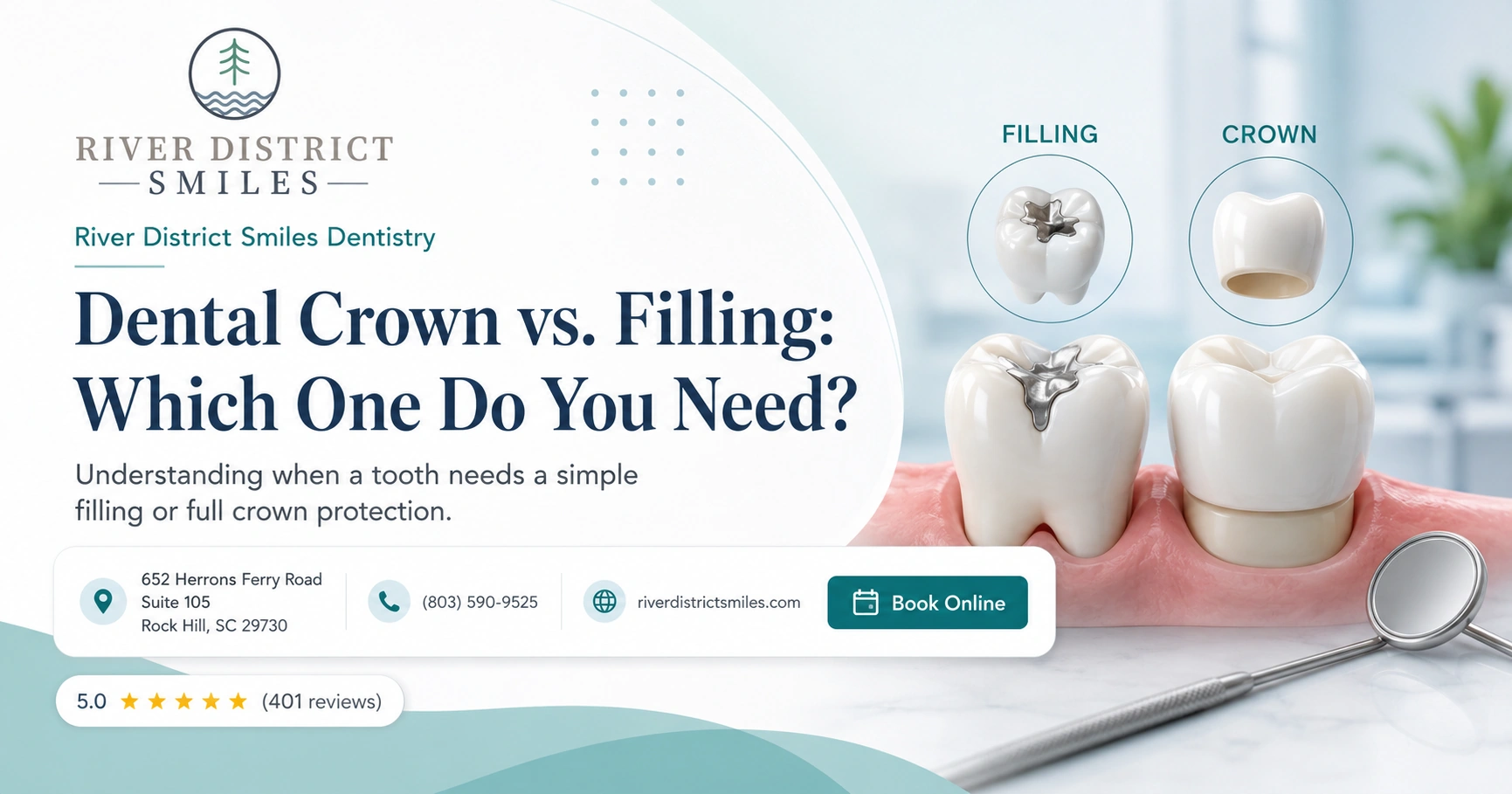

If a dentist says you have a cavity or a broken tooth, one of the first questions is usually, “Can we just do a filling, or do I really need a crown?”
The short answer is this: a filling is usually best when the tooth still has enough strong, healthy structure left. A crown is usually recommended when the tooth is too weak, cracked, broken, heavily filled, or damaged to hold up with a filling alone.
In plain terms, a filling repairs a smaller area. A crown protects the whole tooth.
Fix Tooth Damage Before It Gets Worse
Whether it’s a filling or crown, get trusted dental care right away. Call now for an evaluation.
What a filling does
What a Filling Does
A dental filling replaces the part of the tooth that was damaged by decay, a small chip, or minor wear.
The dentist removes the damaged area, cleans the tooth, and fills that space with a restorative material.
A filling may make sense when:
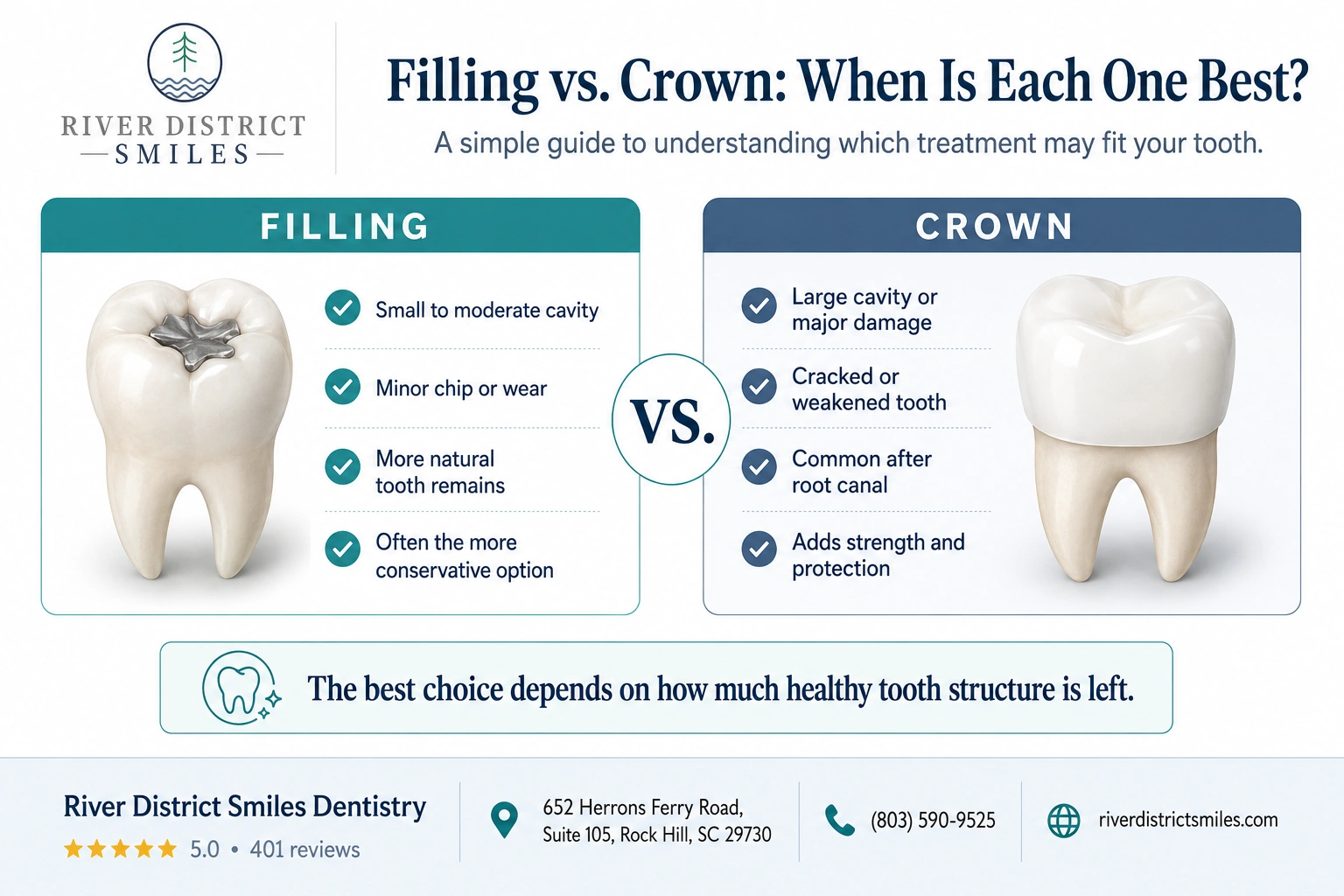
- The cavity is small to moderate
- The tooth is not cracked
- Most of the natural tooth is still strong
- The damaged area is not taking too much biting pressure
- An old filling needs to be replaced, but the tooth still has good support
Fillings are usually more conservative than crowns because less tooth structure has to be removed.
What a Crown Does
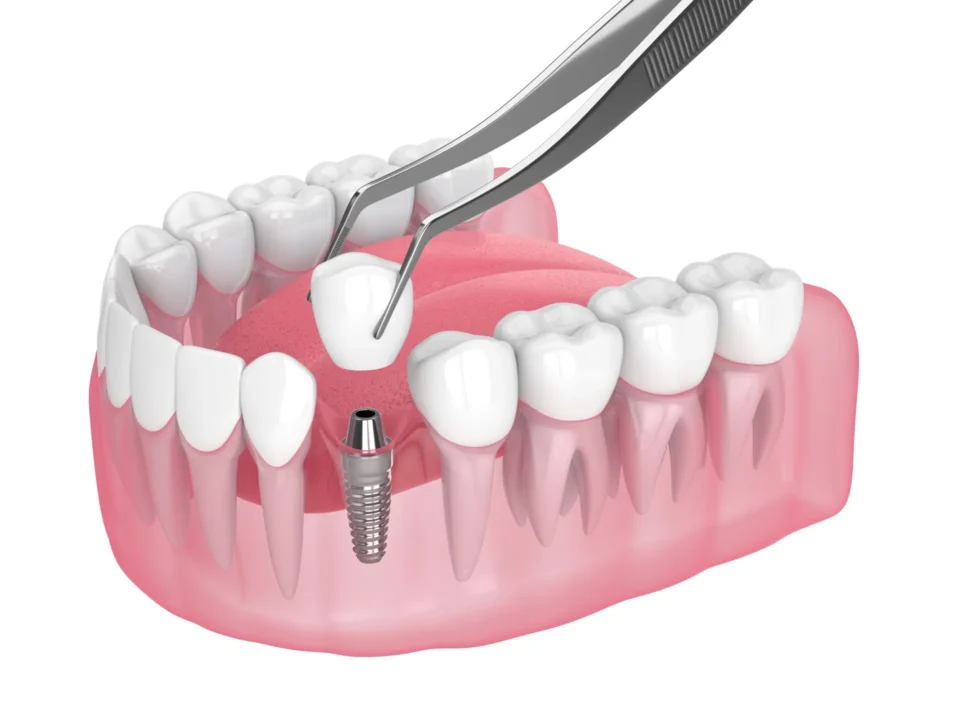
A dental crown is a custom-made cover that fits over the tooth. It restores the tooth’s shape, strength, and function.
Crowns are commonly used to protect weak teeth from breaking or restore teeth that are already significantly damaged.
A crown may make sense when:
- The cavity is too large for a filling
- A large portion of the tooth has broken
- The tooth has cracks
- The tooth has a very large existing filling
- A substantial amount of natural tooth structure has been lost
- The tooth is badly worn down
- The bite puts heavy pressure on that tooth
Crowns can be especially useful when a tooth no longer has enough natural structure to support a filling reliably.
They may also be used as part of dental implant treatment or to restore teeth that have experienced significant structural damage.
The Easiest Way to Understand the Difference
Think of the tooth like a wall.
If there is a small hole in the wall, a filling may patch it well.
If the wall itself is cracked, thin, or no longer strong enough to support pressure, a patch may not hold.
That is when a crown may be the better long-term repair.
Crown vs. Filling Comparison
| Question | Filling | Crown |
| What does it repair? | Smaller cavities or minor damage | Larger damage, cracks, weakness, or broken teeth |
| How much tooth does it cover? | Only the damaged area | Most or all of the visible tooth |
| Is it more conservative? | Usually yes | Less conservative, but more protective |
| Typical time | Often one visit | May be same-day or two visits, depending on technology |
| Cost | Usually lower | Usually higher |
| Best fit | Tooth still has strong structure | Tooth needs added strength and protection |
| Main risk if used incorrectly | May break, leak, or fail if tooth is too weak | More tooth preparation than a filling |
Why Not Always Choose the Cheaper Filling?
It is reasonable to want the simplest and least expensive option.
A filling is often the right choice when the tooth can support it.
But a filling depends on the surrounding natural tooth for strength. If too much tooth structure is missing, a large filling may place additional stress on the remaining walls.
Over time, chewing pressure can cause the tooth to crack or break.
That can turn a manageable problem into a more complicated one.
For example, a large filling on a back molar may look fine at first. But if the remaining tooth walls are thin, the tooth may eventually split.
If the fracture becomes extensive, the tooth may require a crown or, in severe cases, may no longer be predictably restorable and could require extraction.
Choosing the smaller treatment is beneficial only when it provides enough strength for the tooth.

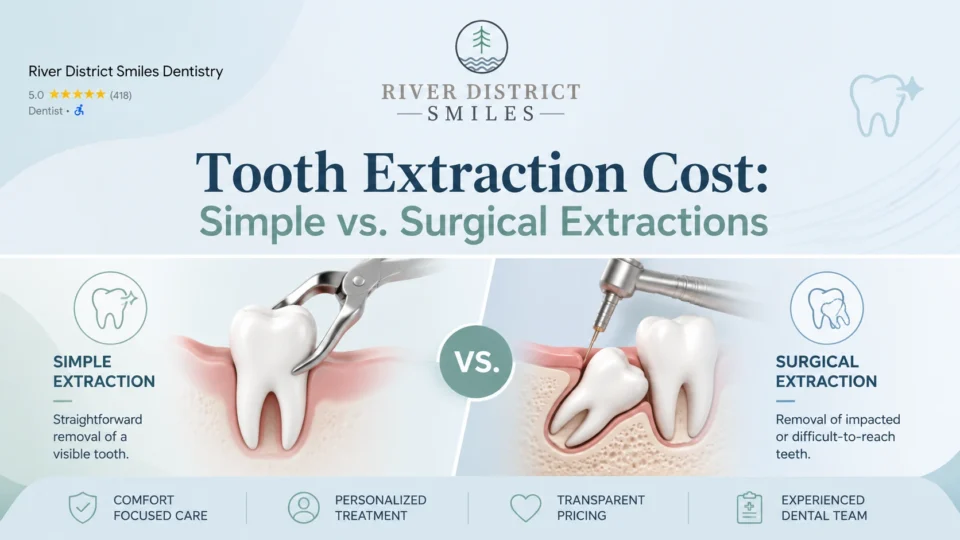
Tooth Extraction Cost: Simple vs. Surgical Extractions
Most people asking about extraction cost already know the tooth is in trouble. It may be badly decayed, broken near…
Why Not Always Choose the Crown?
A crown is not automatically better for every tooth.
A crown costs more, takes more planning, and requires the dentist to reshape the tooth so the restoration can fit properly.
If a tooth has a small cavity and plenty of healthy structure, a crown may be more treatment than you need.
The best dentistry is not always the biggest treatment.
It is the treatment that matches the condition of the tooth while preserving as much healthy structure as reasonably possible.
How Dentists Decide Between a Crown and a Filling
A dentist usually considers several factors before recommending one option over the other.
Size of the Cavity
Small cavities generally lean toward fillings.
Larger areas of decay may require crowns when too little healthy structure remains to support a filling.
Amount of Healthy Tooth Left
The more natural tooth structure remains, the more likely a filling can provide a predictable repair.
When the remaining walls are thin or weakened, broader protection may be needed.
Cracks
Cracks can significantly change the treatment decision.
A filling repairs missing or decayed material, but it does not always provide enough protection for weakened tooth structure that is beginning to fracture.
Size of an Existing Filling
A tooth with a very large old filling may have only thin sections of natural tooth remaining.
Even if the filling itself has not completely failed, the surrounding tooth may be vulnerable to breaking.
Tooth Location
Back teeth generally experience stronger chewing forces than front teeth.
A restoration that works well in one location may not provide enough support in another.
Previous Dental Treatment and Structural Loss
A tooth that has undergone extensive previous treatment or lost a significant amount of natural structure may be more vulnerable to fracture.
The dentist will evaluate how much healthy tooth remains and whether a filling can withstand normal chewing forces.
Your Bite
Grinding, clenching, or a naturally heavy bite can increase the chance that a weakened tooth or large filling will break.
These factors may make additional protection more important.
Cost: crown vs. filling
A filling usually costs less than a crown because it is simpler and uses less material.
A crown generally costs more because it involves additional tooth preparation, custom design, stronger restorative materials, and sometimes dental laboratory or advanced milling technology.
In general:
| Treatment | Typical Cost Pattern |
| Filling | Lower cost, especially for small cavities |
| Crown | Higher cost, particularly for porcelain, zirconia, or customized cosmetic restorations |
The exact cost depends on factors such as:
- Tooth location
- Size of the damaged area
- Type of restorative material
- Complexity of treatment
- Dental insurance coverage
- Whether additional diagnostic or restorative procedures are required
Insurance often treats fillings and crowns differently.
Fillings may be classified as basic restorative care, while crowns are frequently classified as major treatment. Coverage depends on your plan, deductible, waiting periods, annual maximum, and other policy details.
Before choosing treatment, it is reasonable to ask:
“What is my estimated out-of-pocket cost, and what are the risks if we try the smaller restoration first?”
Cost matters, but the lowest initial price should not be the only consideration.
A repair that repeatedly fails can eventually cost more than selecting the appropriate restoration from the beginning.
What happens if you wait?
Waiting depends on what is wrong with the tooth.
A small cavity may slowly become larger.
A cracked tooth may suddenly break.
A large old filling may loosen, fracture, or begin leaking around the edges.
As damage progresses deeper into the tooth, treatment options may become more limited and more complex.
The risk is not that every damaged tooth becomes an emergency overnight.
The risk is that waiting can reduce your options.
A tooth that could have been restored with a filling may later require a crown.
A weakened tooth that could have been protected with a crown may eventually fracture so extensively that preserving it becomes difficult or impossible.
Waiting may also increase the likelihood of:
- Greater sensitivity
- Pain while chewing
- Loss of additional tooth structure
- Dental infection
- A broken cusp
- A split tooth
- Emergency dental treatment
- Tooth extraction
Early treatment generally provides the dentist with more healthy tooth structure to work with.
When a Filling May Be Enough
A filling may be the better choice when the damage is limited and the tooth remains structurally strong.
That usually means:
- The cavity is not too large
- The tooth is not cracked
- The edges and walls of the tooth remain strong
- The bite pressure is manageable
- The filling will not make up most of the tooth
- There is enough healthy structure to support the restoration
When these conditions are present, a filling can be a conservative and effective option.
The dentist removes only the damaged area and preserves the surrounding healthy tooth whenever possible.
When a Crown May Be the Safer Choice
A crown may be the better option when the tooth needs protection rather than simply having a damaged area filled.
That may be true if:
- More than half of the visible tooth is filling or restoration
- A cusp or corner has broken off
- The tooth has a visible or suspected crack
- The tooth hurts when biting
- Significant natural tooth structure has already been lost
- The tooth repeatedly breaks around older fillings
- A large restoration needs replacement
- You grind or clench heavily
- The remaining tooth walls are too thin to support another filling
In these situations, another filling may repair the immediate hole without addressing the underlying weakness.
A crown surrounds the weakened tooth and helps distribute chewing forces across a broader area.
That additional protection can be particularly important for molars and other teeth that receive heavy biting pressure.
What If the Tooth Is Too Damaged for Either Option?
Sometimes the decision is not simply between a filling and a crown.
A tooth may have extensive decay, a deep fracture, significant infection, or so little healthy structure remaining that neither restoration provides a predictable result.
The dentist will evaluate:
- How deeply the damage extends
- Whether the fracture goes below the gumline
- How much healthy tooth remains
- Whether infection is present
- The condition of the surrounding bone and gums
- Whether the tooth can support a durable restoration
If the tooth cannot be predictably restored, extraction may need to be considered.
When care beyond the services available at the practice is appropriate, the dentist can also discuss referral to another dental provider.
The goal is to determine whether the tooth can be restored successfully rather than placing a filling or crown on a tooth with a poor long-term outlook.
Questions to Ask Before Deciding
A good dental visit should help you understand the reason behind the recommendation.
You can ask:
- How much healthy tooth structure is left?
- Is the tooth cracked?
- How large is the cavity or damaged area?
- Would a filling be likely to last, or would it function mainly as a short-term repair?
- What could happen if we choose a filling instead of a crown?
- Is a crown needed now, or can the tooth be monitored?
- Why does the tooth need full coverage?
- What material would the crown be made from?
- How long should the restoration last?
- Does my bite or grinding habit affect the recommendation?
- What will my insurance likely cover?
- What is my estimated out-of-pocket cost?
- Is there any sign that the deeper tissue inside the tooth is involved?
- Is there any sign of infection?
- What happens if I postpone treatment?
- Are there circumstances where the tooth might eventually need extraction?
- Would I need to see another dental provider if the condition is more extensive than expected?
These questions are not pushback.
They are part of understanding your diagnosis and making an informed treatment decision.
The Bottom Line
A filling is usually appropriate for smaller areas of damage when the tooth remains strong.
A crown is generally more appropriate when the tooth is weakened, cracked, heavily filled, broken, or at higher risk of fracturing.
The goal is not to automatically choose the cheapest treatment or the most extensive treatment.
The goal is to choose the restoration that gives the tooth a reasonable chance of remaining functional while preserving as much healthy natural structure as possible.
An examination and appropriate dental imaging can help show whether your tooth needs a relatively simple repair or broader protection.
Treating the problem before additional tooth structure is lost may also preserve more options and reduce the chance that the tooth becomes difficult to restore.
Dental Crown or Filling? Know What Your Smile Needs
Not sure whether your damaged tooth needs a filling or the additional protection of a crown?
River District Smiles can evaluate the amount of healthy tooth structure remaining, look for cracks or decay, assess your bite, and explain which available restorative option is appropriate for your situation.
Schedule an appointment to have the tooth examined and receive a treatment recommendation based on its actual condition..
Dental Crown or Filling? Know What Your Smile Needs
Get expert dental care and the right treatment recommendation. Call today to schedule your visit.