


Being told that you need a “deep cleaning” can be confusing, especially if you scheduled what you thought would be a routine dental cleaning.
Some patients wonder whether a deep cleaning is simply a more thorough version of the same service. Others worry that it is unnecessary because their teeth do not hurt.
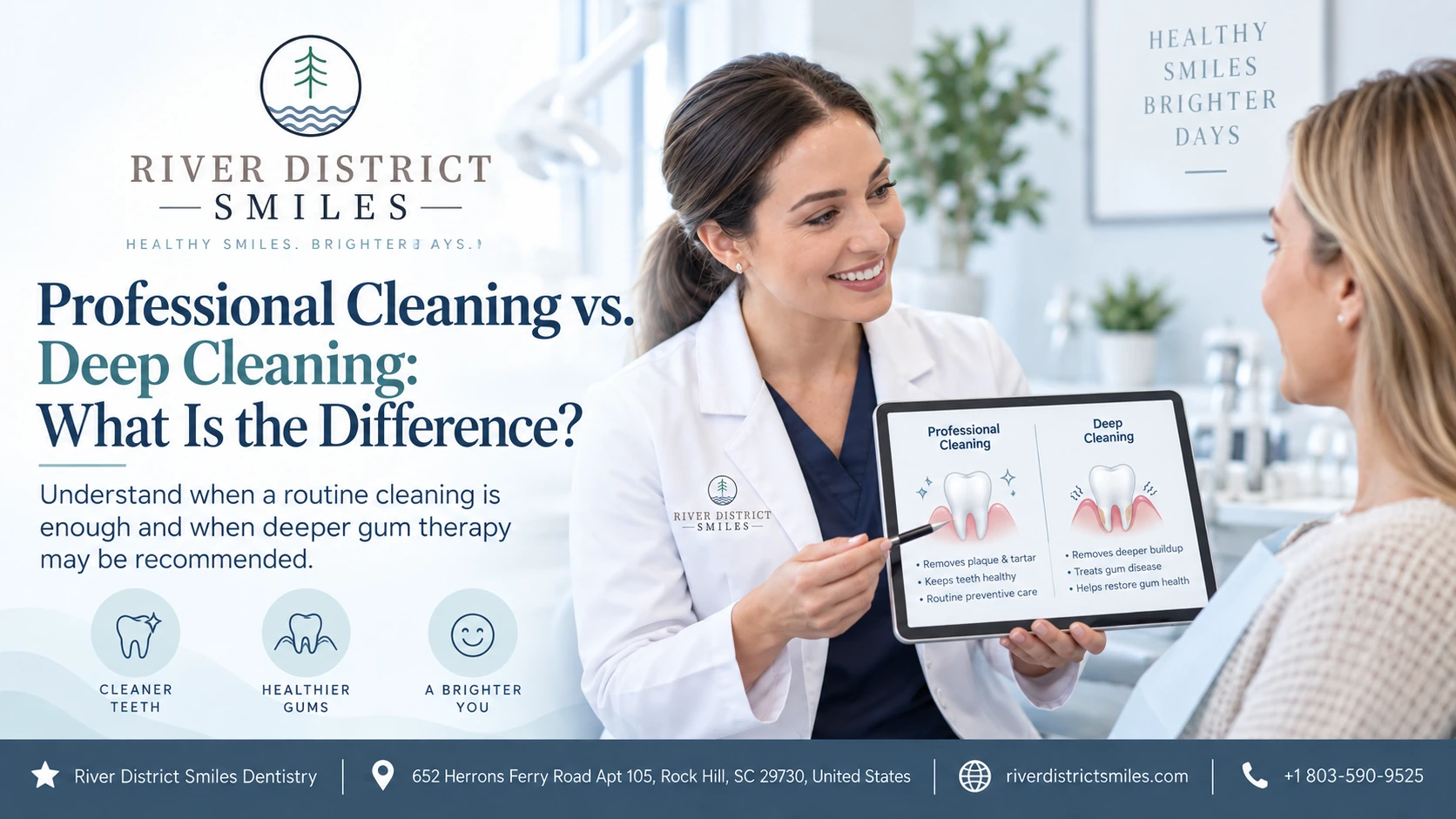
A professional cleaning and a deep cleaning treat two different conditions. A professional cleaning helps maintain a generally healthy mouth. A deep cleaning also called scaling and root planing is used when plaque and tartar have collected below the gums and periodontal disease has begun damaging the tissues that support the teeth.
One is preventive care. The other is treatment for an existing gum problem.
The difference in plain language
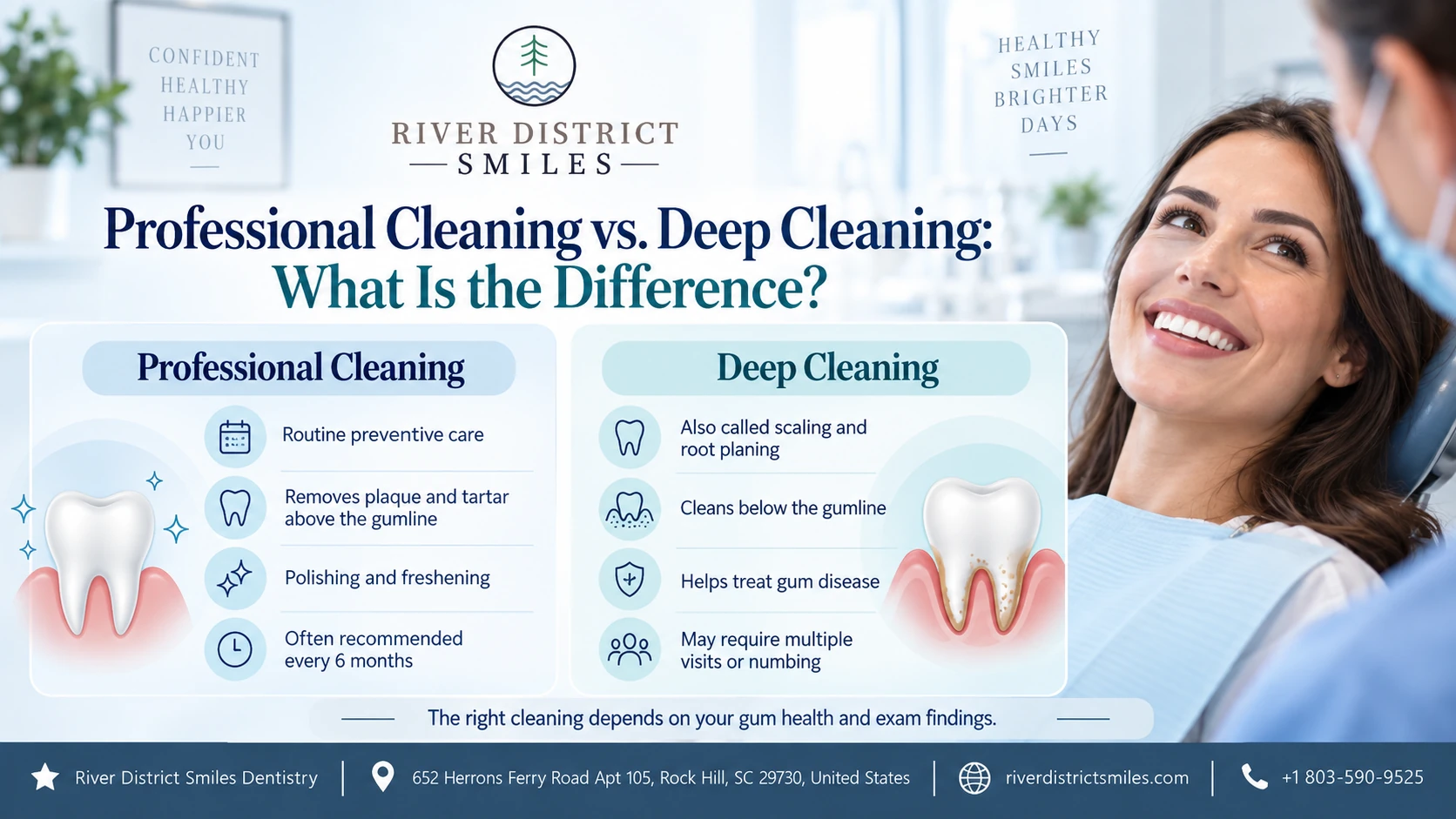
A routine professional cleaning removes plaque, tartar, and surface stain primarily from the visible portions of the teeth and around the gumline.
A deep cleaning goes farther beneath the gums. It removes bacterial deposits from the tooth roots inside periodontal pockets and smooths those root surfaces so the gums can heal more effectively.
| Professional cleaning | Deep cleaning |
| Maintains healthy teeth and gums | Treats periodontal disease |
| Focuses mainly above and around the gumline | Cleans beneath the gumline |
| Usually completed in one routine visit | May be divided into two or more visits |
| Local anesthetic is not usually necessary | Local anesthetic is commonly used |
| Followed by another routine cleaning | Followed by a healing evaluation and periodontal maintenance |
| Appropriate when there is no significant bone or attachment loss | Recommended when deeper pockets, root deposits, or supporting-tissue damage are present |
What happens during a professional cleaning?
A professional cleaning is also called a prophylaxis. Its purpose is to prevent disease and maintain a healthy mouth.
During the appointment, a dental hygienist generally:
- Removes plaque and hardened tartar from the teeth
- Cleans around the gumline
- Polishes away some external stain
- Flosses between the teeth
- Reviews brushing and interdental cleaning
- Checks for areas that may need closer attention
Professional cleanings are commonly recommended at regular intervals, but the right schedule is not identical for everyone. A patient with very little buildup and healthy gums may need a different schedule than someone with heavy tartar accumulation, dry mouth, orthodontic appliances, or a history of gum disease.
River District Smiles describes routine cleanings as part of preventive care intended to help patients maintain healthy teeth and gums and identify concerns before they become more difficult to manage.
What happens during a deep cleaning?
A deep cleaning has two main parts: scaling and root planing.
Scaling
Scaling removes plaque and tartar from above and below the gumline, including deposits at the bottom of periodontal pockets.
Once tartar attaches to a tooth root, brushing and flossing cannot remove it. Specialized dental instruments are needed to clean the area properly.
Root planing
Root planing smooths contaminated or irregular root surfaces. This reduces areas where bacteria can collect and helps the gum tissue heal against the tooth more effectively.
The mouth may be treated in sections rather than all at once. For example, one side may be treated during the first appointment and the other side at a later visit.
Local anesthetic is often used to keep the area comfortable, particularly when the pockets are deep or the roots are sensitive.
Why would someone need a deep cleaning?
Gum disease begins when bacterial plaque accumulates around the teeth. In its early stage, called gingivitis, the gums may become red, swollen, or prone to bleeding, but the supporting bone has not yet been damaged.
When inflammation progresses below the gumline, the gums can pull away from the teeth and form deeper spaces called periodontal pockets. Bacteria and tartar then collect where a toothbrush and floss cannot reach. Over time, the bone and connective tissues supporting the teeth may be lost.
Deep cleaning is often the first nonsurgical treatment for this more advanced stage, called periodontitis.
Possible signs include:
- Bleeding when brushing or flossing
- Red, swollen, or tender gums
- Persistent bad breath
- Receding gums
- Teeth that appear longer
- Pus between a tooth and the gum
- Loose or shifting teeth
- Changes in the bite
- Deep gum measurements
- Bone loss visible on dental X-rays
Gum disease can also progress quietly. Some patients have little pain even when supporting bone has already been affected.
How does the dentist decide which cleaning you need?
The recommendation should be based on an examination not simply on how much time has passed since your last dental visit.
The evaluation may include:
- Measuring the spaces around each tooth
- Checking whether the gums bleed during measurement
- Looking for tartar below the gumline
- Evaluating gum recession
- Reviewing dental X-rays for bone loss
- Checking whether teeth are loose
- Considering medical conditions and risk factors
- Reviewing previous periodontal treatment
Healthy gum spaces are generally shallow and easy to clean. Deeper measurements become more concerning when they are combined with bleeding, tartar beneath the gums, attachment loss, or changes in the supporting bone.
A single deep measurement does not automatically mean the entire mouth needs deep cleaning. Treatment may involve the whole mouth or only specific sections, depending on where disease is present.
Can a regular cleaning treat gum disease?
A routine cleaning may be enough when inflammation is limited to the gums and there has been no meaningful loss of supporting tissue.
Once tartar and bacteria are established deep beneath the gums, however, polishing the visible teeth will not treat the full problem. The instruments used during a routine cleaning are not intended to thoroughly clean the bottoms of diseased periodontal pockets.
The ADA explains that a professional cleaning may be sufficient when gum disease is caught before damage occurs below the gumline. When the pockets are too deep, scaling and root planing may be necessary.
This is why simply “cleaning harder” at home cannot replace deep cleaning after tartar has formed on the roots.
Is a deep cleaning just a more expensive regular cleaning?
No.
The treatments involve different diagnoses, clinical goals, amounts of time, areas of the tooth, and follow-up plans.
A routine cleaning maintains health. A deep cleaning treats disease.
The fee is typically higher because scaling and root planing may require:
- More detailed gum measurements
- Additional X-rays
- Local anesthetic
- More treatment time
- Cleaning in separate sections
- Specialized instrumentation
- A healing evaluation
- More frequent maintenance afterward
A recommendation for deep cleaning should still be explained clearly. You should understand where the disease is located, what measurements or X-rays support the diagnosis, and whether the whole mouth or only certain areas require treatment.
Does a deep cleaning hurt?
Most patients are kept comfortable with local anesthetic during the procedure.
You may feel pressure, vibration, water, or movement, but sharp pain should not be expected. Tell the hygienist or dentist if you are uncomfortable so additional anesthetic can be considered.
Afterward, you may experience:
- Gum tenderness
- Mild soreness when chewing
- Temporary bleeding
- Sensitivity to cold
- Sensitivity along exposed roots
- A feeling that the teeth have more space between them
The ADA notes that discomfort may last a day or two and tooth sensitivity may continue for up to about a week after scaling and root planing.
The teeth may also look slightly longer or spaces may appear more noticeable as swollen gums heal. This does not mean the cleaning damaged the gums. It often means the inflammation has decreased.
How long does a deep cleaning take?
Treatment time depends on:
- How many areas need treatment
- The depth of the periodontal pockets
- The amount and location of tartar
- Tooth and root anatomy
- Sensitivity
- Whether local anesthetic is required
- Whether the treatment is divided into sections
Some limited cases may be treated in one visit. More extensive cases are commonly divided into two appointments, with one side or half of the mouth treated at a time.
The goal is not to finish as quickly as possible. It is to remove deposits thoroughly while keeping the patient comfortable.
How much does a professional cleaning cost?
The price of a routine cleaning varies by location, office, insurance plan, and whether the appointment includes an examination or X-rays.
A typical self-pay professional cleaning may cost roughly $100 to $250, although the total visit may be higher when an exam and imaging are included.
Many dental insurance plans cover preventive cleanings at a high percentage when the patient is eligible. However, frequency limits, waiting periods, deductibles, and network rules may apply.
Before the visit, ask whether the estimate includes:
- The cleaning
- A periodic or comprehensive examination
- Bitewing or full-mouth X-rays
- Fluoride treatment
- Additional periodontal measurements
How much does a deep cleaning cost?
Scaling and root planing is generally charged by section, or quadrant, of the mouth.
A common self-pay range is approximately $200 to $450 per quadrant, which can place full-mouth treatment around $800 to $1,800 or more. Actual fees can fall outside this range depending on the severity of disease, local fees, insurance, medication, imaging, and whether specialist care is required.
Costs may include:
- Periodontal examination and measurements
- Dental X-rays
- Local anesthetic
- Scaling and root planing
- Antimicrobial treatment when appropriate
- A reevaluation visit
- Periodontal maintenance visits
Dental insurance often treats deep cleaning as basic periodontal therapy rather than preventive care. That may mean a deductible, coinsurance, frequency limits, or documentation requirements.
A written treatment estimate should identify which sections of the mouth are being treated and what follow-up care is included.
Does everyone with bleeding gums need a deep cleaning?
No.
Bleeding gums can result from gingivitis, plaque accumulation, inconsistent flossing, irritation, hormonal changes, certain medications, or periodontal disease.
Someone with inflamed gums but no bone or attachment loss may improve with a professional cleaning and better daily plaque removal.
Deep cleaning becomes more likely when bleeding occurs along with:
- Deeper periodontal pockets
- Tartar below the gumline
- Bone loss
- Gum attachment loss
- Recession
- Tooth mobility
The decision should be based on the overall periodontal findings, not bleeding alone.
Can you need a deep cleaning if your teeth look clean?
Yes.
Tartar below the gums may not be visible in the mirror. Likewise, bone loss usually does not cause a visible change in its early stages.
A person can brush carefully and still have areas that are difficult to reach because of tooth crowding, root shape, gum recession, dental restorations, dry mouth, or individual susceptibility to periodontal disease.
Needing periodontal treatment is not a judgment about effort or personal hygiene. The goal is to identify where disease is active and create a plan that makes the mouth easier to maintain.
What happens after a deep cleaning?
Deep cleaning is not usually the end of periodontal care.
After the tissues have had time to heal, the dentist or hygienist will reevaluate:
- Pocket depths
- Bleeding
- Gum inflammation
- Home-care effectiveness
- Tooth mobility
- Remaining areas of tartar
- Whether further treatment is needed
Some pockets may become shallower and easier to clean. Other areas may remain too deep or continue to bleed.
Depending on the response, the next step may be:
- Periodontal maintenance
- Additional scaling in isolated areas
- Antimicrobial treatment
- Referral to a periodontist
- Periodontal surgery
- Monitoring of stable areas
The ADA’s guideline supports scaling and root planing as a central nonsurgical treatment for periodontitis, with additional treatment selected according to the patient’s clinical needs.
What is periodontal maintenance?
Periodontal maintenance is ongoing care after gum disease has been treated.
It is not the same as returning to a standard routine cleaning schedule. A periodontal maintenance visit may include:
- Cleaning above and below the gumline
- Rechecking periodontal pockets
- Monitoring bleeding and inflammation
- Cleaning treated root surfaces
- Evaluating areas with previous bone loss
- Reinforcing home-care techniques
Patients with a history of periodontitis often need visits more frequently than every six months. A common schedule is every three to four months, although the right interval depends on disease stability, plaque control, smoking, diabetes, previous bone loss, and other risk factors.
More frequent care does not mean the original treatment failed. Periodontitis is generally managed over time because the patient remains at increased risk for recurrence.
Can you go back to routine cleanings after a deep cleaning?
Sometimes, but not automatically.
If the original diagnosis was limited, the tissues heal well, measurements return to a healthy range, and there is no continuing evidence of attachment loss, the dentist may reconsider the long-term cleaning schedule.
Patients with established periodontitis are more commonly placed on periodontal maintenance because the history of bone or attachment loss remains relevant even after inflammation improves.
The name of the future cleaning matters less than whether the care matches the patient’s actual risk.
What happens if you do not get a recommended deep cleaning?
Periodontitis usually does not resolve without treatment.
The condition may progress at different rates, but possible consequences include:
- Continued gum inflammation
- Deeper periodontal pockets
- Additional gum recession
- Ongoing bad breath
- Further bone loss
- Teeth becoming loose or shifting
- Difficulty chewing
- Tooth loss
The purpose of scaling and root planing is to reduce the bacterial deposits that are driving inflammation and create an environment the patient can maintain at home.
Delaying for a short time to understand the diagnosis, review insurance, or seek a second opinion is different from ignoring active disease indefinitely.
When is a second opinion reasonable?
A second opinion may be helpful when:
- You were not shown your gum measurements
- The diagnosis was not explained
- You were not told where bone loss is present
- Full-mouth treatment was recommended without discussing which areas are affected
- You have no previous history of gum disease and the recommendation surprised you
- The treatment estimate is unclear
- You want to understand alternatives
- You have advanced disease and want a periodontist’s opinion
Seeking another opinion does not mean the first recommendation was wrong. It can help you understand whether the diagnosis and proposed treatment are consistent.
Bring recent X-rays and periodontal measurements when possible so the second clinician has enough information to evaluate the same concerns.
Can deep cleaning save loose teeth?
It depends on why the teeth are loose and how much supporting bone remains.
If mobility is mainly related to active inflammation, reducing infection may improve stability. If a large amount of bone has already been lost, deep cleaning cannot recreate all of that support.
Additional treatment may be needed, such as:
- Bite adjustment
- Splinting selected teeth
- Periodontal surgery
- Treatment of grinding or clenching
- Extraction of teeth with a hopeless prognosis
A dentist should explain which teeth are expected to improve, which are questionable, and which may not be maintainable.
Do lasers replace scaling and root planing?
Laser treatment may be discussed as an addition to periodontal therapy, but it does not automatically replace careful removal of plaque and tartar from the tooth roots.
The American Academy of Periodontology notes that results with some laser approaches may be similar to scaling and root planing alone, and that outcomes depend on the specific equipment and its proper use.
Patients should ask:
- What specific problem is the laser intended to treat?
- Is it replacing or supplementing scaling and root planing?
- What evidence supports its use in this case?
- Is there an additional fee?
- Would the expected result be different without it?
Technology can support treatment, but it should not replace a clear diagnosis or thorough mechanical cleaning.
How can you make the appointment more comfortable?
Tell the dental team if you have sensitive teeth, dental anxiety, difficulty staying numb, or a previous uncomfortable cleaning.
Comfort options may include:
- Topical numbing gel
- Local anesthetic
- Treating fewer areas per visit
- Short breaks
- A sensitivity-reducing toothpaste
- Adjusting the ultrasonic instruments
- Hand instrumentation in sensitive areas
- Sedation options when appropriate
River District Smiles describes its periodontal approach as personalized, with an emphasis on gentle care, modern diagnostics, and clear explanations for patients at different stages of gum disease.
Questions to ask before agreeing to a deep cleaning
Ask the dentist or hygienist:
- What is my specific diagnosis?
- What were my periodontal measurements?
- Where do I have bleeding or bone loss?
- Is the problem limited to certain teeth or sections?
- Why will a routine cleaning not be enough?
- How many appointments will I need?
- Will local anesthetic be used?
- What is included in the estimate?
- When will the gums be reevaluated?
- Will I need periodontal maintenance afterward?
- What happens if some areas do not improve?
- Would a periodontist’s evaluation be useful?
You should leave the discussion understanding what is being treated and why.
Professional cleaning vs. deep cleaning: which one is better?
Neither treatment is better in every situation.
A professional cleaning is usually the right choice when:
- The gums are generally healthy
- There is no meaningful bone or attachment loss
- Gum measurements are shallow and maintainable
- Plaque and tartar are primarily above the gumline
- The goal is prevention
A deep cleaning is usually the right choice when:
- Periodontal pockets are present
- Tartar has accumulated below the gums
- The gums bleed in areas of attachment loss
- X-rays show supporting bone loss
- The roots require thorough cleaning
- The goal is to control existing periodontal disease
A routine cleaning may be a poor substitute when:
- The disease extends below the gumline
- Bone loss is progressing
- Teeth are becoming loose
- Deep deposits remain on the roots
- The patient has already been diagnosed with periodontitis
A deep cleaning may be unnecessary when:
- The gums are healthy
- There is no attachment or bone loss
- The only issue is light surface buildup or staining
- The recommendation is not supported by periodontal findings
The bottom line
A professional cleaning is preventive care for a generally healthy mouth. A deep cleaning is treatment for gum disease that has moved beneath the gumline and begun affecting the tissues supporting the teeth.
A deep cleaning is not simply an upgraded cleaning, and it should not be recommended based only on how long it has been since your last appointment. The decision should be supported by periodontal measurements, bleeding, below-gum tartar, attachment loss, or changes visible on dental X-rays.
River District Smiles provides routine preventive cleanings as well as personalized periodontal care for patients with gingivitis and more advanced gum disease in Rock Hill. The goal is to explain what the gums are showing, recommend the appropriate level of care, and help patients maintain the result over time.
The next step is not choosing the deeper-sounding treatment. It is finding out whether your gums need routine maintenance or active treatment and seeing the measurements that explain why.