
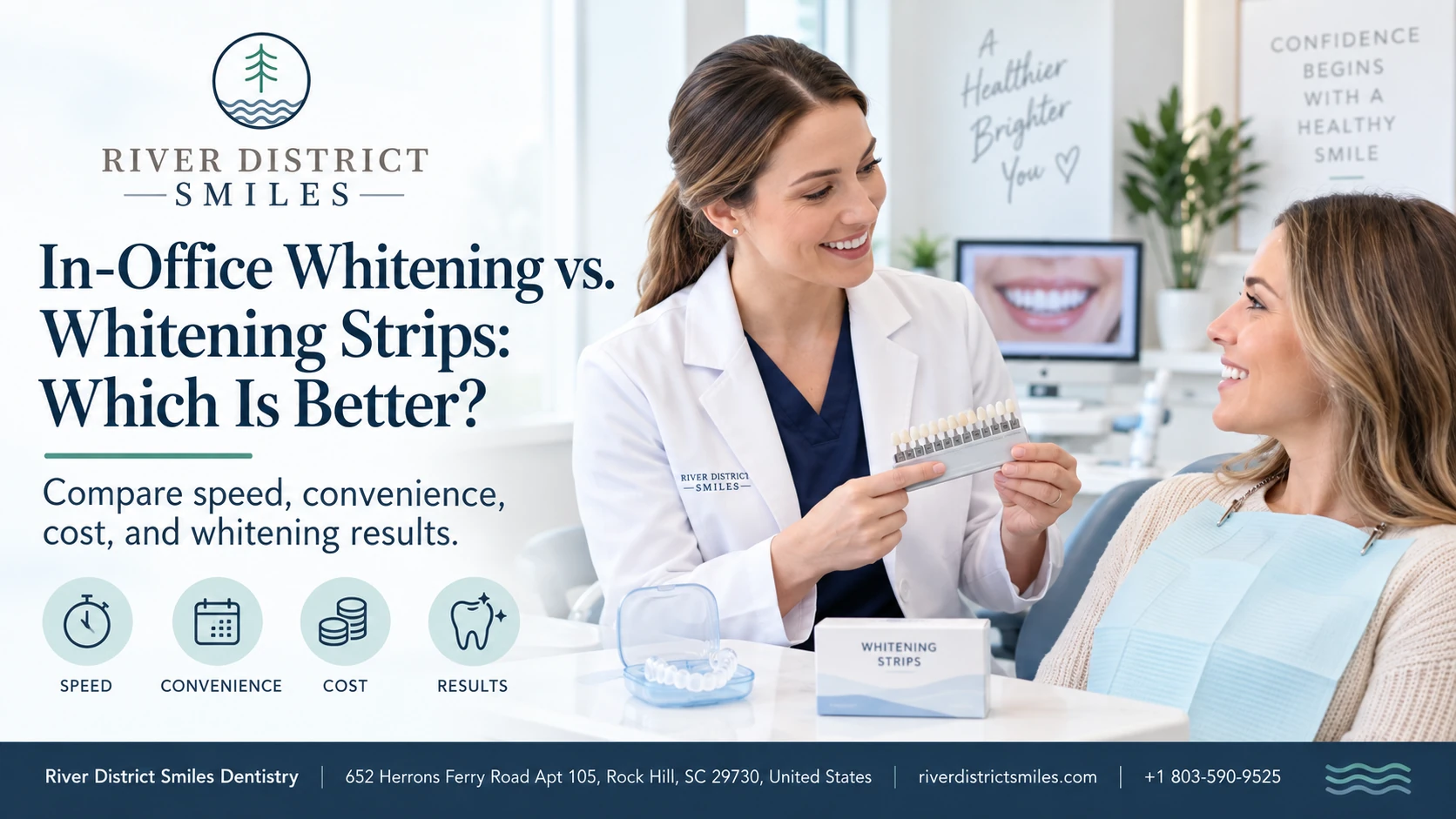


If you want whiter teeth, the choice often comes down to two very different approaches: schedule a professional whitening appointment or buy whitening strips and treat your teeth at home.
Both can work. The better option depends on how quickly you want results, how noticeable the staining is, whether your teeth are sensitive, and how much control you want over the final shade.
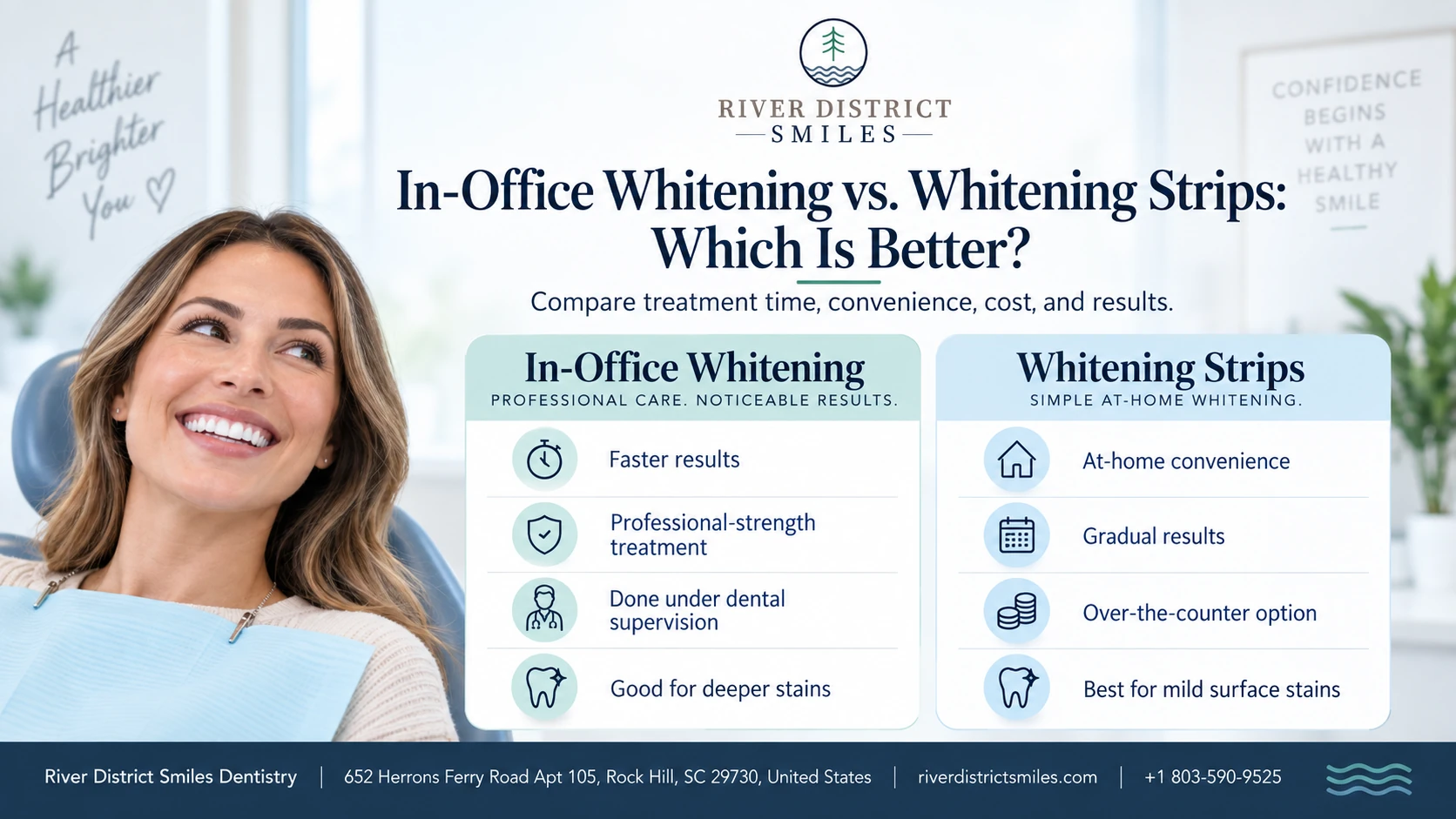
In-office whitening is usually the better fit when you want a faster, more noticeable change under professional supervision. Whitening strips are often a reasonable choice when the discoloration is mild, your teeth and gums are healthy, and you are comfortable whitening gradually over several days or weeks.
Neither option can whiten every type of discoloration, and neither changes the color of crowns, veneers, bonding, or fillings.
What is the main difference?
In-office whitening is performed in a dental office using a professional-strength bleaching gel. The gums and other soft tissues are protected, and the product is applied and monitored during the appointment.
Whitening strips are thin, flexible pieces of material coated with a peroxide-based gel. You place them over the front surfaces of your teeth for a set amount of time each day.
Both methods typically use hydrogen peroxide or a related peroxide ingredient to break apart darker-colored compounds within the teeth. This process lightens the tooth rather than simply polishing away surface buildup.
| Consideration | In-office whitening | Whitening strips |
| Treatment location | Dental office | Home |
| Speed | Usually faster | More gradual |
| Strength | Professionally selected and applied | Lower-strength consumer product |
| Supervision | Dentist or dental team monitors treatment | Patient follows package directions |
| Gum protection | Barriers are placed professionally | Depends on strip placement |
| Best for | Faster or more noticeable whitening | Mild discoloration and lower budget |
| Sensitivity | May be more intense initially | Can still occur, usually over repeated uses |
| Cost | Higher | Lower |
How quickly do the two options work?
In-office whitening
In-office treatment is designed to create a noticeable change in one visit. The appointment may take around an hour to an hour and a half, depending on the whitening system and the number of gel applications used.
Some patients see a significant improvement immediately. The final color may settle slightly over the following days as the teeth rehydrate.
The main advantage is speed. This can be helpful before a wedding, professional event, photographs, or another occasion when there is not enough time for several weeks of home treatment.
The tradeoff is that stronger, faster treatment may cause more noticeable short-term sensitivity. The ADA has noted that in-office whitening can produce faster results, while sensitivity may be more intense and can persist for several days in some patients.
Whitening strips
Whitening strips normally require repeated daily use. Depending on the product, a treatment course may last one to several weeks.
You may begin noticing a difference after several applications, but the change is usually more gradual than professional treatment. Results also depend heavily on using the strips consistently and placing them correctly.
Strips can be a practical choice when you are not in a hurry and only want a modest improvement.
Which one whitens teeth more?
In-office whitening usually has the potential to create a larger and faster color change because the dentist can use professionally selected materials while protecting the gums and monitoring your response.
That does not mean strips are ineffective. Whitening strips are among the most studied over-the-counter bleaching products and can lighten natural teeth when used as directed.
The size of the improvement depends on:
- Your starting tooth color
- The cause of the discoloration
- The type and strength of the whitening product
- How long the product remains on the teeth
- How consistently you complete treatment
- Your individual response to peroxide
- Habits such as smoking or frequent coffee, tea, or red wine consumption
Some people respond very well to strips. Others reach a point where the color no longer changes enough to meet their expectations.
What kinds of stains respond best?
Whitening usually works best on natural teeth that have gradually darkened because of age, coffee, tea, wine, tobacco, or other staining foods and drinks.
It may be less predictable for:
- Gray discoloration
- Discoloration caused by certain medications
- Significant fluorosis
- Trauma-related darkening
- White, brown, or mottled enamel spots
- One tooth that is much darker than the others
- Teeth with very thin or translucent enamel
A dark tooth after an injury may require a different type of evaluation. Whitening the outside of every tooth may not correct a problem that comes from inside one tooth.
River District Smiles offers professional and at-home whitening options, while also noting that more severe or resistant discoloration may be better addressed with treatments such as bonding, veneers, or crowns.
Will whitening change crowns, veneers, or fillings?
No. Whitening products lighten natural tooth enamel, but they do not change the color of:
- Porcelain crowns
- Veneers
- Tooth-colored fillings
- Dental bonding
- Implant crowns
- Bridges
- Dentures
This can create a color mismatch if visible dental work was matched to your current tooth shade.
For example, if you have bonding on one front tooth and then whiten the surrounding natural teeth, the bonding may appear darker afterward. The restoration may need to be replaced if you want a closer color match.
When visible dental work is planned, whitening is often completed first. The teeth are then allowed to stabilize before the new restoration is matched to the final shade.
Which option is safer?
Both professional whitening and reputable over-the-counter strips are generally considered safe when they are used appropriately on healthy teeth and gums.
The most common side effects are:
- Temporary tooth sensitivity
- Gum irritation
- Uneven whitening
- White spots on the gums from gel contact
- Soreness from overuse
The ADA identifies temporary sensitivity and gum inflammation as the most common side effects of vital tooth whitening.
The advantage of in-office whitening is supervision. The dental team can examine your mouth first, protect the gums, control where the product is placed, and stop or adjust treatment if sensitivity becomes excessive.
Whitening strips place more responsibility on the patient. They should be worn only for the recommended amount of time and for the stated number of days. Using more strips, wearing them longer, or combining several whitening products does not guarantee a better result and may increase irritation.
The ADA advises patients to follow product directions and consult a dentist, especially because overuse can irritate the teeth or gums.
Which option causes more sensitivity?
Either option can cause sensitivity.
In-office whitening may produce a stronger but shorter period of sensitivity because treatment is concentrated into one appointment. Whitening strips expose the teeth to lower-strength gel over repeated applications, so sensitivity may build gradually.
You may be more likely to experience discomfort if you already have:
- Sensitive teeth
- Exposed roots
- Gum recession
- Cracked teeth
- Worn enamel
- Untreated cavities
- Leaking fillings
- A history of sensitivity after previous whitening
Sensitivity is often temporary, but it should not be ignored if it is severe or continues well after treatment ends.
A dentist may recommend:
- Using a sensitivity toothpaste before treatment
- Shortening the application time
- Spacing treatments farther apart
- Using a less concentrated product
- Applying a desensitizing agent
- Stopping treatment temporarily
Potassium nitrate and other desensitizing ingredients may help some patients manage whitening-related sensitivity.
Who should avoid whitening until after a dental exam?
Whitening should not be used to cover up a dental problem.
Schedule an examination first if you have:
- Tooth pain
- A cavity
- Broken or leaking fillings
- Cracked teeth
- Gum disease
- Significant gum recession
- One unusually dark tooth
- White or brown enamel spots
- Recent dental work
- Severe sensitivity
- Swelling or infection
Whitening gel may pass through a cavity or crack and irritate the inside of the tooth. Inflamed gums may also become more uncomfortable when exposed to peroxide.
A cleaning may be the better first step if the discoloration is mainly surface stain or tartar. Whitening changes the internal color of the tooth; it does not remove hardened buildup.
In-office whitening: advantages and disadvantages
Advantages
- Faster results
- Professional examination before treatment
- Protection for the gums and lips
- More controlled gel placement
- Ability to adjust treatment for sensitive areas
- Better suited for patients who want a noticeable change quickly
- Easier to coordinate around visible dental restorations
Disadvantages
- Higher cost
- Potential for stronger short-term sensitivity
- Requires a dental appointment
- Results are not permanent
- May not correct resistant internal discoloration
- Cannot whiten crowns, veneers, or fillings
In-office treatment is often worth considering when time, predictability, and professional supervision matter more than keeping the initial cost as low as possible.
Whitening strips: advantages and disadvantages
Advantages
- Lower cost
- Easy to purchase
- Can be used at home
- Allows gradual whitening
- May be enough for mild yellowing or staining
- Easy to stop if the result reaches a shade you like
Disadvantages
- Requires consistent use
- Results take longer
- Strips may not fit every smile evenly
- Gel may touch the gums
- Back teeth may receive little or no whitening
- Crowded or rotated teeth may whiten unevenly
- Overuse can increase sensitivity or irritation
- No professional evaluation is included
Strips tend to work best on relatively straight front teeth. If teeth overlap or rotate, the strip may not contact every visible surface evenly.
How much do they cost?
Whitening strips are usually the less expensive option. A box may cost roughly $20 to $70, depending on the brand, product strength, and number of treatments.
Professional whitening costs more because the fee includes the examination, clinical materials, protective barriers, professional time, monitoring, and a higher level of customization. In-office whitening commonly costs several hundred dollars, though pricing varies by office, system, and location.
Before comparing prices, ask what the professional fee includes. Some offices may include:
- A preliminary examination
- Whitening of both arches
- Several gel applications
- Desensitizing treatment
- Take-home trays or touch-up gel
- Follow-up instructions
Whitening is generally considered cosmetic, so dental insurance usually does not cover it.
The least expensive option may be adequate for mild discoloration. Paying for professional treatment makes more sense when you need faster results, have sensitive teeth, have existing dental work, or are unsure whether whitening will address the problem.
How long do the results last?
Neither professional whitening nor whitening strips creates a permanent color.
Results may last from several months to a few years, depending on your starting shade, oral hygiene, diet, tobacco use, and how often you use touch-up treatment.
Teeth may darken faster if you regularly consume:
- Coffee
- Tea
- Red wine
- Dark soda
- Tomato-based sauces
- Deeply colored berries
- Tobacco products
River District Smiles notes that whitening longevity varies with diet and daily habits.
You do not need to avoid staining food permanently. Rinsing with water afterward, maintaining regular cleanings, and using occasional professionally recommended touch-ups may help preserve the result.
Can you combine in-office whitening and strips?
It is possible to combine professional and at-home whitening, but the plan should be deliberate.
For example, a dentist may recommend in-office treatment for the initial color change followed by custom trays or another home product for maintenance. That is different from immediately adding multiple store-bought products because the teeth do not seem white enough on the first day.
Combining products without guidance can increase sensitivity and gum irritation.
The color immediately after professional whitening may look brighter because the teeth are temporarily dehydrated. It is usually better to let the shade settle before deciding whether additional treatment is needed.
Is a dental cleaning the same as whitening?
No.
A professional cleaning removes plaque, tartar, and some external stain. Teeth may look brighter afterward because the surface is cleaner, but the cleaning does not bleach the natural color of the enamel.
Whitening uses peroxide to lighten pigments within the tooth.
A cleaning should usually come first when there is visible buildup, untreated gum inflammation, or heavy surface staining. Whitening over plaque and tartar may produce a less even result.
Which option is better before a wedding or event?
In-office whitening is usually the more predictable choice when the event is approaching quickly.
Do not schedule it for the night before an important event. Some patients experience sensitivity, and the color may need a few days to settle.
Whitening strips may work well when you have several weeks and want a smaller, gradual change. Starting early also gives you time to pause if sensitivity develops.
Any visible crowns, bonding, veneers, or enamel spots should be evaluated before whitening so you know whether the final result is likely to look even.
Questions to ask before whitening
Before choosing in-office whitening or strips, ask:
- Is my discoloration likely to respond to bleaching?
- Do I have any cavities, cracks, or gum problems?
- Will my existing fillings, crowns, or bonding look darker afterward?
- How much improvement is realistic?
- Am I likely to experience significant sensitivity?
- Should I whiten before replacing visible dental work?
- Is a professional cleaning needed first?
- What should I use for touch-ups?
- How long should I wait before judging the final shade?
- Would bonding or veneers address the color more predictably?
A good whitening consultation should include an honest discussion of what the treatment cannot change.
In-office whitening vs. strips: who should choose which?
In-office whitening may make more sense when:
- You want faster results
- You have an upcoming event
- Your staining is more noticeable
- You want professional supervision
- You have a history of sensitivity
- Your teeth are crowded or irregularly positioned
- You have visible dental restorations that require planning
- You have tried strips without getting the result you wanted
Whitening strips may make more sense when:
- Your discoloration is mild
- Your teeth and gums are healthy
- You are not in a hurry
- You want the lowest-cost starting option
- You can follow the instructions consistently
- Your front teeth are relatively straight
- You are comfortable with a modest result
Neither may be the best first step when:
- One tooth is much darker than the others
- You have untreated decay or gum disease
- Most visible teeth are crowns or veneers
- The discoloration is caused by enamel defects or trauma
- Your teeth are already very sensitive
- Your main concern is tooth shape rather than color
The bottom line
In-office whitening is usually better for speed, professional control, and a more noticeable result. Whitening strips are usually better for affordability, convenience, and mild discoloration that can be treated gradually.
The best choice depends on more than how white you want your teeth to look. It also depends on why they are discolored, whether your enamel and gums are healthy, and whether you have dental work that will remain the same color.
River District Smiles offers professional whitening and personalized at-home options for patients in Rock Hill. The purpose of an evaluation is not to push the strongest treatment. It is to determine whether whitening is likely to work, which approach fits your sensitivity and timeline, and whether another treatment would give you a more natural result.
The next step is not choosing the most powerful product. It is making sure you are whitening healthy teeth and choosing the least complicated option that can realistically produce the change you want.