

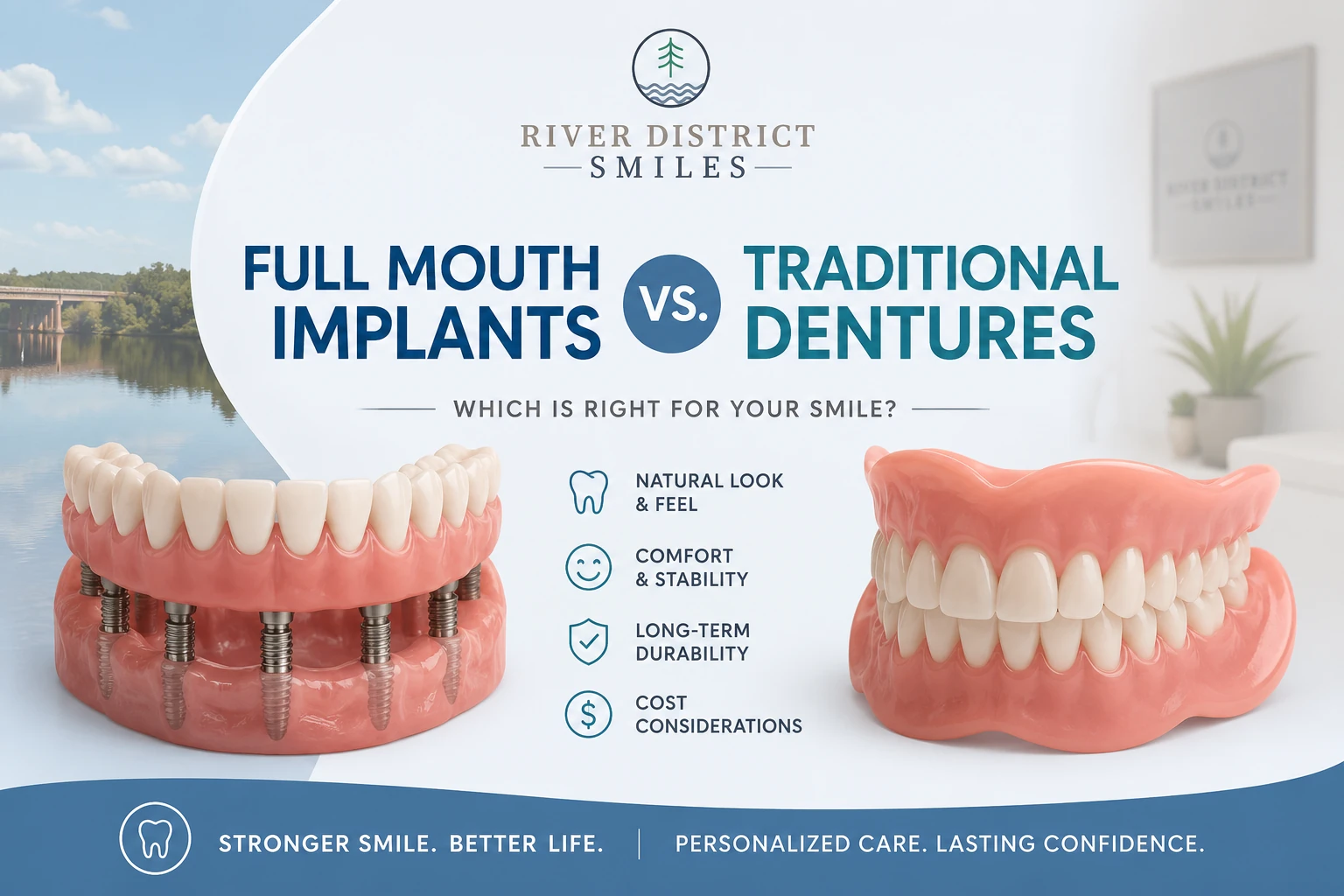


Full mouth implants and traditional dentures both replace missing teeth, but they provide very different experiences. Traditional dentures rest on the gums and are removable. Full mouth implants use dental implants to support either a fixed or removable restoration. One option is generally more affordable and less invasive, while the other often provides greater stability, stronger chewing ability, and a feel that is closer to natural teeth.
A comprehensive dental evaluation helps determine which treatment is appropriate based on your oral health, bone support, medical history, and long-term goals. One of the biggest misconceptions is that full mouth implants are automatically the better option for everyone. In reality, the right choice depends on your health, bone structure, budget, comfort level, lifestyle, and expectations.
Some people do extremely well with traditional dentures. Others spend years struggling with slipping, sore spots, or dietary restrictions before deciding they want something more secure. Both options can restore a smile. The real question is which one best fits the way you want to live.
Ready for a More Secure Smile?
Compare full mouth implants and traditional dentures with a dental professional. Call today to explore your options.
What Are Traditional Dentures?
Traditional dentures are removable appliances that replace all the teeth in the upper jaw, lower jaw, or both.
They typically consist of artificial teeth attached to a gum-colored acrylic base. The upper denture covers part of the roof of the mouth, while the lower denture rests along the ridge of the jaw.
Traditional dentures stay in place through a combination of:
- Suction
- The shape of the gums and jaw
- Muscle control
- Proper fit
- Denture adhesive when needed
They remain one of the most common tooth replacement options because they are effective, widely available, and do not require implant surgery.
That does not mean they are effortless.
New dentures usually require an adjustment period. Eating may feel awkward at first. Speech can sound slightly different. Sore spots may develop and require small adjustments.
Over time, most patients adapt, although everyone’s experience is different.
What Are Full Mouth Implants?
Full mouth implants use dental implants placed in the jawbone to support a complete arch of replacement teeth.
The phrase “full mouth implants” can describe several different treatment options. Some restorations are permanently fixed in place, while others are removable but securely attach to implants.
A full arch may be supported by:
- Four implants
- Six implants
- More implants, depending on the treatment plan
The exact number depends on bone quality, bite forces, jaw anatomy, and the type of final restoration.
The implants function like artificial tooth roots beneath the gumline. Once they integrate with the bone, they provide a strong foundation for the replacement teeth.
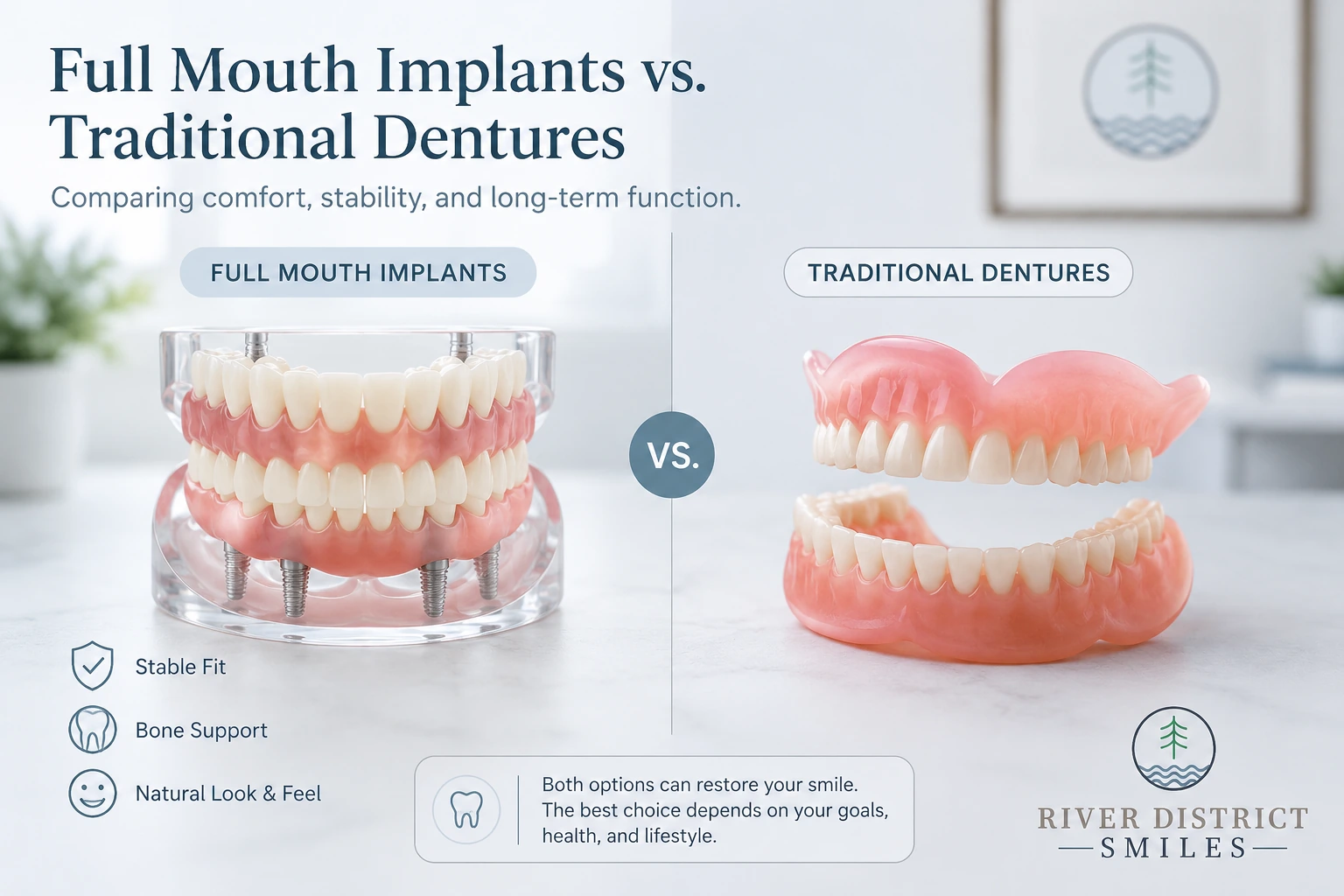
This creates one of the biggest differences between the two treatments. Traditional dentures sit on top of the gums, while implant-supported teeth are anchored directly to the jaw.
That difference influences comfort, chewing ability, maintenance, cost, confidence, and long-term function.
How Full Mouth Implants and Traditional Dentures Compare in Stability
Traditional dentures can move during daily activities.
A properly fitting upper denture may feel very secure because suction helps keep it in place. Lower dentures are often more challenging because of the tongue’s movement and the smaller surface available for support.
Patients may notice movement while:
- Chewing firmer foods
- Laughing
- Coughing
- Speaking quickly
- Yawning
- Biting with the front teeth
Full mouth implants provide significantly greater stability because the replacement teeth are anchored to dental implants.
Fixed restorations remain in place during normal daily use. Removable implant-supported dentures can still be removed for cleaning, but they generally feel much more secure than conventional dentures.
For many patients, this added stability is the primary reason they choose implant treatment.
No one wants to spend dinner wondering whether their teeth are about to shift at the worst possible moment.
Do Full Mouth Implants Feel More Like Natural Teeth?
Full mouth implants generally feel more like natural teeth because they are supported by the jaw rather than resting directly on the gums.
Patients often describe improved confidence while eating and speaking. They also tend to feel less aware of the restoration during everyday activities.
Traditional dentures can look extremely natural, but they often feel bulkier. The upper denture usually covers the roof of the mouth, which can affect taste, temperature sensation, and speech.
Depending on the treatment plan, implant-supported restorations may not require full palate coverage.
That often makes eating and speaking feel more natural.
Still, full mouth implants are not identical to natural teeth. They do not have the same nerves or sensation as natural tooth roots. They are advanced replacements, not biological copies.
Realistic expectations are important regardless of which option you choose.
Eating With Dentures vs. Full Mouth Implants
Food is one of the most noticeable differences between these treatment options.
Traditional dentures restore much of your chewing ability, but some foods remain challenging.
Patients may need to modify or avoid foods such as:
- Tough steak
- Sticky candy
- Hard nuts
- Raw carrots
- Crusty bread
- Popcorn
- Chewy foods
Many denture wearers learn to cut food into smaller pieces and chew evenly on both sides.
Full mouth implants generally provide stronger, more stable chewing. Many patients enjoy a wider variety of foods with greater confidence.
However, implants do not make replacement teeth indestructible.
Chewing ice, biting extremely hard foods, or using your teeth to open packaging can still damage the restoration. Implant-supported teeth are strong, but they are not workshop tools.
Cost Differences Between Full Mouth Implants and Traditional Dentures
Cost is one of the most significant differences between these treatment options.
Traditional dentures generally have a lower upfront cost because they do not require implant surgery, implant components, or advanced restorative procedures.
The cost of traditional dentures may include:
- Dental examinations
- Tooth extractions
- Impressions
- Temporary dentures
- Final dentures
- Adjustments
- Relines
Full mouth implant treatment typically represents a larger investment.
Treatment costs may include:
- Three-dimensional imaging
- Digital treatment planning
- Tooth extractions
- Bone grafting
- Implant surgery
- Temporary teeth
- Sedation
- Custom abutments
- The final restoration
- Follow-up care
Always compare complete treatment plans rather than advertised starting prices.
A low advertised price may only cover part of the process. Understanding exactly what is included allows you to make a more accurate comparison.
Full Mouth Implants Require Surgery
Traditional dentures do not require implant surgery, although tooth extractions may still be necessary.
Full mouth implant treatment involves placing dental implants into the jawbone through a carefully planned surgical procedure.
Treatment often includes:
- Comprehensive examination and imaging
- Removal of damaged teeth
- Bone grafting, if needed
- Implant placement
- Temporary restoration
- Healing and implant integration
- Placement of the final restoration
Healing timelines vary from patient to patient, and complete treatment may take several months depending on healing and whether additional procedures, such as bone grafting, are necessary.
Some patients receive temporary teeth on the same day as implant placement. However, this does not mean treatment is complete.
The implants still require time to integrate with the surrounding bone, and dietary restrictions are often necessary during healing.
The phrase “teeth in a day” can be helpful, but it should never be interpreted as meaning the entire treatment process is completed in a single day.

What Is The Difference Between Veneers And Dental Implants?
Having a cracked tooth might be literally and figuratively painful. When repairing a fractured tooth, it can be challenging to…
How Bone Health Affects Your Treatment Options
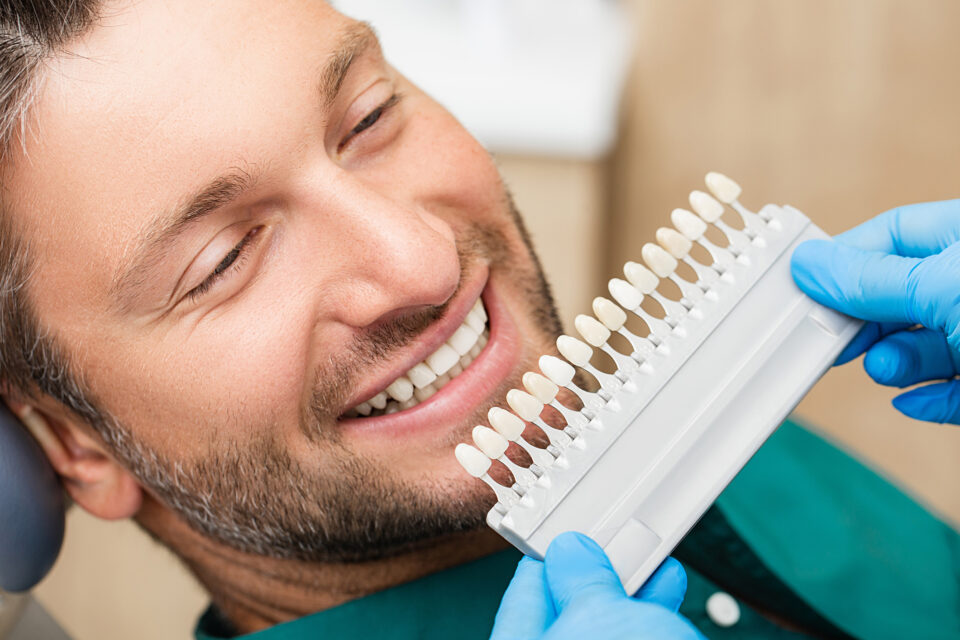
Dental implants require adequate healthy bone for long-term support.
After teeth are lost, the jawbone gradually shrinks because it no longer receives stimulation from tooth roots. Patients who have worn traditional dentures for many years may have experienced significant bone loss.
Bone loss does not always eliminate implant treatment, but it may make treatment more complex.
Some patients require:
- Bone grafting
- Ridge augmentation
- Sinus lift procedures
- Alternative implant placement
- Modified restoration designs
Traditional dentures do not require the same amount of bone support, making them a practical option for patients who are not ideal candidates for implant surgery.
Dental implants may also help preserve bone around the implant sites. Preserving healthy bone can contribute to a more stable restoration over time.
However, implants do not completely prevent bone loss throughout the jaw. Bone can still change naturally in areas where implants are not present.
Maintaining Full Mouth Implants vs. Traditional Dentures
Traditional dentures require daily cleaning.
Patients should remove them, brush them using denture-safe products, clean their gums and tongue, and soak them as recommended.
Regular dental visits remain important because dentures often require:
- Relines
- Repairs
- Adjustments
- Replacement after years of wear
Full mouth implants also require ongoing maintenance.
A fixed implant restoration stays in place, so patients clean underneath it using specialized brushes, flossing aids, or water flossers.
Removable implant-supported dentures should be removed and cleaned daily along with the implant attachments.
Implants cannot develop cavities, but the surrounding gums and bone can still become inflamed or infected if oral hygiene is neglected.
Regular professional maintenance is just as important with implant-supported restorations as it is with natural teeth.
What About Long-Term Durability?
Traditional dentures eventually require replacement as materials wear and the jaw changes shape.
Even if the denture remains physically intact, changes in the jaw can affect how well it fits.
Full mouth implants can last many years with proper care, although the restoration attached to the implants may eventually require repairs or replacement.
Components that may wear include:
- Artificial teeth
- Acrylic or ceramic materials
- Screws
- Clips
- Attachment inserts
Teeth grinding can increase wear and raise the risk of fractures.
Although the implants themselves may last longer than the restoration they support, no dental treatment should be considered maintenance-free or guaranteed for life.
Long-term success depends on oral hygiene, overall health, bite forces, smoking habits, and routine dental care.
Traditional Dentures Are Faster to Complete
Traditional dentures can often be completed more quickly than full mouth implant treatment.
In many cases, immediate dentures are placed on the same day teeth are removed, providing appearance and function during healing.
However, immediate dentures often require adjustments and relining because the gums and jawbone change shape after extractions.
Full mouth implant treatment may take several months depending on healing, bone grafting, and the complexity of the restoration.
Some patients gladly accept the longer timeline because they value the added stability. Others prefer a faster, less invasive solution.
Neither preference is wrong.
Treatment should fit your priorities rather than someone else’s expectations.
Speech Differences Between Dentures and Full Mouth Implants
Both treatment options can restore missing teeth and improve speech.
Traditional dentures may require more practice because movement and palate coverage can affect pronunciation.
Full mouth implants often feel more stable during conversation, which can improve confidence.
Regardless of which option you choose, your tongue, lips, and facial muscles need time to adapt.
Most patients notice steady improvement as they become accustomed to their new restoration. Reading aloud, practicing difficult words, and speaking slowly can help speed the adjustment.
Confidence is not only about appearance.
It is also about being able to laugh, eat, speak, and smile without constantly thinking about your teeth.
Who May Be a Good Candidate for Traditional Dentures?
Traditional dentures may be an excellent choice for someone who:
- Wants a lower initial investment
- Prefers to avoid implant surgery
- Has limited bone support
- Has medical conditions that complicate surgery
- Wants a faster treatment process
- Is comfortable wearing a removable appliance
- Needs a temporary tooth replacement solution
Traditional dentures should not be viewed as a disappointing alternative. For many people, they remain a practical, dependable, and successful treatment option.
Who May Be a Good Candidate for Full Mouth Implants?
Full mouth implants may be appropriate for someone who:
- Wants greater stability
- Struggles with loose dentures
- Wants stronger chewing ability
- Has enough healthy bone
- Is healthy enough for surgery
- Can maintain excellent oral hygiene
- Understands the financial commitment
- Wants a restoration that feels more secure
Medical history plays an important role.
Uncontrolled diabetes, heavy smoking, certain medications, and untreated gum disease may increase the risk of complications.
A comprehensive evaluation is necessary before determining whether implant treatment is appropriate.
Which Option Looks Better?
Both traditional dentures and full mouth implants can produce beautiful, natural-looking smiles.
Appearance depends on factors such as:
- Tooth shape
- Tooth color
- Gum shading
- Smile width
- Lip support
- Material quality
- The skill of the dental team and laboratory
Full mouth implants are not automatically more attractive simply because they cost more.
Traditional dentures can also be highly customized and exceptionally natural in appearance.
The most natural-looking smiles are not always perfectly white or perfectly symmetrical. Small variations in tooth shape and positioning often create a more realistic appearance.
The goal is to create a smile that complements your face rather than one that looks artificial.
Is One Option Better for Everyone?
No.
Full mouth implants generally provide greater stability and stronger chewing ability, but they involve surgery, a larger financial investment, and more complex treatment.
Traditional dentures are less invasive and more affordable, but they may loosen over time and require more adjustments.
The right decision depends on your complete situation, including:
- Oral health
- Medical history
- Bone volume
- Budget
- Expectations
- Willingness to undergo surgery
- Commitment to long-term maintenance
A good dental provider should explain both options honestly, including the advantages, limitations, and long-term maintenance each requires.
The goal is not to recommend the most expensive treatment. It is to recommend the treatment that offers the best combination of comfort, function, health, and value for your individual needs.
Frequently Asked Questions
What is the biggest difference between full mouth implants and traditional dentures?
Traditional dentures rest on the gums and are removable, while full mouth implants are supported by dental implants. This provides greater stability, stronger chewing ability, and a restoration that generally feels more secure.
Are full mouth implants worth the extra cost?
Many patients believe they are because they provide improved stability, confidence, and long-term function. Whether they are worth the investment depends on your oral health, goals, lifestyle, and budget.
Do full mouth implants last longer than dentures?
Dental implants can last many years with proper care, although the attached restoration may eventually require repairs or replacement. Traditional dentures also require routine maintenance and periodic replacement over time.
Can everyone get full mouth implants?
Not always. Adequate bone support, good overall health, certain medications, and lifestyle factors all influence whether implant treatment is appropriate.
Which option is easier to maintain?
Both require daily care. Traditional dentures are removed for cleaning, while implant-supported restorations require careful cleaning around the implants and regular professional maintenance.
Choose the Smile That Fits Your Life at River District Smiles
Choosing between full mouth implants and traditional dentures is about more than replacing missing teeth. It is about finding the solution that best fits the way you want to eat, speak, smile, and care for your oral health for years to come.
At River District Smiles, we’ll take the time to explain every option, answer your questions, evaluate your oral health and bone support, and help you choose the treatment that best fits your goals, lifestyle, and budget.
Whether traditional dentures provide the simplicity you need or full mouth implants offer the stability you’re looking for, our team is here to help you make a confident, informed decision about your smile.
Tired of Loose or Uncomfortable Dentures?
Discover whether full mouth implants can provide greater stability and confidence. Call now to schedule a consultation.