

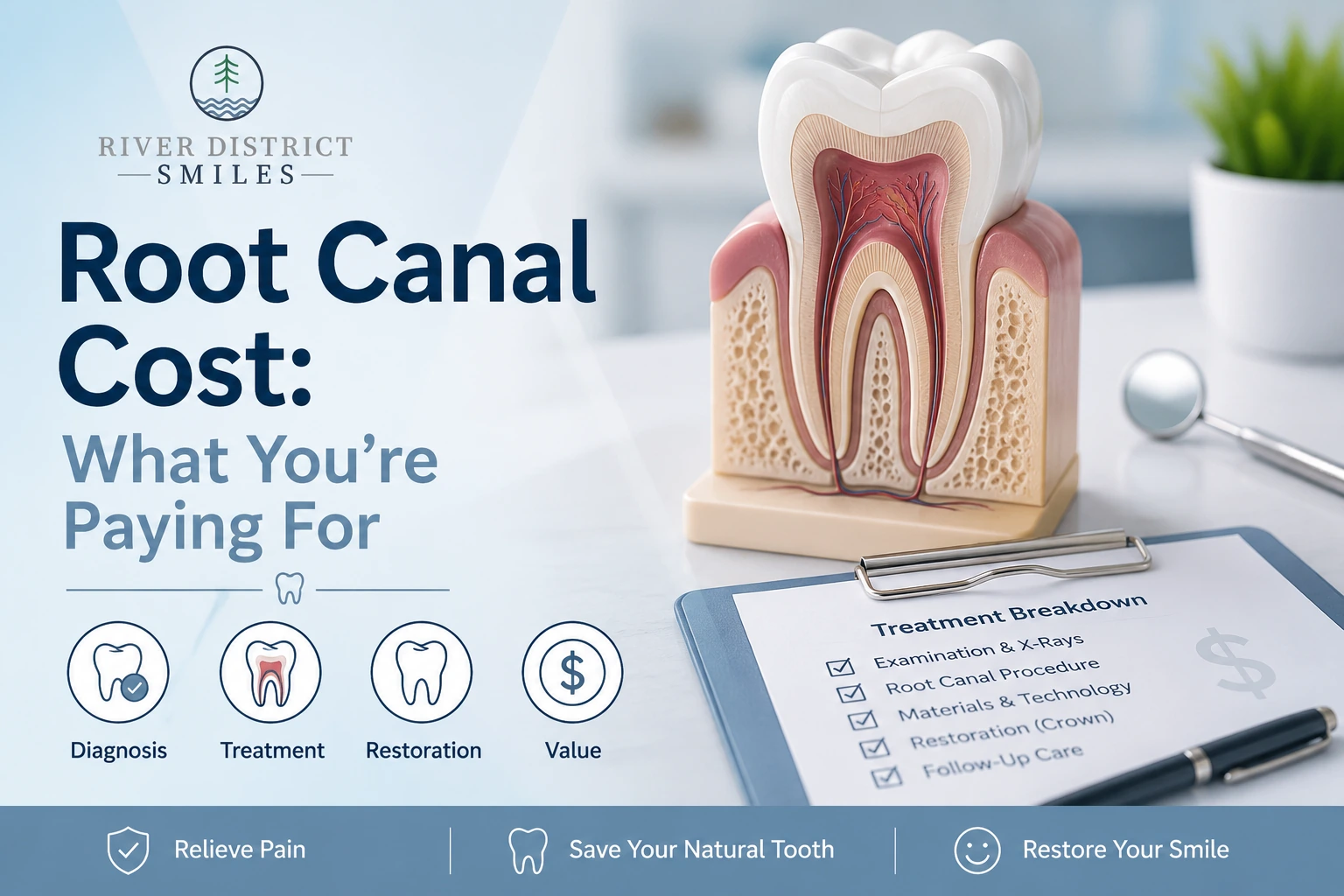

Most people asking about the cost of a root canal are not casually comparing dental procedures. They are usually dealing with a toothache, a cracked tooth, swelling, or a treatment recommendation they did not expect.
The first concern is often simple: How much is this going to cost?
A reasonable national estimate for a root canal without insurance is approximately $700 to $1,800 for the root canal procedure itself. Front teeth are usually at the lower end, while molars tend to cost more because they contain more canals and are harder to reach. A crown, core buildup, examination, X-rays, or specialist care may be separate expenses. Published consumer estimates place the total cost of saving and restoring the tooth anywhere from roughly $1,400 to $4,000 or more, depending on the situation.
Those numbers are useful for planning, but they are not a quote for your specific tooth. Your actual cost depends on what the dentist finds, which tooth needs treatment, how difficult the canals are to treat, and how the tooth must be restored afterward.
Typical Root Canal Costs by Tooth
The tooth being treated is one of the biggest price factors.
| Tooth type | Estimated root canal cost without insurance | Why the price differs |
| Front tooth | $700–$1,100 | Usually has one canal and is easier to access |
| Premolar | $800–$1,400 | Often has one or two canals |
| Molar | $1,000–$1,800 | May have three or more canals and is harder to reach |
| Retreatment | Often higher than initial treatment | Existing filling materials or restorations may need to be removed |
These are broad national planning ranges, not River District Smiles’ office fees. Dental prices vary by location, insurance contracts, treatment complexity, and whether care is provided by a general dentist or an endodontist.
What Are You Actually Paying For?
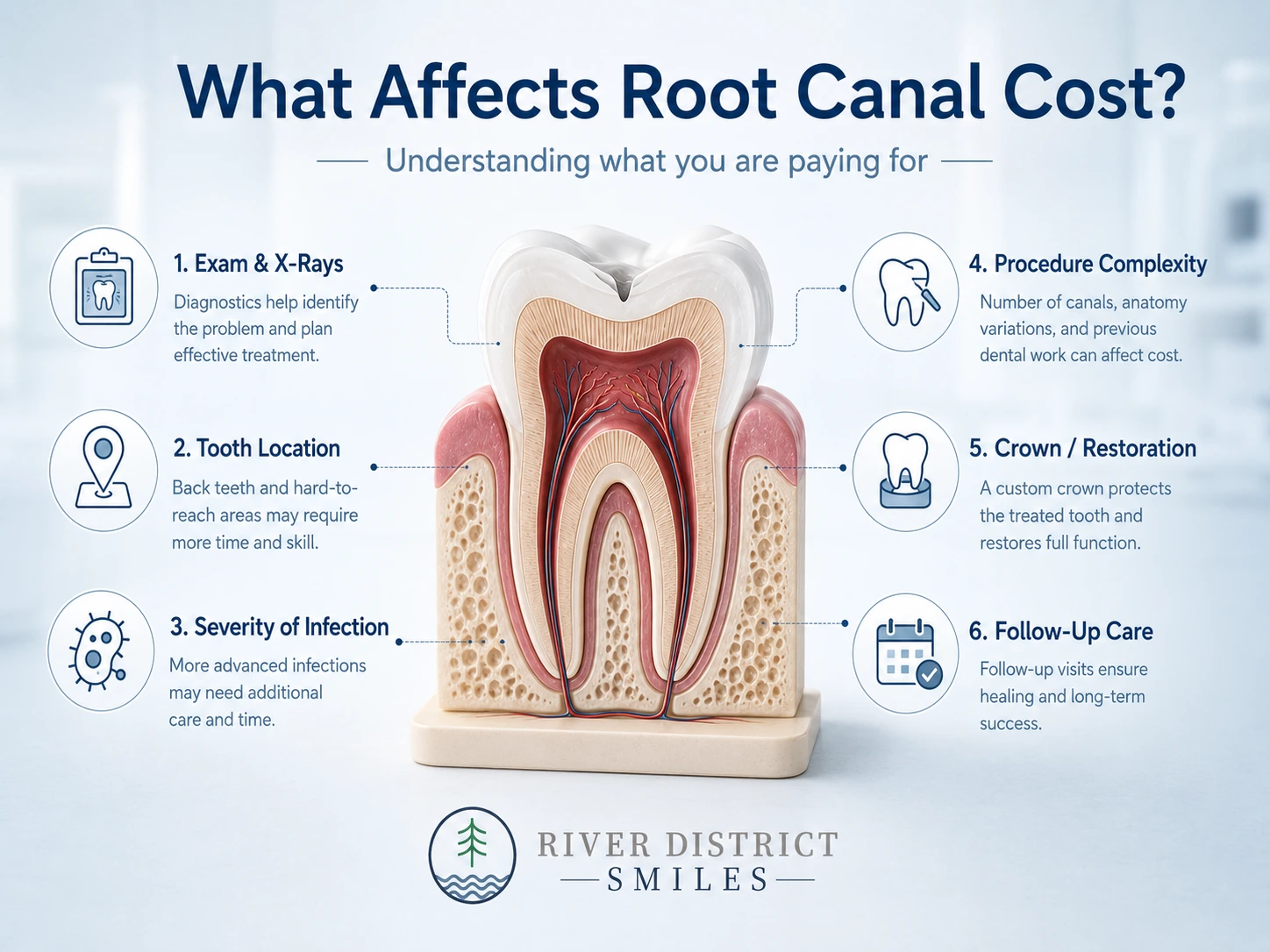
A root canal bill is not simply a charge for “removing the nerve.” The procedure involves diagnosing the source of the problem, finding and disinfecting small spaces inside the tooth, sealing those spaces, and protecting the tooth from reinfection.
Here is what may be included in your treatment plan.
1. The examination and diagnosis
Tooth pain does not always mean you need a root canal.
A cavity, cracked filling, gum infection, sinus pressure, bite problem, or teeth grinding can cause similar symptoms. Before treatment begins, the dentist needs to determine whether the pulp—the soft tissue inside the tooth is inflamed, infected, or no longer healthy.
The examination may include:
- A review of your symptoms
- Dental X-rays
- Temperature or sensitivity testing
- Tapping or pressure tests
- An evaluation of cracks, decay, and existing dental work
- An assessment of whether the tooth can be restored
This diagnostic step matters because a root canal will not solve pain that is coming from a different tooth or a non-dental source.
2. Local anesthesia and keeping the tooth isolated
The area is numbed before the dentist begins. Modern root canal treatment is performed with local anesthesia, much like a filling or crown preparation.
The tooth is also isolated to keep it clean and prevent saliva and bacteria from entering during treatment. This controlled working environment is an important part of reducing the risk of reinfection.
3. Locating every canal
Inside each tooth is a system of narrow canals. Some teeth have one straightforward canal. Others have several canals that curve, divide, narrow, or become difficult to see.
The dentist must locate and treat the full canal system. Missing even a small canal can leave infected tissue or bacteria behind.
This is one reason a molar usually costs more than a front tooth: it generally requires more time, more instruments, and more detailed work.
4. Cleaning and disinfecting the inside of the tooth
During treatment, the inflamed or infected pulp is removed. The canals are then cleaned, shaped, and disinfected.
The goal is not simply to stop the toothache. The goal is to remove bacteria and damaged tissue, reduce the chance of future infection, and preserve the outside structure of the natural tooth.
5. Filling and sealing the canals
Once the canals are clean, they are filled with a dental material designed to seal the space. A temporary filling may then be placed over the access opening until the final restoration is completed.
The seal is important. If bacteria get back inside through leakage, new decay, a damaged filling, or a cracked crown, the tooth can become infected again.
6. Restoring the tooth after the root canal
The root canal treats the infection inside the tooth, but it does not rebuild missing or weakened tooth structure.
Many root canal-treated teeth need:
- A permanent filling
- A core buildup
- A post in selected cases
- A dental crown
Back teeth usually absorb significant chewing pressure and commonly need crowns after root canal treatment. Some front teeth may be restored with a filling instead, depending on how healthy the tooth remains.
This is one of the most common causes of confusion about cost: the quoted root canal fee may not include the crown.
Before treatment, ask whether the estimate includes:
- The examination
- All necessary X-rays
- The root canal procedure
- A temporary filling
- A core buildup
- A post, if needed
- The permanent crown
- Follow-up care
Why Might a Crown Add So Much?
A crown is a separate restoration that covers and protects the remaining tooth.
A root canal-treated tooth may already have a large cavity, an old filling, a crack, or significant structural damage. Even though the infection has been treated, the tooth could still fracture under chewing pressure without adequate protection.
National consumer estimates often place crowns around $800 to $2,000 or more, depending on the material, location, laboratory costs, and technology used. One published summary based on ADA survey data reported a national average of approximately $1,446 for a crown, although actual fees vary considerably.
A crown should not be viewed as an automatic add-on in every case. It should be recommended because the remaining tooth needs protection. Ask your dentist to show you why a filling would or would not provide enough support.
Why Do Some Root Canals Cost More?
Two patients can both need a “root canal” and still receive very different estimates.
The tooth has complicated anatomy
Curved, narrow, calcified, or unusually shaped canals take more time to locate and clean.
The tooth has already been treated
Retreatment is usually more involved than an initial root canal. The dentist or endodontist may need to remove a crown, post, core material, or old canal filling before the tooth can be cleaned again.
The tooth is badly broken down
A tooth with extensive decay or missing structure may need a core buildup, post, crown, or another restorative procedure.
Advanced imaging is needed
Some complicated cases benefit from three-dimensional imaging to better understand the tooth’s anatomy, identify an untreated canal, or evaluate a possible fracture. Not every patient needs this imaging.
A specialist is involved
An endodontist is a dentist with advanced training focused on diagnosing tooth pain and treating the inside of teeth. Specialist care may cost more, but it can be appropriate when the tooth has difficult anatomy, previous treatment, significant calcification, or another complication.
A referral does not necessarily mean something has gone wrong. Sometimes it simply means the tooth is better handled by someone who performs complex root canal procedures every day.
How Dental Insurance Affects the Cost
Dental insurance may pay part of a root canal, but your exact benefit depends on the plan.
Important details include:
- Your deductible
- Whether the dentist is in network
- Your annual maximum
- The percentage your plan pays for root canal treatment
- Whether the crown is covered separately
- Waiting periods
- Frequency or replacement limitations
- How much of your annual benefit has already been used
A plan might contribute toward the root canal but leave less of the annual maximum available for the crown. It is also possible for the root canal and crown to be assigned different coverage percentages.
Before treatment, request a written estimate showing:
- The office fee
- The estimated insurance payment
- Your estimated portion
- Which procedures are billed separately
Insurance estimates are helpful, but they are not guarantees of payment. The insurance company makes the final decision after processing the claim.
Root Canal or Extraction: Which Costs Less?
An extraction is often less expensive on the day the tooth is removed.
That does not automatically make it the less expensive option over time.
When a tooth is removed, you may eventually need to replace it with:
- A dental implant and crown
- A bridge
- A removable partial denture
Replacement can involve additional procedures, appointments, and maintenance. The American Association of Endodontists advises patients to consider the full cost of removing and replacing a tooth, not just the extraction fee.
| Option | Main advantage | Main tradeoff |
| Root canal and restoration | Keeps the natural tooth | Higher immediate cost than extraction alone |
| Extraction without replacement | Lowest initial cost | Leaves a space and may affect chewing or tooth position |
| Extraction and bridge | Replaces the missing tooth without implant surgery | Requires support from neighboring teeth |
| Extraction and implant | Replaces the tooth without using neighboring teeth | Usually costs more and takes longer |
Saving the tooth is not always possible or appropriate. However, when the tooth has a reasonable long-term outlook, a root canal and crown may provide better value than extraction followed by tooth replacement.
When a Root Canal May Not Be Worth the Cost
A root canal should not be recommended simply because a tooth hurts. The tooth also needs to be restorable.
It may not be the best investment when:
- The tooth has a severe vertical root fracture
- Too little healthy tooth remains to support a restoration
- Decay extends too far below the gumline
- The tooth has very poor bone or gum support
- The long-term prognosis is unfavorable
- Another treatment would provide a more predictable result
Some cracked teeth can still be treated successfully, while a vertical fracture extending through the root may require extraction. The distinction often cannot be made without an examination and appropriate imaging.
A useful question to ask is:
“After the root canal and final restoration, how confident are you that this tooth can remain functional?”
The goal is not to spend money saving a tooth at any cost. The goal is to choose the treatment with the most reasonable balance of predictability, function, and long-term value.
What Happens If You Wait?
Some tooth pain comes and goes, but that does not necessarily mean the underlying problem has healed.
When the pulp inside a tooth is irreversibly damaged or infected, it cannot repair itself in the same way a minor gum irritation can. Waiting may allow the infection to spread, damage surrounding bone, or create swelling and more severe pain. The tooth may also become more difficult or impossible to save.
That does not mean every mild sensitivity requires emergency treatment. Sensitivity lasting only a moment after something cold may have several causes. Pain that lingers, wakes you at night, occurs when biting, or is accompanied by swelling deserves a timely dental examination.
Seek urgent dental care for:
- Significant facial or gum swelling
- Severe or worsening tooth pain
- Fever with dental pain
- Drainage or a persistent bad taste
- Difficulty opening your mouth
- A swollen area near a painful tooth
Difficulty breathing or swallowing with facial, jaw, tongue, or neck swelling can indicate a spreading infection and requires immediate medical attention.
Questions to Ask Before Agreeing to Treatment
A good treatment discussion should make the cost easier to understand.
Ask:
- Which tooth needs the root canal, and what caused the damage?
- Can you show me the problem on the X-ray?
- Is the tooth cracked?
- Is the tooth likely to be restorable afterward?
- Will I need a crown?
- Is the crown included in this estimate?
- Could the tooth be treated here, or should I see an endodontist?
- What would extraction and replacement cost?
- What is the expected long-term outlook?
- What happens if I postpone treatment?
You should leave the conversation understanding both the recommendation and the financial picture.
The Bottom Line
For most patients, the root canal itself may cost approximately $700 to $1,800 without insurance, with molars generally costing more than front teeth. The final cost may be higher once the examination, X-rays, buildup, post, specialist care, and crown are included.
What you are paying for is not simply pain relief. You are paying for the diagnosis, the careful removal of infected tissue, cleaning and sealing a complex canal system, and restoring the tooth so it can continue functioning.
River District Smiles provides root canal treatment as part of its general dental care in Rock Hill, SC. The practice emphasizes personalized recommendations and helping patients understand their treatment before moving forward.
The next step is not guessing based on an online average. It is finding out whether the tooth truly needs a root canal, whether it can be restored predictably, and what the complete treatment, not just one part of it, will cost.